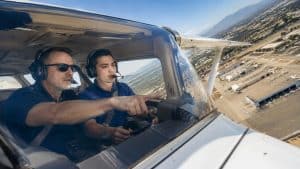
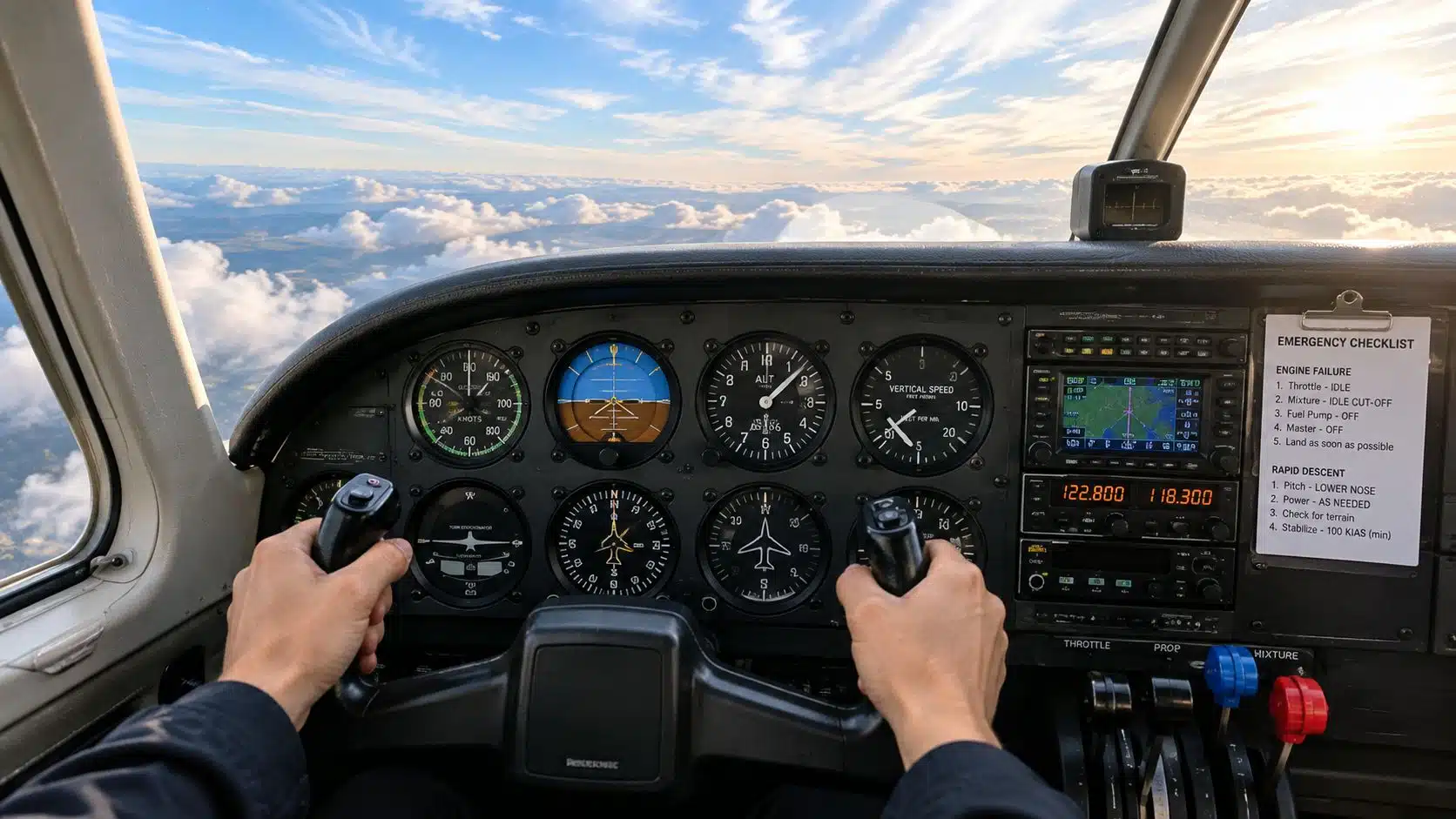
A pilot climbing through the smooth air above the basin, or returning to Chino after an IFR lesson, doesn't need much imagination to see how quickly an abnormal situation can tighten the timeline. A pressurization problem, smoke, or another time-critical failure can turn a routine descent into an immediate one. Emergency descent procedures are the disciplined, aircraft-specific methods pilots use to lose altitude quickly while staying within configuration, speed, terrain, and traffic limits. They are not a panic dive. They are a controlled maneuver and a coordination event.
Table of Contents
- What Emergency Descent Procedures Are and When to Use Them
- How to Fly the Emergency Descent Flow Without Rushing
- Communications and ATC Coordination During the Descent
- Aircraft Variations and Altitude Profiles for Airplanes and Helicopters
- Training the Maneuver With Checklists and Simulator Drills at KCNO
- Common Mistakes to Avoid and How to Recover Safely
- FAQs
- When should a pilot use emergency descent procedures?
- Is an emergency descent just a steep nose-down maneuver?
- Should a pilot always squawk 7700 during an emergency descent?
- Can a pilot descend below any altitude if the situation is serious enough?
- Do all airplanes use landing gear and drag devices in an emergency descent?
- What does good emergency descent training look like?
What Emergency Descent Procedures Are and When to Use Them
An emergency descent usually starts with a trigger that leaves very little room for delay. In a pressurized airplane, that may be a cabin-altitude warning or obvious decompression cues. In an unpressurized airplane, it may be smoke, fire, or another failure where staying high makes the situation worse.
The FAA describes the maneuver as a high-drag, high-airspeed descent flown in a specific configuration, typically with power at idle, propellers forward, landing gear extended, flaps retracted, and a defined emergency descent airspeed rather than an improvised nose-low rush, in the FAA Airplane Flying Handbook emergency procedures guidance. That matters because most bad descents begin with rushing the airplane before configuring it.
The real trigger is urgency, not convenience
A rapid descent for passenger comfort, traffic sequencing, or making up time isn't an emergency descent. Emergency descent procedures belong to situations where altitude itself has become part of the hazard.
A few common examples make the difference clear:
- Pressurization loss: In a high-altitude aircraft, the crew needs to get to a survivable altitude quickly.
- Smoke or fire: Remaining at altitude may prolong exposure and delay landing options.
- Other critical malfunctions: Some failures require immediate altitude loss to reduce risk or reach better conditions.
What doesn't work is treating every urgent descent the same way. The airplane, the malfunction, nearby terrain, and airspace all change the profile.
Regulation versus recommendation
Pilots need to separate what is legally required from what is procedural guidance. The exact emergency descent technique often comes from the POH, AFM, or operator procedure. Communications and handling in controlled airspace are shaped by established emergency procedures and ATC coordination.
Internationally aligned contingency guidance says crews should, when able, turn away from the assigned route, advise ATC as soon as possible, set 7700, and avoid descending below the lowest published minimum altitude that still preserves obstacle clearance of 300 m (1,000 ft), or 600 m (2,000 ft) in designated mountainous terrain, as summarized in FAA-published contingency procedure material.
Practical rule: The urgency may justify leaving the cleared altitude immediately. It does not erase terrain, traffic, or configuration limits.
Why configuration discipline matters
Students often think the point is to point the nose down and get a big vertical speed. That's backwards. The point is to get the airplane into the configuration that gives the best safe descent for that aircraft and failure.
That may mean drag devices. It may mean staying clean. It may mean holding closer to the speed where a structural problem appeared rather than accelerating further. The safe descent is the one the aircraft can sustain and the crew can manage.
How to Fly the Emergency Descent Flow Without Rushing
The first habit to build is simple. Fly a sequence, not a reaction. Fast hands and a disorganized mind usually create overspeeds, poor trim, and missed checklist items.
The FAA's baseline technique for many airplanes is straightforward: reduce power, configure the airplane as prescribed, and establish the published emergency descent airspeed with control maintained throughout, as laid out in the Airplane Flying Handbook guidance on emergency descents. The pilot should think of that as a flow that buys time for the checklist, not as the checklist itself.
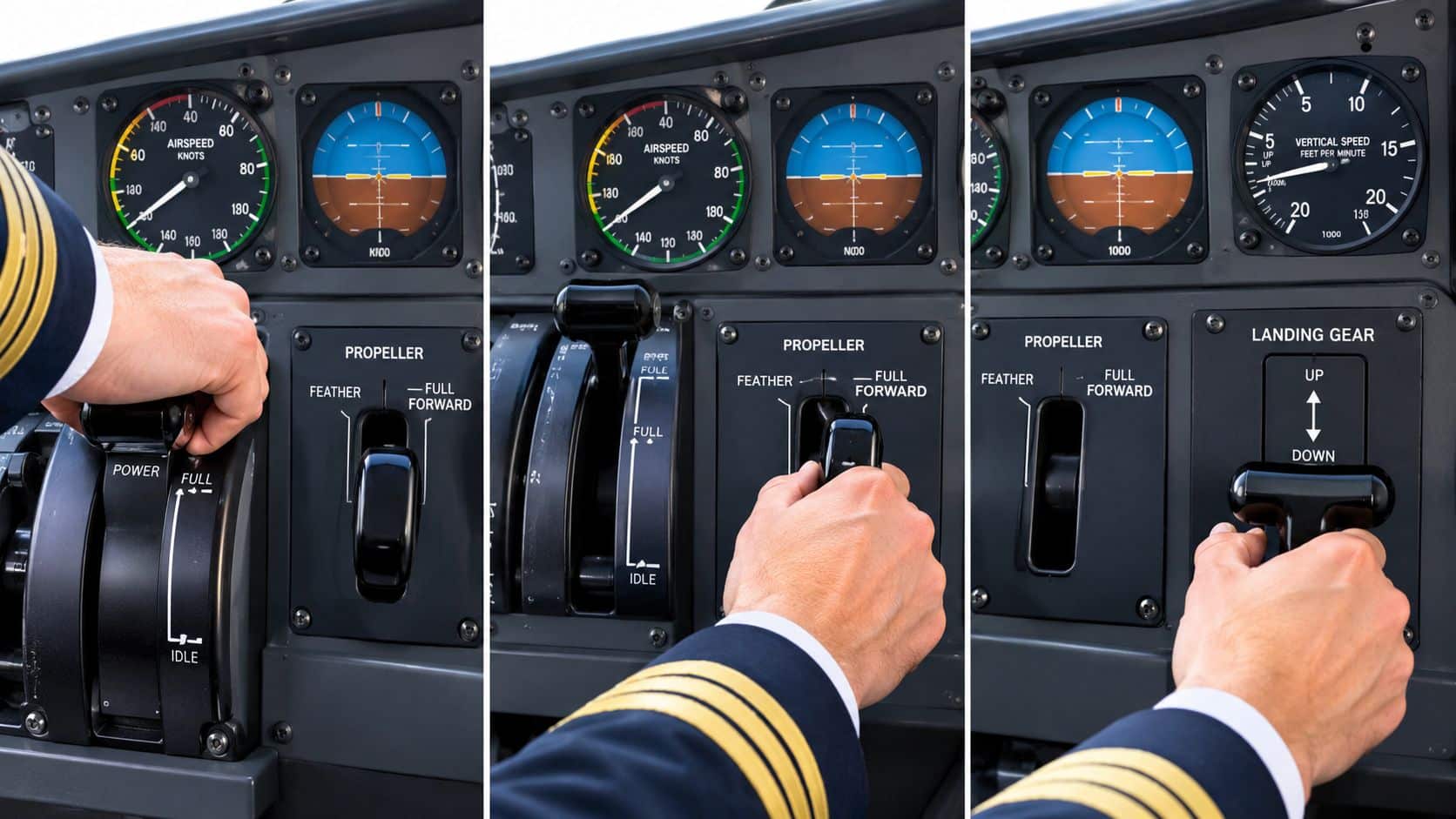
The flow in the cockpit
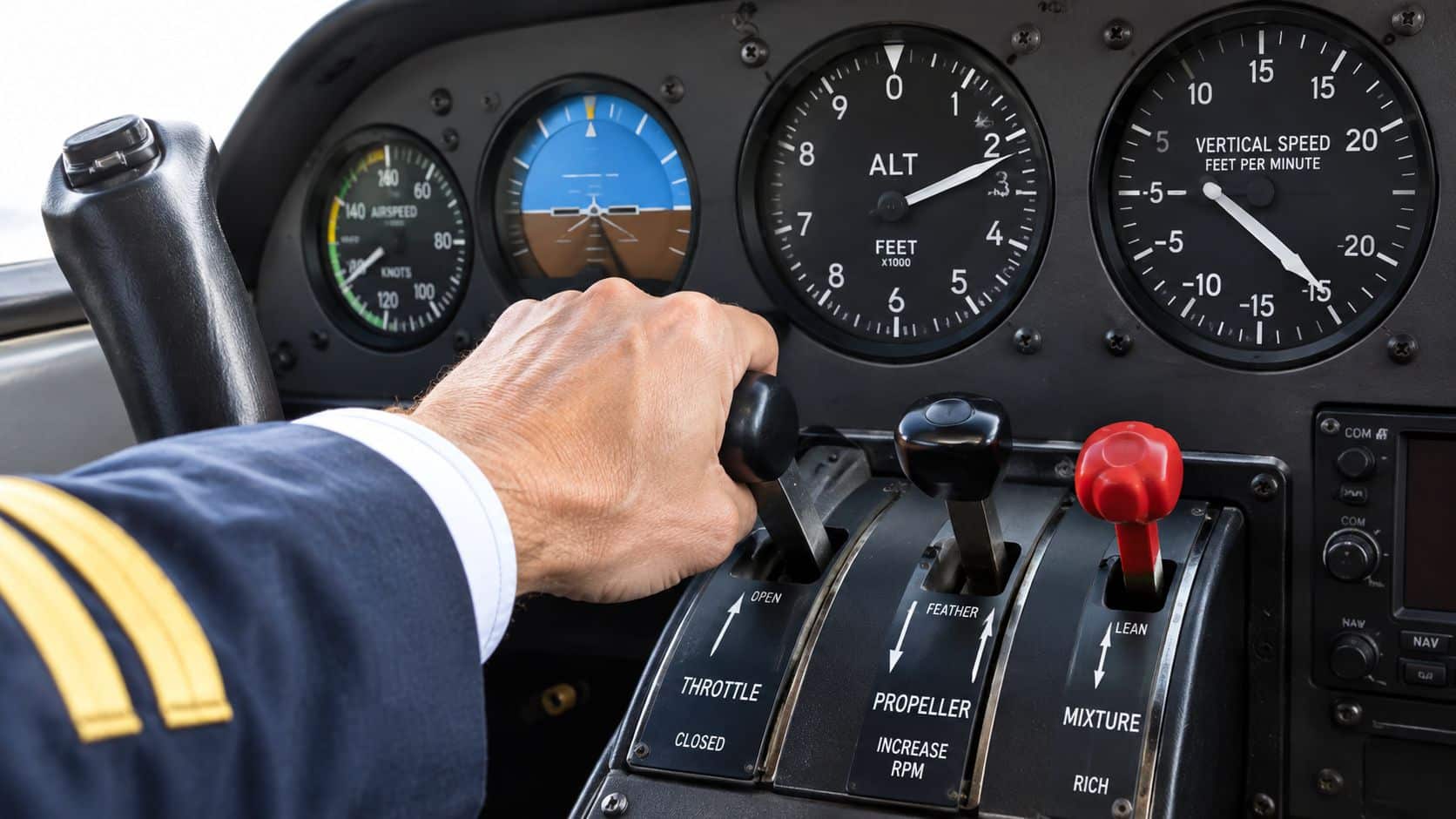
The normal flow begins with getting the engine and propeller where the airplane expects them for a maximum practical descent. In many piston airplanes, that means power to idle and propellers full forward if equipped. If the POH permits gear extension as a drag device, the gear comes next. Flaps are often left retracted unless the aircraft procedure says otherwise.
Then the pilot sets pitch for the airplane's emergency descent airspeed and trims aggressively enough to reduce workload. That part matters. A pilot wrestling the yoke while reaching for radios and checklists will miss something.
A compact cockpit version looks like this:
- Power: Bring it to idle or the prescribed minimum power setting.
- Propeller: Full forward if the airplane has controllable props and the procedure calls for it.
- Drag: Extend gear or other drag devices only if the aircraft procedure allows it.
- Pitch and trim: Set the emergency descent airspeed, then trim to hold it.
- Scan: Keep looking outside. A descending airplane can move into other traffic quickly.
- Verify: Transition from memory items to the printed checklist as soon as control is stable.
What pilots tend to get wrong
The most common mistake is trying to force a dramatic descent rate instead of flying the target speed. Vertical speed is an output. Airspeed control is the job.
Another common error is forgetting that some failures change the target entirely. Guidance for flight crews notes that if structural damage is suspected, the aircraft should be flown near the IAS at which the failure occurred rather than accelerated into a maximum-speed dive, as discussed in flight crew emergency descent guidance. That is one of the clearest examples of why memory items must be backed by judgment.
A good emergency descent looks boring inside the cockpit. The airplane is configured on purpose, the speed is stable, and nobody is chasing needles.
Bank, path, and workload
A shallow turn may be useful to clear the route, avoid weather, or position toward lower terrain, but the bank angle needs to support the bigger priorities. In crowded airspace, especially around Southern California arrivals and departures, the descent path needs to stay predictable enough that the pilot can still watch for traffic and handle radios.
If the airplane is equipped with automation, it may help in some phases and hurt in others. The key question isn't whether the autopilot is available. It's whether it can manage the exact configuration and speed profile required without adding confusion. Pilots who want a better framework for that decision should review how to use autopilot as a workload tool rather than a crutch.
Memory items first, checklist second
The sequence should be practiced until the first actions happen cleanly under pressure. After that, the pilot needs to get eyes onto the actual checklist. That's where details like altitude restrictions, airframe limitations, and follow-on items get confirmed.
A rushed pilot often skips this transition. That's how an emergency descent turns into an unstabilized arrival at the wrong altitude, in the wrong configuration, with the wrong next step.
Communications and ATC Coordination During the Descent
You are at altitude east of Chino, the cabin fills with smoke or a pressurization problem develops, and the airplane is coming down now. In that moment, emergency descent is two jobs at once. Fly the airplane, then make the airspace around you predictable enough that ATC and nearby traffic can stay out of your way.
Under the FAA framework, the sequence is straightforward. Start the descent, declare the emergency as soon as workload allows, use 7700 if appropriate, and give ATC a short plain-language picture of what the airplane is doing. The obstacle-clearance minima covered earlier still apply during the descent. The Aeronautical Information Manual emergency procedures section is the right U.S. reference point here, so the regulatory picture stays consistent.
What the call needs to accomplish
A good call is short and useful. I teach students to pass four items and stop talking.
- Who and where: Call sign and approximate position.
- What failed or what you suspect: Smoke, pressurization, engine issue, onboard medical problem.
- What the airplane is doing now: Descending immediately, turning, unable to maintain altitude.
- What you want from ATC: Vectors, lower now, direct to an airport, traffic advisories, or priority handling.
A simple call works: “SoCal Approach, Cherokee Three Four Five X-ray, five east of Chino, smoke in the cockpit, emergency descent, leaving seven thousand for three thousand, request direct Chino.”
That gives ATC something they can use right away.
Turning, route changes, and conflict management
If conditions permit, move off the cleared route as you start down. That principle exists because traffic on the cleared route is the most likely conflict during an unannounced descent. In busy Southern California airspace, a small heading change can buy ATC room to protect you and reduce the chance of meeting opposite-direction or same-route traffic at the worst time.
That does not mean hunting for the perfect turn or delaying the descent for a radio call. It means treating the maneuver as an airspace event from the first second, not as a private cockpit exercise.
KCNO reality check
At KCNO, the radio side matters more than students expect. Chino can have pattern traffic, helicopter operations, IFR training, and arrivals or departures that stack quickly around the field. If you drop into that environment without a clear declaration, tower and approach lose time sorting out whether you are practicing, repositioning, or dealing with a real problem.
Make the event unmistakable. Use the word “emergency.” State that you are descending now. If you need the nearest runway, say so. If you need to stay clear of the pattern and sort things out first, say that too.
Pilots who still hesitate on frequency order or who to call first should review flight service frequencies and communication references before training. Under stress, familiar radio structure shortens the gap between problem recognition and useful coordination.
Aircraft Variations and Altitude Profiles for Airplanes and Helicopters
A good emergency descent in one aircraft can be a poor one in another. The goal stays the same. Get down promptly, stay inside the airplane's limits, and arrive at a planned altitude ready for the next decision. The way you do that changes with the airframe, the systems, and the reason for the descent.
That matters in training at Chino. A student who learns one dramatic nose-low picture and tries to use it everywhere usually ends up fast, behind the airplane, or both.
Why configuration changes by aircraft type
Some airplanes lose altitude best with drag out early. Others need a cleaner setup to protect structural margins, system limits, or controllability. If the descent follows smoke, pressurization trouble, or suspected damage, the book may call for a different profile than the one you use for a routine training maneuver.
Flight crew guidance discussed earlier makes that point clearly. Configuration should match the failure. If damage is suspected, holding near the airspeed at which the problem occurred may be smarter than pushing for the highest descent rate available.
That is the trade-off. More drag can increase descent rate and help control speed, but it can also raise workload and complicate the pullout.
Emergency Descent Configuration by Aircraft Type
| Aircraft Type | Configuration and Profile Notes |
|---|---|
| Single-engine piston airplane | Usually flown with power reduced, a target descent speed from the POH, and drag devices only if approved for the maneuver. In some airplanes, gear helps a lot. In others, a cleaner profile gives better control of airspeed and recovery. |
| Multi-engine piston airplane | The same basic flow applies, but propeller settings, cowl flap use, and engine-out considerations can change the picture quickly. Added drag is only helpful if it does not make the level-off or restart plan harder to manage. |
| Turbofan airplane | Pressurization events are highly procedural. The initial priority is crew oxygen and aircraft control, followed by the descent profile specified for that model. Crews do not treat it as a generic dive to the lowest altitude possible. |
| Helicopter | Rotorcraft use a different energy-management problem altogether. Airspeed, rotor RPM, and rate of descent have to stay inside rotorcraft flight manual limits, so fixed-wing memory items do not transfer cleanly. |
Altitude targets and level-off discipline
The recovery deserves as much attention as the push-over. Set a floor altitude before starting the maneuver, especially in training around KCNO where nearby shelves, pattern traffic, and helicopter routes can make an unplanned low stop a bad surprise.
For practical test and training purposes, pilots are commonly expected to recover smoothly and stop close to the assigned or briefed altitude. A good working standard is about ±100 feet unless the training objective or aircraft procedure calls for something tighter. That keeps the maneuver honest. Anyone can point the nose down. The test is stopping where intended without a balloon, secondary dive, or airspeed excursion.
The maneuver is complete when the aircraft is level, under control, and positioned for what comes next.
Human factors change the timeline
High-altitude descents add a delay that light-airplane students do not always expect. The aircraft may be capable of descending at once, but the crew still has to recognize the event, get oxygen on, and then configure. FAA handbook guidance for decompression scenarios builds that human response time into the procedure.
The lesson carries over to every airplane we train. Brief the trigger, the configuration, and the stop altitude before you start. In Chino-area practice, brief the heading too. A disciplined altitude plan keeps the maneuver from turning into a rushed descent that solves one problem and creates another in busy airspace.
Training the Maneuver With Checklists and Simulator Drills at KCNO
You are south of Chino with the power set, the area briefed, and the descent about to start. Then tower calls traffic, a student in the right seat reaches for the wrong control, and the checklist is still folded in a side pocket. That is why we train this maneuver as a cockpit workflow, not just a steep push to lose altitude.
At KCNO, the drill has to cover aircraft control, checklist discipline, and airspace coordination in the same sequence. A clean emergency descent in quiet practice airspace is one skill. Doing it while staying predictable around Class D traffic, helicopter activity, and arrivals into Chino is the standard that transfers to real flying.
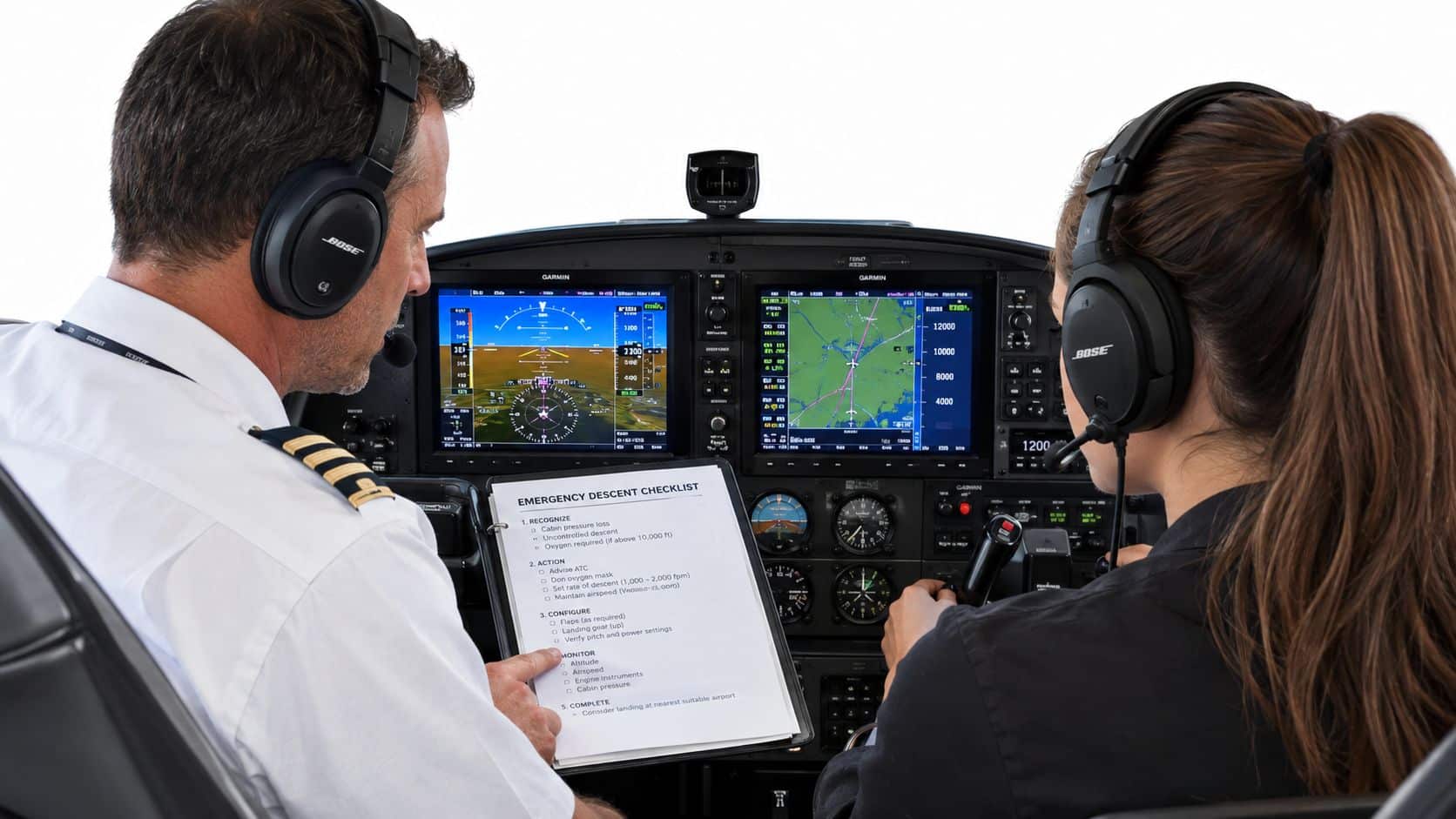
A practical training progression
Good training starts before the avionics come on. Brief the trigger, the memory items, the checklist location, who talks, and where the maneuver stops. In a single-engine trainer, that may be a simple cockpit fire or smoke scenario with a rapid descent to a prebriefed altitude. In a complex airplane, add cowl flaps, gear considerations, higher airspeeds, and more trim force. In a helicopter, the profile changes again because descent attitude, rotor management, and airspeed targets are different from the fixed-wing picture.
The sequence I want students to build is consistent:
- Start with chair-flying: Practice the first few hand movements and callouts until they happen in order and without hunting.
- Put the checklist where it can be reached: If it takes both hands and a search, the cockpit setup failed before the maneuver began.
- Assign the radio job: In dual instruction, one person flies and one person talks. If the student is solo, the call goes out after the aircraft is under control.
- Use KCNO in the brief: Include the likely frequency, nearby traffic flow, and the direction that gives the best margin from pattern congestion.
- Reset and repeat: Run the scenario again after the debrief while the corrections are still fresh.
That last step matters. One repetition shows the mistake. The second repetition fixes it.
Why simulator sessions help
A simulator lets instructors load the pilot with the parts of the maneuver that are hard to reproduce efficiently in the airplane. Radio congestion, smoke scenarios, reroutes, and interrupted checklists can all be practiced without spending half the lesson climbing back for another setup. That makes it easier to train judgment instead of just the descent profile.
Pilots who want to rehearse the flow before doing it in the aircraft can use a dedicated device at a simulator training center to practice checklist access, frequency changes, and crew coordination with less reset time. For flight departments or schools that want to build scalable simulation training, the useful lesson is simple. Match the drill to the cockpit sequence, including the communication task, or the training will not hold up under pressure.
KCNO-specific habits that transfer
Chino exposes weak habits quickly. If a pilot drops the nose without first deciding who is talking, where the traffic is, and which way to turn for spacing, the workload spikes fast. That is the value of training here.
A strong KCNO lesson should include these habits:
- Brief a usable heading: Pick a direction that reduces conflict with pattern traffic and common arrival paths.
- Expect an interruption: Train with a tower call, traffic advisory, or missed readback in the middle of the maneuver.
- Practice role swaps: Have the student fly one repetition and handle radios on the next.
- Train by aircraft type: A Cessna 172, a retractable single, and a helicopter should not be briefed as if the descent picture is identical.
- Debrief the timeline: Note when control was established, when the checklist came out, and when the radio call was made.
The goal is disciplined speed, not drama. A well-trained pilot at KCNO gets the airplane configured, gets the descent started, and stays ahead of the airspace the whole time.
Common Mistakes to Avoid and How to Recover Safely
Over Chino, this usually goes wrong in a predictable way. The pilot gets the airplane pointed downhill, then starts chasing speed, radio calls, and traffic all at once. The descent may look aggressive, but the airplane is no longer being flown with a clear plan.
The better standard is simple. Get the aircraft into the right configuration, fly the published or trained profile for that aircraft, and treat the recovery as part of the maneuver from the start. At KCNO, that also means leaving mental space for pattern traffic, tower instructions, and a level-off that does not create a second problem.
Errors that show up often
These are the mistakes I see most often, and each one has a straightforward fix if caught early:
The nose goes down before the configuration is set. That usually leads to overspeed, rushed trim changes, and a sloppy pull-out. Pause long enough to configure first, then let pitch and drag produce the descent you briefed.
Pilots chase the VSI instead of the airspeed picture. A steep needle on the vertical speed indicator can tempt people into pushing too much. Fly the target airspeed and attitude for the airplane you are in. The descent rate will follow.
Heads stay inside the cockpit too long. At a towered field, that can turn a clean maneuver into a traffic conflict fast. Bring the eyes outside on a regular scan, especially after checklist items and before any turn.
The call to ATC comes late because the pilot wants everything perfect first. If control is established, make the short call and let tower or approach start protecting space around you. In the Chino area, that coordination matters almost as much as the stick-and-rudder part.
Level-off starts too late, or cleanup starts in the wrong order. The result is a balloon, a second descent, or a lot of unnecessary workload near the stop altitude. Plan the recovery before you get there.
Terrain still constrains the maneuver. The obstacle-clearance minima discussed earlier still constrain the descent profile even under emergency authority.
A safe recovery framework
A good recovery starts before the airplane reaches the bottom of the descent. Know the stop altitude, know what configuration change comes first, and know who is handling the radio if ATC calls in the middle of it.
Use a disciplined sequence:
- Begin the pull-out early enough to stop cleanly at the planned altitude without a sharp pitch change.
- Reduce drag and reconfigure in the proper order for that airplane, whether that means speed brakes, power, gear, or flap changes.
- Stabilize the aircraft first, then reassess the problem. Decide whether the safest outcome is a straight-in landing, a diversion, or another immediate checklist.
- Continue with the next appropriate checklist or memory items so the emergency descent flows into the next decision instead of ending in confusion.
Practicing that recovery framework with an instructor at a busy field like Chino builds the discipline the maneuver demands.
DuBois Aviation offers airplane and helicopter training, aircraft rental, and simulator-based instruction at Chino Airport in a setting where emergency procedures can be practiced with real towered-field communication and traffic awareness. Pilots working toward private, instrument, commercial, multi-engine, or instructor goals can use that environment to build cleaner emergency descent procedures from briefing through recovery. Prospective students can reach out for training information or arrange a visit to see how that kind of proficiency work is taught.
FAQs
When should a pilot use emergency descent procedures?
A pilot should use emergency descent procedures when altitude has become part of the hazard and getting lower promptly improves safety. Typical examples include depressurization, smoke, fire, or another time-critical malfunction. The exact trigger and method should come from the aircraft's approved guidance and the situation at hand.
Is an emergency descent just a steep nose-down maneuver?
No. The FAA describes it as a high-drag, high-airspeed maneuver flown in a defined configuration, not an improvised dive, in the FAA Airplane Flying Handbook emergency procedures guidance. Configuration discipline and speed control are the core safety limits.
Should a pilot always squawk 7700 during an emergency descent?
If able, established emergency descent guidance says crews should advise ATC as soon as possible and set 7700. In a real event, aircraft control comes first, but the transponder code helps ATC identify and protect the aircraft quickly.
Can a pilot descend below any altitude if the situation is serious enough?
Not automatically. Emergency authority is broad, but terrain still matters. Emergency descent guidance keeps obstacle clearance in play and says crews should avoid descending below the minimum altitude that preserves 1,000 ft obstacle clearance, or 2,000 ft in designated mountainous terrain, as noted in the earlier linked guidance.
Do all airplanes use landing gear and drag devices in an emergency descent?
No. Some procedures use gear or other drag devices, while others favor a clean, high-speed descent. If structural damage is suspected, guidance for flight crews says the aircraft should be flown near the IAS at which the failure occurred rather than accelerated further, as discussed in the earlier linked flight crew guidance.
What does good emergency descent training look like?
Good training combines a clear brief, a memorized initial flow, prompt checklist use, radio work, traffic scan, and a stable recovery to the planned altitude. The maneuver should be trained as both aircraft control and airspace coordination, because that's how it appears in actual operations.