

"Get eight hours and listen to the body" sounds sensible, but it's a weak safety plan. A pilot can log eight hours in bed, wake feeling acceptable, and still start a lesson with poor timing, leftover sleep debt, or slowed performance that doesn't feel obvious. Fatigue management means protecting real sleep, limiting time awake, planning around low alertness hours, and moving or canceling a flight when those controls fail. Feeling fine isn't a clearance. The practical question comes before the briefing. Did the schedule create a real chance to sleep, and does the record support flying now?
Table of Contents
- Fatigue Management Benchmarks You Can Use Today
- How to Check Fitness Before the Flight
- When Sleep Happens Matters as Much as Hours
- What to Change on a Long Training Day
- Part 117 Rest Rules and What They Do Not Cover
- Bring Fatigue Awareness Into Your Training Plan
- Questions Pilots Ask After the Checklist
Fatigue Management Benchmarks You Can Use Today
Fatigue management starts with a screen that can change a booking, not with encouragement to try harder in the pattern. Students, renters, and instructors can run the numbers before engine start and treat a miss as a reason to delay, shorten, move to ground work, or cancel. The figures below are operational benchmarks from fatigue risk practice, not hour limits under Part 61 or Part 91 and not proof that a pilot is sharp.
Table. Fatigue benchmarks before a training or rental flight
| Control | Benchmark | What it is not |
|---|---|---|
| One continuous wake period | Do not exceed 17 hours | Not a target to reach before landing |
| Daily time off duty | At least 10 hours | Not the same as hours asleep |
| Sleep in the previous 24 hours | At least 5 hours | A floor, not a personal target |
| Sleep in the previous 48 hours | At least 12 hours | Not satisfied by one long night alone |
| Pre-duty nap | Generally no longer than about 45 minutes | Not a replacement for nighttime sleep |
| Recovery after sleep debt | Two consecutive nights of unrestricted sleep | Not cleared by one day off |
How the screen fits a flight school
The ICAO fatigue management approaches describe a performance based Fatigue Risk Management System, or FRMS, that identifies hazards, assesses risk, applies controls, collects reports, and reviews trends. That model names a benchmark to prevent a single wake period from exceeding 17 hours, provide at least 10 hours of daily off time, and target at least 5 hours of sleep in the preceding 24 hours and 12 hours in the preceding 48 hours before duty. A small training operation doesn't need airline software to borrow the logic. A simple log of sleep, wake time, report time, and duty end gives the instructor something firmer than a shrug.
The screen works because it catches three common failures early.
- Rest confused with sleep: A 10 hour break shrinks fast after commuting, eating, family duties, and time spent falling asleep.
- Debt from the night before ignored: A decent night after two short nights may still leave the 48 hour total low.
- One yes or no declaration trusted: "Fit to fly" without hours, timing, or wake duration hides the exact risks the table exposes.
Count duty, not only flight time
A 1.2 hour lesson can sit inside a much longer duty period. Preflight preparation, weather checks, dispatch, briefing, fueling, the flight itself, postflight paperwork, and debriefing all consume alert time. Ground instruction before and after can add more. Pilots who count only Hobbs time underestimate how long they've been awake and how little sleep opportunity remains before the next report.
Total duty duration also matters for instructors flying several blocks. Back to back lessons with different students, different maneuvers, and constant radio monitoring create workload that a short flight time figure doesn't capture. A benchmark review at midday can be as useful as the morning screen. When the remaining plan would push wakefulness past the limit, the last block changes first.
Screening rule: The strictest missed row controls the decision. One strong number doesn't cancel another weak one.
When poor sleep keeps repeating
Occasional short sleep calls for a schedule change. Repeated unrefreshing sleep, loud snoring, witnessed pauses in breathing, or morning headaches call for a medical conversation rather than another nap strategy. Pilots concerned about possible sleep apnea can review home sleep testing for apnea-related fatigue as background before discussing symptoms and aeromedical implications with an aviation medical examiner. That's health information, not a fitness clearance for a particular flight. Any diagnosis or treatment question belongs in the proper medical channel.
Apply the table in order. Calculate hours awake at the planned landing time, not only at report. Check actual sleep across 24 and 48 hours. Confirm that the previous off duty period allowed real sleep. Then decide whether the flight, a later departure, a simulator session, or no flight best fits the record.
How to Check Fitness Before the Flight
Self assessment fails in a specific, dangerous way. Performance can slip while perceived fatigue stays flat, so confidence rises on a signal that isn't keeping pace with impairment. A check built only on feelings will miss that gap.
The FAA fatigue research summary reports a study of helicopter air ambulance pilots in which subjective fatigue and sleepiness ratings remained stable even while objective performance worsened. Cumulative fatigue also increased across a seven-day work period and persisted into recovery days. The same research identifies sleep inertia after pilots are awakened for a flight request, which means recent sleep doesn't equal immediate readiness.
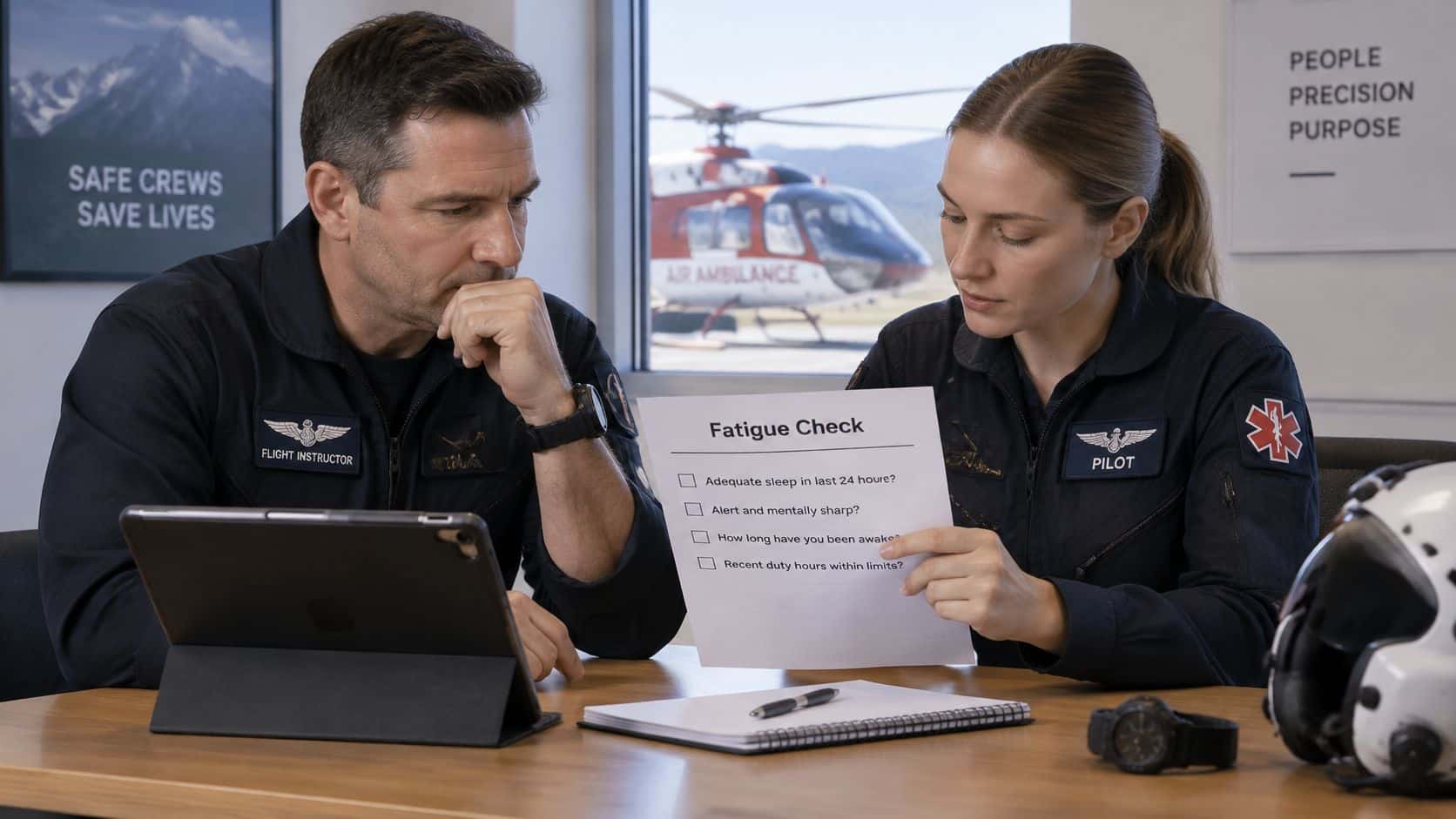
A six step preflight fitness check
- Write the record down. Note sleep duration, wake time, report time, planned duty end, and a brief alertness comment before checking weather or grabbing keys.
- Compare the record with clear limits. Flag short recent sleep, long time awake, an early report, night work, or several duty days in a row. A personal minimum written in advance beats a judgment invented at dispatch.
- Look for slips already visible. Repeated small errors, slower checklist execution, missed radio awareness, and trouble recalling a clearance are operational evidence, not personality flaws. Ground behavior predicts cockpit behavior.
- Invite challenge. An instructor, another pilot, or a trusted peer reviews the numbers and can question the plan. Self clearance ends where another qualified set of eyes begins, consistent with structured go and no-go criteria for training flights.
- Change the operation when a flag appears. Delay the launch, shorten the lesson, move the work to a simulator, switch to ground instruction, or cancel before engine start. Changing early is cheaper and safer than discovering impairment at altitude.
- Respect the wake up transition. A pilot woken abruptly for an early flight needs time for sleep inertia to pass before accepting the aircraft, driving any distance, or making a final fitness call.
A dawn solo that should move later
Consider a student scheduled for an early solo at a towered field. The student slept poorly, woke to an alarm well before the normal time, drove in the dark, and now reports feeling alert after coffee and a bright briefing room. Nothing in that scene proves readiness. The short night, abrupt awakening, and early report form exactly the combination the check is designed to flag. Moving the solo to late morning after proper recovery, or converting the slot to ground review, protects both the flight and the student's confidence.
Renters face the same trap without an instructor at the desk. A written personal minimum and a peer phone call replace informal reassurance. Passengers, a nonrefundable plan, or good weather add pressure, but none of those factors improve attention. External pressure is a reason to slow the decision, not to skip it.
An unresolved flag means no-go. It doesn't mean fly carefully, stay local, or promise extra vigilance.
Instructors carry a double responsibility. A fatigued instructor may miss a student's drift, delay taking controls, or deliver a muddled debrief. The same six steps apply to the right seat, and canceling sets a stronger safety example than pushing through.
When Sleep Happens Matters as Much as Hours
Seven hours in bed is not a fatigue measurement. Two pilots can log the same total and arrive with very different alertness. One slept through the night and reports midmorning. The other slept in fragments, woke at 04:30, and faces an early departure after a late finish the day before. When sleep happens relative to departure and landing matters as much as how many hours were in bed.
A common mistake is to compare total hours and stop there. Sleep works less like a bank deposit than like fuel loaded at a time the engine can use it. The clock time of the sleep period, and the clock time of report and landing, change how much of that sleep pays off.
The Window of Circadian Low, roughly 02:00 to 06:00, is the body clock period when alertness and performance naturally drop. Flying, driving, or doing demanding checklist work in that window carries added risk even when earlier sleep looked adequate. The range is a planning approximation, not a regulatory limit. Check the current eCFR wording before applying a general range to a specific operation, because a regulation and a chronobiology approximation may define terms differently.
Table. How duty timing typically changes sleep
| Timing situation | Typical effect | Planning response |
|---|---|---|
| Sleep before a flight in the cargo study | About 48 minutes shorter on average | Protect the preflight sleep window |
| Departure between 06:00 and 11:59 | About 57 minutes less sleep beforehand | Avoid stacking an early report on a late night |
| Landing between 00:00 and 05:59 | About 97 minutes less sleep afterward | Plan recovery and the drive, not only the approach |
| Window of Circadian Low, roughly 02:00 to 06:00 | Naturally lower alertness and performance | Keep high workload flying out of this window when possible |
The first three rows come from a 2026 study of cargo pilots using continuous smart-ring monitoring. The circadian low row is a planning approximation, not a regulatory limit.
Those results come from cargo operations, not a flight school ramp. They don't set a legal rest rule for every general aviation flight. The transferable lesson is narrower: departure and landing clock times predict sleep loss, so a schedule review should examine the clock, not only total hours in bed. Feeling fine at report is a weak test, because alertness at a given clock hour does not prove the sleep that preceded it was sufficient.
Three training scenarios
- A 07:00 lesson after a late commute: The early report likely truncates sleep at the morning end. Moving the lesson later, or protecting an earlier bedtime the night before, addresses the actual hazard.
- A dusk return followed by a long drive: The flight may end before deep fatigue sets in, while the drive extends wakefulness. A shorter route, an earlier departure, or a planned rest before driving belongs in the flight plan.
- A night cross-country landing near the low window: High workload navigation, radio work, and a night landing stack on reduced alertness. Rehearsing procedures in a simulator at a better hour can preserve training value without accepting the worst timing.
Pilots planning longer personal or commercial travel can also consult The Sleep Consultant flight sleep guide for general strategies on timing sleep around flights, then translate only the scheduling principles that fit pilot duty. Passenger sleep tactics don't replace fitness for duty judgment. A nap at the wrong circadian phase, or a long nap too close to report, can create grogginess rather than readiness.
Planning point: No single safe hour count replaces a clock time plan for sleep, departure, landing, recovery, and the drive home.
Build the plan backward. Start with the desired landing time, subtract flight and duty, identify the report and wake times, and check whether the prior sleep window lands at a biologically plausible hour. If the arithmetic requires falling asleep at an unrealistic time, the schedule is a no-go until it changes.
What to Change on a Long Training Day
Feeling alert at the preflight briefing is the weakest evidence you will get all day. Alertness at 8 a.m. says almost nothing about your capacity at 4 p.m., after three lessons, a long debrief, and a late return. Caffeine buys an hour or two of borrowed sharpness. It does not restore judgment, repay sleep debt, or shorten a duty day. Real fatigue controls work on three fronts: prevention before the first flight, detection during the day, and recovery after it.
Fatigue management is now a monitored operational discipline. The ICAO address on FRMS standards notes that the ICAO Council adopted international FRMS standards on 13 June 2011, and those standards became applicable on 15 December 2011. That timeline explains why a training school talks about rosters and reporting at all. Schedules, reporting, and review carry the load that personal toughness cannot.
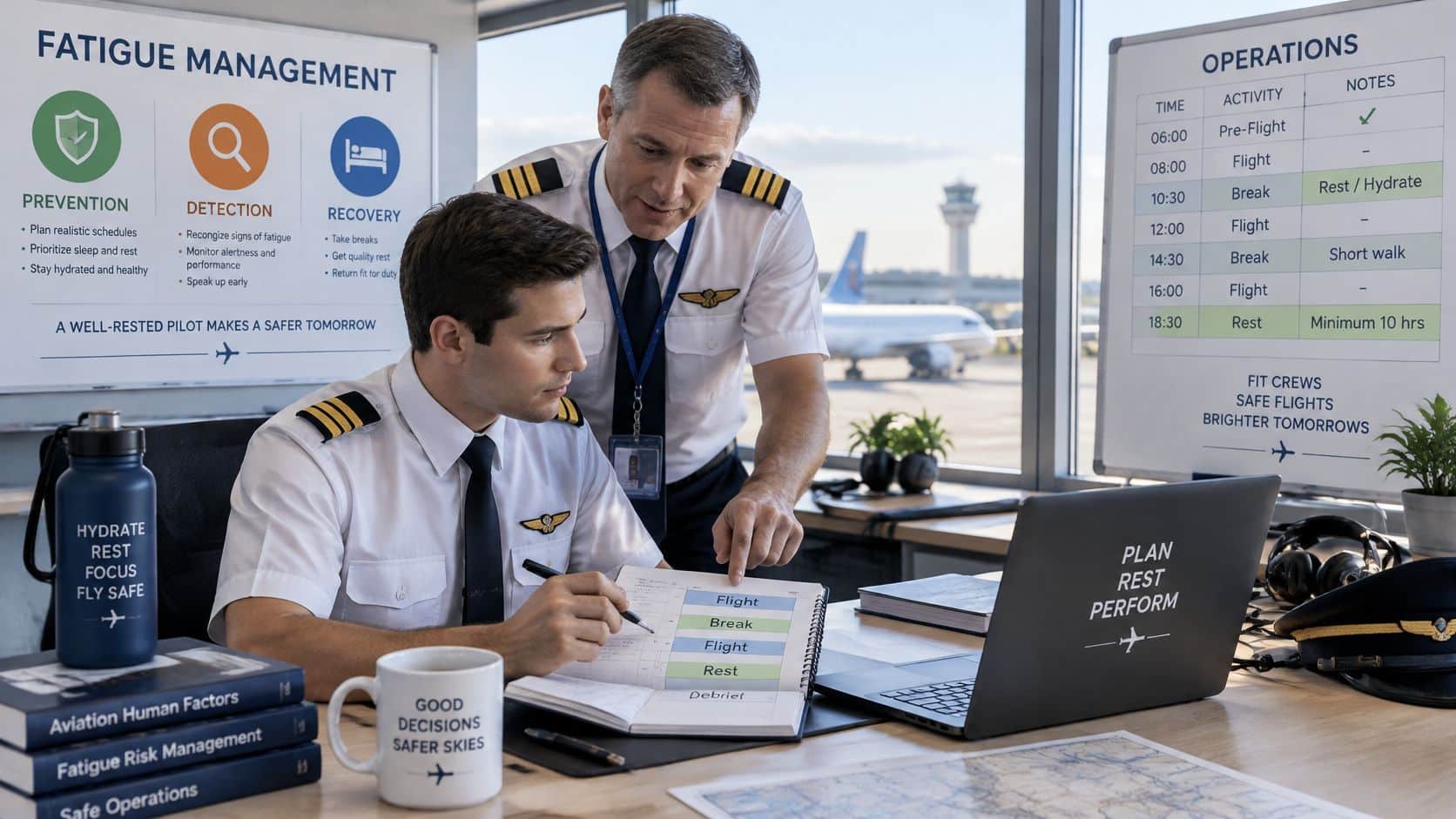
Prevention
Protection starts with the next sleep period, not the current lesson. Limit consecutive high workload blocks, insert a real break away from students and radios, and resist filling every open aircraft slot just because the airplane is available. A short strategic nap before duty helps when it is timed so you are clear headed at report; the same nap placed too close to departure leaves you groggy in the run-up. One nap cannot repay several short nights. Stacking a dawn lesson, midday ground school, and a night flight in one duty stretch builds exactly the cumulative exposure the benchmarks exist to prevent.
The shape of the day matters as much as its total length. A dawn departure after a 5 a.m. wake is a different flight from an identical duration departing at 10 a.m., because the sleep that preceded it sat at a different point on your body clock. Compare the planned sleep window against report and landing times before you compare hours in bed.
Detection
Watch trend rather than waiting for a dramatic admission. Checklist drift, terse or missed radio calls, slower decisions, repeated altitude deviations, and irritability during briefing all signal declining capacity. Instructors should compare performance with the student's normal baseline, not with a generic standard. A normally precise student who starts missing callouts deserves a direct conversation and a schedule change.
Confidential or anonymous reporting helps a school spot patterns that individuals hesitate to raise. Underreporting can conceal a roster problem until an incident exposes it. Reviewing reports by time of day, lesson type, and sequence length turns private discomfort into usable safety information. That system view aligns with broader workload management strategies for pilots that reduce task saturation before errors compound.
Recovery and the scale of the risk
Recovery means changing what remains. Shorten the last flight, replace a maneuver block with a simulator session, end the duty day early, and protect unrestricted sleep afterward. The ICAO FRMS presentation on the pilot view estimates that 4 to 7% of civil aviation incidents and accidents may be attributable to fatigued pilots, and it cites an FAA advisory circular reporting a NASA survey in which 80% of 1,424 regional airline flightcrew respondents reported having nodded off during a flight at some point.
Both figures describe broad civil aviation or airline populations; neither measures a student pilot rate. Used properly, they justify conservative training decisions without exaggeration. Fatigue is common enough in professional operations to deserve systems, monitoring, and schedule flexibility, and a school can act on the warning without claiming those percentages for its own students.
Consider an instructor carrying three lessons, a long debrief, and a late return. The safest revision is rarely another pattern squeezed into fading light. Convert the final block to simulator procedures, move the flight to a rested day, and protect two full nights of sleep if real debt has built. Recovery sometimes looks like a flight that never launched because the schedule changed on the ground, and that ground decision costs far less than a deteriorating approach at dusk.
Part 117 Rest Rules and What They Do Not Cover
Career track pilots need a bright line between airline regulation and training practice. 14 CFR Part 117 governs covered airline flightcrew members. It doesn't set the rest rule for a Part 61 training flight or a typical Part 91 rental, and borrowing its numbers doesn't make a lesson Part 117 compliant.
Table. Part 117 limits compared with training practice
| Topic | Part 117 flightcrew rule | Training or rental practice |
|---|---|---|
| Pre-duty rest | 10 consecutive hours immediately before duty, including at least 8 uninterrupted hours of sleep opportunity | No numeric training minimum; apply the benchmark table and a separate fitness call |
| Report decision | A pilot may not report until required rest is received | Make a separate fitness decision after commuting and time to fall asleep |
| Consecutive night duty | Generally no more than 3 flight duty periods infringing the window; up to 5 only with at least 2 hours in suitable accommodation | Avoid stacking early or night lessons even though 117.27 is not the training rule |
| Split duty | 22:00 to 05:00 local, at least 3 hours suitable accommodation, scheduled ahead, after the first segment, combined period no more than 14 hours | A casual nap or delay is not split duty rest and is not a reset |
The airline minimums stated precisely
The current eCFR text of 14 CFR Part 117 sets the minimum pre-duty rest at 10 consecutive hours immediately before a reserve or flight duty period, with at least 8 uninterrupted hours of sleep opportunity, and a pilot may not report until the required rest has been received. Regulatory text can change, so pilots should check the current section before relying on it. Even a fully legal rest period doesn't guarantee fitness once commuting, illness, personal obligations, and time needed to fall asleep enter the picture.
Night exposure has its own limit. Under 14 CFR 117.27 on consecutive nighttime hours, a carrier generally may not schedule more than three consecutive flight duty periods that infringe on the window of circadian low, with up to five only when each period provides at least 2 hours in suitable accommodation measured from arrival there.
Split duty is narrower than everyday language suggests. Under 14 CFR 117.15 on split duty, an unaugmented operation requires rest between 22:00 and 05:00 local time, at least 3 hours in suitable sleeping accommodation, scheduled before duty begins and after the first flight segment, with the combined period not exceeding 14 hours. A lounge nap, weather delay, or informal break doesn't become split duty rest.
What a student can borrow safely
Training pilots can copy the conservatism without copying the legal claim. Protect an 8 hour sleep opportunity before an early lesson. Avoid stacked dawn reports. Refuse to treat a couch nap as a reset. Those habits build judgment that transfers to airline flying, where compliance becomes mandatory and personal fitness assessment still applies.
Responsibility doesn't disappear outside Part 117. Pilot in command authority and accountability still attach to the training or rental flight, and an operator's scheduling rules may add limits. Legal to start isn't the same as fit to fly. A regulation sets a floor for a defined group. A fitness decision evaluates a specific pilot on a specific day.
Bring Fatigue Awareness Into Your Training Plan
Booking a lesson is also choosing a wake time, a commute, and a sleep window. Fatigue planning belongs in the first training conversation, not after a rough checkride prep week exposes the problem. A student who learns to screen sleep before solo carries that habit into instrument, commercial, and instructor work. The useful question combines hours slept with when that sleep ended relative to report time and how long the pilot will be awake by landing.
The benchmark screen gives student and instructor shared language. A flag can delay the launch, shorten a maneuver block, move remaining work to a ground session, or reschedule the flight. None of those outcomes wastes the slot. Ground instruction on weather, systems, or oral exam topics still advances the syllabus while keeping the next flight a fair test of skill.
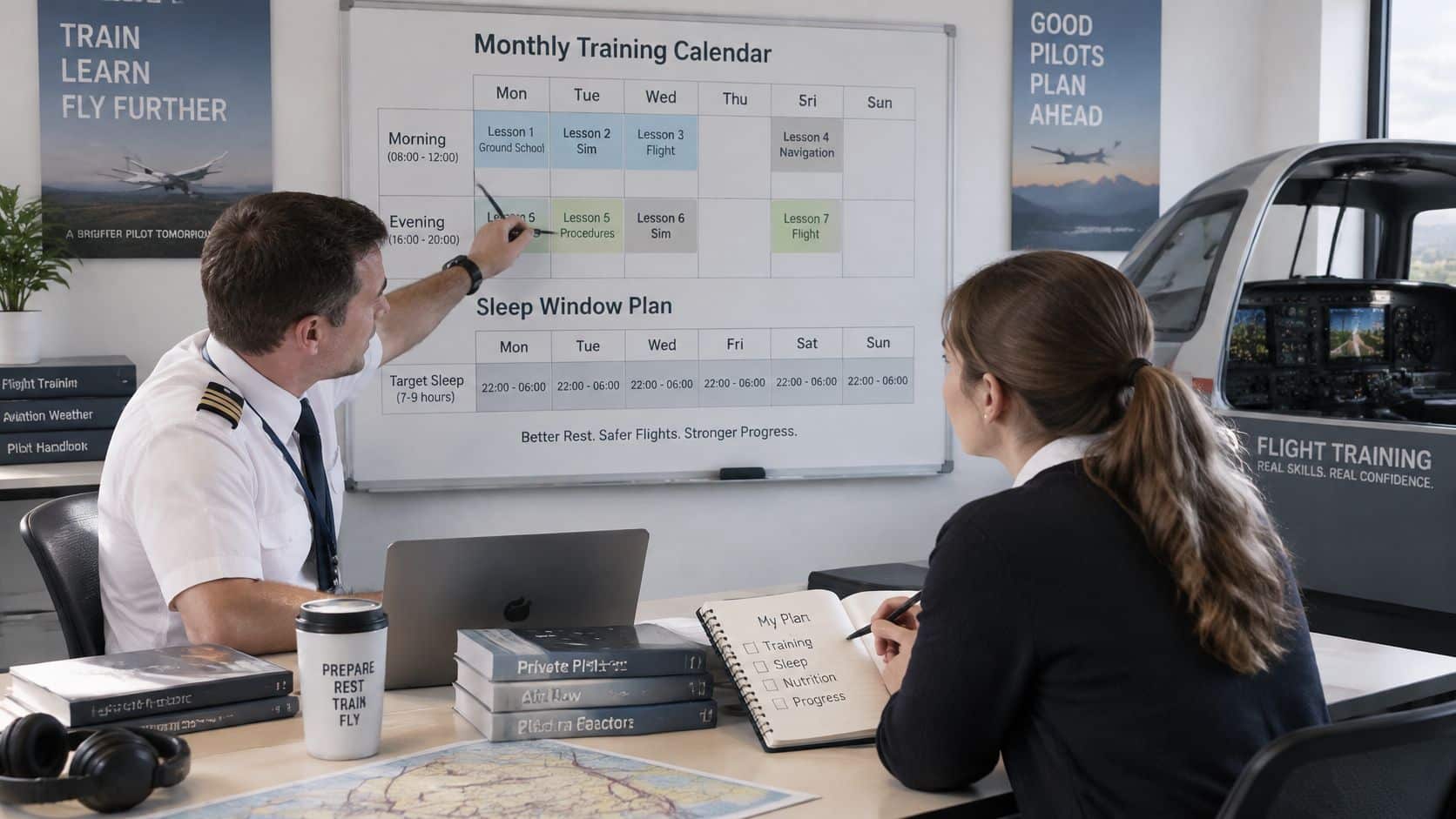
DuBois Aviation trains at Chino Airport, a towered field in Southern California where radio workload forms part of early lessons. Busy frequency work, runway changes, and traffic calls make alertness visible quickly, which gives instructors concrete behavior to debrief. Pilots should verify current airspace and airport details in the FAA Chart Supplement before flight. A prospective student can ask how lesson times fit work, school, and commute patterns, because a schedule that looks efficient on paper may stack early reports or late returns.
That conversation becomes part of human factors training for safer pilot decisions, where sleep, workload, and personal minimums sit beside weather and aircraft limits. Career-track students gain an added benefit. Habits built around sleep opportunity and honest reporting prepare them for later operations where rest rules are mandatory and fatigue calls carry professional weight. Renters gain a portable standard that doesn't depend on an instructor standing nearby.
Bring a two-week sleep and wake log to the first lesson. Note bed time, wake time, and lesson start so the pattern is visible without relying on memory. Lesson frequency and start times can then match the life the student leads. Intensive schedules deserve special care, since compressed training raises the cost of poor sleep across consecutive days. A training plan that ignores sleep will eventually collect the debt in performance.
Questions Pilots Ask After the Checklist
Is eight hours in bed enough
Only if enough of that window became actual sleep at a useful clock time. An early report can cut off the end of sleep, and an overnight landing can disrupt the sleep that follows. Time in bed overstates rest when falling asleep takes an hour or the alarm cuts the final cycle. Judge the window by sleep obtained, timing, and hours awake at landing. Eight hours is a planning target, not a guarantee.
Can coffee fix a short night
Caffeine masks sleepiness; it does not restore sleep. A pilot who needs it to feel normal at dispatch has already found a warning sign. If you use caffeine, treat it as a minor aid inside an otherwise sound plan. Never let it become the plan. The lift is temporary, and the sleep debt remains.
What if a pilot feels fine after five hours
Five hours in 24 is a planning floor in the benchmark screen, not a target or a regulatory minimum. A calm self-report after a short night proves little, so run a check you can finish in under a minute. Read a short paragraph from the Chart Supplement aloud, close it, and summarize the main restriction from memory. If you reopen the page twice or lose the point of the sentence, your performance is giving you better information than your mood. Then check the 48-hour total, time awake, departure timing, and visible slips. An unresolved concern still means delay or cancel.
Should the drive home follow the same standard as the flight
Yes. The drive extends wakefulness after the highest workload portion of the day, and the same timing logic applies to the drive. If you landed in an early morning window, plan a rest before driving, shorten the trip, or arrange another ride when alertness is doubtful. A safe landing followed by a drowsy drive is an incomplete safety plan.
Does fatigue look different on a checkride
The signs stay familiar. Checklists slow down, clearances get missed, decisions become unstable, and small errors need repeated correction. Evaluation pressure can hide sleepiness briefly while increasing workload. A checkride is a poor place to discover a preventable sleep deficit, so protect the nights before an evaluation the same way you protect the flight itself.
A checklist that ends with a calm feeling is not a clearance. If the answers point to short sleep, poor timing, or too many hours awake, the safe choice is to delay, cancel, or change the plan.
DuBois Aviation offers flight training and aircraft rental at Chino Airport, with instruction that treats sleep, workload, and honest go or no-go decisions as part of pilot proficiency from the first lesson. Prospective students and renters can ask about course availability, schedule a school tour, or request training information and discuss lesson times that fit a realistic sleep plan. Visit DuBois Aviation to start that conversation before the next early report.