
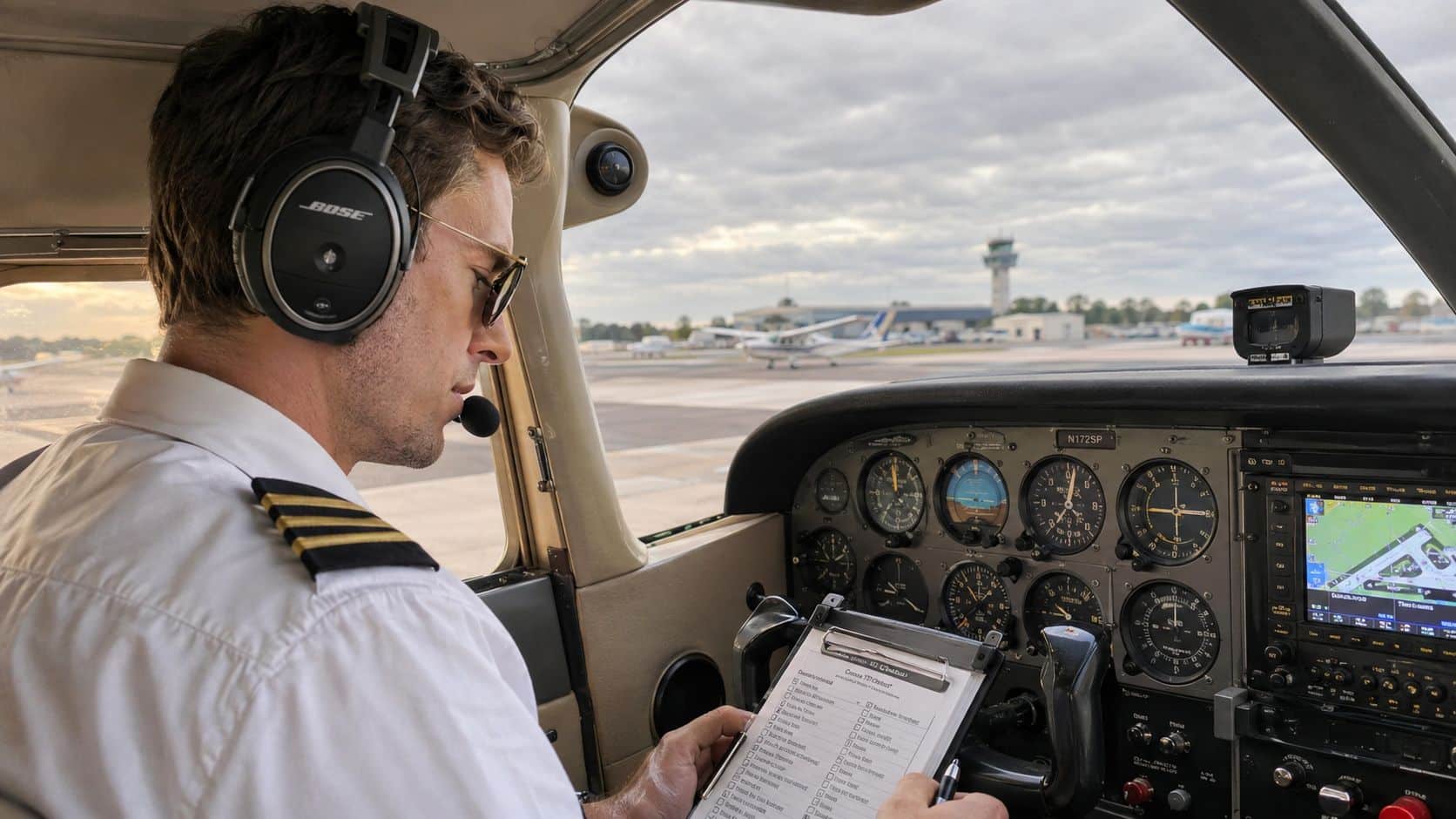
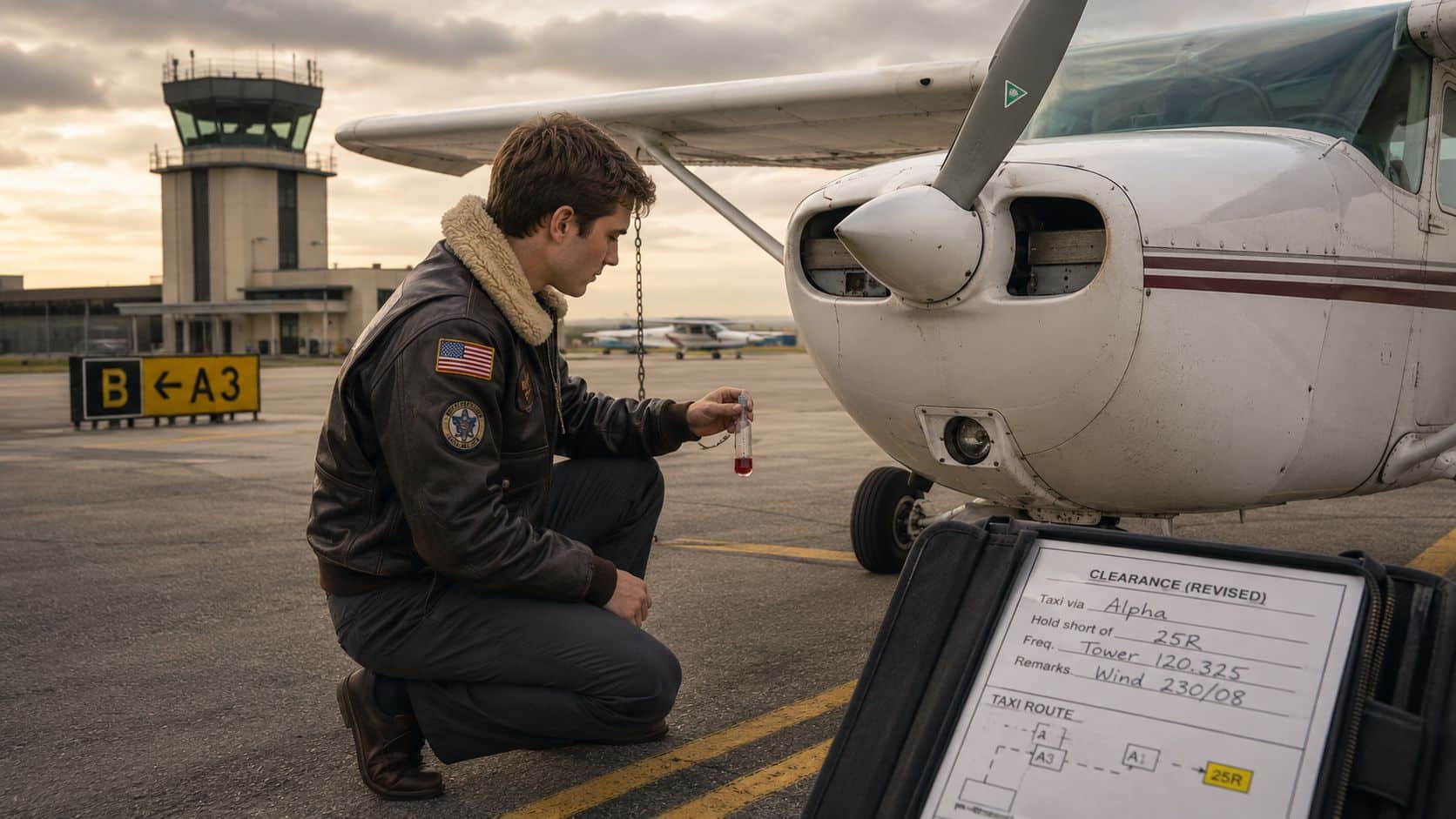
A student pilot at Chino Airport is halfway through a preflight when three problems appear at once. The fuel sample shows an unexpected discrepancy, ground control issues a revised taxi clearance, and a low ceiling sits just above the pilot's personal minimums. Threat and error management gives the pilot a practical way to sort the situation, identify what could increase risk, catch mistakes early, and protect the aircraft's safety margins before departure.
TEM isn't an airline-only concept or another checklist to memorize before solo. It's a continuous method for managing threats, errors, and undesired aircraft states from preflight through engine shutdown. The framework fits a training flight, a rental aircraft, an instrument approach, and the busy Class D environment around KCNO.
Table of Contents
- What Threat and Error Management Means for Pilots
- The Three Core Elements of the TEM Model
- Why Aviation Adopted Threat and Error Management
- Common Threats and Errors in General Aviation
- Practical TEM Strategies for Every Phase of Flight
- Integrating TEM Into Flight Training and Simulator Sessions
- Misconceptions About Threat and Error Management
What Threat and Error Management Means for Pilots
The fuel discrepancy is the first issue. The revised taxi clearance is a second threat because it changes the pilot's expected route and increases the chance of a wrong turn or runway conflict. The low ceiling adds pressure to complete the flight as planned, even though the conditions may leave little room for correction.
A pilot using TEM doesn't acknowledge each item and continue. The pilot pauses, assesses the combined workload, verifies the fuel issue with an instructor or mechanic as appropriate, reviews the new clearance, and decides whether the weather still supports the flight. That pause is a safety action, not a failure to make progress.
The Federal Aviation Administration describes threats as events outside the flightcrew's influence that increase operational complexity, and errors as deviations from intended actions that reduce safety margins in its advisory circular on Threat and Error Management. For a general aviation pilot, a threat might be a runway change, an unfamiliar taxi route, deteriorating visibility, fatigue, or an aircraft malfunction. An error might be selecting the wrong frequency, missing an item on a checklist, or turning toward the wrong taxiway.
TEM is a continuous cockpit loop
TEM works as a repeated cycle:
- Identify the threats that could affect the flight.
- Assess how those threats interact with the pilot, aircraft, environment, and external pressures.
- Act with a specific mitigation, delay, reroute, briefing, or cancellation.
- Monitor whether the plan still matches reality.
FAA human-factors training materials describe this practical sequence as identify, assess, act, and monitor (FAA TEM training material). The sequence matters because a threat can change during a flight. A manageable crosswind may become unacceptable after a runway change, or a routine taxi may become confusing after a clearance revision.
TEM also complements crew resource management. A pilot who understands why frontline workers need mobile apps can recognize the broader value of timely, clear communication in safety-critical work. In aviation, that principle appears through accurate readbacks, shared cockpit information, and early communication with instructors, dispatch-like support, maintenance personnel, or air traffic control.
Practical rule: A threat deserves a planned response before it creates an error.
DuBois Aviation's crew resource management guide provides useful context for how communication, teamwork, and human-factors defenses support TEM. A solo pilot still has resources, including ATC, flight service resources, checklists, maintenance personnel, passengers, and an instructor.
The student in the opening scenario might decide to resolve the fuel discrepancy before taxi, ask ATC for progressive taxi if the route remains unclear, and delay the flight if the ceiling doesn't provide an acceptable margin. TEM hasn't guaranteed a perfect flight. It has prevented several small problems from becoming one unmanaged chain.
The Three Core Elements of the TEM Model
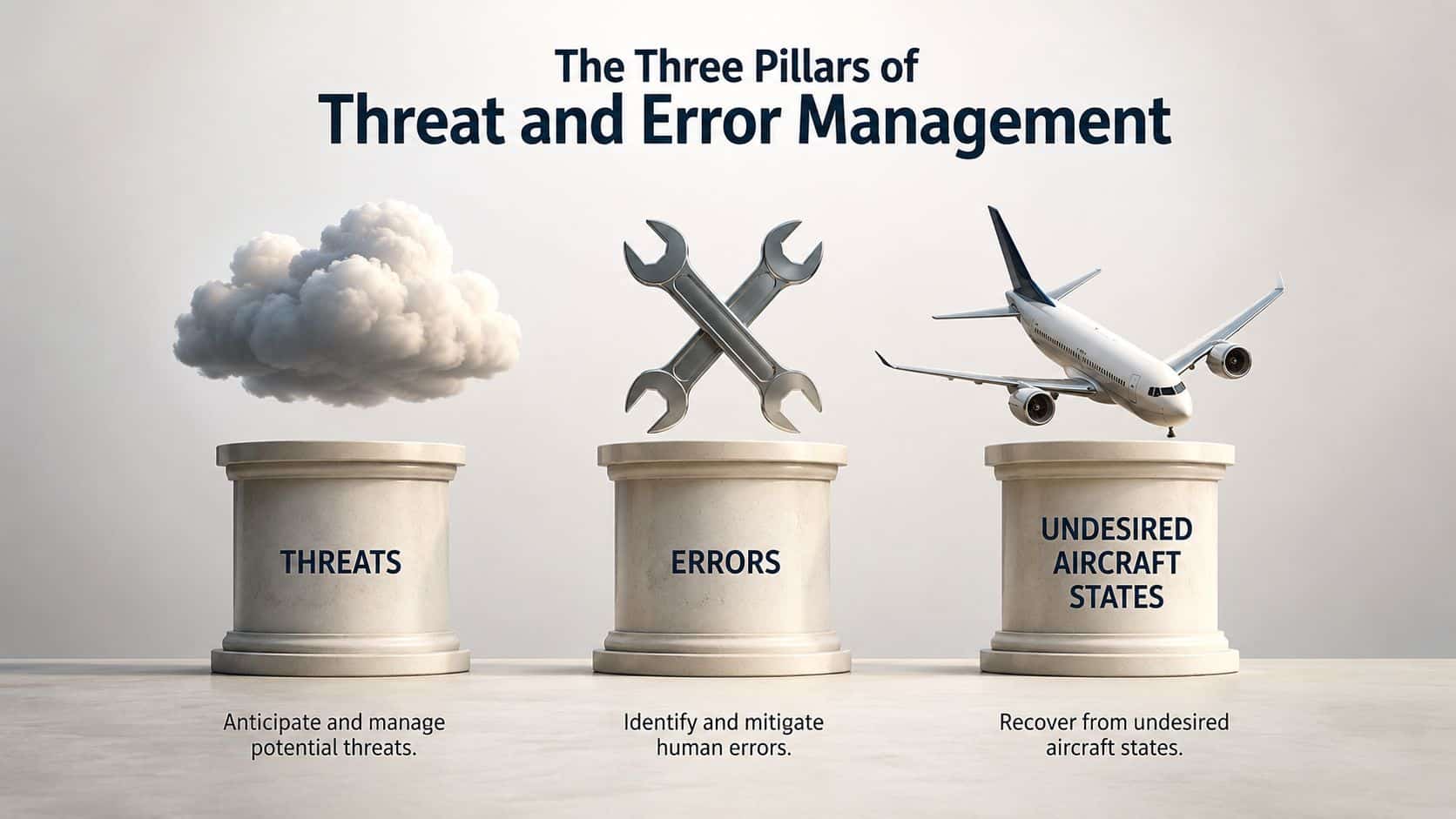
The TEM model has three connected elements: threats, errors, and undesired aircraft states. The distinction helps a pilot describe what's happening accurately instead of treating every problem as a vague feeling that “something is wrong.”
Threats increase complexity
A threat is a condition or event that raises workload or reduces available margins. Some threats come from the operating environment, such as weather, traffic, runway changes, unfamiliar airports, or bird activity. Others arise from the aircraft or the pilot, including equipment malfunctions, fatigue, limited recent practice, or pressure to meet a schedule.
At a busy towered airport, a last-minute runway change can require a pilot to update the taxi route, review the departure plan, set the correct heading, and listen for new traffic information. The runway change itself isn't an error. It becomes a threat when it increases the chance of confusion or overload.
Errors are deviations from the plan
An error is an action or inaction that differs from the pilot's intention. A student might read back the wrong taxiway, select an incorrect frequency, misread a chart symbol, omit a checklist item, or configure the aircraft incorrectly for an approach.
Errors are often understandable. A pilot can be distracted, rushed, or working with an incomplete mental picture. TEM doesn't ask whether the error was embarrassing. It asks whether the pilot recognized and trapped it before safety margins narrowed further.
Undesired aircraft states show reduced margins
An undesired aircraft state is the transitional condition that results when an error remains unmanaged. Examples include an unstable approach, an airspace deviation, an incorrect runway entry, an excessive energy state, or an aircraft configuration that no longer supports the intended maneuver.
The causal chain is straightforward:
- Threat: ATC changes the departure runway during a high-workload taxi.
- Error: The pilot turns toward the wrong taxiway or misses a hold-short instruction.
- Undesired state: The aircraft approaches a protected runway or loses the expected clearance picture.
- Incident risk: The pilot has fewer options and must recover quickly.
The chain can be interrupted at every stage. A pre-taxi briefing addresses the threat. A complete readback traps the clearance error. A stop-and-communicate decision corrects the undesired state before the aircraft continues into a conflict.
FAA training materials identify the same three elements and frame the operational objective as identifying threats, preventing or trapping errors, and recovering before an undesired state develops into an incident (FAA Safety TEM study material).
Countermeasures break the chain
Countermeasures should be specific enough to use under pressure:
- Briefings establish the expected route, configuration, threats, and decision points.
- Checklists protect against memory gaps during predictable workload.
- Callouts make deviations visible to another pilot or instructor.
- Cross-checks compare instruments, clearances, and aircraft status.
- Go-around discipline provides a planned response when an approach no longer meets the pilot's criteria.
The point isn't to add procedure for its own sake. Each countermeasure should address a known way that a threat could become an error or an undesired state.
Why Aviation Adopted Threat and Error Management
A pilot departing Chino Airport receives an unexpected runway assignment while the frequency stays busy. The pilot must adjust the departure plan, confirm the heading, monitor nearby traffic, and configure the aircraft without rushing. That ordinary situation captures why aviation adopted Threat and Error Management. Safety depends not only on reliable aircraft, but also on how pilots handle changing conditions, workload, communication, and human limitations.
Aviation safety history showed that technical reliability alone could not address every accident risk. A Flight Safety Foundation review reports that the United States experienced 40 fatal accidents per 1 million aircraft departures in 1959, while later fatal accident rates fell to a fraction of that level (Flight Safety Foundation review). As aircraft became more reliable, safety work gave greater attention to how pilots and organizations managed operational complexity.
NTSB material from the 1996 era cited that 60% of fatal commercial air carrier accidents involved human error, and that 80% of the aviation industry's causal factors associated with human error involved poor cockpit resource management. The practical lesson was clear. Pilots could not eliminate every error, so aviation needed layered defenses that reduced opportunities for error, trapped mistakes, and limited their consequences.
Line Operations Safety Audit research helped turn that lesson into an operational model. The FAA says TEM evolved in 1997, when a University of Texas at Austin team worked with Continental Airlines to expand LOSA methods (FAA history of LOSA). The emphasis shifted toward observing threats and errors during normal operations, rather than studying only accidents or unusual events.
LOSA made routine risk visible
LOSA observations showed that threats and errors are normal features of airline flying. One summary reported an average of four threats per flight, about three errors per flight, and more than 81% of flights encountering at least one threat. The same FAA history source also describes a TEM and LOSA dataset containing 19,053 threats, 13,675 errors, and 2,589 undesired aircraft states across 4,532 flights (FAA history of LOSA).
| Finding | Statistic | Implication |
|---|---|---|
| Threats encountered during normal operations | Average of four threats per flight | Threat recognition must be routine |
| Errors observed in line operations | About three errors per flight | Error-free performance is not a realistic safety strategy |
| Flights encountering at least one threat | Over 81% | TEM applies to ordinary flights, not only emergencies |
| Large TEM and LOSA dataset | 19,053 threats, 13,675 errors, and 2,589 undesired aircraft states across 4,532 flights | Safety depends on trapping and managing events |
ICAO later formalized TEM guidance around threats, errors, and undesired states. That framework also fits general aviation. A student or renter in a Cessna 172 may face a changing wind, radio congestion, distractions, aircraft limitations, or an imperfect decision while operating in busy Class D airspace.
The important shift was cultural. A safe pilot is not expected to avoid every mistake. A safe pilot identifies threats early, uses available defenses deliberately, and corrects errors while useful options remain.
Common Threats and Errors in General Aviation
General aviation and airline operations look different, but their TEM logic is remarkably similar. A renter in a Cessna 172 may face a changing wind, a crowded ramp, and an unfamiliar taxi route. An airline crew may manage high-altitude weather, complex reroutes, and automation mode changes. The aircraft and operating environment differ, but each crew must maintain a clear plan while conditions shift.
At Chino Airport, a last-minute runway assignment can increase radio and navigation workload. A pilot who expected one departure path may need to adjust the heading, review nearby traffic, confirm the clearance, and configure the aircraft without rushing. The threat is the changing operation. The error might be an incorrect readback or an unverified heading.
| Category | General Aviation Example | Airline Example |
|---|---|---|
| Weather | Unexpected crosswind, low ceiling, or density altitude | High-altitude weather or convective activity |
| ATC and routing | Last-minute runway or taxi change at a busy Class D airport | Complex reroute or amended clearance |
| Aircraft condition | Fuel discrepancy, unfamiliar equipment, or malfunction | System indication or automation-related issue |
| Pilot workload | Incomplete checklist or distraction during taxi | Automation mode confusion or task saturation |
| Communication | Misheard clearance or incomplete readback | Crew or controller communication breakdown |
| Flight planning | Poor fuel planning or weak alternate thinking | Dispatch, fuel, and reroute coordination |
| Traffic environment | Bird activity, wake turbulence, or simultaneous runway operations | Dense terminal traffic and separation demands |
Recognizing the parallel
A general aviation pilot may omit a checklist item because attention shifted to a passenger or radio call. An airline crew may miss a mode change while managing multiple tasks. The technical details differ, but both errors arise when workload exceeds the pilot's current mental capacity or when the crew's cross-check weakens.
The practical lesson for students is that TEM isn't reserved for turbine aircraft. A pilot renting an aircraft should identify threats before engine start, state the intended taxi route, verify the active runway, and ask for clarification instead of guessing.
The threat is not always the obvious problem
Density altitude and crosswind are visible planning concerns, but external pressure can be just as influential. A pilot may feel committed because passengers are waiting, a rental period is scheduled, or a planned lesson has already been delayed. That pressure doesn't make the flight unsafe by itself. It can, however, make a pilot less willing to stop when the plan no longer fits the conditions.
Decision gate: If the aircraft, clearance, weather, or pilot condition no longer matches the briefing, pause before continuing.
Airline LOSA data helped demonstrate that operational safety depends on how pilots manage events, not merely on whether threats or errors occur. A student pilot can apply that lesson during every pattern, instrument approach, and cross-country flight.
Practical TEM Strategies for Every Phase of Flight
TEM becomes useful when it produces a behavior a pilot can perform. The following sequence gives a student or renter a repeatable way to manage workload without treating safety as a vague intention.
Preflight creates the first defense
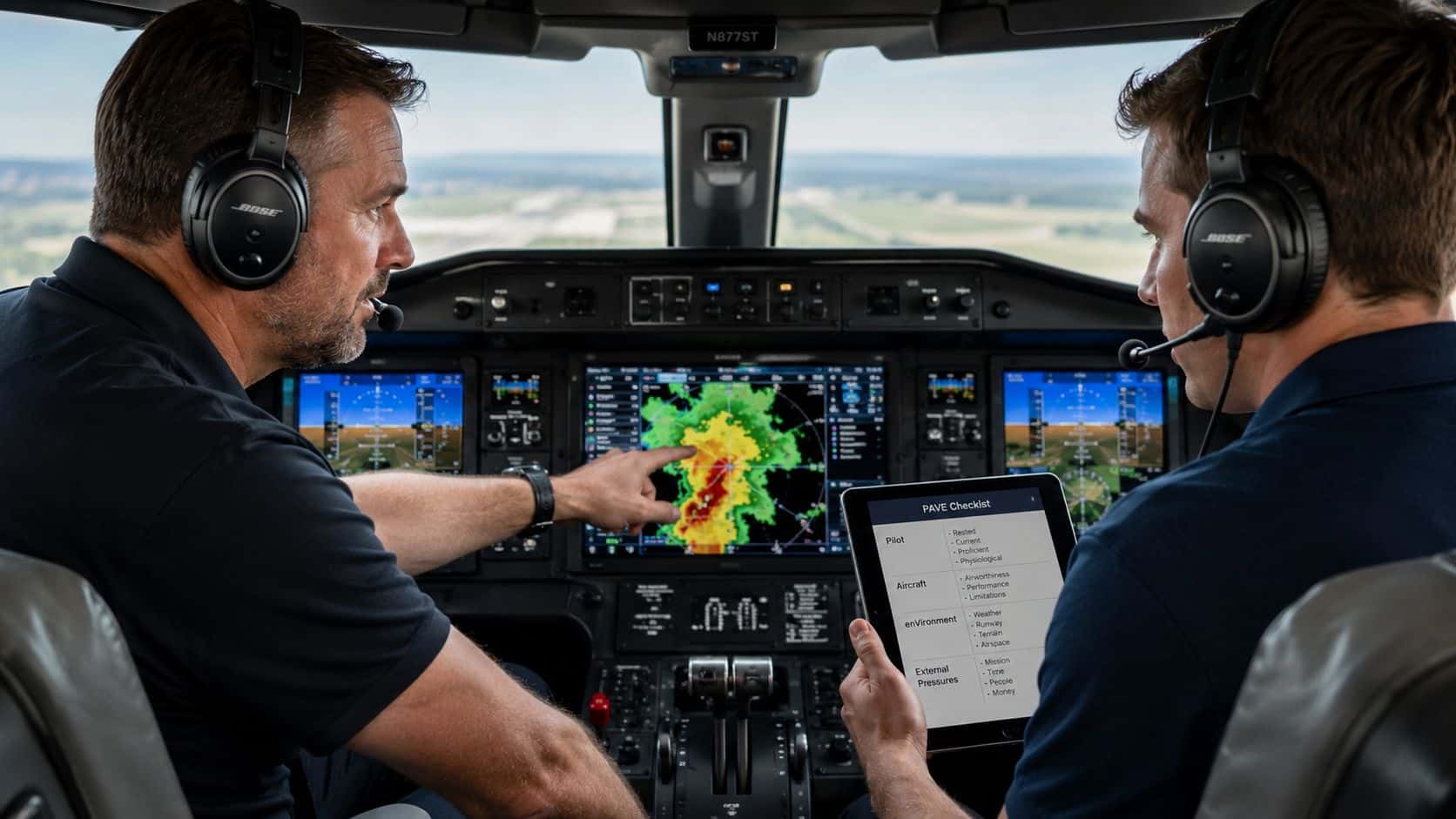
Begin with PAVE, considering the pilot, aircraft, environment, and external pressures. Then set personal minimums before the conditions create pressure to continue.
- Pilot: Assess fatigue, stress, recent practice, illness, and familiarity with the planned operation.
- Aircraft: Confirm fuel status, maintenance condition, required equipment, performance, and known discrepancies.
- Environment: Review weather, runway conditions, terrain, airspace, traffic, and expected airport procedures.
- External pressures: Identify deadlines, passengers, rental return expectations, or the desire to complete a lesson.
A fuel sample that looks wrong isn't a minor inconvenience to be ignored because the flight is already scheduled. The pilot should stop, determine whether the aircraft is airworthy, and involve qualified personnel when needed.
Taxi demands deliberate communication
At a busy Class D airport such as KCNO, the pilot should brief the expected taxi route before moving. If ATC issues a clearance that doesn't match the airport diagram or the pilot's expectation, the aircraft should stop in a safe location and request progressive taxi instructions.
Use a sterile cockpit during taxi and other high-workload phases. Passengers can receive a short briefing before movement, and nonessential conversation can wait until the aircraft is clear of the busiest parts of the operation.
DuBois Aviation's workload management strategies offer related guidance for organizing attention when several tasks compete at once. The same principle applies to renters operating unfamiliar aircraft. A clear plan reduces the chance that a radio call, checklist item, or taxiway identification will be lost.
Flight and approach require active error trapping
Verbalize critical actions when appropriate, compare expected indications with actual indications, and ask another qualified pilot or instructor to verify information when available. During simultaneous runway operations, maintain a deliberate traffic scan and anticipate the possibility of wake turbulence rather than reacting only after encountering it.
For an instrument approach, establish decision points before workload peaks. If the aircraft becomes unstable, the required configuration isn't complete, or the pilot loses the expected approach picture, a go-around or missed approach should be an available response, not an admission of defeat.
A short postflight debrief completes the TEM loop:
- What threats appeared?
- Which threats were anticipated?
- Did any errors occur?
- What trapped or corrected them?
- What change would improve the next flight?
Safety education often works better when it shows a recognizable decision and its consequence. A behavior-changing safety video guide can help instructors and organizations think about how to present operational scenarios clearly, but the cockpit habit remains the same: identify, assess, act, and monitor.
Integrating TEM Into Flight Training and Simulator Sessions
Flight training can introduce TEM before students face complex emergencies. During early lessons, an instructor can ask the student to identify threats in a simple local flight, such as unfamiliar airport signage, changing wind, limited fuel margins, or a passenger distraction. The student then chooses a countermeasure and explains what condition would trigger a change of plan.
Before a solo cross-country, a TEM briefing can identify expected airports, airspace transitions, weather concerns, navigation workload, and decision points. The student doesn't need airline-style language. The value comes from naming the threat and deciding in advance how to manage it.
Scenarios should become more demanding
Advanced training can combine threats so students learn to recognize interaction rather than isolated problems. A partial-panel failure paired with an amended ATC clearance, for example, forces the pilot to prioritize aircraft control, clarify the clearance, and preserve enough capacity for navigation and communication.
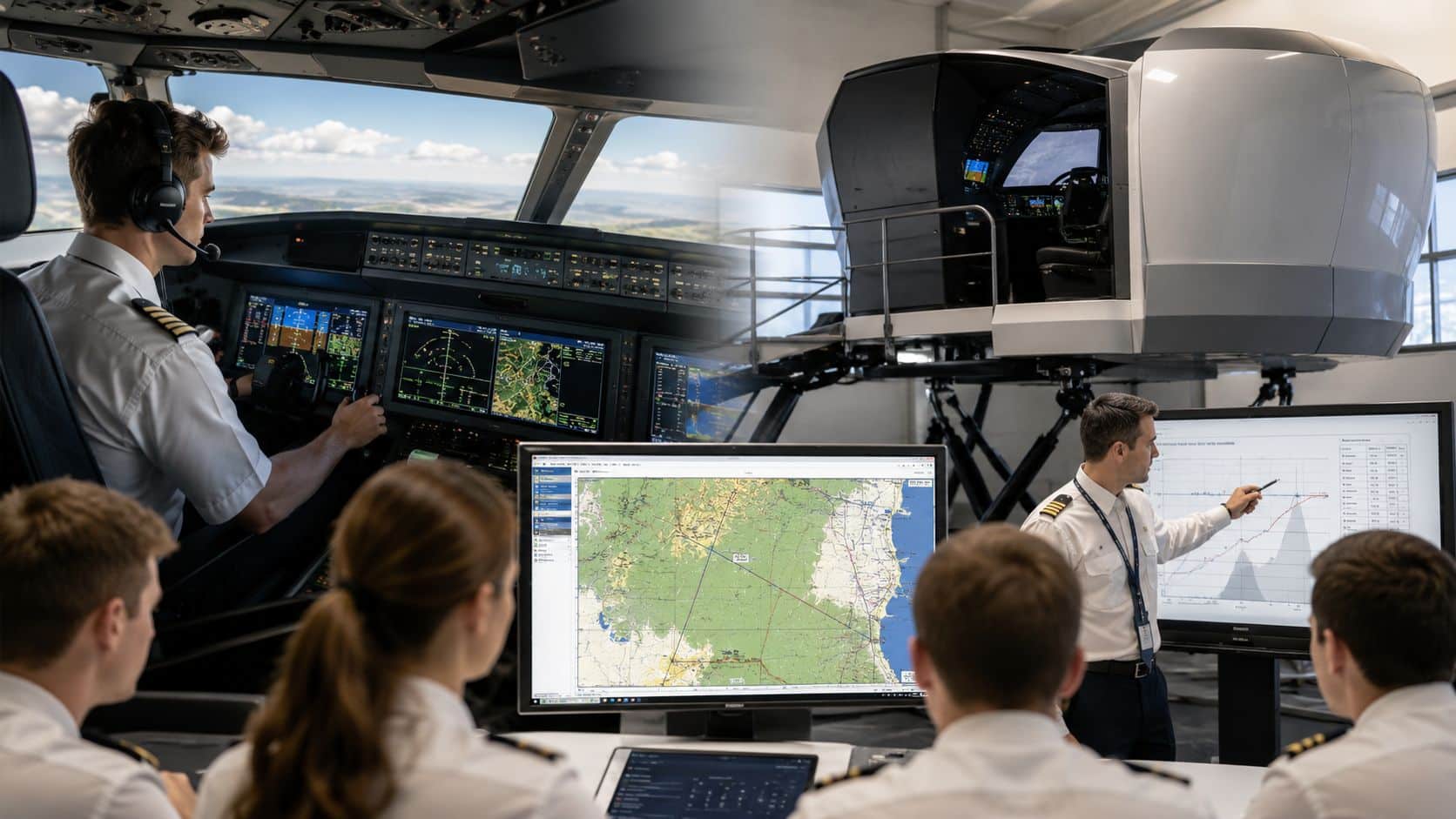
A simulator can expose students to demanding situations without creating real-world consequences. Instructors may use scenarios involving an IMC transition, an engine failure, or terrain concerns, while keeping the exercise appropriate to the student's certificate, aircraft, and training objectives. The instructor's role is to observe decision-making, not to surprise the student with an arbitrary trap.
DuBois Aviation offers simulator training at its training center, which can support structured practice and debriefing alongside aircraft instruction.
Debriefing turns events into skill
The debrief should separate threats from errors. A student might identify weather as the threat, a missed briefing item as the error, and an unstable approach as the undesired state. That vocabulary helps the student see where an earlier intervention could have broken the chain.
LOSA-style observation forms can also support checkride preparation. An instructor can record whether the student anticipated threats, used available resources, trapped deviations, and recovered appropriately. Over time, TEM becomes part of how the student prepares for a maneuver, not a separate topic added after the maneuver is complete.
Misconceptions About Threat and Error Management
TEM isn't only for airline crews flying complex jets. A student pilot in a Cessna 172 faces the same basic sequence as a crew in a transport aircraft: an outside threat increases complexity, an action or inaction creates an error, and an unmanaged deviation reduces safety margins.
TEM also isn't a replacement for aeronautical decision-making or risk-management tools such as PAVE and IMSAFE. Those tools help pilots evaluate readiness and risk, while TEM helps pilots manage changing conditions in real time. A pilot can make a sound preflight decision and still need TEM after an unexpected clearance, malfunction, or weather change.
Another misconception is that error-free flying is the goal. The FAA's TEM framework recognizes that errors occur and emphasizes trapping them before they become undesired aircraft states (FAA advisory circular). Callouts, sterile cockpit discipline, written taxi instructions, and cross-checks aren't excessive workload when they prevent a small deviation from growing.
TEM is best understood as a mindset supported by practical habits. It scales from a local pattern at Chino to a complex terminal approach because every pilot benefits from noticing when reality no longer matches the plan and acting while options remain.
DuBois Aviation provides private, instrument, commercial, multi-engine, CFI/CFII/MEI, helicopter, simulator, and aircraft rental services at Chino Airport, where students practice real towered-airport communication and workload management. Visit DuBois Aviation to ask about course availability, schedule a school visit, or request a training plan built around practical TEM habits.


