
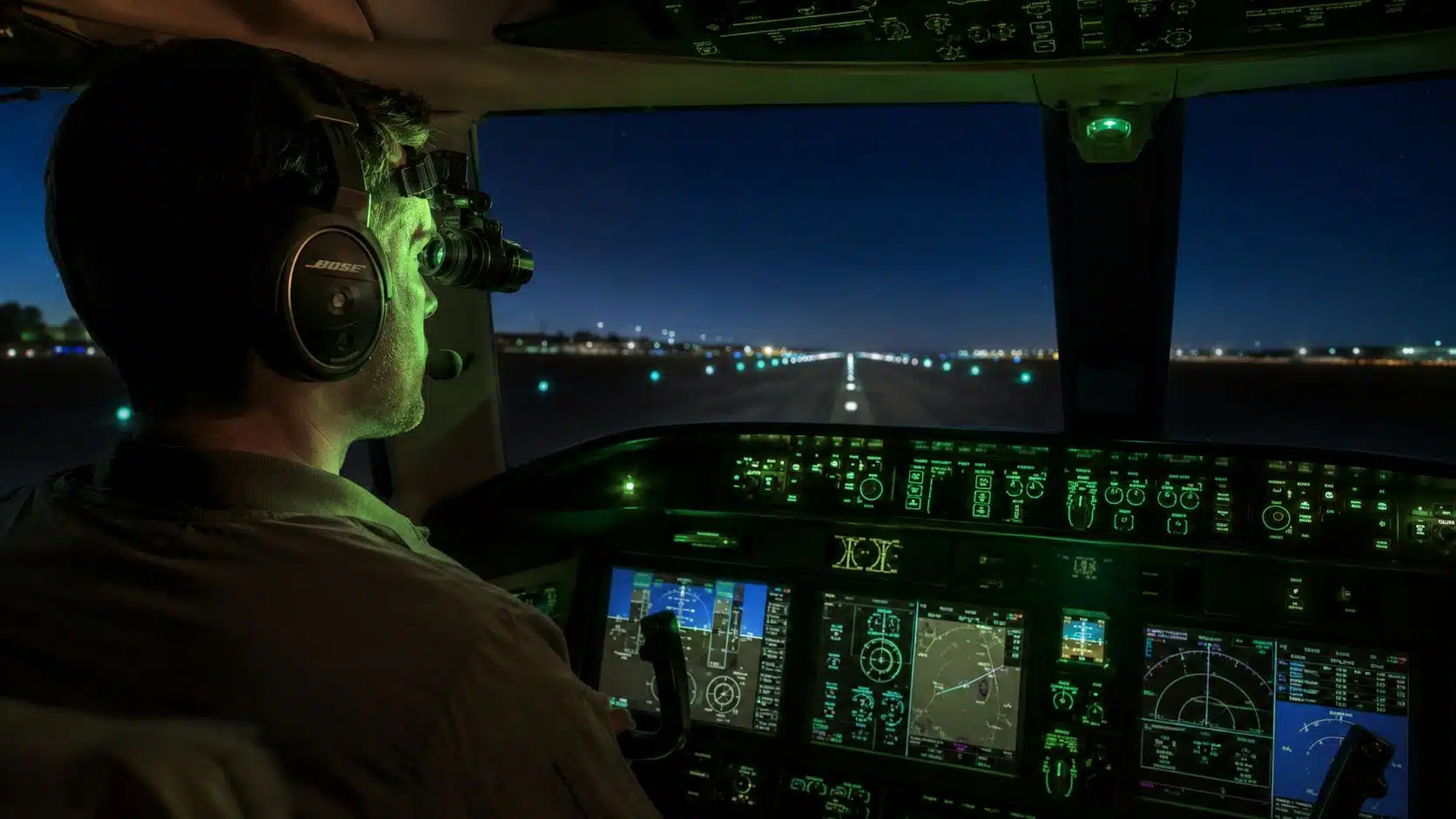
Civilian pilots may use night vision goggles only after completing specific FAA-approved training, logging the required NVG tasks, and using goggles that meet TSO-C164a or an FAA-accepted equivalent. The question isn't whether NVGs make darkness disappear, but whether a pilot can use them safely within the equipment, training, authorization, and currency rules.
For a flight student, renter, or career-track aviator, NVGs aren't another piece of cockpit equipment. They change how the pilot scans, interprets terrain, manages cockpit lighting, transitions between aided and unaided vision, and maintains traffic awareness. The FAA treats NVG use as a distinct operating privilege, not as a substitute for ordinary night experience.
That distinction matters at a busy airport such as Chino, where tower communications, nearby traffic, surrounding terrain, and instrument procedures demand disciplined scanning. A pilot considering NVG training should first understand the normal night flying requirements, then determine whether the intended operation requires a specialized NVG provider.
Table of Contents
- What Night Vision Goggles Mean for Civilian Pilots
- How Aviation Night Vision Goggles Actually Work
- FAA Training, Logging, and Currency Rules for NVG Use
- Safety Limits, Peripheral Vision, and See-and-Avoid
- Training Path, Checkride, and Realistic Costs
- Night Vision Goggles in Airplanes and Helicopters
- Next Steps for Pilots Considering NVG Training
- Frequently Asked Questions About Night Vision Goggles
What Night Vision Goggles Mean for Civilian Pilots
A civilian pilot generally has to clear four gates before using night vision goggles in flight:
- Approved equipment: The goggles must meet the applicable aviation standard, including TSO-C164a or an FAA-accepted equivalent.
- Formal training: The pilot must complete the training required for NVG operations under 14 CFR 61.31(k).
- Proper authorization: The pilot must hold the required training endorsement and operate under the applicable aircraft, operator, and regulatory framework.
- Recent experience: The pilot must log the specified NVG tasks within the required period before carrying passengers.
A regular night flight doesn't automatically satisfy those requirements. A pilot can be fully current for ordinary night operations and still lack the authority or recent experience to act as pilot in command while using NVGs.
The reason is operational, not bureaucratic. NVGs alter the pilot's visual reference, narrow the usable field of view, and require deliberate transitions between the intensified image and unaided vision. They also interact with aircraft lighting, windshield reflections, terrain contrast, traffic detection, and cockpit workload.
Practical rule: Buying approved equipment doesn't create the privilege to use it. The pilot earns that privilege through training, documentation, and currency.
The technology itself has a long military development lineage. In 1985, the U.S. military awarded production contracts to ITT/Varo Joint Venture and Litton to replace older PVS-5 systems, and the AN/PVS-7B was fielded in 1988 at Fort Hood. The AN/PVS-7 and AN/PVS-14 later became iconic milestones that remained in use for more than three decades, helping define modern helmet-mounted night-vision operations across major defense markets. This historical market overview describes that development path.
Civilian pilots should therefore approach NVGs as a specialized operating system. The goggles, aircraft lighting, training syllabus, medical considerations, airspace procedures, and pilot currency all have to work together.
How Aviation Night Vision Goggles Actually Work
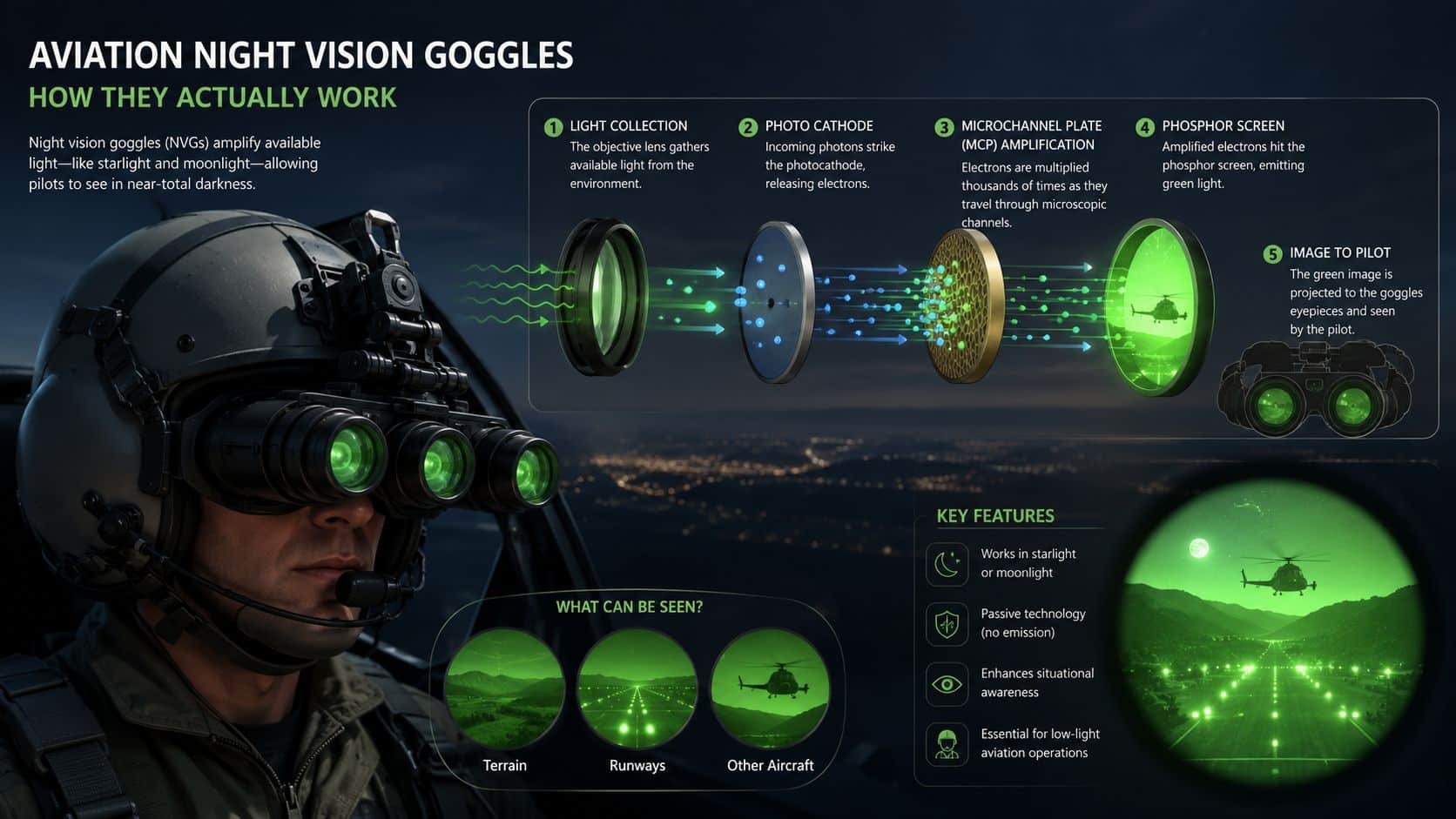
What lets a pilot see terrain and traffic after unaided vision has lost the detail? Aviation night vision goggles usually rely on image intensification. Ambient light enters the objective lens and reaches an image-intensifier tube, where it becomes electrons. The tube amplifies that signal, then converts it back into a visible image at the eyepiece.
The goggles do not create daylight, and they do not detect heat like thermal cameras. They need some usable ambient light, such as moonlight or artificial light, even when that light is too faint for unaided human vision. The infographic explaining how aviation night vision goggles collect and amplify light shows this process from lens to eyepiece.
The common aviation arrangement is a head-mounted binocular system with 1x magnification and a 40° field of view. With no magnification, nearby movement and aircraft attitude are less distorted. Two tubes also preserve matching visual information for both eyes, which supports depth perception during flight. A representative Gen III aviator specification reports 64 to 72 lp/mm tube resolution, a signal-to-noise ratio of about 23, and brightness gain around 2800. These figures appear in the representative Gen III aviator specification.
What the specifications mean in flight
Resolution affects how clearly a pilot can separate terrain features, obstacles, lights, and other low-contrast objects. Signal-to-noise ratio describes image cleanliness, particularly when available light is weak. Brightness gain determines how strongly the system amplifies the signal. More brightness alone does not guarantee better recognition, because contrast, cockpit compatibility, and the pilot's visual adaptation also matter.
A monocular leaves one eye viewing unaided darkness while the other sees the intensified image. That can reduce equipment weight and retain a natural visual reference, but depth cues differ between the eyes. Binocular goggles provide a matched image to both eyes, while their weight and narrower peripheral view still affect workload.
Panoramic designs use more than the conventional dual-tube arrangement to widen the visual field. The wider view can help in demanding operations, but it does not replace a deliberate scan, transition practice, or aircraft-specific procedures.
Why certification matters
Civil approval evaluates the complete NVG system, not just its intensifier tube. The FAA TSO for NVGs specifies binocular head-mounted operation and a minimum on-axis system resolution of 1.3 cycles per milliradian under optimum light conditions. Accepted civil-aviation systems have been reported to provide aided visual acuity as good as 20/40, with brightness levels in roughly the 0.3 to 2.2 foot-lambert range depending on generation. The FAA TSO-C164a document explains why tube performance, cockpit lighting, and display brightness must be assessed together. For a civilian pilot, that approval is one part of the operating privilege. Training, documentation, and recent experience still determine whether the equipment may be used legally in flight.
FAA Training, Logging, and Currency Rules for NVG Use
What must a civilian pilot complete before using NVGs as pilot in command? The regulatory path begins with training. 14 CFR 61.31(k) requires additional training for NVG use, and the FAA's guidance connects that qualification with logging and proficiency provisions in 61.51(k), 61.57(g), 61.195(k), and 91.205(h). A night endorsement, instrument rating, or ordinary passenger-carrying currency does not replace NVG qualification. The FAA NVG regulation summary explains how these requirements fit together.
The privilege also has a recent-experience gate. A pilot carrying passengers during NVG operations must complete the applicable tasks during the two calendar months before the month of the flight. Those flights are the pilot's regulatory proof of current skill, much like keeping a key recently used rather than relying on one used long ago. If the experience expires, previous NVG flights no longer support passenger-carrying operations. The pilot must complete the required experience again first.
The required tasks
The core work includes takeoffs and landings, area departures and arrivals, and aided-to-unaided-to-aided visual transitions. Transitions deserve deliberate practice because the pilot may need to change visual references while maintaining aircraft control, monitoring traffic and terrain, and using cockpit instruments.
| Task | Airplanes | Helicopters and powered-lifts |
|---|---|---|
| Takeoffs and landings | 3 | 3 |
| Area departures and arrivals | 3 | 3 |
| Aided-to-unaided-to-aided transitions | 3 | 3 |
| NVG operations | 3 | 6 |
| Hovering tasks | Not applicable | Required when NVGs will be used during hovering |
The passenger-carrying requirements are specified in 14 CFR 61.58. Helicopter and powered-lift pilots must meet additional hovering requirements when the operation includes NVG hovering, and those aircraft categories require more NVG operations for recent experience.
Log each task precisely. The record should identify what was completed, the aircraft category, and the qualifying period. The pilot currency requirements offer useful context for separating initial qualification from the recent experience needed to carry passengers legally.
Safety Limits, Peripheral Vision, and See-and-Avoid
What changes when a pilot can see farther at night but sees less at the edges? NVGs can improve detection of conventional lights at extended distances, yet they narrow peripheral vision and may pull attention toward the object already visible in the intensified image.
That combination creates a serious see-and-avoid risk. A pilot might notice a distant light sooner while missing movement outside the goggles' field of view. Concentrating on terrain, a landing area, or a bright light can narrow attention further.
A wider-looking image is not the same as natural peripheral vision. The pilot still has to scan deliberately and manage attention outside the goggles.
Why scanning discipline changes
Unaided night flight already demands a purposeful scan. The eye's most sensitive area is not always the best place to detect faint objects, so pilots use slight off-center viewing and keep their eyes moving. NVGs add more tasks: monitor the intensified image, cross-check instruments, watch cockpit indications, maintain aircraft control, and assess what may be outside the goggles' field.
Short, deliberate scan cycles help. Look through the goggles, check the instruments, then return attention to the surrounding airspace and flight path. The goggles are one source of information, not a replacement for the pilot's full visual scan.
Transitions need practice. Removing or flipping the goggles up can expose the pilot to a sudden change in brightness and available visual information. A sound syllabus rehearses aided-to-unaided and unaided-to-aided transitions until the pilot can protect aircraft control and maintain awareness during both.
NVGs also leave weather, terrain, wires, unlighted traffic, and optical limits in place. Bright lights can affect the image, while low contrast can make terrain difficult to interpret. Pilots must continue using charts, instruments, airspace knowledge, external-lighting procedures, and aircraft-specific limitations. Review collision avoidance techniques for night operations as part of that broader scan discipline.
Airspace mitigation
The FAA treats reduced field of view as a factor that can degrade see-and-avoid capability. NVG operations therefore use monitored airspace or a NOTAM-defined area issued at least 48 hours before lights-out operations. These safeguards address the gap between what the goggles display and what may be present outside their view.
Confirm the exact operating authorization and procedure with the responsible operator, instructor, or aviation authority. Civilian NVG use is a regulated operating privilege, not just a matter of wearing goggles after dark. The operation must account for traffic detection, communications, airspace monitoring, and hazards that the goggles' strengths can introduce.
Training Path, Checkride, and Realistic Costs
What does an NVG qualification involve beyond putting on the goggles after sunset? For a civilian pilot, it is a structured operating privilege shaped by the operator, aircraft, authorization, and intended role. The path may differ between civilian, public-safety, and commercial operations, but each begins with confirming that the pilot and equipment meet the applicable requirements.
A provider normally reviews the pilot's certificate, medical qualification, aircraft experience, operating role, and equipment standard. Ground instruction then builds the mental model behind the device. Topics include image intensification, cockpit compatibility, visual illusions, scanning, transitions, aircraft limitations, emergency procedures, and applicable regulations. The goggles are an aid to the pilot's existing skills, not a substitute for them.
A typical training sequence
- Ground instruction: The pilot learns what the goggles can and cannot show, how to inspect and fit them, and how cockpit lighting changes the image.
- Aircraft and equipment training: The pilot practices mounting, adjustment, focus, battery or power procedures, lighting configuration, and recognition of abnormal indications.
- Day and dusk preparation: The instructor introduces visual transitions and cockpit tasks while enough natural light remains to correct problems early.
- Night flight practice: The pilot applies the scan, aircraft control, navigation, communications, takeoffs, landings, area work, and transitions required by the syllabus.
- Evaluation: The pilot completes the applicable checkride or evaluator ride and receives the required endorsement or authorization.
The sequence works like learning to fly an unfamiliar aircraft. First the pilot understands the controls and limitations, then practices individual tasks, and finally demonstrates that those tasks can be managed together. A provider may require further preparation before passenger carriage or specialized missions. Public-safety and Part 135 operations can add standardization, crew coordination, dispatch, risk management, and line-check requirements.
Why cost estimates vary
No single training price applies to every pilot. The total depends on aircraft rental, instructor time, ground training, approved goggles, maintenance, evaluator availability, and whether the provider supplies the equipment. Aircraft access can change the budget substantially, especially when the pilot must reserve a compatible aircraft and arrange qualified instruction separately.
Equipment access matters as much as rental time. A pilot using a specialty provider may face a different financial commitment from an employed pilot entering an employer-funded public-safety program. Ask for a quote that separates aircraft, instructor, equipment, ground-school, evaluation, and any required preparation costs. That breakdown shows which assumptions drive the estimate and whether the proposed training matches the operating authorization.
A purchase price alone can mislead. The relevant question is what the approved goggles, aircraft installation, instruction, maintenance, and evaluation will cost for the specific operation. The qualification is earned through documented training and evaluation, then retained through the applicable logging and currency requirements, rather than through equipment ownership alone.
Night Vision Goggles in Airplanes and Helicopters
NVG use exists in both airplanes and helicopters, but the operating demands aren't identical. Helicopters often work close to terrain, landing areas, obstacles, and unlighted surfaces, so the ability to maintain external visual references during low-light operations can be especially valuable. Airplanes generally operate with different obstacle, landing, and traffic profiles, and civilian fixed-wing NVG operations are less common.
The regulatory distinction becomes visible in the recent-experience requirements. Airplane pilots must complete the specified takeoffs, landings, area departures and arrivals, transitions, and NVG operations. Helicopter and powered-lift pilots have the additional hovering requirements when NVGs will be used during hovering, along with the higher NVG operation count described earlier.
Fixed-wing considerations
An airplane pilot needs strong fundamentals before adding NVG work. Those fundamentals include ordinary night proficiency, instrument cross-check, radio discipline, stabilized approaches, runway awareness, and the ability to transition between visual and instrument references. A busy towered airport can provide useful experience with communications and traffic sequencing, but it doesn't by itself provide an NVG qualification.
The aircraft also has to be compatible. Cockpit lighting, windshield design, instrument readability, mounting equipment, electrical systems, and operating authorization all require evaluation. A pilot shouldn't assume that goggles approved for one aircraft can be moved to another without an equipment and procedures review.
Helicopter considerations
Helicopter training adds hovering, confined-area operations, low-level visual references, and more immediate consequences from losing a usable external picture. A helicopter pilot considering NVGs should ask whether the intended career path involves emergency medical services, law enforcement, utility work, or another operation with an approved NVG program.
Students at Chino Airport can build the underlying skills through structured night, instrument, and helicopter training, but ordinary helicopter instruction isn't automatically a complete NVG course. A discovery flight can also help a prospective student decide whether helicopter workload and night operations fit the intended goal before pursuing a specialized provider.
The important comparison is practical: airplane pilots usually build toward NVG work through disciplined night and instrument proficiency, while helicopter pilots must also demonstrate reliable hover and low-level control under the applicable syllabus.
Next Steps for Pilots Considering NVG Training
A pilot weighing NVG training should start with the mission, not the equipment catalog. The right question is whether the intended flying requires an approved NVG operation, or whether the pilot is still building ordinary night, instrument, commercial, or helicopter experience.
A useful decision process looks like this:
- Define the flying goal. Separate personal night flying from public-safety, commercial, instructional, or employer-directed NVG operations.
- Confirm the regulatory path. Identify the applicable certificate, medical qualification, operator authorization, training endorsement, and recent-experience requirements.
- Speak with a specialty provider. Ask whether the provider conducts civilian Part 91 NVG training, supplies compliant equipment, and evaluates the exact aircraft category involved.
- Check the aircraft. Verify cockpit lighting, mounting provisions, instruments, electrical systems, maintenance support, and operating limitations.
- Build the foundation first. Strengthen night proficiency, instrument skills, abnormal procedures, radio work, and aircraft control before adding goggles.
- Try the environment safely. A discovery flight or supervised night lesson can reveal whether the pilot is comfortable managing darkness, workload, and visual transitions.
A student at a Southern California airport might begin with a discovery flight, continue through private and instrument training, and later discuss commercial or instructor goals with a qualified provider. Another pilot may already hold advanced ratings but need a separate NVG syllabus because ordinary currency doesn't transfer automatically.
Questions to ask before enrollment
- Does the provider train airplane pilots, helicopter pilots, or both?
- Does the syllabus include the passenger-carrying recent-experience tasks?
- Who supplies the goggles, and what aviation approval do they carry?
- How are cockpit lighting and aircraft compatibility evaluated?
- What happens if the pilot's currency lapses after completion?
- Is the training intended for personal Part 91 flying or an employer's operational program?
A school can help a pilot build the prerequisite flying skills, but it shouldn't imply that standard aircraft rental or ordinary night instruction alone authorizes NVG use. The equipment and operating approval need to match the mission from the beginning.
Frequently Asked Questions About Night Vision Goggles
How much does NVG training cost?
There is no single reliable price for NVG training. The total reflects aircraft rental, instructor time, ground instruction, equipment access, maintenance, and the evaluation arrangement. Ask the provider for a written estimate tied to the aircraft category and syllabus, rather than relying on a generic quote.
Can private pilots legally use NVGs?
A private pilot may be eligible, but holding a private certificate does not by itself authorize NVG operations. The pilot must complete the required training under 14 CFR 61.31(k), use compliant aviation equipment, obtain any applicable authorization, and meet the recent-experience requirements for the planned flight. Review the regulation with an instructor or operator before flying.
Does airplane NVG training transfer to helicopters?
No. Helicopter and powered-lift operations introduce aircraft-specific tasks, including hovering considerations, and their recent-experience rules differ from airplane requirements. A pilot changing categories should plan on additional training and a review of the applicable endorsement and currency rules. Familiarity with one cockpit does not substitute for proficiency in another.
Do NVGs change medical certificate requirements?
NVGs do not replace the pilot's existing medical obligations. The pilot must still meet the medical requirements for the certificate and operation. An NVG program may also set additional requirements through its operator or evaluator. Discuss individual medical concerns with an aviation medical examiner.
How often must NVG currency tasks be repeated?
For passenger-carrying PIC operations, the required tasks must be logged within the two calendar months before the month of the flight. They include three takeoffs and landings, three area departures and arrivals, three aided-to-unaided-to-aided transitions, and the applicable NVG operations. Helicopter and powered-lift pilots also need the required hovering tasks when using NVGs during hovering.
Pilots considering NVG operations can strengthen regular night and instrument skills through DuBois Aviation's airplane and helicopter training, then discuss the intended pathway with a qualified specialty provider. Visit DuBois Aviation to ask about course availability, schedule a discovery flight, or request training information before choosing equipment or enrolling.


