
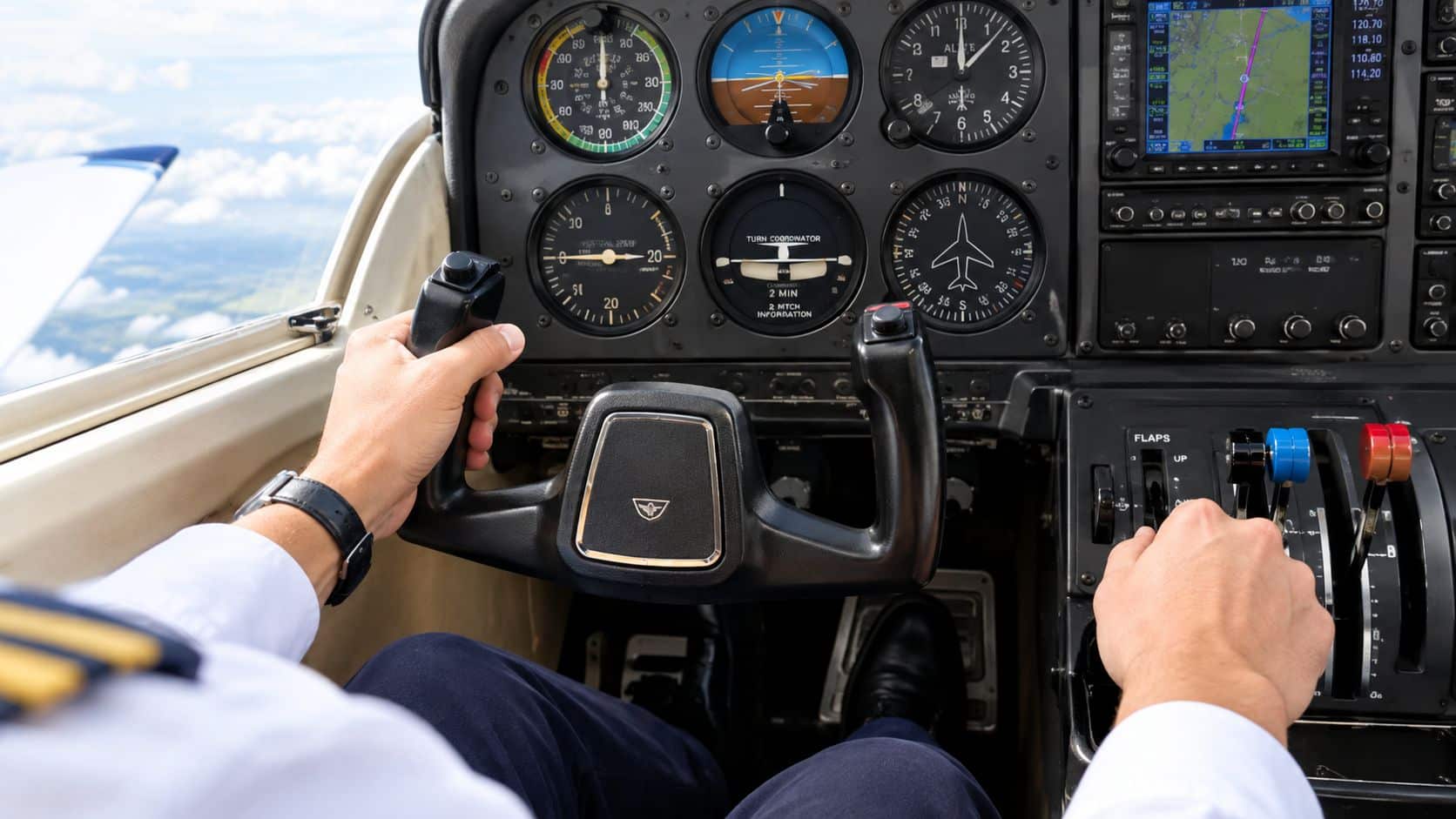
The airplane rolls into a turn, the ball slides left, altitude starts wandering, and the pilot adds more aileron while pressing the wrong rudder pedal. That pattern is common in early training, but it isn't a personality flaw or a lack of natural ability. How to improve coordination skills in flight comes down to deliberate, task-specific practice: time the rudder and aileron together, keep the outside scan moving, and measure whether the airplane is doing what the pilot commands.
For a student at a busy towered airport such as Chino, coordination has to hold up while the radio is active, traffic is moving, and the runway environment is changing. The following program connects each drill to FAA language about coordinated flight, slips, skids, and cross-checking, so practice develops a skill an instructor and examiner can directly observe.
Table of Contents
- What Coordination Actually Means in the Cockpit
- The Four Coordination Skills Every Pilot Trains
- Foundational Drills That Build Smooth Control
- Building a Weekly Practice Schedule That Works
- Measuring Progress Without Guesswork
- Common Setbacks and How to Correct Them
- Bringing It Together for Checkrides and Real Flying
What Coordination Actually Means in the Cockpit
The FAA Airplane Flying Handbook describes coordination as the pilot's ability to use the hands and feet together subconsciously and in the proper relationship to produce the desired result in the airplane. That definition matters because coordination isn't just comfort. It is the controlled relationship between aileron, rudder, elevator, power, attitude, and attention.
A student enters a bank, but the control inputs arrive out of phase. The aileron starts the roll, the rudder comes late, the nose yaws, the ball moves, and the pilot chases the error with another input. Airspeed and altitude then drift because the pilot is correcting symptoms instead of managing the airplane as one system.
Slip and skid in plain language
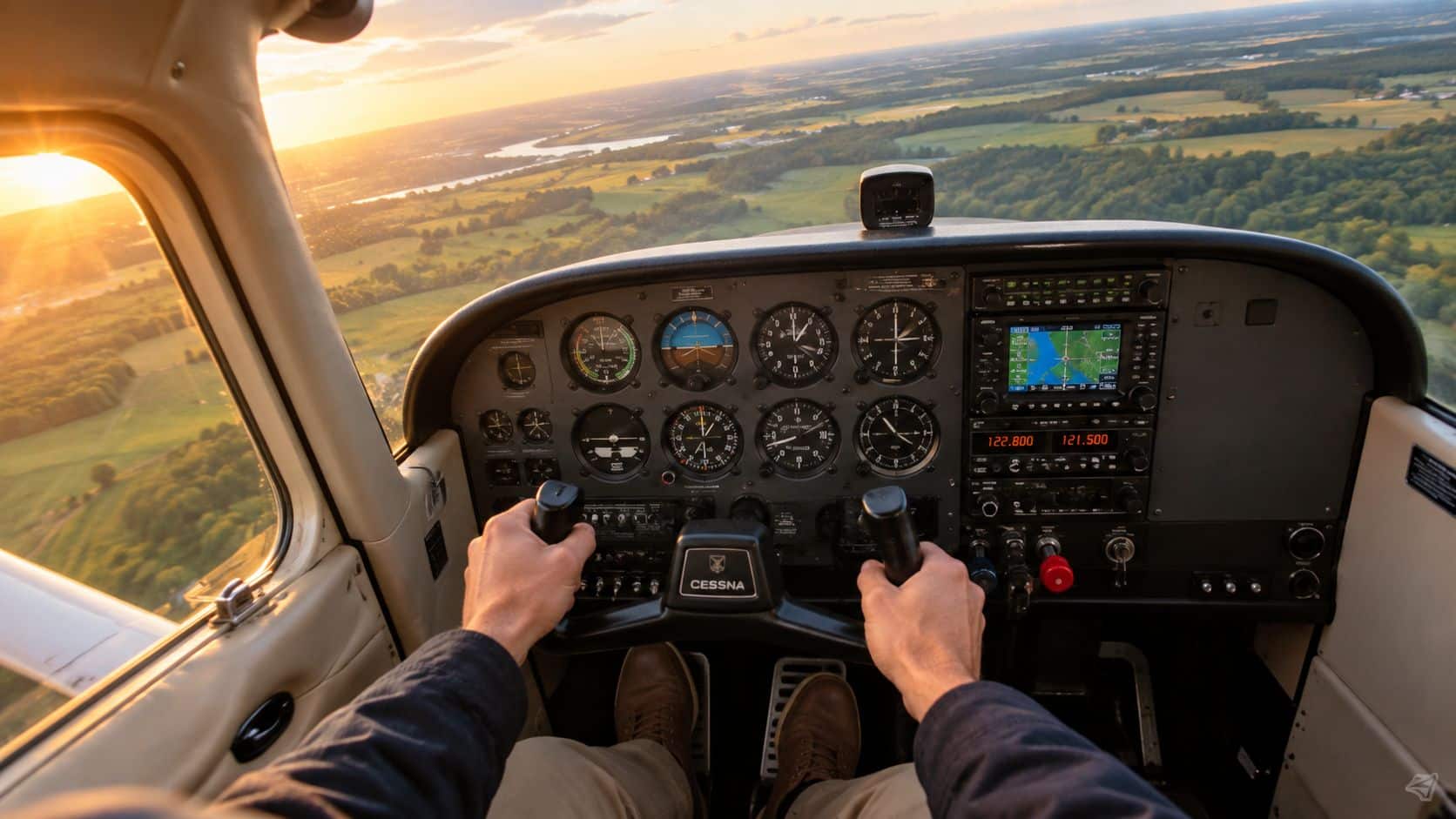
A slip and a skid are both forms of uncoordinated flight, but they aren't the same error. FAA safety material explains that, in a slip, the airplane is yawed toward the outside of the turn and the pilot feels pushed toward the inside. In a skid, the airplane is yawed toward the inside and the pilot feels pushed toward the outside. The FAA handbook discussion of slips and skids also identifies the classic cross-controlled slip by the rudder pointing toward the sky, while the classic cross-controlled skid has the rudder pointing toward the ground.
In a coordinated turn, the inclinometer ball stays centered. A ball displaced to one side gives the pilot a measurable indication that the relationship between bank and yaw is wrong. A turn coordinator helps show the direction and rate of turn, but it doesn't replace the outside view, attitude information, or sound control judgment.
Cockpit rule: Correct the control relationship, not just the instrument indication. The ball tells the pilot that coordination is wrong, while the attitude, bank, yaw, and outside picture help explain why.
Coordination is therefore a trained behavior. A structured review of randomized controlled trials in developmental coordination disorder found that only 9 trials covering 15 interventions met strict inclusion criteria, which shows that evidence-based coordination training remains a young field. The review found that task-oriented approaches, including Neuromotor Task Training, conventional motor training, and motor imagery plus practice, were more effective than generic approaches, while Wii Fit and self-concept training were ineffective. The systematic review supports a useful aviation principle: specific practice beats vague repetition.
Pilots who want to assess coordination outside the airplane can also review validated coordination assessment tools as a general framework for observing timing, balance, and movement control. Flight-specific assessment still belongs with a qualified instructor, especially when the problem appears during stalls, steep turns, or approach work. DuBois Aviation's human factors training can also help connect control technique with attention, workload, and decision-making.
The Four Coordination Skills Every Pilot Trains
A pilot can say, “The turn felt sloppy,” but that description isn't precise enough to choose the right correction. Coordination has several parts, and each one can fail independently. A pilot who fixes a foot problem with more hand movement usually creates a second problem.
| Domain | Cockpit symptom | First correction |
|---|---|---|
| Hand-eye coordination | The nose drifts from a visual target and the pilot makes large control movements | Use small, timed corrections while keeping the outside reference primary |
| Hand-foot coordination | The ball moves during roll-in or roll-out | Match rudder pressure to the direction and timing of aileron movement |
| Instrument cross-check | The pilot stares at one instrument and loses heading, altitude, or attitude | Use a predictable scan that returns to attitude and performance |
| Multi-tasking coordination | Radio, traffic, configuration, and alignment tasks compete during final | Stabilize the airplane first, then sequence the remaining tasks |
Hand-eye coordination
This skill appears whenever the pilot holds a visual reference. During a ground-track exercise, the nose may begin drifting away from a selected point. The correction should be small and early, not a full control deflection followed by an opposite correction.
The same problem shows up on final when a pilot chases airspeed with the elevator. A glance at the airspeed indicator becomes a large pitch change, then power and trim are adjusted late. The better habit is to keep the runway picture, pitch attitude, power setting, and airspeed relationship in view together.
Hand-foot coordination
This is the core of turn coordination. As the aileron rolls the airplane into a bank, the rudder must be applied in the same turn direction to counter adverse yaw. FAA guidance states that holding rudder after the turn is established can produce a skid to the outside, while inadvertent opposite rudder can produce a slip to the inside. The FAA maneuver guidance gives the correction a mechanical basis rather than treating the ball as a mysterious signal.
Instrument cross-check
A cross-check is not a stare at the turn coordinator. It is a repeatable movement among attitude, heading, altitude, and turn information, with the outside view included whenever conditions permit. This becomes the foundation for instrument flying because the pilot must recognize a developing error before it becomes a large correction.
Multi-tasking coordination
On short final, the pilot may be listening to a clearance, scanning for traffic, confirming configuration, tracking the runway, and managing alignment. Coordination fails when the pilot tries to perform every task at once without prioritizing aircraft control. The first correction is always to protect attitude, airspeed, and flight path, then handle the next task in a deliberate order.
Foundational Drills That Build Smooth Control
Coordination improves when each drill has a visible target. “Practice more” doesn't tell a pilot whether the problem is timing, scan discipline, control pressure, or workload management.
Start on the ground with a rudder-feel exercise. With the yoke centered and the airplane stationary, press each rudder pedal in turn and notice how pedal movement relates to nosewheel or rudder position according to the aircraft's design. The next rehearsal is visual and mental: move the imagined aileron and rudder together as one turn-entry motion, then reduce both as the desired bank is reached.
Move from simple timing to divided attention
A visual scanning drill can be done in the pattern. Select three safe visual references, such as a hangar, a taxiway sign, and a distant ridge. Call out the color or shape of each reference in sequence while maintaining aircraft control. The point isn't memorizing the objects. It is preventing the eyes from freezing on the ball, airspeed indicator, or runway centerline.
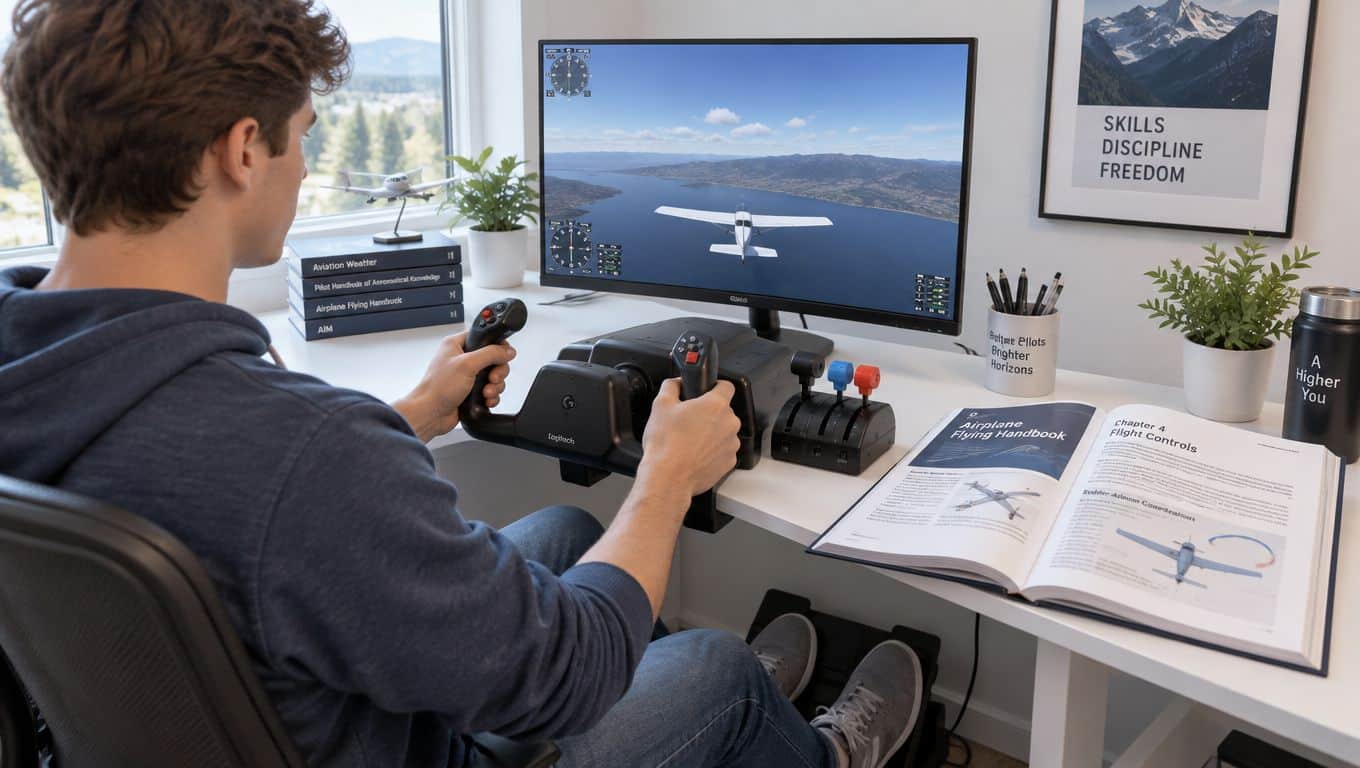
Chair-flying then adds mental sequencing. In a quiet room, rehearse a left 45-degree turn to a selected heading. Say the intended bank, rudder direction, attitude check, heading trend, rollout timing, and post-rollout correction aloud. Mental rehearsal paired with physical practice was among the more effective task-oriented approaches identified in the systematic review cited earlier.
In the airplane, slow flight exposes rough control harmony quickly. At a safe altitude and under instructor supervision, the pilot uses small power, pitch, and rudder changes while watching whether altitude and airspeed remain under control. Large reversals show that the pilot is reacting late or using too much force.
Practical standard: A correction should solve one error without creating a larger one elsewhere. If altitude improves but the ball swings hard, the control input wasn't coordinated.
Under the hood, a partial-panel exercise can narrow the scan and increase workload, but it must be conducted with an instructor and appropriate aircraft procedures. The pilot practices maintaining attitude, heading, and coordination with limited information, rather than staring continuously at a single instrument. A simulator can provide repeatable practice before that workload is introduced in the aircraft, and the DuBois Aviation simulator training center is one way to structure that practice.
Pilots can also borrow the idea of timing, spacing, and movement sequencing from drills for high press coordination, while keeping the application aviation-specific. The useful connection is not the sport itself. It is the demand to observe a changing situation, select a response, and execute it without losing the larger pattern.
Building a Weekly Practice Schedule That Works
A workable schedule needs enough repetition to preserve timing, but it also needs rest. Fatigue makes pilots late on corrections, impatient with the scan, and more likely to over-control.
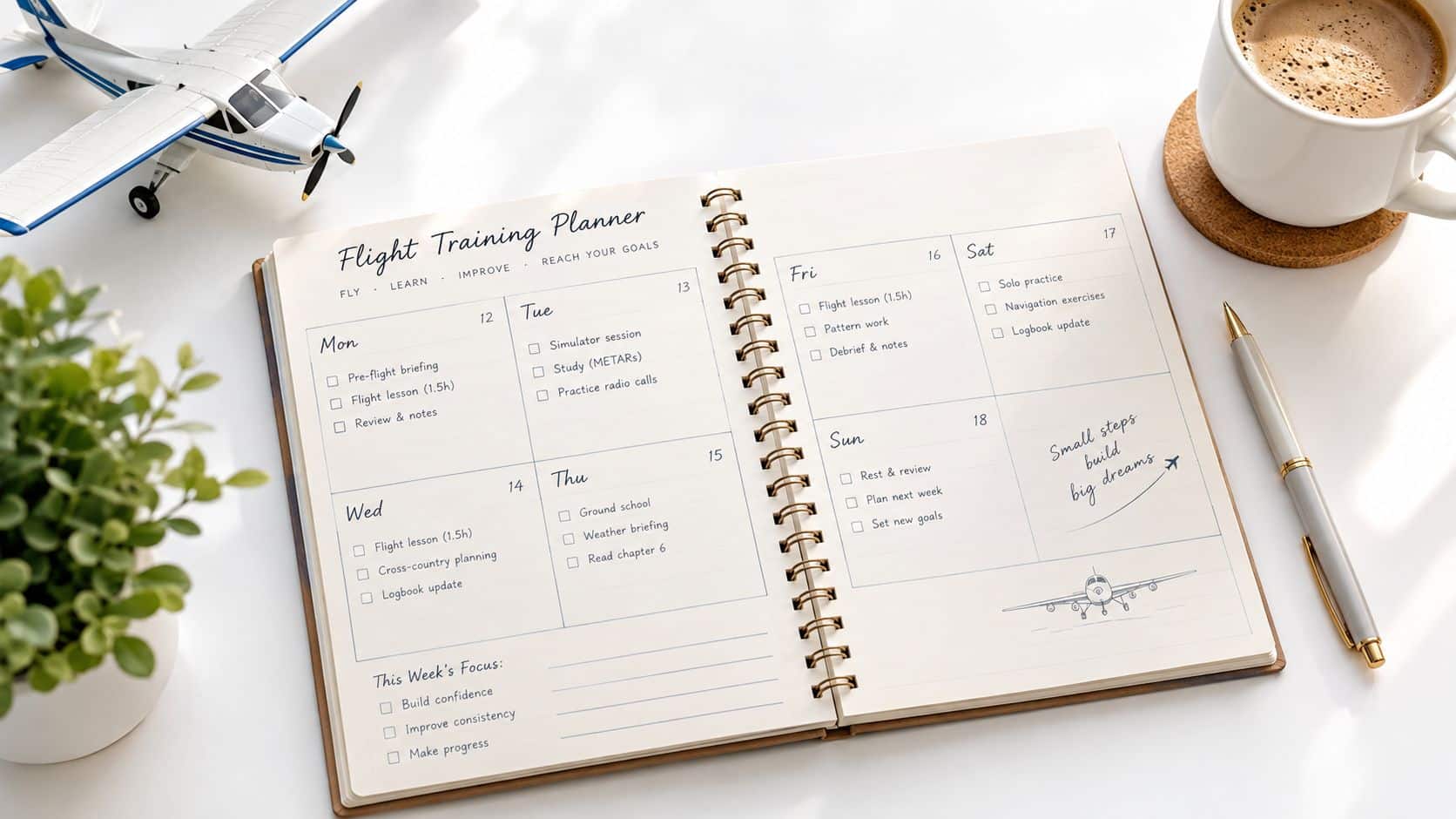
A practical planning assumption is 90 minutes of focused practice three to four times per week, divided approximately 60/40 between aircraft and home simulator or chair-flying. That allocation is a recommendation for organizing practice, not an FAA requirement. Aircraft time should be reserved for tasks that require real control feel, traffic awareness, and instructor observation.
A repeatable four-week block
| Week | Primary aircraft focus | Ground or simulator focus | Review target |
|---|---|---|---|
| First | Rudder and aileron timing in basic turns | Chair-flying and visual scan | Identify whether the first error is roll, yaw, or pitch |
| Second | Slow flight and coordinated roll-ins and rollouts | Instrument cross-check | Record the time needed to stabilize after a bank entry |
| Third | Steep turns, traffic-pattern workload, and configuration changes | Task-loaded simulator scenarios | Maintain the scan while handling radio and traffic prompts |
| Fourth | Instructor review and maneuver integration | Logbook review and targeted rehearsal | Select one weak domain for the next block |
The first session should front-load rudder-aileron timing. The second should emphasize the instrument cross-check. The third should combine aircraft control with radio, traffic, and configuration tasks. The fourth should be a debrief and instructor review rather than another unstructured repetition session.
Renters without regular CFI access can replace one practice session with a tablet-based simulator and another with a safety-focused flight accompanied by an instructor or an approved safety program. The aircraft should not be used to test an unfamiliar drill without an appropriate briefing, clear weather and traffic considerations, and a plan for returning to normal flight.
Rest days have a purpose. They give the pilot time to review notes, visualize the sequence, and return to the airplane without fatigue-driven slips. If performance deteriorates late in a session, the useful response may be to stop, debrief, and reschedule rather than force more repetitions.
Measuring Progress Without Guesswork
Coordination should be logged as performance, not mood. A pilot may feel smoother because the exercise is familiar, while still allowing the ball to move during every turn entry. The instructor's job is to turn that impression into observable behavior.
Three measurement layers are useful:
- Aircraft indication: Track whether the ball stays centered during a maneuver and whether the pilot recognizes a developing slip or skid without waiting for a large deviation.
- Control smoothness: Note whether the pilot uses one deliberate correction or several visible reversals to reach the target bank, heading, altitude, or airspeed.
- Task loading: Observe whether the pilot can preserve aircraft control while scanning, communicating, configuring, and maintaining awareness of the runway environment.
The FAA identifies failure to apply coordinated aileron and rudder pressure as a specific training error that results in slips or skids. That makes coordination a detectable control-input issue, not a vague impression. The FAA handbook material on flight maneuvers also reinforces the need to sense uncoordinated flight without relying only on instruments.
Useful flight-by-flight entries
A simple spreadsheet or logbook note can record:
- Time to stabilize after a 30-degree bank entry
- Whether the ball moved left, right, or stayed centered
- Number of noticeable control reversals
- Number of scan cycles completed during a short exercise
- Instructor scores for coordination, altitude, heading, airspeed, and workload
- The task that broke down first when the pilot became busy
The table below uses qualitative targets because aircraft type, maneuver, conditions, and the applicable practical-test standard can change the correct tolerance. An instructor should set aircraft-specific standards rather than treating these descriptions as universal regulatory limits.
| Skill | Beginner target | Checkride-ready target |
|---|---|---|
| Turn entry | Recognizes yaw and corrects with instructor prompting | Anticipates rudder and keeps the turn balanced |
| Visual reference | Returns attention to the outside picture after instrument checks | Maintains the selected ground or runway reference with small corrections |
| Cross-check | Moves between attitude, heading, altitude, and turn information | Uses a consistent scan without fixation |
| Task loading | Protects aircraft control when one task is added | Maintains control while handling communications, traffic, and configuration |
| Debrief accuracy | Can describe that the turn felt unstable | Can identify the first incorrect input and propose a specific correction |
Progress should be reviewed across four to six lessons, not judged from one flight. Pilots can use DuBois Aviation student progress tracking to keep instructor feedback tied to repeatable benchmarks and the next training objective.
Common Setbacks and How to Correct Them
The most stubborn coordination problems usually come from reasonable instincts applied at the wrong time. A pilot sees the ball move, reacts immediately, and then creates another error before the first correction has taken effect.
Over-controlling the ball
The first trap is chasing the ball with rudder and aileron at the same time. The pilot sees a displacement, adds one pedal, sees the bank change, adds aileron, and begins a skidding oscillation.
The correction is to identify the primary error before adding more control. If excessive bank is driving the problem, reduce or neutralize the aileron first, allow the airplane to respond, and then add measured rudder in the correct direction. The aircraft may not look perfect for an instant, but a stable correction is safer and easier to learn than rapid reversals.
Fixating on the turn coordinator
A pilot who stares at the ball loses the outside scan, attitude picture, traffic awareness, and runway relationship. The instrument becomes the task instead of the information source.
Use a metronome-based cross-check. The pilot can return to the coordination indication every three to five seconds during a visual exercise, while continuously maintaining the larger outside picture. That interval is a training suggestion, not a regulatory requirement, and it should change with workload and aircraft phase of flight.
Rushing the scan under workload
The third trap appears when a pilot tries to handle radio, traffic, configuration, and alignment without first slowing the airplane's workload. The scan compresses, errors compound, and the pilot starts making hurried control inputs.
The correction is to stabilize first with appropriate power and trim, then rebuild the scan in a deliberate order. Aircraft control takes priority. A useful debrief method is to write down the first task that was dropped, then design the next exercise around that specific failure rather than adding more unrelated tasks.
A structured review process can help instructors and students discuss workload, communication, and follow-through. For readers exploring general team accountability concepts, what is an employee engagement platform offers a separate organizational perspective, but it shouldn't replace aviation-specific instruction, aircraft procedures, or a CFI's evaluation.
Bringing It Together for Checkrides and Real Flying
Coordination isn't a separate workout that ends when the drill is complete. It is the connective tissue in climbs, descents, turns, stalls, takeoffs, landings, and instrument procedures. The FAA's language makes that clear: failure to use aileron and rudder in the proper relationship produces slips or skids, and those errors can appear anywhere the airplane changes attitude or direction.
During a soft-field takeoff, the pilot must manage pitch, power, directional control, runway alignment, and the transition to flight without letting the nose swing. In a steep turn, the pilot must coordinate bank, rudder, pitch, and power while maintaining the required reference. In a chandelle, changing pitch and bank make timing especially important. A coordination failure may first appear as a displaced ball, but the consequence can spread into altitude, airspeed, heading, and maneuver geometry.
Map practice to the practical test
The weekly plan should connect directly to these tasks:
- Rudder and aileron timing: Apply the foundational drill during normal turns, climbs, descents, and the entry and rollout of steep turns.
- Cross-check work: Use attitude, heading, altitude, and coordination information during instrument exercises, then confirm the same control discipline visually.
- Task loading: Add radio calls, traffic scanning, and configuration changes during pattern work only after basic aircraft control is stable.
- Instructor review: Compare the logbook entries with the applicable Airman Certification Standards and the instructor's observed performance.
The 2016 systematic review cited earlier found that task-oriented training and mental rehearsal plus physical practice were more effective than generic exercises. Aviation training follows the same logic. A pilot doesn't become checkride-ready by accumulating random repetitions. The pilot becomes checkride-ready by repeating the exact control relationships that the maneuver requires, under progressively more realistic workload.
For working pilots and renters, coordination is also a form of safety currency. Skills that aren't used deliberately can become less reliable, especially during approach and landing when alignment, yaw control, airspeed, configuration, and attention converge. A short, focused review of coordinated turns can expose a developing habit before it appears during a demanding arrival.
A practical next action is to book a focused 60-minute coordination-only lesson with a CFI. The pilot can fly one coordinated-turn circuit per flight hour, log the time needed to stabilize after each bank entry, and retake the self-test from the measurement section every 30 days to check retention. Those are training recommendations, not FAA mandates, but they create a specific way to determine whether coordination is improving or merely feeling familiar.
DuBois Aviation provides one-on-one airplane and helicopter instruction, simulator-supported training, aircraft rental, and instructor guidance across private, instrument, commercial, and multi-engine paths at Chino Airport. Pilots can discuss a coordination-focused checkout, course availability, or a training plan by visiting DuBois Aviation and requesting information suited to their aircraft and certificate goal.
Frequently asked questions
Can coordination skills be learned, or are they natural?
They can be learned. The evidence reviewed in the coordination literature favors structured, task-specific practice over generic exercise, and flight coordination is a series of observable control relationships. A student may start with poor timing and still build reliable habits through deliberate repetition and feedback.
What does a slip feel like compared with a skid?
In a slip, the airplane is yawed toward the outside of the turn and the pilot feels pushed toward the inside. In a skid, the airplane is yawed toward the inside and the pilot feels pushed toward the outside. The ball and the outside picture should be interpreted together, not in isolation.
Should a pilot stare at the ball during turns?
No. The ball is an important coordination reference, but continuous fixation damages the broader scan. The pilot should keep the outside picture and aircraft attitude primary, returning to the coordination indication as part of a predictable cross-check.
Can a home simulator replace aircraft practice?
No. A simulator or chair-flying session can rehearse timing, scanning, and workload sequencing, but it can't fully reproduce aircraft control feel, real traffic, radio conditions, or the consequences of poor energy management. Aircraft practice with an instructor remains necessary for flight-specific evaluation.
How often should a pilot practice coordination?
The schedule should match the pilot's training stage, aircraft access, fatigue level, and instructor guidance. A practical plan can use focused sessions several times per week, with aircraft time reserved for control feel and real workload, and simulator or chair-flying time used for rehearsal and scan discipline.
What should a pilot do after repeated skids in the pattern?
Stop trying to fix the symptom with larger inputs. Review whether the pilot is entering the turn with the correct rudder timing, whether the scan is fixated, and whether workload is too high. A focused lesson with a CFI can isolate the first incorrect input and connect the correction to the applicable maneuver standard.


