
You already have your private pilot certificate. You've started thinking about weekend trips, family flights, maybe even business travel that doesn't depend on the airlines. Then a low marine layer settles in, the horizon disappears, and your “easy morning departure” turns into a cancellation.
That moment is where a lot of pilots first get serious about instrument training.
I've watched it happen over and over at busy airports. A pilot is capable, current, motivated, and still stuck on the ground because VFR has hard limits. The instrument rating changes that. More specifically, instrument rating ground school is where that change starts. Before you can fly a clean approach through the clouds or copy a fast clearance without getting behind the airplane, you need the knowledge framework that makes IFR flying make sense.
Two practical options worth comparing
These are specific products pilots commonly compare for this type of flying. Confirm compatibility with your aircraft and instructor before ordering.
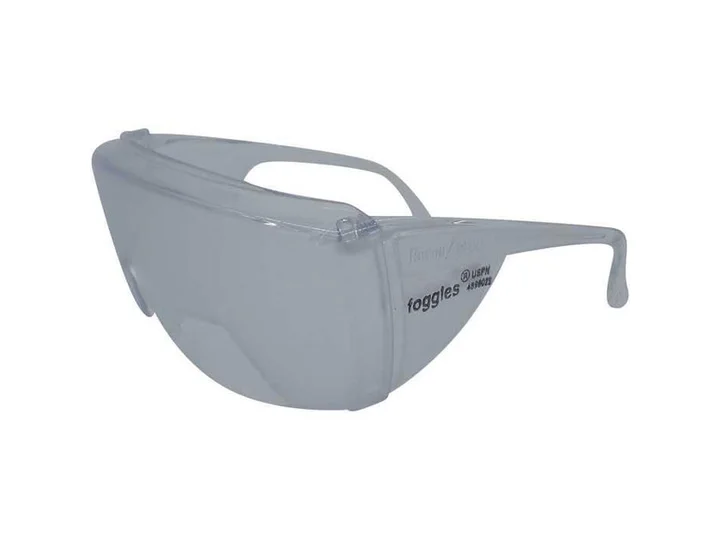 Instrument trainingFoggles Aviation IFR Training GlassesCheck current availability on Amazon (paid link)
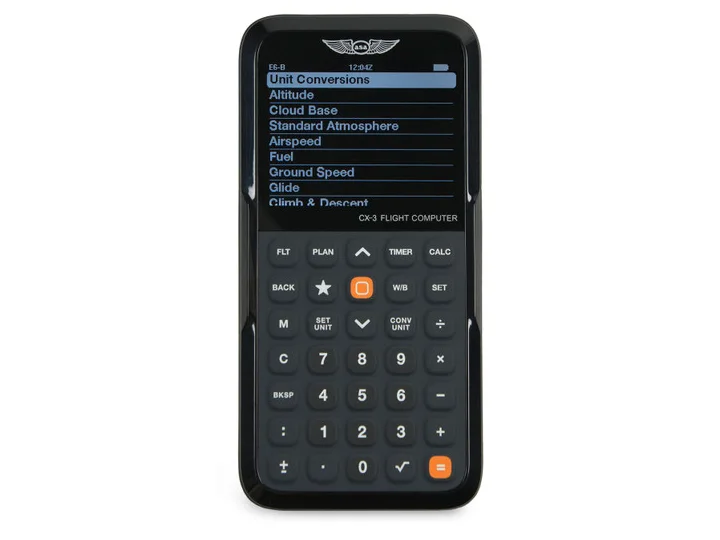 Flight planningASA CX-3 Flight ComputerCheck current availability on Amazon (paid link)
Ground school isn't a side task. It's the part that teaches you how to think like an IFR pilot.
From VFR Limits to IFR Freedom
You launch from Chino on a morning that looked manageable from the parking lot. By the time you are ready to taxi, the basin is covered by a low layer, traffic is stacking up, and the route you planned under VFR is no longer a good option. At a busy airport like KCNO, that kind of day makes the difference between a pilot who can continue safely and a pilot who has to wait it out.
That is why many private pilots start instrument training. The rating does not remove weather from the equation. It gives you a different set of tools for working within the weather, the airspace system, and ATC procedures.
What IFR really changes
Instrument Flight Rules let you operate with structure when outside visual references are limited. Instead of building the flight around what you can see out the windshield, you build it around procedures, instrument indications, clearance limits, and constant situational awareness. The shift is practical, not abstract. You are learning how to depart through a layer, stay ahead of a reroute, brief an approach correctly, and know what comes next before ATC says it.
The FAA also sets clear training requirements for the rating. Under 14 CFR § 61.65 in the FAA's Electronic Code of Federal Regulations, you need instrument time, instructor time, and a qualifying instrument cross-country before you can earn the certificate. That should tell you something important. IFR proficiency is built through both study and repetition.
The rating is also common among active U.S. pilots. The FAA tracks certificate and rating totals in its U.S. Civil Airmen Statistics, which is the primary source behind many summaries you may see elsewhere. More important than the percentage is what the rating represents in day-to-day flying. It turns more trips from "maybe" into "possible, if the weather and the plan support it."
Why ground school comes first
New instrument students often expect the hardest part to be holding altitude by reference to the gauges. That skill matters, but the greatest load comes from putting several tasks together without falling behind.
Ground school gives you the operating manual for the IFR system.
You learn how to read weather as a decision-making tool, not a trivia subject. A METAR stops being a coded report to decode and starts acting like a quick snapshot. A TAF becomes a forecast you can compare against your departure time, alternate planning, and fuel strategy. At KCNO, where traffic flow, nearby terrain, and SoCal weather patterns can change the day fast, that matters.
You also learn the language and rhythm of ATC. A clearance works like a route card handed to you before the play starts. If you understand each part of it, clearance limit, route, altitude, departure frequency, transponder code, the radio feels organized. If you do not, the same transmission sounds too fast and too dense.
Then there are approaches. An ILS, a VOR approach, and an RNAV approach can all get you to the runway environment, but they do not ask the same things from the pilot. Ground school teaches you how to brief each one, where the traps are, and why missed approach instructions deserve the same attention as the final segment.
That preparation pays off long after the checkride. Staying sharp under IFR depends on keeping both your knowledge and your recent experience current, which is why many pilots review the instrument currency requirements for legal and safe IFR flying as they train.
At a place like KCNO, good IFR ground training shows up in small moments. You copy a clearance correctly the first time. You know why ATC assigned that route. You brief the approach before the workload peaks. That is how ground school turns textbook knowledge into real flying freedom.
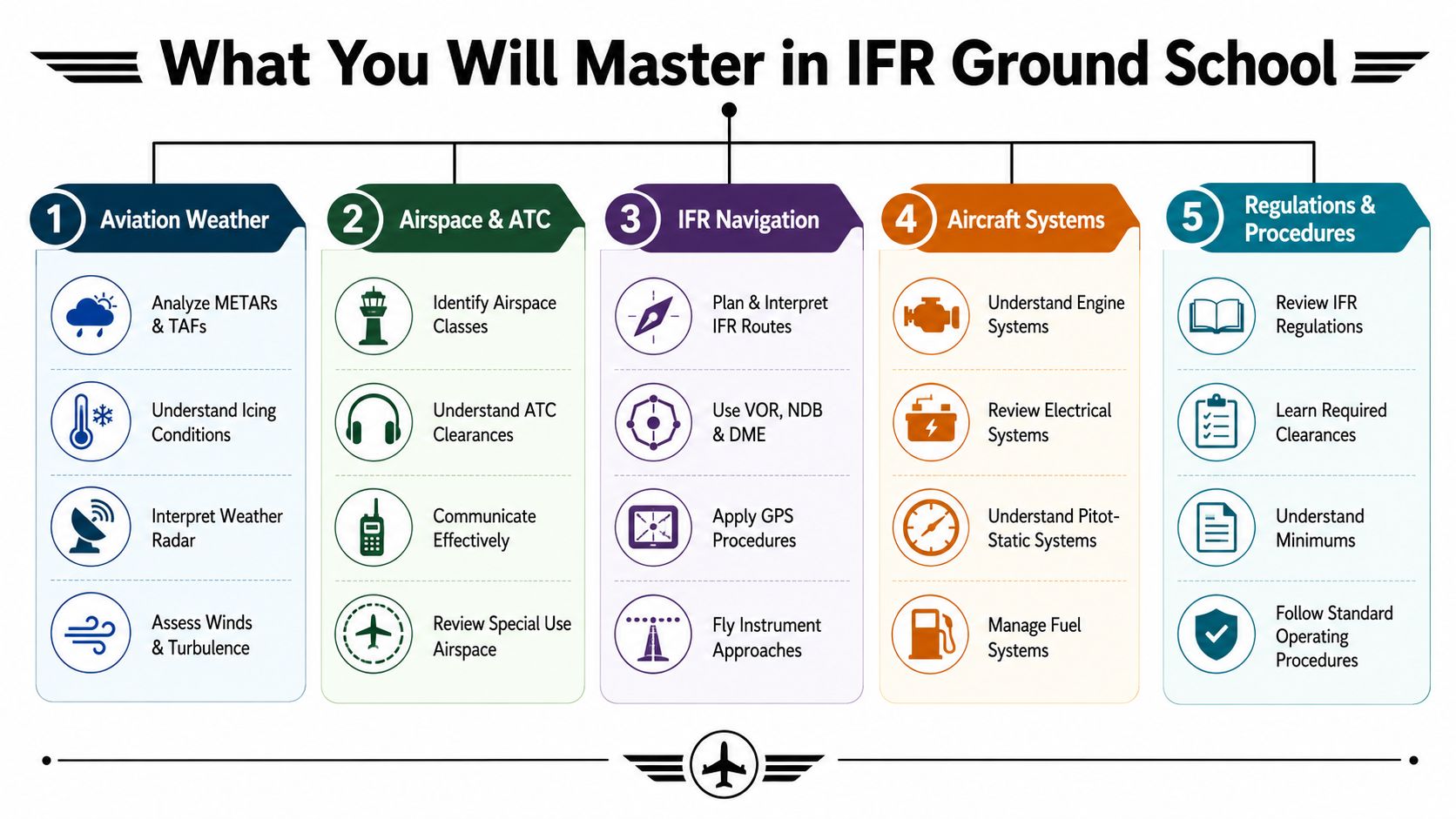
What You Will Master in IFR Ground School
IFR ground school works best when you stop thinking of it as a pile of test questions and start seeing it as a connected system. The usual curriculum, often organized around a Jeppesen-style Part 141 structure, breaks the subject into core lessons like human factors, instrument navigation, FARs, and ATC procedures. One source reports that students who complete a 40-hour syllabus show a 95% first-attempt pass rate on the FAA written exam, compared with 65% for students with abbreviated training in Gleim's overview of Jeppesen syllabus integration.
Attitude instrument flying and human factors
Students learn one of the hardest lessons in aviation. Your body can lie to you.
In VFR flying, your eyes outside usually confirm what the airplane is doing. In IFR, especially in cloud, your senses can disagree with the instruments. Ground school teaches you why that happens and how to trust a disciplined scan instead of instinct.
A student might say, “It felt like the airplane was banking left.” Then we look at the panel and the airplane was level. That disconnect is not rare. It's central to instrument training.
Key ideas here include:
- Instrument scan: How to move your eyes in a consistent pattern instead of staring at one gauge
- Control and performance: How pitch, power, and trim work together
- Spatial disorientation: Why sensations in cloud can be misleading
Navigation and approaches
At this point, the material starts feeling practical.
You learn how to move through the IFR system using nav aids and avionics, then how to arrive at an airport on a published procedure. In plain terms, you're learning the highways, exits, and lane markings of instrument flying.
Students usually need time to sort out the differences between:
- VOR navigation: Older but still useful for understanding raw data and course tracking
- GPS and RNAV procedures: Common, efficient, and often the backbone of modern IFR operations
- Localizer-based approaches: Precise lateral guidance and high standards for tracking accuracy
Approaches can look overwhelming at first because the plates are dense. But they become manageable when you know how to break them apart: frequencies, courses, altitudes, fixes, minimums, and missed approach instructions.
Practical rule: Never study an approach plate as one big page. Read it in layers, from setup, to initial segment, to final approach, to missed approach.
If you later want to keep those skills current after the rating, it helps to review real-world expectations for IFR currency requirements.
Regulations, weather, and ATC language
A lot of students underestimate these subjects because they don't sound as dramatic as flying an approach. They shouldn't.
Regulations matter because IFR flying is procedural. You need to know what's required, what's allowed, and what's smart.
Weather matters because IFR isn't just “cloud flying.” It's decision-making in a system shaped by ceilings, visibility, icing, convective activity, and forecast trends.
ATC communication matters because instrument pilots live on the radio. A clearance that sounds fast and complicated gets much easier once you know its structure.
Here's how these pieces fit together in day-to-day flying:
| Ground school topic | What it helps you do in the airplane |
|---|---|
| Weather analysis | Decide whether the trip is reasonable and what to expect en route |
| FAR Part 91 and 61 knowledge | Stay legal and avoid bad assumptions |
| Clearance reading | Copy route, altitude, and departure instructions accurately |
| Chart interpretation | Transition from cruise to approach without confusion |
| Emergency procedures | Stay organized when a system or plan breaks down |
The student who succeeds in instrument rating ground school doesn't memorize random facts. They learn how each topic supports the next one.
Choosing Your Ground School Training Format
Students usually choose among three paths. They attend an in-person class, enroll in an online course, or build a self-study plan around books, videos, and test prep. None of those is automatically right for everyone.
The better question is this: what kind of learner are you when the subject gets dense, procedural, and time-sensitive?
Side-by-side comparison
| Feature | In-Person (e.g., DuBois) | Online Course | Self-Study |
|---|---|---|---|
| Schedule | Fixed sessions and routine | Flexible and self-paced | Fully flexible |
| Instructor access | Immediate questions and live discussion | Often delayed or limited | Depends on whether you add outside help |
| Accountability | High | Moderate | Low unless you're very disciplined |
| Learning style fit | Strong for students who learn by interaction | Strong for independent learners | Strong for highly organized readers |
| Real-time clarification | Easy | Varies by platform | You have to find answers yourself |
| Connection to flight lessons | Usually tight | Can be good if paired with a CFII | Often uneven |
What each format feels like in practice
In-person ground school works well for students who want structure. If an instructor explains holds on a whiteboard, answers questions on the spot, and then ties that lesson directly to your next flight, the material tends to stick faster.
Online ground school gives you control of pace. That's useful if you work irregular hours or want to repeat a lesson several times. The catch is that flexible pacing can turn into slow drift if you don't set deadlines.
Self-study can work, but only if you already know how to build a study system and follow it. IFR material isn't impossible alone. It's just easier to misunderstand subtle topics when no instructor is there to catch the error.
A practical way to decide
Pick the format that best answers these questions:
- Do you need external structure? If yes, in-person usually helps.
- Do you learn best by replaying lessons? If yes, online may fit.
- Can you spot your own weak areas early? If not, pure self-study can be risky.
- Will your flight training and ground training stay coordinated? That alignment matters more than most students expect.
The most efficient path is usually the one you'll actually complete on schedule, not the one that looked cheapest at the start.
At a busy airport, I've seen students with expensive materials still struggle because they studied in isolation and never practiced applying the knowledge to real clearances, real charts, and real cockpit workload.
The DuBois Advantage Real-World IFR Training at KCNO
You are on an IFR clearance at KCNO. Ground control is moving quickly, another aircraft is calling ready, and you are trying to copy a route, altitude, and departure instructions without falling behind. A student who only knows the textbook version of IFR often gets overloaded at this point. A student who has trained in that environment starts to recognize the rhythm.
KCNO matters because it turns ground school knowledge into something you can use under pressure. At a busy towered airport, clearances are not abstract examples on a page. They are part of taxi, departure flow, frequency changes, vectors, and arrivals that happen in real time.
Why a busy towered airport helps
IFR ground school teaches the language and logic of the system. Training at KCNO helps you hear that language at normal speed and use it while managing the airplane. That combination is what many new instrument students need.
At KCNO, students regularly practice:
- Copying and reading back clearances clearly
- Changing frequencies without losing the bigger picture
- Managing taxi, run-up, departure, and arrival flow at a towered field
- Understanding how IFR and VFR traffic share the same airport environment
That last point is easy to underestimate. In the classroom, a clearance limit or vector to final can feel like a memorization item. At a place like KCNO, those instructions connect to a moving airport system, much like learning road signs makes more sense once you start driving in city traffic instead of an empty parking lot.
Simulator work builds procedure before workload stacks up
A simulator gives you repetition that is hard to match in the airplane. You can pause, reset, and try the same sequence again while the lesson is still fresh.
That is especially useful for tasks that tend to snowball when a student gets behind, such as:
- unusual attitude recovery
- missed approach transitions
- holds
- approach sequencing
- system failures and abnormal procedures
The simulator works like a practice field before game day. You build the scan, callout flow, and decision sequence first. Then, when you hear the same kind of clearance in the airplane at KCNO, your brain has already seen the pattern.
Students preparing for the knowledge test sometimes also benefit from study methods outside aviation specific materials. Resources such as Vivora for test success can help with recall, pacing, and study habits, especially if written-test anxiety is slowing progress.
The airport environment shapes how you think
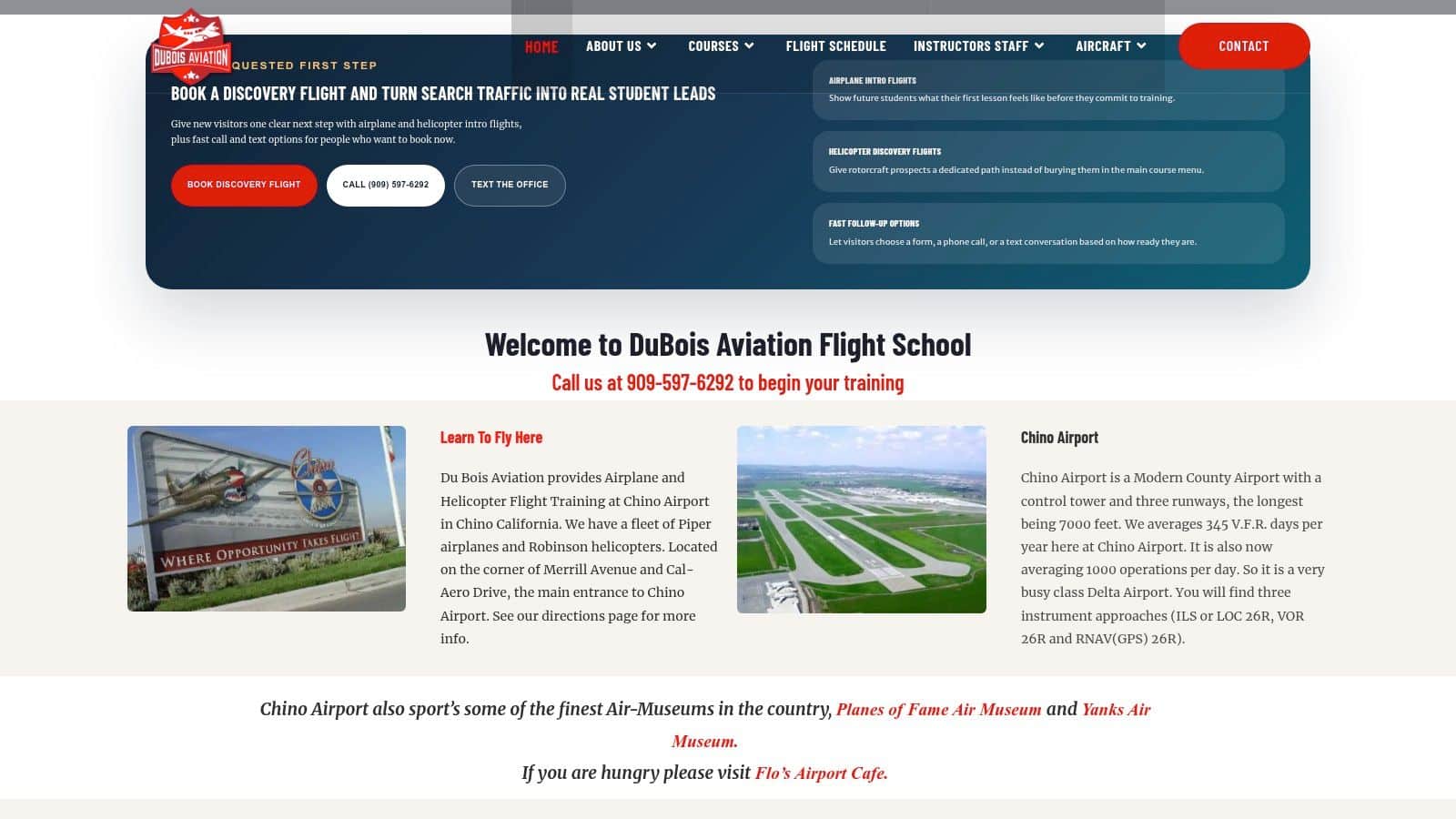
One option students can consider is DuBois Aviation, a flight school at Chino Airport that provides instrument training with Jeppesen-based materials, one-on-one instruction, aircraft rental, and simulator access in a busy Class D environment. That matters less as a brand point and more as a training setup. If your instructor teaches a clearance in ground school and you hear a similar one on frequency that week, the lesson tends to stick.
This is the true benefit of training in an active airport environment. You stop treating IFR as a set of separate topics, and start seeing it as one connected workflow. Weather, charts, radio phraseology, procedures, and cockpit management all meet in the same place, which is exactly what happens on an actual instrument flight.
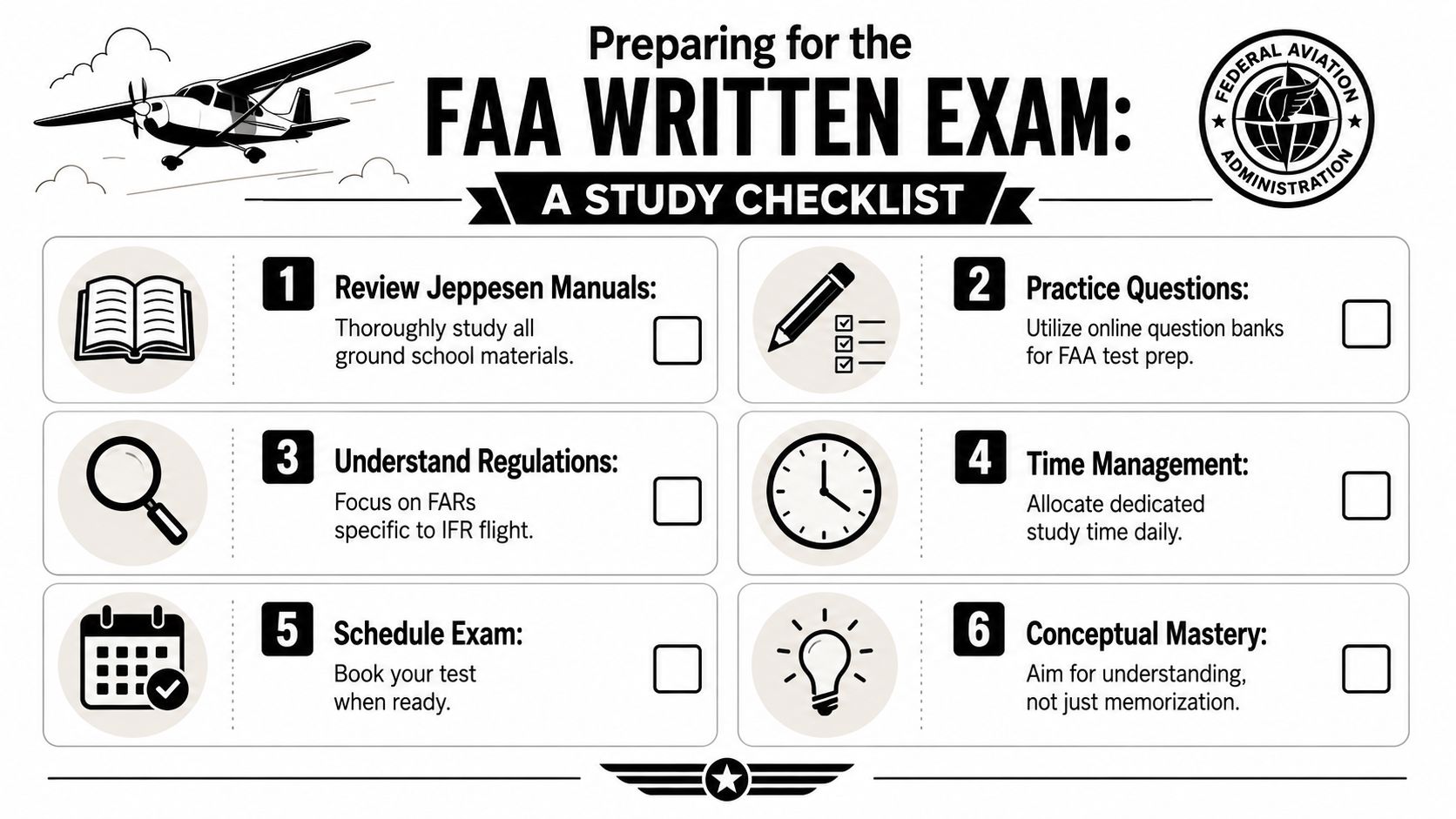
Preparing for the FAA Written Exam A Study Checklist
The FAA Instrument Airplane knowledge test is straightforward in format and demanding in content. It has 60 multiple-choice questions, and you need a 70% passing score according to the FAA test guide information. That sounds manageable until you realize the questions draw from regulations, systems, weather, navigation, and procedures that all overlap.
The students who do well don't just grind through question banks. They build understanding first, then use practice tests to sharpen recall and speed.
A study routine that works
Start with your core materials. If your course uses Jeppesen texts, stay with them. If you're using prep tools like Sporty's or Gleim, use them to reinforce the same concepts rather than bouncing randomly between unrelated explanations.
A strong routine usually looks like this:
- Read for understanding first. Don't open with quiz mode on day one.
- Study by topic blocks. Weather with weather. Regulations with regulations.
- Take short practice sets. Use missed questions to diagnose confusion.
- Review with a CFII. Some topics sound easy until you have to explain them out loud.
- Return to weak areas. Don't keep retesting only your strengths.
Where students usually get stuck
The written exam often exposes the same trouble spots:
- FAR Part 91 and 61 details: Students confuse what's legal, what's current, and what's recommended.
- Weather products: It's easy to memorize abbreviations without grasping operational meaning.
- Approach chart interpretation: Students know the symbols but miss the sequence.
- Holding entries: These can become mechanical and fragile if not understood conceptually.
If you want help building a more disciplined test-prep routine, this guide on Vivora for test success offers useful study habits that transfer well to aviation exams, especially around review cycles and avoiding pure memorization.
Don't aim to “beat the question bank.” Aim to recognize why the right answer is right.
Written exam checklist
Use this before you schedule the test:
- Ground school complete: Finish the full curriculum rather than sampling parts of it.
- Question bank reviewed: Work enough practice questions to see patterns in your mistakes.
- Charts and figures familiar: Don't let the supplement pages slow you down.
- Regulations organized: Keep a simple summary page for common IFR rules.
- Instructor sign-off ready: Make sure you've met the endorsement requirement.
- Test timing practiced: Do at least a few full-length practice runs under realistic conditions.
The written matters on its own, but it also previews the oral exam. When you study for understanding now, you're reducing future stress, not adding extra work.
Budgeting and Scheduling Your Instrument Rating
Every student asks the same two questions early. How much is this going to cost, and how long is it going to take?
Those are fair questions, and the honest answer is that your pace matters almost as much as your school or airplane choice. One independent source estimates the total cost of an instrument rating at about $7,000 to $9,000, with a training timeline that can range from about 2 months for a dedicated student to over a year for someone with limited availability in this instrument rating ground school guide.
What affects the final cost
The published range gives you a planning baseline, but individual outcomes vary based on how you train.
Main cost drivers include:
- Training frequency: Long gaps between lessons often lead to review time
- Aircraft and simulator mix: Efficient use of simulator sessions can help with procedural practice
- Ground preparation quality: Students who arrive prepared use flight time better
- Instructor continuity: Working with the same instructor often reduces repeated reteaching
A student who flies consistently, studies before each lesson, and shows up ready for briefings usually spends money more efficiently than the student who relearns the same material every other week.
Scheduling matters more than most students think
Instrument training rewards rhythm. If too much time passes between lessons, your scan softens, radio confidence drops, and procedures stop feeling automatic.
That's why I tell students to build a calendar before they start, not after they get excited. If your work schedule is packed, use tools and habits that help you protect study blocks and flight slots. This article on how to improve your scheduling and calendar is useful for turning good intentions into a realistic routine.
If financing is part of your planning, review options such as financial aid for pilot training.
Consistency beats intensity. Two well-prepared lessons each week usually move a student farther than one rushed lesson followed by a long gap.
The cheapest month in instrument training is often the month where you stayed organized.
How to Buy an Airplane the Safe Way
Many instrument students reach a point where the question changes. It is no longer just, “How do I earn the rating?” It becomes, “If I buy an airplane for this kind of flying, what should I look for?”
That question belongs here only if we keep it tied to instrument training and real IFR use.
At a busy airport like KCNO, an airplane can look perfect on the ramp and still be a poor choice for instrument work. A polished panel does not tell you whether the pitot-static system is current, whether the radios behave consistently, or whether deferred maintenance will interrupt training right when you are starting to build rhythm. IFR flying asks more of the airplane than a fair-weather local flight. Ground school gives you the knowledge to see that difference before you sign anything.
A safe purchase starts with mission fit. If your goal is instrument training, recurrent practice, and occasional cross-country flying, judge the airplane by that mission. Ask whether the panel supports common IFR tasks without creating extra workload in busy airspace. Can you load and brief an approach without hunting through menus? Is the navigation setup something you can learn, use, and maintain proficiency in?
Then verify the airplane itself, not just the equipment list.
- Pre-buy inspection: Use an A&P mechanic who knows the make and model. For IFR use, have them pay close attention to avionics condition, antenna installations, pitot-static components, vacuum or backup systems if installed, and any signs that the airplane has been sitting without regular use.
- Logbooks and maintenance history: Look for complete entries, recurring squawks, overdue inspections, and signs that repairs were delayed instead of addressed.
- IFR legality and practicality: An airplane may be legal on paper yet still be frustrating to train in. Old radios, intermittent autopilot behavior, poor lighting, or hard-to-read instruments can add workload fast.
- Downtime risk: If a navigator or display fails, can your local shop support it, or will the airplane sit for weeks waiting on parts and scheduling?
Students often shop for the screen they want instead of the airplane they need. IFR ownership works more like buying a tool for daily use than buying a toy for occasional fun. Reliability, documentation, and support matter more than a flashy first impression.
Ground school helps here in a very practical way. Once you understand approach requirements, alternates, weather decisions, and avionics workflow, you start asking better questions as a buyer. You stop saying, “This panel looks modern,” and start saying, “Will this setup let me brief, load, and fly approaches cleanly in actual conditions?”
If you already own an airplane, the same thinking applies before instrument training begins. Make sure the aircraft fits the kind of IFR practice you plan to do, and get any weak spots identified early. If you are returning to instrument flying after time away, a structured review such as an instrument proficiency check for rusty IFR pilots can also reveal whether the airplane and the pilot are both ready for real-world use.
Buying safely means slowing the process down, asking training-based questions, and treating the airplane as part of your IFR system rather than a separate purchase.
Instrument Rating Ground School FAQs
Part 61 or Part 141
Part 61 usually gives you more flexibility. That works well if you have an irregular schedule or want a training plan that adapts around work and family.
Part 141 is more structured. Some students do better with a set syllabus, lesson sequence, and tighter checkpoints. The better option depends less on prestige and more on how you learn.
Do I need to finish ground school before I fly
Not always, but you should stay ahead of the airplane academically. If your flight lessons outpace your understanding of charts, weather, and procedures, training gets expensive fast.
The best rhythm is overlap. Study the topic, brief it with your instructor, then go fly it.
Can simulator time help
Yes. Simulator sessions are useful for procedures, radio flow, holds, approach sequencing, and abnormal situations. They also let you stop, repeat, and debrief without the pressure of managing the full airplane environment.
That doesn't replace aircraft time. It makes some aircraft time more productive.
What if I already have the rating but feel rusty
That's common. Legal currency and real confidence aren't always the same thing. If you haven't flown instruments in a while, a structured review with an instructor is usually the right move before you put yourself in demanding weather or busy airspace.
If you need a formal path back to readiness, review what's involved in an instrument proficiency check.
Is financing or veteran funding available
This depends on the school, the program structure, and your individual eligibility. Ask early, not after you've already built a training timeline around assumptions.
Bring specific questions. Ask what applies to ground school, flight training, testing, and any required materials.
If you're ready to turn weather-related cancellations into real IFR capability, DuBois Aviation is one place to explore instrument training, simulator practice, and next-step guidance for pilots training at Chino Airport.