
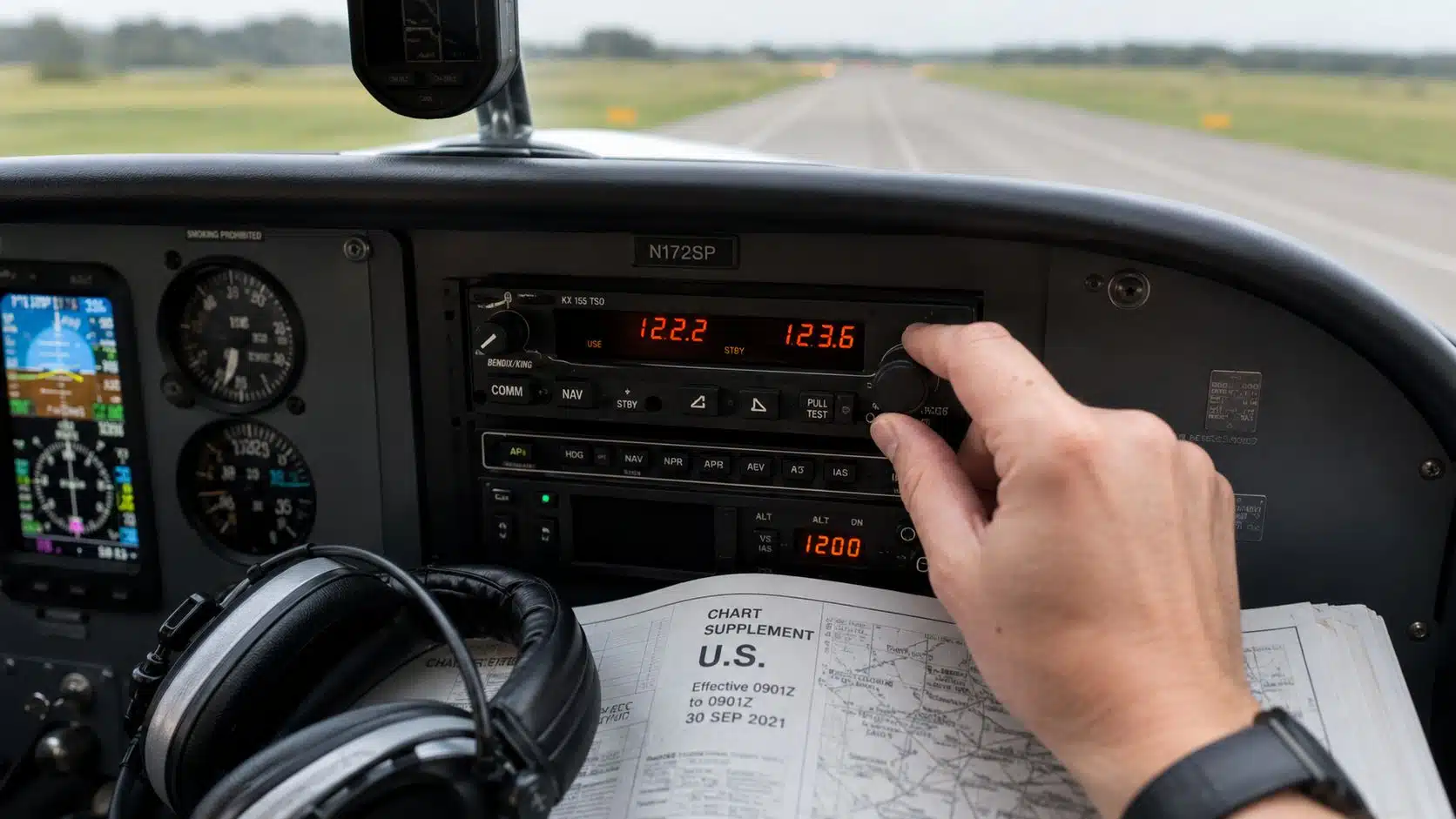
You're sitting in the runup area at Chino, the engine's stable, and the radio stack is already busy enough that one sloppy switch will snowball the whole flight. The student beside you is trying to sort out ATIS, tower, and the next frequency out of habit, while another airplane is calling base on CTAF and a controller is already moving traffic across the pattern. That's where flight service frequencies stop being a memorization exercise and become a cockpit skill that keeps the whole day from turning into radio churn.
Table of Contents
- Why Flight Service Frequencies Matter in Real Cockpits
- The Core Frequency Categories Every Pilot Recognizes
- Beyond 122.2 MHz The Regional Outlet Reality
- Tools to Look Up Local Frequencies Quickly
- Chino KCNO Frequencies in Practice
- Phraseology and Example Scripts That Actually Work
- Filing and Closing Flight Plans with Flight Service
- Frequency Discipline and the Minimum-Frequency Principle
- Quick-Reference Matrix of Common Frequencies
- Three Frequency Myths Worth Retiring
- Best Practices for Every Phase of Flight
Why Flight Service Frequencies Matter in Real Cockpits
A sloppy radio moment at Chino rarely starts with a dramatic mistake. It usually starts with a student who tunes the wrong frequency, hears half of a clearance, then asks for a repeat while the pattern is moving fast and the workload is already climbing. That's how you miss the rhythm of the airport, and once the rhythm is broken, every call feels rushed.
The fix is not more guessing. It's knowing which service you need, whether that's Flight Service, CTAF, tower, or an approach facility. The FAA's own traffic numbers show why that matters, because the national system handled 16.1 million IFR flights and 14.5 million VFR flights in FY2024, with traffic up year over year, and on a peak day in July 2024 the system averaged 5,500 IFR flights en route every minute, with a maximum of 5,700 FAA FY2024 air traffic by the numbers.
The real issue is workload, not trivia
In a busy Southern California training environment, frequency literacy cuts repeat calls, keeps your eyes outside, and lowers the chance you'll step on someone else's transmission. If you know the expected service before you key the mic, you're not doing radio archaeology while turning base or crossing the departure end.
Practical rule: if you're unsure, decide what job the radio call has to do first, then choose the frequency that matches that job.
That mindset is why good instructors harp on radio discipline early. A pilot who can identify the correct service on the first call usually sounds calmer, gets cleaner responses, and spends less time head down.
The Core Frequency Categories Every Pilot Recognizes
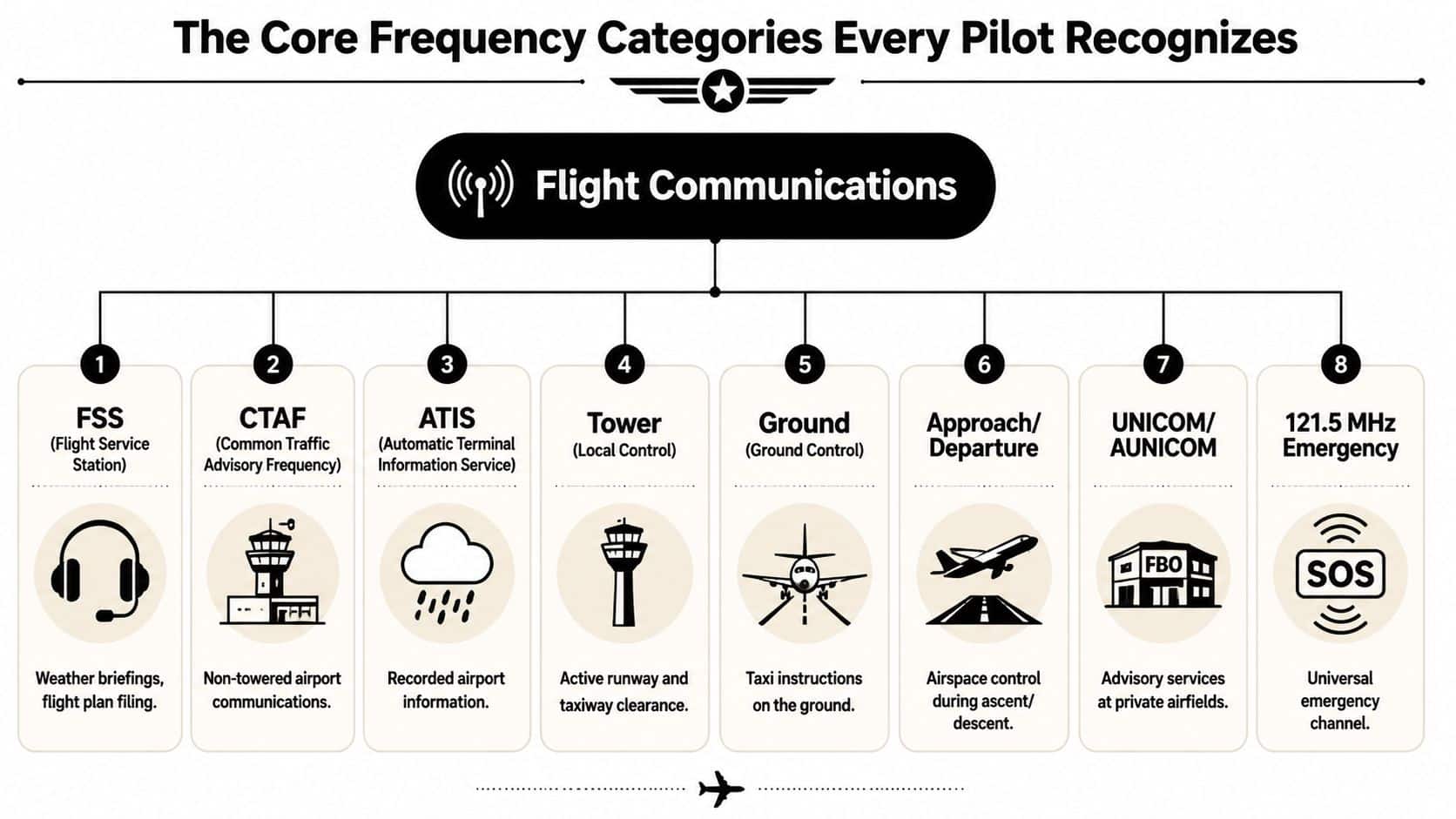
A pilot does not need every frequency memorized. A pilot needs to know the category, because the category determines how the call should sound and what kind of reply to expect. The FAA identifies 122.2 MHz as the universal FSS frequency when you are unsure which local frequency to use, while airport advisory service may use 123.6 MHz and the emergency frequency remains 121.5 MHz FAA AIP Part 1, Section 3.4.
The eight categories in practice
- FSS, Flight Service Station: Used for weather briefings, flight plan filing, and flight plan closure. A typical call is, “Flight Service, Cessna N12345, request weather brief and VFR flight plan.” The point is service, not traffic sequencing.
- CTAF, Common Traffic Advisory Frequency: Used at non-towered airports for self-announce calls. A normal example is, “Chino traffic, Cessna 12345, midfield downwind runway 26R, touch and go.”
- ATIS, Automatic Terminal Information Service: A recorded airport information broadcast. You listen first, then tell tower or approach you have the current information.
- Tower, Local Control: Used for runway and taxi clearances at controlled airports. A clean call is, “Chino Tower, Cessna 12345 holding short runway 26R, ready for departure.”
- Ground: Used for taxi instructions on the surface. Example, “Ground, Cessna 12345 at transient, request taxi for south ramp.”
- Approach or Departure: Used in controlled airspace for sequencing, altitude changes, and radar services. A standard initial call gives who you are, where you are, and what you want.
- UNICOM or AUNICOM: Used at many non-towered or private fields for advisory traffic and local coordination. It is not a clearance frequency.
- 121.5 MHz emergency: The universal guard channel for distress and urgent communications.
The FAA's operating principle is straightforward, use the minimum number of frequencies needed, monitor what you have been assigned, and use each channel only for its intended purpose FAA Flight Service operations guidance. That is the difference between a disciplined cockpit and a noisy one.
Keep the service category in mind before you touch the radio. If the job is weather, use FSS. If the job is pattern traffic, use CTAF. If the job is taxi, use ground. That is how the stack stays organized.
Beyond 122.2 MHz The Regional Outlet Reality
The student answer is usually, “Just use 122.2.” That can work, but it is not the full picture. The better question is, which FSS outlet is reachable from my position right now, because the active CONUS list is tied to location, and the practical answer changes with altitude, terrain, and which outlet you can hear.
A published frequency can also conceal a receive-only setup. A box above certain VOR stations may show the frequency, and an “R” suffix means receive capability only. So a listing like 122.1R means the station can receive on 122.1 MHz, while transmitting occurs over the associated VOR frequency Pilot Workshop on FSS comms.
At Chino and other busy Southern California fields, that detail is not academic. If you are in the pattern, under a shelf, or working around rising terrain, the local outlet that should answer on paper may still be weak in the cockpit. The radio call only helps if the exchange is clean enough to avoid repeats and missed readbacks.
Why the universal number can still fail you
The habit of treating one number as the answer everywhere does not hold up in real flying. Some regions have a usable 122.2 outlet, others are better served by a regional remote communication outlet, and reception changes with terrain and aircraft position. That is why explanations that stop at “just call 122.2” leave student pilots short when they are flying training patterns near hills, coastlines, and busy transition corridors.
A practical read of the system is simple. If you cannot hear the outlet cleanly, the number matters less than the path. The right outlet is the one that gives you an intelligible exchange with the fewest repeats.
Older “flight watch” language also creates confusion. FAA guidance says 122.0 MHz flight watch was retired in favor of 122.2 MHz and other area remote communication outlet frequencies, so the old label can send pilots looking for a service model that no longer matches the current system FAA Flight Service overview.
Do not ask only, “What is the FSS frequency?” Ask, “What outlet can I actually use from here?” That is the operational question that matters.
Tools to Look Up Local Frequencies Quickly
The best frequency check starts before you roll the airplane. On a busy ramp, the question is rarely whether a frequency exists. It is whether you can confirm the right outlet fast enough to avoid guessing with the engine running and other pilots waiting on frequency. That is why I keep both the official airport source and a cockpit app in reach. One gives you the published reference, the other gets you there quickly when you need to make a decision without dragging the aircraft across the ramp.
The Chart Supplement remains the FAA's local reference for airport data. For a quick phone check, Flight Service can be reached in the CONUS, Hawaii, and U.S. territories at 1-800-WX-BRIEF (1-800-992-7433), while Alaska uses 1-833-AK-BRIEF (1-833-252-7433). If you fly beyond your home area, those numbers belong on the kneeboard or in your phone before you launch. For the practical cockpit workflow, the FAA's flight service guidance and this pilot tablet guide fit the same job from different angles, one official, one operational.
What each lookup tool is good for
- Chart Supplement: Use it first when you want the airport's published frequency set as the reference point. It is the source I trust when I want to verify the field itself, not just what an app cached.
- ForeFlight or Garmin Pilot: Use these for a fast preflight check when you want the airport page, frequencies, and chart context together. They are efficient on the ramp, especially when you are moving between airplane, fuel, and briefing space.
- AirMap or SkyVector: These work well for a quick visual check when you are comparing airport location, nearby airspace, and the surrounding service area. They help you see whether the outlet you plan to use makes sense from your position.
- FAA active CONUS spreadsheet: Use this when you need the underlying frequency list and want to see which regional outlet is active in a specific area. It is slower than a cockpit app, but it helps when the direct answer is not obvious.
- Phone support: Use this when the cockpit is isolated, the tablet is offline, or you want a human answer before departure. A short call can save you from a bad guess, especially when terrain or distance makes reception uncertain.
The practical trade-off is simple. Apps are faster, paper is steadier, and the phone gives you a live voice when the other two do not settle the question. In a training cockpit, I would rather spend ten extra seconds confirming the outlet than spend the next five minutes working around a missed call.
The clean habit is to check the airport page, confirm the local outlet, then write the next expected channel on the kneeboard before taxi. That small step keeps the radio work grounded in what you can use from the ramp, not just what looks right on a list.
Chino KCNO Frequencies in Practice
At KCNO, the radio stack feels real because it has to be. You're not just learning a list of frequencies, you're moving through a controlled training airport with tower, ground, ATIS, approach, and CTAF expectations that change with runway use and traffic flow. Chino's busy pattern work makes frequency discipline visible, because every missed call has an immediate consequence in the flow.
How the frequency stack works at KCNO
The useful pattern is straightforward. You check ATIS first, contact Ground for taxi, then Tower for departure, and once you're outside the busy local control environment you transition to the appropriate SoCal Approach/Departure channel for the airspace segment you are in. When you're returning, the sequence reverses.
The important part is not the memorization, it's the order. A student who hears the tower frequency but hasn't copied ATIS or the taxi instructions is already behind, and that shows up fast at a place like Chino where aircraft are constantly entering, exiting, and rejoining the pattern.
Chino also benefits from good pre-briefing. In a flight school environment, the towered Class D structure, the three-runway setup, and the training traffic mean you can't treat the radio like background noise. If you're planning a local hop, a practice area sortie, or a rental checkout, a quick review of the airport data and routing notes on the KCNO training page helps you arrive with the frequencies already organized instead of hunting for them at the hold short line.
At a field like Chino, the pilot who knows the next frequency before switching sounds composed. The pilot who guesses sounds rushed, and the radio congestion follows that mood.
If you're teaching or renting there, the primary goal is consistency. The local stack should feel automatic by the time the wheels move, because that's what keeps the flow clean when the pattern gets busy.
Phraseology and Example Scripts That Actually Work
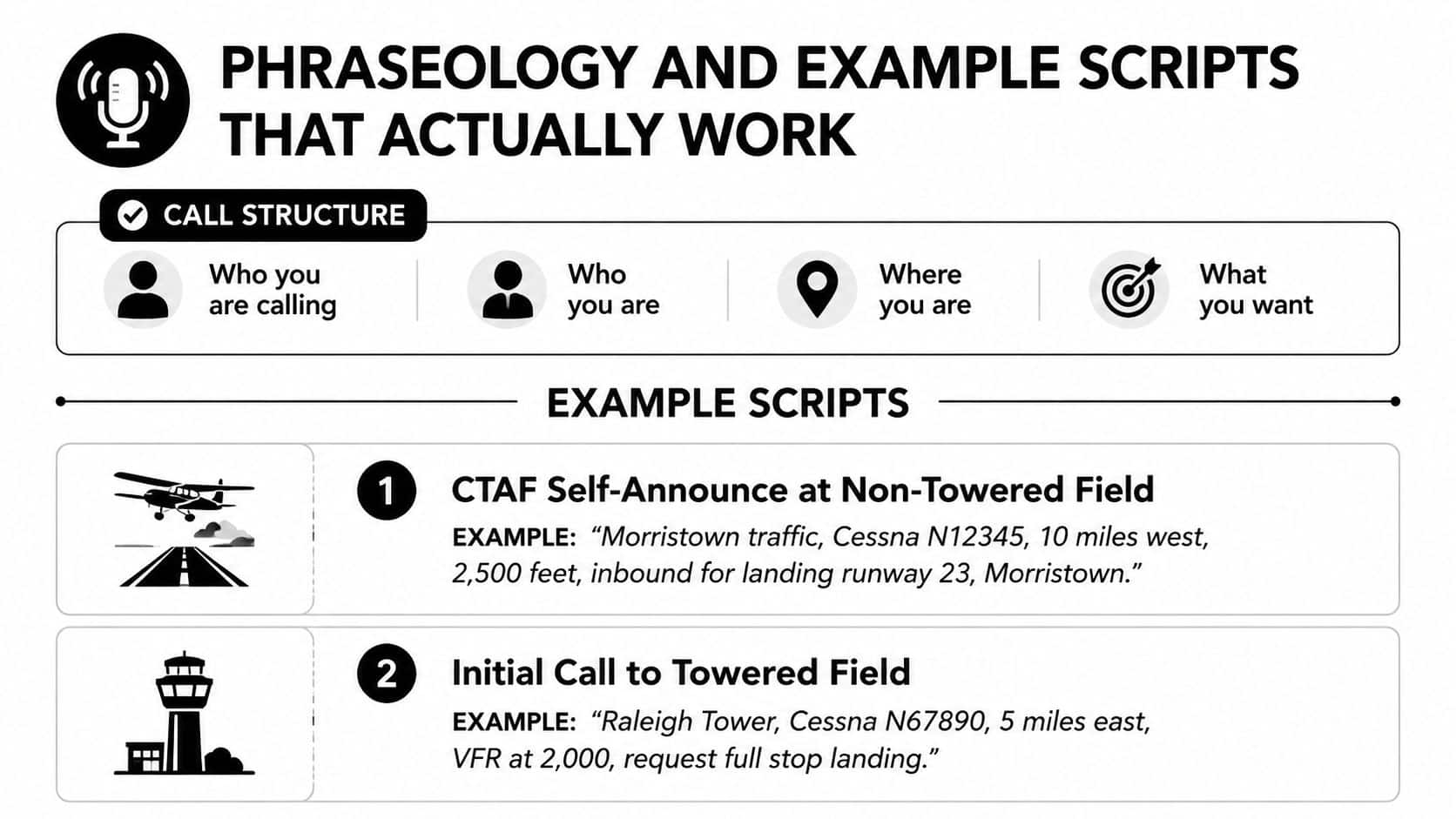
On a busy radio, the strongest call is the one that gives the other side exactly what it needs and nothing extra. I teach students to lead with who you are calling, who you are, where you are, what you want, because that order cuts down on back-and-forth and keeps the frequency moving. The FAA and AOPA also keep pilots honest about radio phrasing, including the practical point that aviation voice communication uses only certain hundredths-digit values, so a pilot says 122.6 instead of 122.65 AOPA frequency guidance.
A good script sounds like a pilot who already knows the answer.
Scripts that sound natural in the cockpit
For a CTAF call at a non-towered field, keep the call short and complete. “Morristown traffic, Cessna N12345, 10 miles west, 2,500 feet, inbound for landing runway 23, Morristown.” That gives the traffic picture without making everyone guess where you are or what you intend.
An initial call to approach should sound just as direct. “SoCal Approach, Cessna 12345, 5 miles east of Chino, VFR at 2,000, request flight following.” That version works because it names the controller, the aircraft, the position, the altitude, and the request in one pass, which is exactly what a busy sector wants to hear.
ATIS acknowledgment stays simple. “Information Bravo received.” Anything longer just clutters the channel.
For FSS, plain language is still the right tool. “Flight Service, Cessna 12345, request weather brief for a local VFR flight,” or “Flight Service, Cessna 12345, close my VFR flight plan.” The point is to state the task clearly so the specialist can move straight to it.
The "hundredths digit" habit matters because awkward frequency wording creates hesitation at the exact moment you want smooth cockpit flow. When students rehearse solo work, I have them say the frequency the way pilots speak it, not the way it looks printed on a page.
That habit shows up later in the air. A pilot who has already practiced these scripts spends less attention on wording and more on traffic, altitude, spacing, and the next switch.
Filing and Closing Flight Plans with Flight Service
A flight plan only helps if you use it the right way. For VFR flying, the practical habit is straightforward, file when the trip merits it, open the plan before departure, and close it when you land or divert. Skip the last step and the system can treat the flight as overdue, which sends attention toward the wrong place.
For pilots who want a direct human contact, Flight Service still gives you that option. In the CONUS, Hawaii, and U.S. territories, the number is 1-800-WX-BRIEF, and Alaska uses its separate number. The FAA's Flight Service guidance lays out those contact paths and the basic filing options FAA AIM Chapter 7, Section 1. For many pilots, a phone call is still the cleanest way to file, open, or close without dealing with app menus at a bad time.
What to say and when to say it
When you call to file or open, give the route, departure time, aircraft identification, people on board, fuel, and any remarks that matter to the flight. Keep the exchange focused on the operational need, not the story behind the trip. If you are working through the steps in a structured way, a clear guide to filing a flight plan helps because the sequence is easier to remember when it matches the order you will speak it.
Closure is the part pilots underemphasize until they get burned by it. Call as soon as you are on the ground and safe. If you divert, close with the actual destination or update the plan so search-and-rescue logic does not chase the wrong airport. That is the safety purpose of the system, and it works only when the last call happens.
In training and in day-to-day flying, I care more about clean execution than perfect phrasing. A flight plan that opens cleanly and closes cleanly usually disappears into the background, and that is exactly what you want.
Frequency Discipline and the Minimum-Frequency Principle
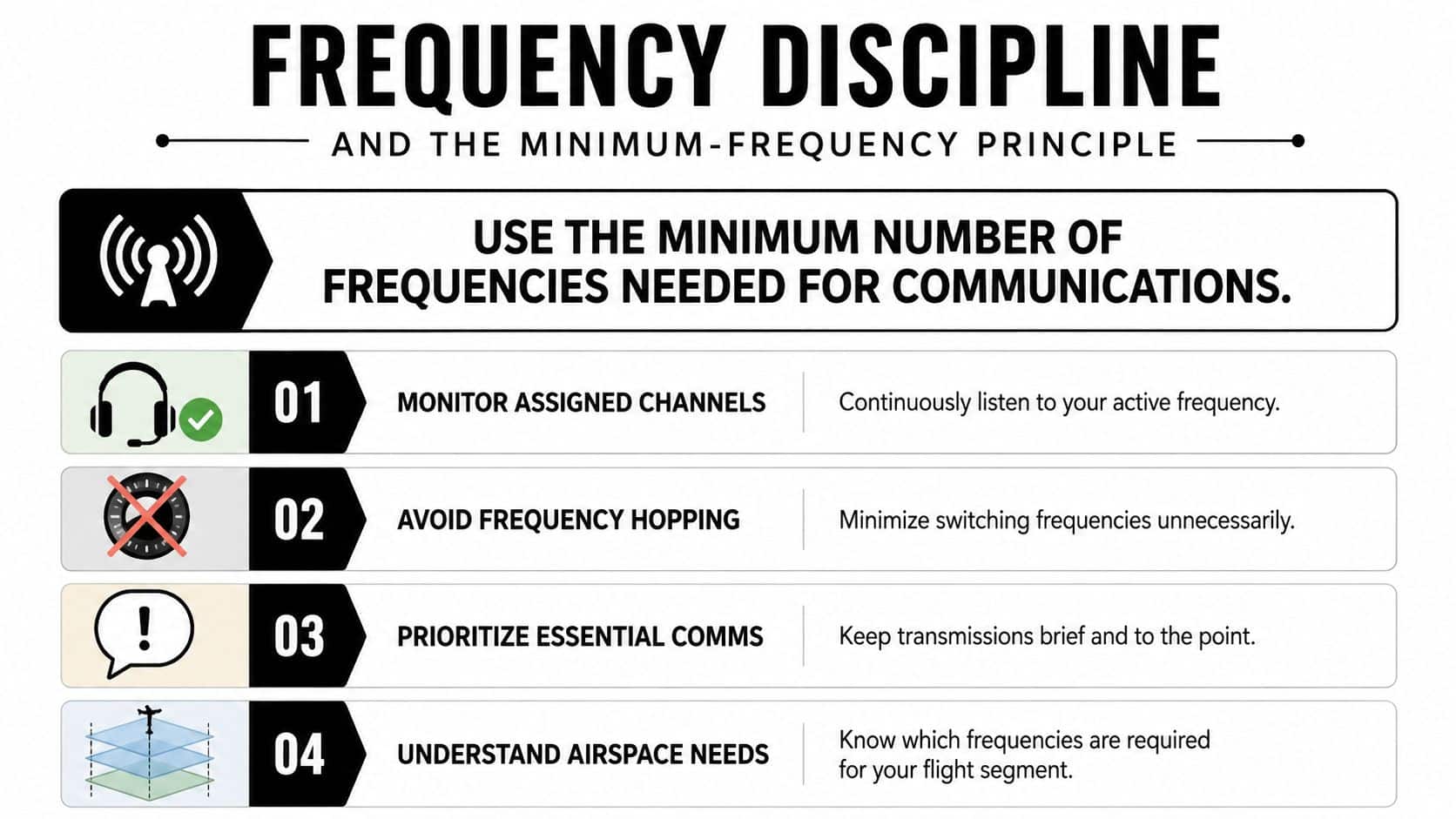
A busy cockpit punishes radio clutter. The FAA's rule is straightforward, use the minimum number of frequencies needed, stay on the one you are assigned, and use each channel only for the job it is meant to do.
At towered airports, that discipline shows up in small choices that keep the cockpit under control. If tower or approach has you, stay with that frequency until the handoff comes. If you are taxiing, briefed for departure, and still waiting on a clearance, there is no benefit to bouncing around the radio stack looking for a better answer. Every extra switch adds workload, and in real training traffic that workload is what gets attention away from scan and spacing.
The cleanest habit is to prepare the next step before you need it. Write down the next frequency, confirm it, and make the change only when you are ready to use it. That avoids the awkward “say again” exchange, and it keeps you from hunting through memory while other aircraft are calling in the pattern or on final.
What disciplined frequency use looks like
- Monitor assigned channels: Listen first, then transmit. If you are already on tower or approach, remain there until you are instructed to change.
- Avoid frequency hopping: Do not bounce between channels out of curiosity. Each unnecessary switch raises workload and makes you easier to distract.
- Prioritize essential comms: Keep the call short and relevant. If the message does not move the flight ahead, save it for later.
- Match the phase of flight: Know whether you are taxiing, departing, en route, or arriving, then use the frequency that fits that phase.
There is a real trade-off here. A universal contact point is useful when you are unsure where to start, but once ATC or Flight Service has given you the correct outlet, discipline means staying put and listening. That is especially true in training around busy Southern California fields, where constant radio changes can turn a simple leg into a series of interruptions.
Guard can stay in the background, but it should not compete with the primary scan. Quiet radio habits help because they reduce noise, keep the cockpit calmer, and leave more attention for traffic, aircraft control, and the next call that matters.
Quick-Reference Matrix of Common Frequencies
| Service | Frequency | Purpose | When to Use |
|---|---|---|---|
| FSS | 122.2 MHz | Universal Flight Service contact when unsure of a local outlet | Weather briefings, flight plan filing, flight plan closure |
| Airport advisory | 123.6 MHz | Advisory service at some airports | Local airport traffic coordination when published |
| CTAF | Published CTAF | Self-announce traffic calls | Non-towered airport arrivals, departures, and pattern work |
| ATIS | Published ATIS | Recorded airport information | Before taxi and before arrival calls |
| Tower | Published tower frequency | Local control clearance and sequencing | Controlled airport departures and arrivals |
| Ground | Published ground frequency | Taxi instructions | Surface movement before takeoff and after landing |
| UNICOM or AUNICOM | Published local advisory | Local advisory or coordination | Private fields and some non-towered airports |
| Emergency | 121.5 MHz | Universal emergency channel | Distress or urgent communications |
The easiest way to use this table is to match the service to the job, then confirm the local airport publication before each leg. That avoids the most common student error, which is treating all frequencies as interchangeable.
Three Frequency Myths Worth Retiring
The first myth is that 122.0 MHz flight watch is still the active default. That habit is stale. As noted earlier, flight service now centers on 122.2 MHz and the reachable regional outlet for your position, so using the old channel can send you straight to the wrong place.
The second myth is that 122.2 MHz guarantees coverage everywhere. It does not. In real cockpit work, the usable answer depends on where you are, which outlet covers that area, and whether terrain, altitude, and distance let the transmission get through. If you keep calling a channel you cannot hear, you lose time and start second-guessing the setup.
The third myth is that CTAF means the same thing at towered and non-towered airports. It doesn't. At a towered field, the airport publication and the control environment still govern who you call and when, while self-announce use follows the local procedures the airport publishes. At a non-towered field, CTAF becomes the center of the traffic picture, and that difference matters the first time you arrive into a busy pattern.
If you treat every frequency like a general-purpose chat line, you create your own confusion. If you use each one for its actual job, the cockpit stays readable.
The practical payoff is fewer crossed wires, fewer repeated calls, and more mental bandwidth for flying the airplane instead of chasing the radio.
Best Practices for Every Phase of Flight
A clean frequency habit starts before the prop turns. In a real cockpit, the pilot who checks the airport data, confirms the expected channels in the chart supplement or app, and lines up the next call before taxi has one less distraction once the workload starts climbing. At busy Southern California fields, that matters because a missed frequency change tends to cost more time than the original check would have taken.
The best routine is simple, but it has to be deliberate.
A simple cockpit checklist
- Before taxi: Verify ATIS, then ground, then tower or CTAF as appropriate. The airport picture should already be in your head before you move.
- Before departure: Have the next frequency written down before switching. Don't wait until the controller hands it off.
- In the air: Stay on the assigned channel until the job is done. If you're working a controlled arrival, don't browse around the dial.
- On arrival: Use the published CTAF window correctly. FAA guidance calls for self-announce use of the published CTAF from about 10 miles inbound to landing and for departures from startup through taxi until about 10 miles outbound.
- After landing: Close the flight plan, then clean up the rest of the cockpit. Don't let the day end with one unresolved radio task.
That routine works because it turns radio management into a sequence instead of a scramble. Once the sequence is habitual, the radio stops stealing attention from flying.
Chino KCNO is a good place to see the difference. When traffic is busy, the pilot who already knows whether the next call belongs on a discrete tower frequency, a CTAF call, or a flight service outlet spends less time sorting the radio and more time flying the airplane. That is the fundamental trade-off: universal frequencies are easy to remember, but the right local outlet is what effectively gets a message through.
If you want to get better at this in a real training environment, DuBois Aviation at Chino Airport works with pilots who need clean radio habits as much as stick-and-rudder skill. Visit DuBois Aviation to see how structured instruction, local airport experience, and practical frequency discipline come together in day-to-day training.


