
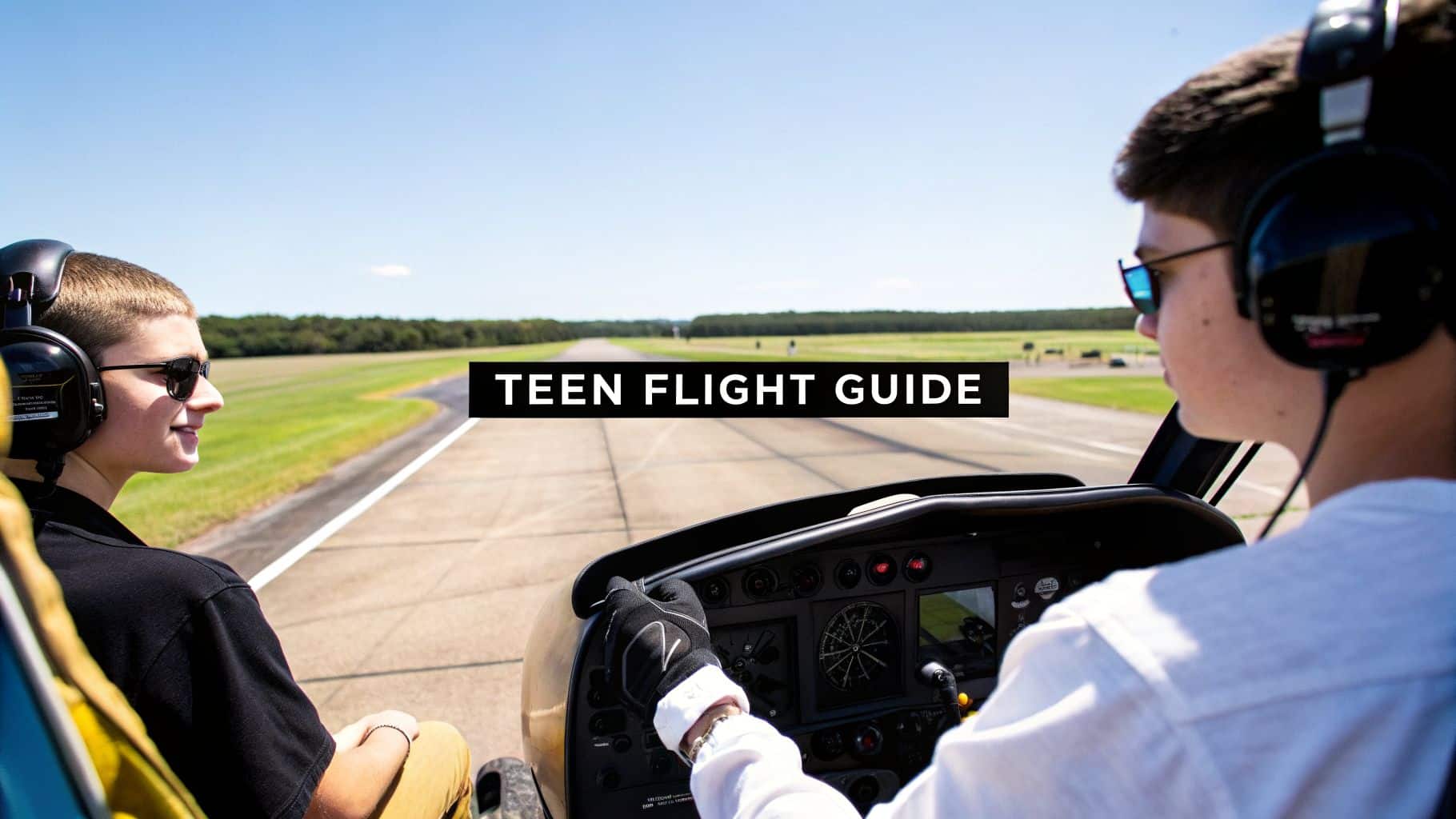
Flying lessons for teenagers aren't just a cool hobby—they're an incredible launchpad for building maturity, responsibility, and a serious head start in a booming career field. In fact, teens can start logging flight hours at 16, giving them a massive leg up long before most of their peers have even settled on a college major.
Why the Teen Years Are an Ideal Time to Learn to Fly
While most people think of getting a driver's license as the defining milestone of the teenage years, learning to fly is a journey on a whole different level. The structured world of flight training demands a kind of focus and accountability that builds character in a way that few other activities can. It’s a true investment in skills that pay dividends far beyond the cockpit.
This isn’t just about learning to operate a machine. It's about mastering a complex environment where every single decision counts. That process develops critical life skills that set a young person up for success, no matter what career path they ultimately choose.
Building Skills Beyond the Cockpit
Flying lessons instill a deep sense of personal responsibility. When a student pilot is at the controls, they learn to manage risk, think clearly under pressure, and maintain total situational awareness. These are skills that translate directly to better performance in school, at work, and in life.
The discipline it takes to run through a pre-flight checklist, talk to air traffic control, and fly precise maneuvers builds a foundation of methodical thinking and real-world confidence that is truly hard to find anywhere else.
It's also a smart career move. The aviation industry has a massive, well-documented need for new pilots. Projections show North America alone will need 206,000 new pilots by 2037. Teenagers who get started now are placing themselves at the front of the line for these opportunities. In fact, FAA data reveals a growing trend of 16 to 19-year-olds entering flight training, which you can read more about in the latest pilot age statistics on Pilot Institute.
The Advantage of Starting Young
Learning to fly is a lot like learning a language or a musical instrument—younger minds just seem to soak it all up faster. Teenagers often grasp complex aerodynamic principles and develop the fine motor skills needed for flying more quickly and naturally.
At DuBois Aviation, we've created the perfect environment to start that journey. Our experienced instructors are mentors who guide teens every step of the way, ensuring they build not just the technical skills, but also the sound judgment and maturity that define a great pilot. This early start provides an undeniable advantage, sparking a lifelong passion for the sky and opening up a future full of possibilities.
Getting Your Teen Started in the Cockpit
Wondering how to get your teen from dreaming about the sky to actually sitting in the pilot's seat? It's a lot more straightforward than most people think. The absolute best place to begin is with a discovery flight.
This isn't some passive sightseeing tour. It's a real, hands-on introductory lesson where your teen gets to fly the plane under the watchful eye of a Certified Flight Instructor (CFI). It’s the perfect, no-pressure way to see if their interest is a true passion before committing to a full training program. We've designed our introductory flying lessons at DuBois Aviation to be that perfect first taste of aviation.
Understanding the Official Requirements
The Federal Aviation Administration (FAA) has a clear pathway for young pilots. While a teen must be 16 years old to fly an airplane solo and 17 to earn their Private Pilot Certificate, there's actually no minimum age to start taking lessons and logging flight time.
This is a huge advantage. A younger student can start building fundamental skills—like takeoffs, landings, and handling the controls—at a comfortable pace. By the time they're old enough to solo, they're already well ahead of the game, flying with confidence and skill.
One of the first practical steps is getting an FAA Medical Certificate. This is a standard health checkup with an Aviation Medical Examiner (AME), and it's a must-have before any student can legally fly the plane by themselves. We always suggest tackling this early on to make sure there are no unexpected medical hurdles down the road.
Think of the medical certificate as the official green light for solo flight. It ensures a student meets the health standards necessary to safely act as pilot in command, which is a foundational requirement for their entire aviation journey.
Key Milestones for Teen Pilots
Navigating the requirements is pretty simple when you see them laid out. Here’s a clear breakdown of the key FAA minimums for a teenager's flight training journey.
Teen Pilot Milestone Requirements
| Milestone | Minimum Age | Medical Certificate Required |
|---|---|---|
| Begin Logging Flight Hours | No minimum age | Not required to start |
| Fly Solo (Pilot in Command) | 16 years old | Yes (Third-Class or higher) |
| Earn Private Pilot Certificate | 17 years old | Yes (Third-Class or higher) |
As you can see, the path is progressive, allowing students to build a solid foundation of experience long before they reach the age milestones for solo flight and certification.
The Training Roadmap: From First Flight to Pilot License
Getting a pilot license isn't some mysterious, overnight thing. It's a journey, a step-by-step adventure with clear milestones. Think of it like learning an instrument—you start with scales, then chords, and eventually, you're playing entire songs. Each lesson builds on the last, turning a huge dream into a series of smaller, achievable wins.
The whole process runs on two parallel tracks: ground school and flight training. Ground school is where you learn the "rules of the road" for the sky—everything from how a wing generates lift to decoding weather charts and understanding FAA regulations. Flight training is where you put all that theory into practice, getting your hands on the controls and making the airplane do what you've learned it can do.
This timeline gives you a bird's-eye view of the key milestones a young pilot can expect to hit along the way.
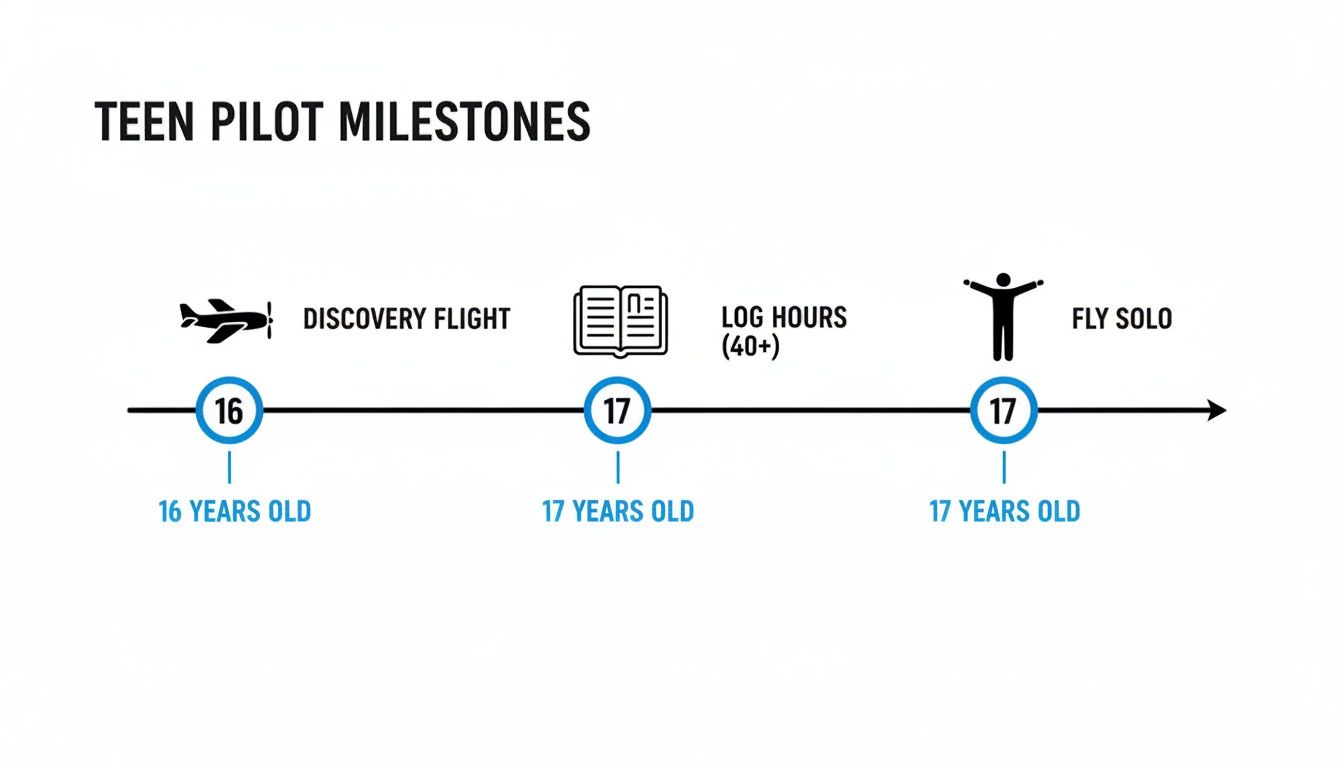
It’s a logical progression, starting with that very first flight and building up to the unforgettable moment they fly the plane all by themselves.
Ground School: Building the Foundation
Before anyone can truly command an aircraft, they have to understand the forces that make flight possible. Ground school is where we build that critical knowledge base. It’s where students learn the why behind every maneuver and decision they'll make in the cockpit.
Here’s a glimpse of what’s covered:
- Aerodynamics: The simple physics of how planes fly.
- Aircraft Systems: What makes the engine run, what the dials mean, and how the controls work.
- Weather Theory: How to read the sky and make go/no-go decisions based on weather reports.
- Federal Aviation Regulations (FARs): The official rulebook for every pilot in the United States.
- Navigation & Flight Planning: The art and science of getting from Point A to Point B safely and efficiently.
This isn’t just about passing a written test. It’s about building the solid judgment and airmanship that define a truly safe and competent pilot.
Flight Training: From Takeoff to Flying Solo
This is where the magic happens. Under the wing of a Certified Flight Instructor (CFI), your teen will start with the fundamentals: how to do a pre-flight inspection, how to take off and land smoothly, and how to just fly straight and level. Once they master those, they’ll move on to more advanced skills like stall recoveries and handling simulated emergencies.
The first solo flight is the biggest moment in any pilot's journey. It’s when the instructor hops out, gives a nod, and suddenly, your teen is the only one in the plane—the Pilot in Command. The confidence and self-reliance they gain from that single experience is something they'll carry with them for the rest of their lives.
After that first solo, the training deepens. The focus shifts to mastering cross-country flights, which means planning a trip to a different airport, navigating the route, and landing successfully. This is where real-world decision-making skills are forged.
Training at a towered airport like Chino (KCNO) from day one is a huge advantage. Talking to Air Traffic Control is a fundamental skill, and our students get comfortable with professional radio communication in a busy environment right from the start. That constant, real-world practice makes them more capable and confident pilots, ready for any airspace they'll encounter down the road.
Investing in Your Teen's Future: A Cost Breakdown
When parents start looking into flying lessons for their teenager, one of the first and most practical questions is always about the cost. It’s helpful to think of flight training less as a hobby and more as a powerful educational investment, similar to a specialized trade school or even a college degree. The good news is that the costs are straightforward, broken down into clear components so you always know what you’re paying for.
The total price tag for earning a Private Pilot Certificate is essentially a sum of its parts. You have the hourly rental rate for the airplane itself, the hourly fee for the Certified Flight Instructor (CFI), the cost of ground school materials (like books and software), and finally, the fees for the official written and practical exams. Each piece is a direct investment in building a safe, competent pilot.
Unpacking the Primary Costs
The lion's share of the investment will be the flight time—that's the aircraft rental and instructor fee combined. While the FAA requires a minimum of 40 flight hours, the reality is that the national average for a student to feel truly ready and proficient is closer to 60-75 hours. This can vary based on how often your teen flies and how quickly they pick up the new skills.
To get a better feel for what those initial flights look like financially, you can check out our detailed guide on introductory flight lesson costs.
This kind of training is a major investment, and it reflects a worldwide trend. The global flight training market was valued at USD 10.61 billion in 2025 and is on track to hit USD 24.86 billion by 2032. North America commands a massive 40% market share, making this one of the best places on earth to learn to fly. For those who like the data, you can discover more insights about the flight training market on Coherent Market Insights.
Smart Strategies for Funding Flight Training
Financing this incredible journey is often more manageable than people assume. A whole community of aviation organizations is out there, actively looking to support the next generation of pilots with scholarships.
Think of scholarships as a co-investment in your teen's future. Organizations like the Experimental Aircraft Association (EAA) and the Aircraft Owners and Pilots Association (AOPA) offer millions of dollars annually to aspiring pilots.
These resources can make a huge dent in the overall cost. And remember, the return on this investment can be incredible. A pilot certificate doesn't just teach responsibility and discipline; it opens the door to a rewarding, well-paying career. With a bit of planning and a look into the financial aid available, the dream of flight is absolutely within reach.
Ready to Buy Your First Plane? Here’s How to Do It Safely
So, the aviation bug has well and truly bitten your family. As the hours in the logbook add up, that dream of owning your own aircraft starts to feel less like a fantasy and more like a logical next step.
It’s a huge milestone, and a lot like buying your first family car, but the stakes are obviously much higher. You’re not just looking for a good deal; you're making an investment in your family's safety and future adventures in the sky.
The first big question you'll face is whether to buy new or used. A brand-new plane is a beautiful thing, gleaming with the latest tech and backed by a factory warranty. However, for most families, the used market is where the real value lies. A classic, well-maintained Cessna or Piper trainer can be an incredible and affordable entry into ownership, but you have to know what you're looking for.
The One Step You Can Never, Ever Skip
Whether the plane you're eyeing looks flawless or has a few hundred hours on the clock, there is one step that is absolutely non-negotiable: the pre-buy inspection. This isn't just a casual once-over. It's a meticulous, top-to-bottom teardown and examination by a certified Airframe & Powerplant (A&P) mechanic who has no skin in the game.
Think of a pre-buy inspection as the most intense home inspection you could ever imagine, but for an airplane. The mechanic's sole mission is to uncover any hidden gremlins—from a spot of corrosion inside a wing to a potential engine issue—that could transform your dream purchase into a dangerous and expensive headache.
This inspection gives you the unvarnished truth about the aircraft's condition. It's the single most powerful tool you have to protect yourself from costly surprises and ensure the plane you bring home is ready for safe flying.
Reading an Airplane's Life Story
Every single aircraft has a story, and that story is written down in its logbooks. These binders are the official, detailed history of every inspection, every repair, and every modification the plane has ever had. Getting comfortable with digging through these logbooks is a critical skill.
What are you looking for? A clean, consistent, and complete maintenance history. Gaps in the records or entries showing the same major problem being fixed over and over are big red flags. A well-kept logbook is one of the best signs of a well-loved airplane, and it’s the key to having confidence in the aircraft that will carry your family on countless adventures to come.
It’s All About Community: Specialized Youth Aviation Programs
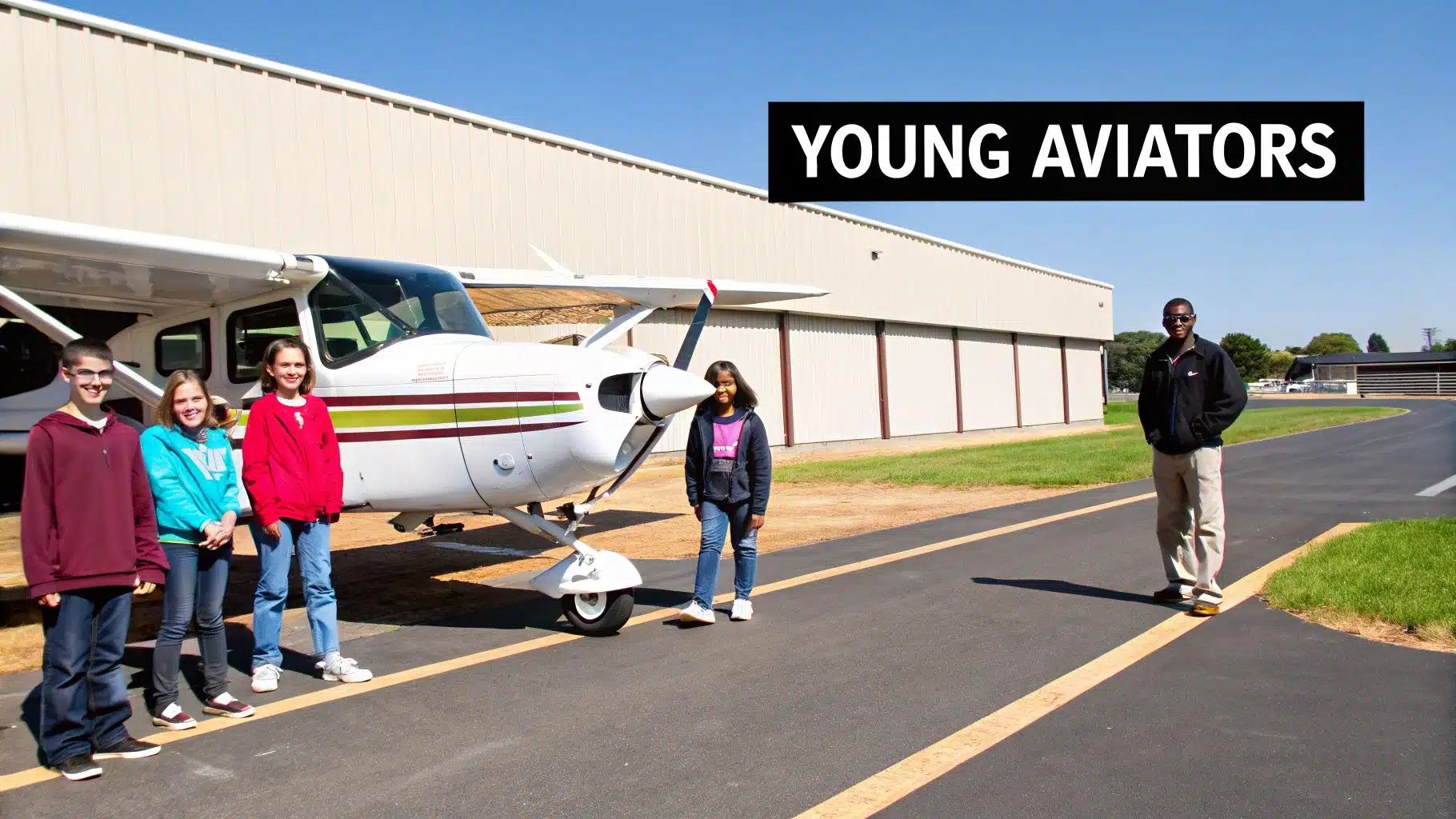
Learning to fly is an incredible personal journey, but it’s even better when shared. While that one-on-one time with your instructor is where the magic happens, it's the sense of community that truly gets young pilots hooked for life. Programs designed specifically for teens turn what could be a solo endeavor into a shared adventure with friends who get just as excited about airplanes as you do.
That feeling of belonging is a huge motivator. When a teenager sees their friends tackling the same challenges and celebrating the same wins, it makes the whole process more fun and reinforces their commitment. It’s the difference between just taking lessons and truly becoming part of the aviation world.
Learning Together is Better
Think about it: an immersive aviation camp is a world away from just showing up for a lesson. When teens are learning side-by-side, it creates this incredible energy. They work together, push each other, and solve problems as a team. It's a fantastic way to fast-track learning in a setting that feels more like fun than school. We've seen it firsthand in our own local aviation camp program at DuBois Aviation.
I’ve seen it time and again—the friendships built during training often last a lifetime. There's a special bond that forms when you've prepped for a first solo together or celebrated passing a checkride with friends who know exactly what it took to get there.
It’s no surprise that structured youth programs have become such a big part of flight training. In fact, a 2019 study of teenage student pilots in California revealed that things like campus activities and a school’s reputation were major factors in their decision. It just goes to show that a strong, supportive community is a massive draw for young aviators starting at age 14. You can read more about what motivates teenage pilots.
Keeping the Passion Alive
The community doesn't stop when camp is over. Programs like Flyers' clubs and mentorship opportunities offer a way for teens to stay connected and keep growing long after they’ve earned their wings.
These groups provide some incredible benefits:
- Real-World Connections: They host events with guest speakers like airline pilots, air traffic controllers, and mechanics who share invaluable, real-world insights into aviation careers.
- Building a Network Early: Meeting experienced pilots and other industry pros gives teens a huge head start on building their professional network.
- Just Having Fun: Group fly-ins to local airports and other social events are all about keeping the passion for flying alive and enjoying the camaraderie that comes with it.
Ultimately, these programs do so much more than just provide flying lessons for teenagers. They create a space where young people feel supported, inspired, and connected, building the next generation of confident, passionate pilots.
Questions We Often Hear from Parents
As a parent, your first priority is always your child's safety. So, when your teenager brings up the idea of learning to fly, it's completely natural to have a few questions. We get it, and we've heard them all. Our goal is to give you clear, straightforward answers to help you feel confident about this incredible journey.
This is a big step for your teen, but it’s an exciting one for you, too. Understanding everything from our safety culture to the long-term benefits can make all the difference.
Just How Safe Is It for a Teenager to Fly a Plane?
This is usually the very first question, and it's the most important one. The entire world of aviation is built on a foundation of safety. In fact, flight training is one of the most structured, supervised, and safety-focused environments a young person can experience.
Every single flight is under the direct guidance of a Certified Flight Instructor. The aircraft themselves are held to incredibly high standards, undergoing frequent and mandatory maintenance checks that are far more rigorous than anything your family car requires.
More than that, learning to fly instills a profound sense of responsibility. Your teen will learn discipline, risk management, and how to make calm, calculated decisions—skills that will benefit them for the rest of their lives, both in and out of the cockpit.
Can My Teen Really Fly an Airplane Before They Can Drive a Car?
Yes, they absolutely can, and it's a huge milestone. The FAA sets the minimum age for a student pilot to fly an aircraft solo at 16 years old. This often happens before they can even get an unrestricted driver's license.
But this isn't a privilege that's just handed out. Before a student is ever allowed to fly solo, they must prove to their instructor that they have mastered the aircraft's handling, procedures, and emergency responses. They also have to pass a written exam. The first solo flight only happens when both the student and the instructor are 100% confident.
That first solo flight is a powerful moment. It’s a testament to the student's hard work, the instructor's mentorship, and a training system designed to build exceptional self-reliance. It’s an achievement they will never forget.
What Happens After They Earn a Private Pilot License?
Think of the Private Pilot License as the key that unlocks the sky. It’s the foundation for a lifetime of adventure or a future career. With it, your teen can fly with passengers during good weather, opening up incredible opportunities for travel and recreation.
For those with professional aspirations, this is just the beginning. The next steps could include:
- Instrument Rating: To learn how to fly in clouds and rely on the aircraft's instruments.
- Commercial License: The rating required to be paid to fly.
- Flight Instructor Certificate: A fantastic way to build experience and share their passion with new students.
Ready to give your teen an unforgettable look at the world from the pilot's seat? At DuBois Aviation, we specialize in making that dream a safe and exciting reality.