
You’re probably here because flying has stayed in the back of your mind for years.
Maybe you watch every small airplane that passes overhead. Maybe you’ve looked up discovery flights more than once, then closed the tab because the whole thing felt bigger than it should. That’s normal. A first plane flying lesson feels like a leap until you understand how structured it really is.
Flight training isn’t guesswork. It hasn’t been for a very long time. The process is deliberate, supervised, and built around safety from the first handshake on the ramp to the first time you taxi back in after landing.
From Dream to Cockpit Your Journey Begins
A student pulls into Chino Airport for a discovery flight, hears a run-up in the distance, and realizes this is no longer an abstract goal. At KCNO, flying becomes concrete fast. You see airplanes moving, hear the radios, and start to understand that pilot training is a practiced discipline with clear standards.
Curiosity is enough to start.
A first plane flying lesson gives that curiosity a proper test. Instead of wondering whether you would enjoy flying, you sit in the left seat, follow the lesson flow, and get a realistic feel for how training works at an active airport.
A serious skill, taught step by step
Good instruction removes mystery without removing respect for the airplane. That balance matters. Students do better when they see early that flight training is structured, but also understand that every habit they build from day one carries forward to solo flight, checkride work, and later ratings.
At DuBois Aviation, I want a new student to leave the first lesson with a clear sense of what training feels like. Not a sales pitch. A real impression of the work. Some people step out of the airplane excited and ready to schedule the next lesson. Others realize they need more time, or that their goal is occasional recreational flying rather than a long training track. Both are useful outcomes.
If you want a broader view of the training path, this guide on what it takes to become a pilot lays out the progression in practical terms.
Why starting at KCNO helps
Training at KCNO gives students early exposure to real airport habits. You watch for traffic, listen for clearances, and learn that order on the ground supports safety in the air. That environment builds judgment sooner than a quiet, isolated field often does.
It also gives you a better preview of where aviation can lead. The first lesson is about fit, but serious students should already be thinking one step ahead. If you continue, the path does not stop at a private pilot certificate. You may add an instrument rating, work toward commercial training, or eventually buy an aircraft of your own. Each step asks for more judgment, not just more hours.
That is why I treat the first lesson as the beginning of a decision process. The right question is simple: do you want to keep training in a way that builds skill safely, one lesson at a time? If the answer is yes, the dream starts becoming a plan.
How to Prepare for Your First Plane Flying Lesson
Preparation for a first lesson is simple, but it matters. Small mistakes on the ground tend to become distractions in the air.
Show up rested. Wear comfortable clothes. Use closed-toe shoes with good feel on the rudder pedals. Bring your photo ID, sunglasses, water, and whatever you’ll need to stay comfortable for the time you’re at the airport.
What helps before you arrive
The best first lessons usually come from students who do a little preparation but don’t try to over-study.
A short checklist works well:
- Dress for movement: You’ll be climbing onto a wing, stepping into the cockpit, and working the controls with your hands and feet.
- Eat lightly: Don’t arrive hungry, but don’t show up after a heavy meal either.
- Bring questions: Ask about the aircraft, the lesson flow, and what you’ll handle in flight.
- Keep expectations realistic: Your instructor will handle the high-workload parts. Your job is to learn, not perform.
What doesn’t help is trying to memorize everything before you’ve ever touched the controls. Students who come in determined to “prove” they already understand flying often make the first lesson harder on themselves.
Nervous is normal
A lot of people are more concerned about anxiety than the actual flying. They worry about airsickness, talking on the radio, making mistakes, or freezing up once the airplane leaves the ground.
That concern is common, and it’s manageable. Aviation psychology research indicates that pre-lesson simulator exposure can reduce first-flight dropout rates by up to 40%, which is why a ground-based cockpit experience can help people settle in before they ever fly (pre-lesson simulator exposure and confidence).
Tell your instructor if you’re nervous before the lesson starts. That’s useful information, not a weakness.
A calm first lesson usually comes from good pacing. Sit in the airplane on the ground. Learn where the controls are. Put on the headset. Listen to the engine run. None of that is wasted time.
What works and what doesn’t
A few trade-offs are worth understanding early.
| Approach | What works | What usually doesn’t |
|---|---|---|
| Mental prep | Arrive curious and coachable | Arrive trying to be perfect |
| Physical prep | Rest, hydration, light meal | Too much coffee, no water, poor sleep |
| Learning style | Focus on one task at a time | Trying to track every gauge and every radio call |
| Confidence | Ask for clarity when unsure | Stay quiet because you don’t want to look inexperienced |
If you’re especially concerned about nausea, speak up early. Instructors can smooth the lesson out, shorten a maneuver, level off, or return to the airport. A first flight should stretch you a little. It shouldn’t overwhelm you.
Preflight Ground School and Your Time in the Air
A good first lesson feels organized from the minute you arrive. That’s not accidental. Predictability lowers stress and helps you absorb more.
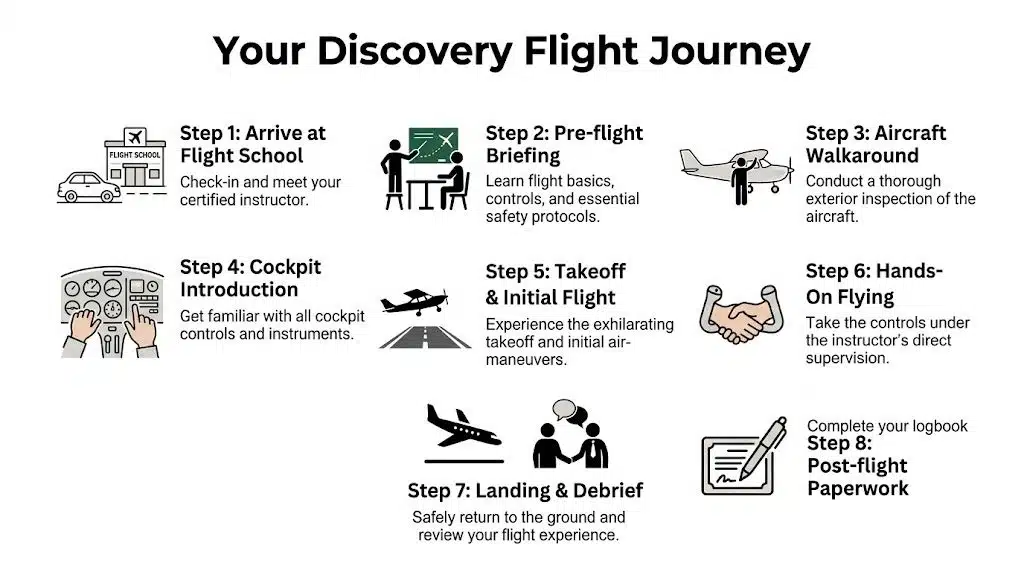
The flow is usually straightforward. You meet your instructor, review the plan, inspect the airplane, get settled in the cockpit, fly a short lesson, then debrief what happened and what comes next.
Early in the process, it helps to see the overall sequence:
The briefing before the engine starts
The preflight briefing is where the lesson begins. Not at takeoff.
Your instructor will explain the basic controls, how the airplane moves around each axis, what the lesson area will be, and what safety items matter most. This is also where you set expectations. Who will taxi. Who will handle takeoff. When you’ll take the controls. How to hand them back.
Then you walk out to the airplane and inspect it together. You’re not doing this for ceremony. You’re learning to verify that the aircraft is airworthy, properly fueled, and ready to fly.
Students often enjoy the walkaround because it makes flying feel tangible. Fuel caps, tires, control surfaces, oil checks, hinges, lights. The airplane stops being mysterious.
If you want a more detailed example of that process, this guide to pre-flight checks on a Cessna 172 shows the kind of thinking instructors want students to build early.
In the cockpit
Once strapped in, the airplane gets smaller and the lesson gets more focused.
You’ll get familiar with the yoke, rudder pedals, throttle, brakes, headset, and the key flight instruments. At a busy airport like KCNO, you’ll also start hearing why cockpit discipline matters. Headsets on. Listen carefully. Don’t talk over a radio call. Follow one instruction at a time.
This is usually where first-time students realize they do not need to understand everything at once. They only need to stay with the lesson.
A useful preview of the experience is below.
How you’ll be taught in the air
Your instructor will use the FAA-approved demonstration-performance method. That means the maneuver is explained, demonstrated, performed by the student under supervision, and then evaluated. It’s a proven way to teach kinesthetic skills and help students build correct habits early (FAA-approved demonstration-performance method).
In plain terms, your instructor shows you what right looks like before asking you to do it.
You might start with straight-and-level flight. Then gentle turns. Then a climb or descent. The lesson isn’t about checking boxes. It’s about showing you how control inputs feel and how the airplane responds when those inputs are smooth and timely.
Smooth is better than aggressive. New students almost always try too hard on the controls.
That’s one of the first trade-offs in training. People assume flying requires large movements. It usually requires small pressures and attention.
What a first flight often feels like
Takeoff is the busiest part for a new student, so instructors usually handle it while talking through the sequence. Once you’re clear of the airport and at a safe altitude, the pace changes.
Then comes the moment every student remembers. “You have the controls.”
Beginners often find that the airplane feels more stable than expected. The nose doesn’t wander wildly. The yoke doesn’t require wrestling. What surprises them is how far ahead they need to think. Hold altitude. Look outside. Check attitude. Make a small correction. Wait. Recheck.
When it’s time to return, your instructor will handle the higher workload as you head back toward the airport environment. You’ll listen, watch, and start building a picture of how arrival and landing fit together.
The debrief after shutdown is where the lesson becomes useful. That’s where you sort out what felt natural, what felt awkward, and whether the next step is another lesson, a simulator session, or a longer training plan.
Mapping Your Path to a Pilot Certificate
After the first few lessons, the question changes. It stops being “Do I like this?” and becomes “Am I ready to train consistently enough to earn the certificate?”
A Private Pilot Certificate follows a clear sequence, but very few students move through it in a perfectly straight line. Progress depends on lesson frequency, weather, aircraft availability, and how well you study between flights. At KCNO, that also means learning to work in a busy Southern California airspace environment, which is good preparation. If you can stay ahead of the airplane here, cross-country flying and future ratings tend to feel less intimidating later.
The milestones that matter
Training usually starts with fundamentals that have to become repeatable. Aircraft control, checklists, radio calls, airport operations, and pattern work all need to look calm before an instructor signs off the next step.
The first solo is the milestone students talk about most, and for good reason.
A solo is not a reward for bravery. It is an instructor’s judgment that you can manage the airplane, the traffic pattern, and your decisions without coaching from the right seat. At a field like Chino, that judgment has to include more than just decent landings. You need steady airspeed control, reliable checklist habits, and the discipline to go around when the picture is wrong.
After solo, the training gets more serious in a useful way. You plan and fly cross-country trips, handle diversion decisions, tighten up maneuvers to practical test standards, and build the habits that matter on real flights. The checkride sits at the end of that process, but the ultimate goal is broader. Safe pilots make good decisions early, stay within their limits, and keep small problems from turning into larger ones.
Good instruction also has to develop judgment, not just mechanical skill. Scenario-based training helps with that. Instead of memorizing one correct response, students work through situations they are likely to face, such as a weather change on a short cross-country or an engine issue that forces an off-airport planning discussion near the Chino Hills. The FAA supports that approach in its Aviation Instructor’s Handbook section on scenario-based training.
DuBois Aviation uses that practical structure with one-on-one instruction and KCNO-based training. Students who want a clearer outline of the full sequence can review this guide on how to get my pilot’s license.
Budgeting without guessing
Training cost depends less on a headline number and more on efficiency.
Students who fly regularly usually spend less in the long run because they retain more from lesson to lesson. Students who fly once, then wait three weeks, often pay again to regain the same proficiency. That is one of the biggest trade-offs in flight training. A slower schedule can feel easier on the monthly budget, but it often increases the total cost.
A practical budget should include:
| Expense Category | What to expect |
|---|---|
| Aircraft rental | Varies by airplane type and local hourly rate |
| Instructor time | Includes flight instruction plus preflight briefings and postflight debriefs |
| Study materials | Ground school access, books, apps, and charts |
| Testing fees | Knowledge test and examiner fees paid at different stages |
| Pilot gear | Headset, kneeboard, logbook, and other supplies |
That table is less tidy than the fixed totals you see on some websites, but it reflects how training functions. Preparation matters. Frequency matters. Weather delays matter. So does choosing one instructor and sticking with a clear plan.
What helps students finish strong
Students who earn their certificate efficiently usually do a few things well:
- Fly often enough to keep momentum
- Arrive prepared for the lesson on the schedule
- Use postflight notes to fix specific weak spots
- Train with a long-term goal, not just the next hour in the logbook
That long-term goal matters more than many beginners realize. A private certificate is the foundation, not the finish line. Some pilots continue into instrument training so they can handle cross-country flying with better judgment and more capability. Others build time for commercial work. Some eventually decide that owning an airplane fits their mission better than renting. The smart path is to train now with those later decisions in mind, especially if you expect aviation to become a serious part of your life.
A pilot certificate comes from repeatable habits, sound judgment, and consistent work. Hours matter, but habits matter more.
From Renter to Owner How to Buy an Airplane Safely
Aircraft ownership attracts pilots for good reasons. You control availability, know the maintenance history more closely, and can equip the airplane around your mission. It can also become expensive very quickly if you buy with emotion and inspect later.
The safe way to buy an airplane starts with one question. What is the mission?
A local weekend airplane, an instrument cross-country machine, a time-builder, and a family traveler are not the same purchase. If you skip that step, you can end up with the wrong airplane even if the airframe itself is sound.
Buy the mission, not the fantasy
A lot of buyers shop by appearance, cruise-speed bragging, or panel photos. That’s how people overbuy.
Mission planning keeps the search grounded:
- Short local flights: Simpler trainers and modest operating costs usually make more sense.
- Regular trips with passengers: Useful load, cabin space, and reliability matter more.
- Instrument travel: Avionics, autopilot condition, and maintenance history deserve closer attention.
- Helicopter ownership: The same logic applies, but the maintenance and operating picture needs even more careful review.
Used aircraft can be good buys. They can also hide years of deferred maintenance behind fresh paint and a polished interior.
The inspection you do not skip
The most important step in the transaction is the pre-purchase inspection by an independent A&P mechanic who works for you, not the seller.
This is not the same as a casual look by a friend on the field. It is not the same as trusting the annual inspection is “recent.” And it is not optional.
A proper pre-buy should review the airframe, engine, propeller, logs, avionics status, compliance with required inspections, and signs of corrosion, damage history, or poor repairs. The findings may not kill the deal. They may change the price or the terms. But you need facts before money moves.
If the seller discourages an independent pre-buy, walk away.
That same rule applies to helicopters. The systems are different, but the buying discipline is the same. Define the mission. Review the records. Inspect independently. Understand the maintenance reality before you own it.
The real cost is never just the purchase price
New buyers often focus on acquisition price because it feels concrete. Ownership costs are what determine whether the airplane remains practical.
Think through the ongoing obligations:
| Ownership area | What to examine closely |
|---|---|
| Storage | Hangar or tie-down availability and terms |
| Insurance | Requirements based on make, model, and pilot experience |
| Scheduled maintenance | Annual inspections and recurring service items |
| Unscheduled maintenance | The unexpected repairs every owner eventually sees |
| Paperwork | Title, registration, and transaction documentation |
Logbooks matter here more than people expect. They tell you how the airplane has been treated. Gaps, vague entries, or poor organization should slow you down.
Buying safely isn’t about avoiding every imperfect airplane. It’s about avoiding surprises you could have uncovered with proper diligence.
Your Aviation Adventure Awaits
A first plane flying lesson isn’t a stunt or a bucket-list moment unless you want it to be. For many people, it becomes the beginning of a disciplined skill that keeps unfolding for years.
The path is clearer than it looks from the outside. You start with curiosity. You prepare properly. You learn how the airplane is inspected, started, flown, and shut down. You build toward a certificate through repetition, judgment, and steady coaching. Later, if you want to own an aircraft, you apply that same aviation mindset to buying safely.
The pattern behind all good training
The same idea runs through every stage of aviation. Be methodical.
That’s true when you brief a first lesson. It’s true when you work toward a first solo. It’s true when you evaluate an airplane for purchase. Safe pilots don’t rely on excitement to carry them. They rely on process.
That’s one reason students who train at a busy airport often mature quickly. They learn early that flying is not random. There is a flow to it. Listen. Plan. Verify. Communicate. Execute. Review.
What happens after the first flight
Some people take one lesson and enjoy it. Others leave the airport already thinking about the next booking, the written exam, night flying, instrument training, or eventually owning an airplane.
Both outcomes are fine. The first lesson still did its job.
If you’re serious about progressing, keep the momentum going while the experience is fresh. Debrief. Write down what you remember. Schedule the next step before too much time passes. In flight training, long gaps make simple things feel hard again.
The students who go far in aviation are usually not the least nervous. They’re the ones who keep showing up.
That applies whether your goal is a private certificate, advanced ratings, or the long road to a professional cockpit.
If you’re ready to stop wondering and start learning, book a Discovery Flight with DuBois Aviation. You’ll get a structured introduction to the cockpit, a clear sense of what training feels like, and a practical starting point for the next step in your aviation journey.


