
You might be reading this because you’ve looked up at a passing airplane over the Inland Empire, driven past a row of tied-down trainers at a local airport, or wondered whether flying is something other people do, not you.
I can tell you as an instructor mindset, that’s how many pilot journeys start. Not with a grand plan. Just a persistent thought: Could I do this?
In California, that question matters because the environment gives you a real chance to turn curiosity into skill. You can train in varied terrain, changing weather patterns, dense radio traffic, and busy Southern California airspace that teaches you to think ahead. That matters whether you want to fly for fun on weekends, build a professional career, or eventually own your own airplane or helicopter.
This guide is written for the person at the start of that path, but it doesn’t stop at the first certificate. It follows the full arc of pilot training california students often need to understand: how the ratings fit together, how to choose a school, how to think about financing, and how to buy an aircraft safely if ownership becomes part of your future.
Your Journey to the California Skies Begins
A common first step is a discovery flight. You show up a little early, sign a few papers, walk out to the airplane, and suddenly the idea becomes physical. You smell avgas, hear radios crackling, and see how much of flying is procedure, checklist discipline, and calm repetition.
Then the airplane lifts off. The freeways shrink. The neighborhoods turn into patterns. If you’re flying in Southern California, you may see mountains in one direction and haze over the basin in another. That moment tends to answer the emotional question right away. Yes, you want to do this.

The practical question comes next. Is this worth pursuing now? For many people, the answer is stronger than it was a few years ago. Amid a global pilot shortage projected by Boeing to require 602,000 new pilots over the next 20 years, California’s training pipeline has become even more important, as noted by the U.S. Bureau of Labor Statistics pilot career outlook.
Why California changes the learning experience
California isn’t just a scenic place to train. It’s a demanding classroom.
A student who learns at a quiet untowered airport can become a good pilot. A student who also learns to operate around Southern California traffic, tower instructions, and layered airspace often develops stronger radio habits and better cockpit pacing early. You don’t just learn to move the controls. You learn how to manage workload.
Flying in busy airspace can feel harder at first. That’s often why it pays off later.
What most new students need to hear
You do not need to know everything before the first lesson. You don’t need pilot jargon memorized. You don’t need a perfect long-term plan. You need three things:
- A real first step. Usually that’s a discovery flight or school visit.
- A training rhythm. Consistency matters more than intensity for most beginners.
- A realistic mindset. Flying is learnable, but it rewards preparation and humility.
If you stay with it, the path becomes clearer. The first few lessons answer the “what if.” The next phase becomes “what certificate comes first,” then “what school fits me,” then eventually “what kind of pilot do I want to become?”
Understanding Pilot Certifications and Ratings
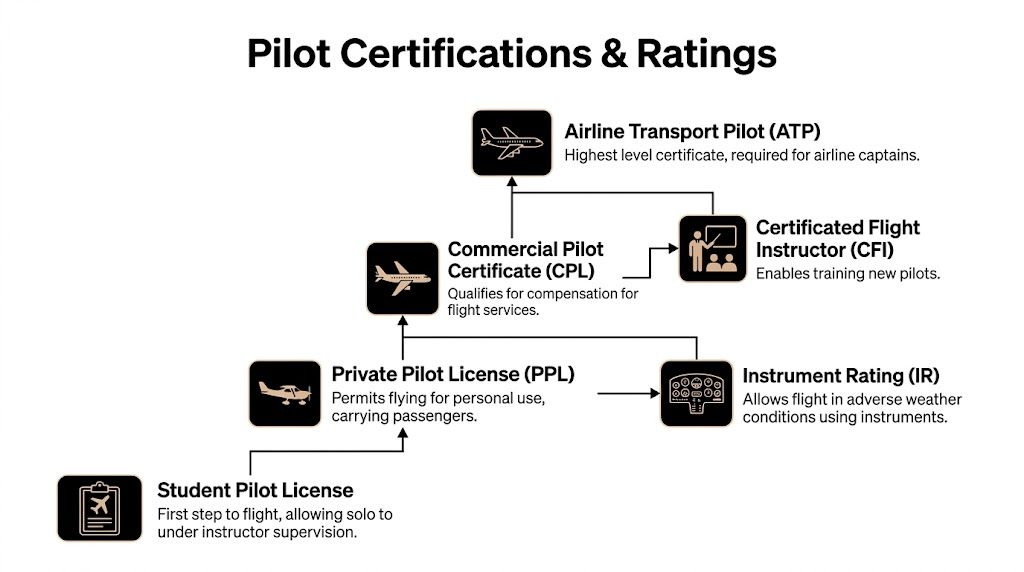
The FAA training path confuses people because it mixes certificates and ratings. Think of a certificate as your base privilege level. Think of a rating as an added capability. You build them in layers.
A student usually starts with a student pilot stage, then moves to Private Pilot, adds Instrument, then earns Commercial, and often adds Multi-Engine if professional flying is the goal. Some continue into CFI and eventually ATP.
The building blocks that matter most
Here’s the plain-English version.
| Certificate / Rating | What It Lets You Do | FAA Minimum Hours (Part 61) | Estimated Cost Range |
|---|---|---|---|
| Student Pilot | Begin training and eventually solo under instructor endorsement | Not specified as a standalone training minimum | Varies by school, aircraft, pace, and materials |
| Private Pilot | Fly for personal use and carry passengers, not for compensation | Varies by route and school | Varies by school, aircraft, pace, and materials |
| Instrument Rating | Fly by reference to instruments and operate more effectively in reduced visibility conditions | Varies by route and school | Varies by school, aircraft, simulator use, and pace |
| Commercial Pilot | Fly for compensation in many operations | 250 hours under Part 61 | Varies widely based on prior time and aircraft used |
| Multi-Engine Rating | Operate aircraft with more than one engine | Add-on rating, not a single universal minimum | Higher than single-engine training due to aircraft cost |
The table’s cost column stays broad on purpose. Schools structure pricing differently, and total spend depends heavily on your frequency, preparation, and how efficiently you learn.
Private Pilot is where you become a real decision-maker
Private Pilot is your foundation. You learn takeoffs, landings, airspace, navigation, weather basics, radio communication, emergency procedures, and how to make safe go or no-go decisions.
Even those pursuing an airline career later often begin here. It’s the point where flying stops feeling magical and starts becoming methodical. That’s a good thing. Safe pilots are built from routines.
If you want a useful overview of how the certificates fit together, this breakdown of pilot certification levels is a helpful companion.
Instrument Rating changes how you think
Instrument training is where many students make a big leap. You stop relying only on the outside view and learn to trust the panel, scan efficiently, and manage workload in a more disciplined way.
This doesn’t only matter for airline pilots. It matters for any pilot who wants sharper procedures, better situational awareness, and safer cross-country capability. Students often tell me this is the phase that makes them feel more professional.
Practical rule: If you think you may fly serious trips later, don’t treat the instrument rating as optional.
Commercial and Multi-Engine are career steps
Commercial training refines precision. The standards get tighter. Your maneuvers, planning, and aircraft control need to show consistency, not luck. Multi-engine training adds asymmetric throughst, higher systems workload, and more complex aircraft management.
One point students often miss is that the commercial certificate isn’t just “more hours.” It’s a different quality of performance.
Part 61 and Part 141 are not the same thing
This is one of the most common areas of confusion in pilot training california searches.
Under Part 61, training is more flexible. It can work well for people with changing schedules, slower pacing, or highly individualized instruction.
Under Part 141, the school follows an FAA-approved syllabus with tighter structure and oversight. That structure can reduce the flight time required for some outcomes. FAA-approved Part 141 schools in California can allow a student to earn a Commercial Pilot Certificate in 190 hours, compared with 250 hours under Part 61, according to the FAA pilot school guidance.
How to choose your path
A simple rule works well:
- Choose Part 61 if you need schedule flexibility and want training adjusted to fit your work, family, or changing availability.
- Choose Part 141 if you want a defined syllabus, checkpoint structure, and a potentially shorter path to some milestones.
- Choose based on fit, not marketing. A well-run school matters more than a label on the door.
Choosing the Right California Flight School
Many students spend too much time comparing websites and not enough time comparing training environments. A clean homepage doesn’t teach landings. The right school does.
Your decision should come down to how that school helps you train consistently, safely, and with minimal friction. In California, where options range from small local operations to structured career programs, the differences matter.

What to evaluate before you enroll
Start with the basics people often overlook.
- Instructor consistency. Ask whether you’ll mostly train with one instructor or bounce between several. Constant handoffs can slow progress.
- Aircraft availability. A good fleet on paper means little if you can’t book it when you’re ready to fly.
- Maintenance culture. You want clean records, grounded aircraft when needed, and no pressure to “just go.”
- Scheduling system. If scheduling is clunky, training often becomes inconsistent.
- Ground training support. Flight lessons go better when the school also helps you prepare on the knowledge side.
A school should be willing to walk you through all of that clearly. If the answers feel evasive, keep looking.
Why the airport itself matters
Where you train shapes the pilot you become.
At a busy towered field, students learn to copy instructions accurately, taxi with purpose, sequence with traffic, and stay ahead of the airplane. That can feel demanding in the beginning, but it builds strong habits. In Southern California, that experience is especially valuable because professional flying often means operating in complex environments.
By contrast, a quieter airport may feel easier at first and may suit some learners well. The tradeoff is that you may need to seek out complexity later rather than absorb it from day one.
The airport is part of the curriculum, even if it isn’t listed in the brochure.
Questions worth asking on a campus visit
Ask direct questions and listen for direct answers.
| Question | Why it matters |
|---|---|
| How far out are lessons typically booked? | Reveals whether the schedule supports momentum |
| What happens if my assigned aircraft goes down for maintenance? | Shows how resilient the operation is |
| Who handles stage checks or progress reviews? | Tells you how training quality is monitored |
| Can I meet current students? | Gives you an unfiltered view of daily experience |
| What kind of flying do students do around this airport? | Shows whether the environment builds practical skill |
After the conversation, walk the ramp. Look inside the aircraft. Watch how instructors brief students. Small details tell you a lot.
A school comparison can help you spot options that match your goals, especially if you’re weighing fixed-wing against helicopter training. This guide to California flight schools is useful because it highlights differences in fleet and training focus, including rotorcraft pathways.
Later, when you’re narrowing your list, it helps to hear how a school presents itself and what training feels like on site.
Don’t ignore specialty needs
Some students know from the beginning that they want helicopters, not airplanes. Others care about multi-engine access, advanced avionics, or a future instructor route. Those details should shape your search early.
Some California schools, including schools covered in the comparison above, offer specialized training on aircraft such as the Enstrom F-28A helicopter, which matters if you’re interested in rotorcraft options that many fixed-wing-focused guides barely mention. If helicopters are your goal, make sure the school treats rotary training as a real program, not a side offering.
A Closer Look at DuBois Aviation at Chino Airport
A useful way to judge any school is to ask whether its setup matches the advice experienced instructors usually give. Does it offer consistent aircraft access, varied training capability, a realistic operating environment, and enough support for a student to keep moving?
At Chino Airport, that question becomes practical very quickly. A towered Class D field changes the pace of training. Students work with tower communications early, taxi among active operations, and learn to manage radio workload while still mastering the basics. That can feel like a lot on lesson one, but it tends to produce pilots who are less intimidated by busy airspace later.
What the environment adds
Chino isn’t just a place where airplanes sit. It’s part of the learning process.
A student who trains in that setting gets used to reading back instructions clearly, entering traffic flow with discipline, and staying organized during departure, pattern work, and arrivals. Those habits matter whether the long-term goal is business aviation, airline training, weekend cross-country flying, or helicopter work.
Fleet variety changes what’s possible
One of the easiest ways a student loses momentum is needing to switch schools for the next rating. That often happens when a school can handle the private certificate but not the next step.
Here, the fleet matters. The published lineup includes Piper Cherokees, a Cessna 150, a Mooney M20B, a Piper Apache, and both Robinson and Enstrom helicopters. That range matters because each aircraft supports a different phase of growth. A trainer for fundamentals, a complex or high-performance platform for endorsements, a twin for multi-engine work, and rotorcraft options for helicopter students.
Curriculum and pacing
A good curriculum doesn’t just list lessons. It gives the student a repeatable way to prepare, fly, debrief, and come back stronger on the next lesson.
The school describes using Jeppesen learning materials, one-on-one instruction, an in-house simulator, and seven-day scheduling through an online booking system. For the right student, that combination can reduce one of the biggest training problems, which is not motivation but inconsistency. If you can book regularly, study against a known structure, and practice procedures on the ground, your learning curve usually improves.
The strongest students aren’t always the most naturally talented. They’re often the ones who train on a repeatable schedule.
Programs for more than one type of student
Another sign of a mature training operation is whether it serves only one narrow profile or supports multiple entry points into aviation.
The published program mix includes private, instrument, commercial, and multi-engine airplane training, helicopter training, an Airline Career Program, youth aviation camps, a Flyers Club, aircraft rental for certificated pilots, and scenic helicopter discovery flights. That matters because real aviation communities aren’t made up of only career-track students. They include teenagers, working adults, returning pilots, aircraft renters, and future owners.
Why this case matters for school selection
You don’t need to train at a large school to build a serious foundation. You do need the right combination of instruction, aircraft, and operating environment.
Chino-based training is a good example of what prospective students should look for anywhere in California. Not a flashy promise. A functional setup that teaches communication, precision, and cockpit management in real conditions.
Your Flight Path Financing and Career Outlook
A lot of prospective pilots reach the same moment. The first lesson sounds exciting, the long term career path sounds promising, and then the spreadsheet comes out. The numbers feel heavy. That reaction is normal.
Flight training is less like buying a product and more like funding a long course of study with moving parts. Airplane availability, instructor continuity, weather, your work schedule, and how often you can train all affect what you spend. A lower advertised rate can still cost more if gaps between lessons force you to relearn skills over and over.

How to judge the cost the right way
Start by asking a better question. Which training setup gives you the clearest path to finish on time and at a steady pace?
That shift matters. A school with organized scheduling, reliable aircraft, and instructors who teach to a clear syllabus often helps students avoid one of the biggest budget traps in aviation, which is repetition caused by inconsistency. If you train once, then wait three weeks, part of the next lesson becomes review. In practical terms, your wallet pays for rust.
Southern California can help here if you use the environment well. More flyable days often means fewer weather cancellations and better training continuity than students get in many other parts of the country. Busy airspace also builds habits that employers value later, because you learn to listen carefully, plan ahead, and stay calm while handling radio work and cockpit tasks at the same time.
Common ways students pay for training
Few students pay for every rating from one source. A mixed plan is more common and usually more realistic.
- Savings. This gives you flexibility and can reduce stress, especially during private pilot training.
- School-supported financing options. Some programs help students review payment paths and timing. A good place to start is this guide to financial aid for pilot training.
- Family support. Many younger students use this for the early stages, then shift to self-funding as they progress.
- Scholarships and nonprofit programs. These can make a real difference for students who have interest and aptitude but limited access.
Organizations such as the Fly Compton Foundation matter for that reason. Aviation has never had a talent shortage. Access has been the harder problem.
Build a timeline before you borrow
This is the part students often skip.
Map the full path, not only the first certificate. Private pilot is the entry point, but career-track students often continue to instrument, commercial, multi-engine, and flight instructor certificates to build experience and income. If your goal is professional flying, ask how long each stage may take, how often you can realistically train, and what interruptions could slow you down.
A simple plan works better than an optimistic one. If you work full time, care for family, or can only fly on weekends, build your budget around that reality. Finishing a little slower on a schedule you can sustain is usually better than starting fast, running short on funds, and stopping midway.
Career outlook is strong, but careers grow in steps
The earning potential in aviation is real, and so is the gap between your first certificate and your first high-paying job. As noted earlier in this article, federal labor data points to steady hiring demand for pilots. What matters for planning is understanding the staircase.
The first paid flying job is often a time-building job. Many California pilots instruct, fly survey, work in charter support, or move into other commercial roles before reaching airline or corporate seats. That is normal. It is how experience is built.
California gives you a useful advantage here too. The state has a dense aviation ecosystem. Flight schools, busy general aviation airports, charter activity, corporate aviation, maintenance shops, and aircraft owners all create more ways to stay involved and keep building flight time. For students thinking beyond the checkride and into the ownership or business side of aviation, these insights from the National Business Aviation Association (NBAA) provide helpful context.
One more practical point. Your first aviation job does not need to be your forever job. It needs to teach judgment, build time, and keep you progressing. That is how a student pilot in California grows into a professional, and in some cases into an aircraft owner later on.
Beyond Certification Buying and Selling Aircraft in California
A lot of training guides stop at the checkride. Real aviation life doesn’t. After certification, some pilots rent for years. Others join clubs. Some start looking at aircraft ownership much sooner than they expected.
Buying an airplane or helicopter can be smart, but only if you do it carefully. The wrong purchase can drain your budget, ground your flying, and create maintenance headaches that destroy the joy of ownership.
How to buy an aircraft the safe way
Start with this mindset: you are not buying a car with wings. You are buying a machine with a maintenance history, legal paperwork, operating limitations, and a future support burden.
Use a disciplined process.
Define the mission first
Don’t shop by paint scheme or panel photos. Decide what the aircraft needs to do. Local proficiency flights, family travel, mountain flying, helicopter sightseeing, time-building, or business use all point to different aircraft choices.Review the logbooks before you fall in love
Missing logs, long maintenance gaps, recurring unresolved issues, or confusing entries are warning signs. If the paperwork is disorganized, ownership may be too.Get a true pre-buy inspection
This is not optional. Use a mechanic or shop with experience in that aircraft type, and make sure the inspector works for you, not the seller. A pre-buy should look at airframe condition, engine history, damage history, corrosion risk, avionics condition, and overall maintenance quality.Check title and liens
You need to know who owns the aircraft and whether any financial claims are attached to it. Clean paperwork matters as much as mechanical condition.Talk to insurers early
Some buyers shop first and call insurance later. Reverse that. Insurance availability, training requirements, and transition expectations can affect whether a specific aircraft is practical for you.
Airplane buying mistakes I see repeatedly
These are common and expensive.
- Buying too much airplane. A complex, fast aircraft may sound efficient, but it can increase insurance cost, training demand, and stress.
- Assuming fresh paint means healthy mechanics. Cosmetic work can hide neglect.
- Ignoring support reality. Some aircraft are wonderful in the air and difficult on the ground because parts, mechanics, or type-specific knowledge are hard to find.
- Skipping a mission fit check. If you mostly fly solo locally, don’t buy around a fantasy mission you may never fly.
A safe purchase starts with restraint. The best aircraft for your next two years may not be the aircraft you dream of owning forever.
Selling takes preparation too
If you’re selling, organize the aircraft before you list it.
Clean logbooks, current status information, readable records, and realistic pricing help serious buyers move faster. If there are known issues, disclose them early. Bad surprises kill deals and damage trust.
Where flight schools fit into ownership
Flight schools and local aviation communities can help more than many people realize. Instructors often know who’s buying, who’s selling, which mechanics know a specific type, and what aircraft make sense for a newly certificated owner.
That doesn’t replace legal, title, and maintenance due diligence. It does give you practical local knowledge, which can save you from chasing the wrong airplane or helicopter.
Conclusion Your Next Steps to Take Flight
Many individuals don’t need more inspiration. They need a clean first move.
If you’ve made it this far, you probably already know whether aviation keeps pulling at you. The key question is whether you’ll turn interest into action while the motivation is still fresh.
Here’s a practical sequence that works.
Book a discovery flight
That gives you a direct feel for the cockpit, the airport environment, and whether training feels exciting in practice, not just online.Get your FAA medical questions answered early
If you think you may pursue flying seriously, handle this sooner rather than later. It removes uncertainty.Visit at least two schools in person
Compare how they schedule, brief, maintain aircraft, and talk to students.Choose a training frequency you can sustain
A realistic schedule beats an ambitious one you can’t keep.Start ground study immediately
Students who study between flights retain more and waste less time in the airplane.Think beyond the first certificate
Even if you’re starting for fun, understand where private, instrument, commercial, and ownership possibilities may lead.
Aviation rewards people who start before they feel completely ready. If you’re waiting to feel like “pilot material,” that feeling usually comes after training begins, not before.
Frequently Asked Questions About Pilot Training
Do I need a medical certificate before I start?
You can take a first lesson before getting your FAA medical, and many students do. If you think flying may become more than a one-time experience, handle the medical early. It is much better to answer that question after a few lessons than after months of training and expense.
A good first step is simple. Take the discovery flight, then talk with an instructor about which class of medical matches your goals.
How often should I fly as a beginner?
Try to train often enough that each lesson builds on the last one. For many beginners, that means two or three flights a week if schedule and budget allow. Once a week can still work, but progress is usually slower because you spend more time relearning the feel of the airplane, the checklists, and the radio flow.
Flying skills work a lot like learning a musical instrument. Regular practice keeps the basics from getting rusty.
Is a busy Southern California airport too hard for a beginner?
Busy does not mean wrong for a beginner. It means you will learn sooner how to stay organized, listen carefully, and speak clearly on the radio.
Southern California gives you a training environment with real variety. You may deal with towered airport procedures, dense traffic, changing weather along the coast and inland valleys, and complex airspace all within a relatively small area. That can feel demanding in the first few lessons, but it often produces pilots who are more comfortable outside the pattern later because they started in an environment that asked them to think ahead.
Should I choose airplane or helicopter training first?
Start with the aircraft that fits the kind of flying you want to do. Airplane training makes sense for personal travel, time-building, and the airline or corporate path. Helicopter training fits students aiming for rotorcraft jobs such as tours, utility work, certain public service roles, or helicopter charter.
The wrong first choice usually costs money. The right one gives your training a clear direction from day one.
What’s the difference between training in a Cessna, Piper, Mooney, or helicopter?
A Cessna or Piper is usually the right classroom for primary training. Both are common trainers because they are forgiving enough to let you focus on the fundamentals: attitude control, trim, landings, checklists, and good judgment.
A Mooney is different. It is faster, often more complex, and better matched to pilots who already have solid basics and want to step into cross-country efficiency and aircraft ownership questions.
Helicopters are a separate skill set from the start. The control inputs are more active, the coordination demands are different, and the workload can feel higher in hover and low-speed operations. Students interested in both fixed-wing and rotorcraft should treat them as two tracks, not as small variations of the same thing.
Are structured schools actually more effective?
For many students, yes. A structured school gives you a clearer syllabus, more predictable stage checks, and fewer gaps between what you study on the ground and what you practice in the airplane. That does not guarantee success, but it often helps students who want accountability and a visible path from first lesson to checkride.
As noted earlier, one California aviation university reported a strong program completion rate, which supports the basic point here. Organized training often makes it easier to stay on pace than a loose, lesson-by-lesson approach.
What if I want to own an aircraft someday?
That goal deserves more thought than a quick online search and a handshake on a used airplane. Train first. Rent different aircraft. Talk with instructors, mechanics, and owners who fly for the same reasons you expect to fly.
Aircraft ownership in California can be rewarding, especially if you want scheduling freedom or regular family and business travel, but the purchase price is only one part of the decision. Maintenance history, hangar or tie-down availability, insurance, mission fit, and pre-buy inspections matter just as much. The students who make the best ownership decisions usually start planning well before they ever shop.
If you’re ready to move from research to action, DuBois Aviation offers airplane and helicopter training, discovery flights, aircraft rental, and a Southern California training environment at Chino Airport that can help you start with a clear next step.


