You're probably here because spin training sounds important, but also a little abstract. Maybe you're working on a certificate, getting back into flying after time away, or thinking ahead to owning your own airplane and wondering how deep you really need to go on stalls, spins, and loss of control.
That's a fair question. Most pilots won't spend their flying lives doing intentional spins. But every pilot can end up close to the conditions that produce one, especially when the workload rises, the turn gets rushed, or attention narrows at the wrong moment. That's why spin awareness training matters. It teaches you to recognize the chain early, break it early, and stay ahead of the airplane.
Why Spin Training Is a Core Pilot Skill
A classic setup catches pilots because it starts as something ordinary. You're turning from base to final. The runway feels like it's slipping away. You add a little more bank, maybe a touch of rudder to hurry the nose around, and airspeed starts eroding while your attention shifts outside. That sequence can move from a stall to a spin faster than many students expect.
The FAA's guidance explains why this subject became central to training. It notes that an FAA study found stall/spin-related accidents accounted for approximately one-quarter of all fatal general aviation accidents, a finding that helped drive later training changes in Part 61 and the current emphasis on awareness and recovery training in AC 61-67C.
Prevention matters more than bravado
Students sometimes hear “spin training” and picture aerobatics, unusual attitudes, or a specialized skill for a small group of pilots. That's the wrong frame. In everyday flying, its primary value isn't showing that you can recover from a fully developed spin. It's learning to identify the warning signs before the airplane gets there.
Those signs are practical and familiar:
- A tightening turn when you're tempted to salvage the approach instead of going around
- Increasing back pressure as you try to hold altitude while airspeed decays
- Uncoordinated rudder use that sneaks in when you rush alignment
- Tunnel vision that keeps your eyes on the runway and away from energy cues
Practical rule: If the approach starts asking for heroic control inputs, stop trying to rescue it. Go around.
That's why I teach spin awareness as a confidence skill. A pilot who understands stall onset, yaw, and coordination usually flies calmer patterns, makes cleaner go-around decisions, and doesn't feel the need to force the airplane into doing something it's warning against.
Why this matters even more for future owners
If you plan to buy an airplane or helicopter, your margins become your responsibility in a more personal way. You're no longer just learning maneuvers for a checkride. You're making decisions about loading, runway choice, wind, currency, and how accurately you assess your own proficiency.
Spin awareness training supports that judgment. It sharpens the habits that keep normal flying normal, which is what aircraft ownership really demands.
Understanding the Aerodynamics of a Spin
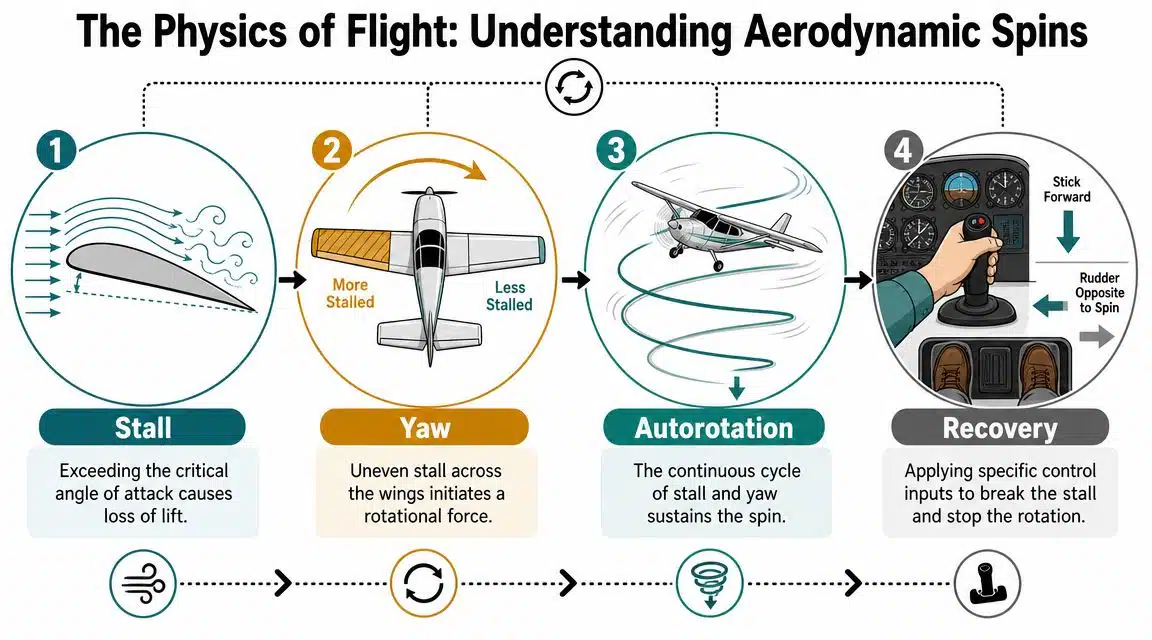
A spin is easier to understand when you strip away the mystery. Think of it as two things happening at once. The airplane is stalled, and it's also rotating. One wing is more stalled than the other, so the airplane keeps yawing and descending in an autorotative motion.
That's different from a simple stall, where the wing exceeds its critical angle of attack and lift breaks down, but the airplane may not yet be rotating. It's also different from a spiral dive, where the airplane is turning and descending rapidly, but the wings are not necessarily stalled.
The two ingredients you need to watch
A spin needs two ingredients.
First, the wing must be stalled. That means the airplane has exceeded the critical angle of attack. If you want a clean explanation of that concept, this guide on angle of attack is worth reviewing before advanced maneuver training.
Second, the airplane needs yaw. Not roll by itself. Not just a nose drop. Yaw. Once yaw combines with a stall, one wing sees a different angle of attack than the other. The more stalled wing drops back, the less stalled wing moves ahead, and the rotation feeds itself.
Where students usually get confused
Many pilots mix up spin, spiral, and stall because all three can involve a descending nose and a strong sense that things are happening quickly. The fixes are different, so the distinction matters.
| Condition | What's happening | Main risk cue |
|---|---|---|
| Stall | Wing exceeds critical angle of attack | Buffet, mushy controls, loss of lift |
| Spin | Stall plus yaw creates autorotation | Rotation with stalled wing condition |
| Spiral dive | Steep descending turn, often with rising airspeed | High speed, high load factor, tightening descent |
A spin doesn't start because the airplane “just rolled.” It starts because the airplane stalled while yaw was present.
How this differs from upset recovery
General upset prevention and recovery training covers a broader set of unusual attitudes and loss-of-control events. Spin awareness training is narrower and more specific. It focuses on how stalls progress, how yaw enters the picture, and how a pilot interrupts that sequence before or during spin entry.
That's why spin awareness belongs in normal flight training. It isn't a side topic for thrill-seeking pilots. It's a precise study of how ordinary errors in coordination and energy management can combine into something serious.
The Complete Spin Awareness Training Curriculum
A good spin awareness course isn't one flight and a dramatic demo. It's a layered curriculum. Students learn the concepts on the ground, rehearse the sequence in a simulator or procedural trainer when available, and then apply those lessons in the airplane with a qualified instructor.
Ground briefing
The ground phase is where the training becomes orderly instead of intimidating. You learn what a spin is, what it is not, what your aircraft's approved procedures are, and what limitations matter before anyone starts an engine.
Topics usually include:
- Aerodynamics in plain language so you can explain stall, yaw, and autorotation without memorizing jargon
- Aircraft-specific procedures because spin entry and recovery guidance must match the approved airplane and POH
- Human factors such as startle, overcontrol, fixation on the runway, and delayed go-around decisions
- Regulatory context so you understand the difference between awareness training and intentional spin requirements
Simulator practice
A simulator can't replace every physical sensation of flight, but it can do something extremely valuable. It lets you slow the sequence down and rehearse the decision points without pressure.
Students often benefit from practicing:
- pattern scenarios that begin normally and then deteriorate
- overshoots from base to final
- go-arounds with rising workload
- distractions that pull attention away from coordination and angle of attack
In spin awareness training, a student learns that spin prevention starts long before rotation. It starts with recognizing a bad setup and refusing to force the approach.
In training, the best recovery often begins with a decision made ten seconds earlier.
Supervised in-air exercises
The flight portion should feel structured, not theatrical. A qualified CFI briefs each maneuver, demonstrates when appropriate, and keeps the lesson focused on recognition, prevention, and disciplined recovery inputs in an approved aircraft.
Here's what that progression often looks like.
| Training Phase | Key Learning Objectives |
|---|---|
| Ground Briefing | Understand stall and spin aerodynamics, aircraft limitations, approved procedures, and common accident chains |
| Simulator Practice | Rehearse recognition, decision-making, pattern errors, distraction management, and recovery flow in a low-risk environment |
| Supervised In-Air Exercises | Experience stall cues, coordination errors, spin entry characteristics where appropriate, and recovery under direct instructor supervision |
What students usually gain
By the end of a solid course, students usually stop treating spins as a mysterious event that “happens out of nowhere.” They see the setup earlier. They respect coordination more. They make go-around decisions sooner. And they stop confusing confidence with trying to save a bad approach.
That's the point of the curriculum. Not drama. Judgment.
Is Spin Training Required for Your Certificate
A student pilot turns base to final a little tight, adds inside rudder to hurry the nose around, and suddenly the airplane feels wrong. That sequence is why this question matters. Pilots often ask whether spin training is required for the checkride, but the better safety question is what level of spin knowledge prepares you to catch a developing loss-of-control event before it becomes one.
For most certificates, the FAA requires spin awareness, not intentional spin demonstrations. Private, instrument, and commercial pilots are expected to understand stalls, coordination errors, and the situations that can lead to a spin. Intentional spin training is typically required for flight instructor-airplane and flight instructor-glider applicants, as outlined in FAA AC 61-67C. If you are mapping that requirement against the broader training sequence, this guide to pilot license levels shows where those certificates fit.
What the requirement means in practical terms
The FAA's distinction is simple. Every pilot needs hazard recognition. A smaller group of pilots needs demonstrated proficiency in intentional spins because they will be teaching, demonstrating, and evaluating those situations.
That difference can confuse students. If intentional spins are not required for a private pilot checkride, some assume spin awareness is a minor topic. It is not minor at all. It sits underneath safe takeoffs, coordinated pattern work, go-around decisions, and approach discipline. In other words, the regulation draws the minimum line for certification. Good training aims higher because real-world flying does not grade on a written standard alone.
For pilots who expect to own and operate their own aircraft, this matters even more. Aircraft ownership brings freedom, but it also removes the habit of flying only with an instructor nearby. Spin awareness helps owners recognize the setup early, protect their margins, and avoid the kind of low-altitude mistakes that leave no time to sort things out.
Who benefits most from going beyond the minimum
Spin awareness training is especially useful for pilots who are:
- Sharpening pattern discipline and want cleaner coordination on takeoff, landing, and go-around
- Transitioning to a different aircraft with a new sight picture, control feel, or energy profile
- Returning to flying after time away and want to rebuild judgment along with stick-and-rudder precision
- Preparing for aircraft ownership and want stronger loss-of-control prevention habits before flying more independently
A good way to view it is this. The certificate requirement tells you what must be covered. Spin awareness training shows you how those ideas appear in the cockpit, during ordinary flights, when workload rises and small errors begin to stack up.
For instrument and commercial pilots, the payoff often shows up in routine flying. Better rudder coordination, better angle-of-attack awareness, and earlier recognition of a deteriorating approach all improve day-to-day safety.
Safety Protocols for Spin and Upset Recovery
Students are right to ask whether spin training itself is safe. The honest answer is that it has to be conducted with discipline. When it is, the lesson is controlled, briefed, and built around margins.
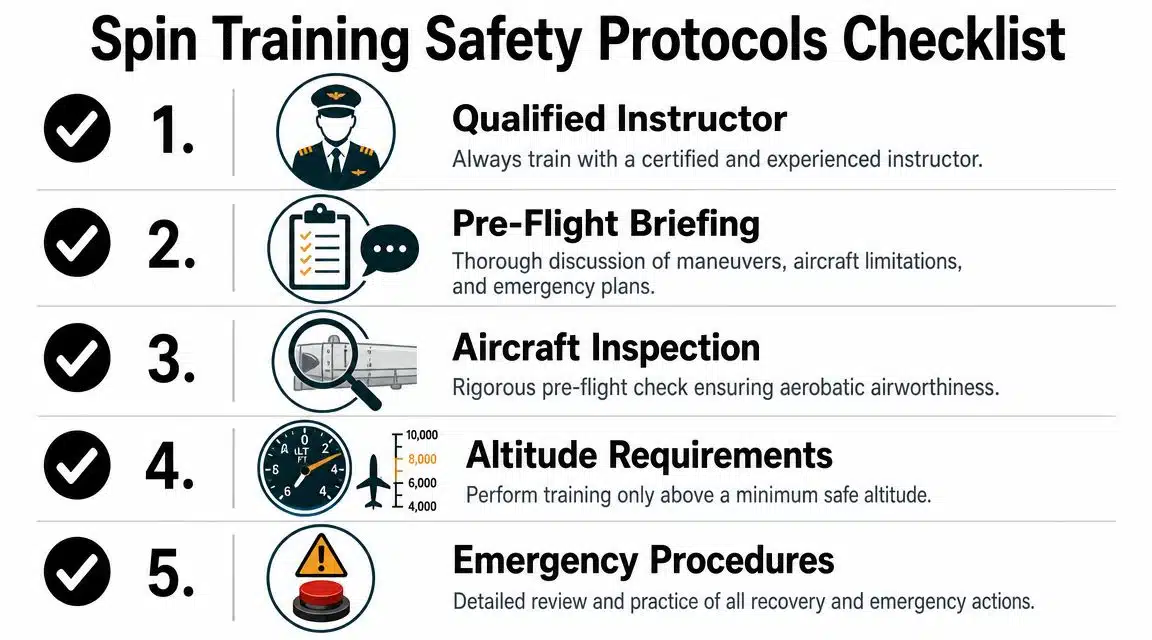
One of the clearest examples is altitude. A widely cited summary notes that the FAA recommends spin practice for instructor candidates begin above 3,500 feet AGL, while recovery should be complete by 2,000 feet AGL or higher in the Canadian guidance discussed in the same review at Rapp.org's summary of mandated spin training. Those numbers matter because they show the maneuver is not taught down low where options disappear.
What a professional training setup looks like
Before any maneuver, the instructor should confirm that the aircraft is approved for the training being conducted and loaded within applicable limits. That includes weight and balance, aircraft category limitations, and a clear understanding of the published recovery procedure for that exact airplane.
A disciplined lesson also uses standard checks before maneuvering. Many instructors use a HASELL-type flow or a similar framework to verify height, area, security, engine, lookout, and limitations. The exact mnemonic matters less than the habit of not freelancing.
Crew coordination matters too, even in small training aircraft. Clear task sharing, verbal confirmation, and mutual awareness reduce mistakes. The same communication habits taught in crew resource management improve advanced maneuver training because both pilots know who is flying, what comes next, and when the lesson stops.
What students should expect before the first entry
A careful instructor will brief these points clearly:
- Entry conditions including altitude, area, weather, and aircraft configuration
- Recovery gates so everyone knows when the maneuver must be terminated
- Transfer of controls with exact wording and no ambiguity
- Emergency considerations such as what happens if the aircraft doesn't respond as expected
Why the safety mindset matters
The skill you're really learning is not “how to be fearless.” It's how to respect the envelope, use procedure, and leave room for recovery. That mindset carries directly into normal operations.
A pilot who trains this way tends to fly patterns with more margin, abandons unstable approaches earlier, and avoids treating low altitude as a place to experiment.
Your Spin Training Pathway at DuBois Aviation
The practical value of spin awareness shows up in ordinary flying, not just in maneuver practice. A pilot can get into trouble during takeoff, a rushed return to the runway environment, an overshoot in the pattern, or a go-around where pitch, power, trim, and rudder all need attention at once.
That's why a useful training pathway combines aircraft handling with realistic workload. A school operating from a towered airport adds another layer. You're not just manipulating controls in a quiet practice area. You're also learning to manage radio calls, sequencing, and task saturation without giving away coordination or airspeed.
How the pieces fit together in real training
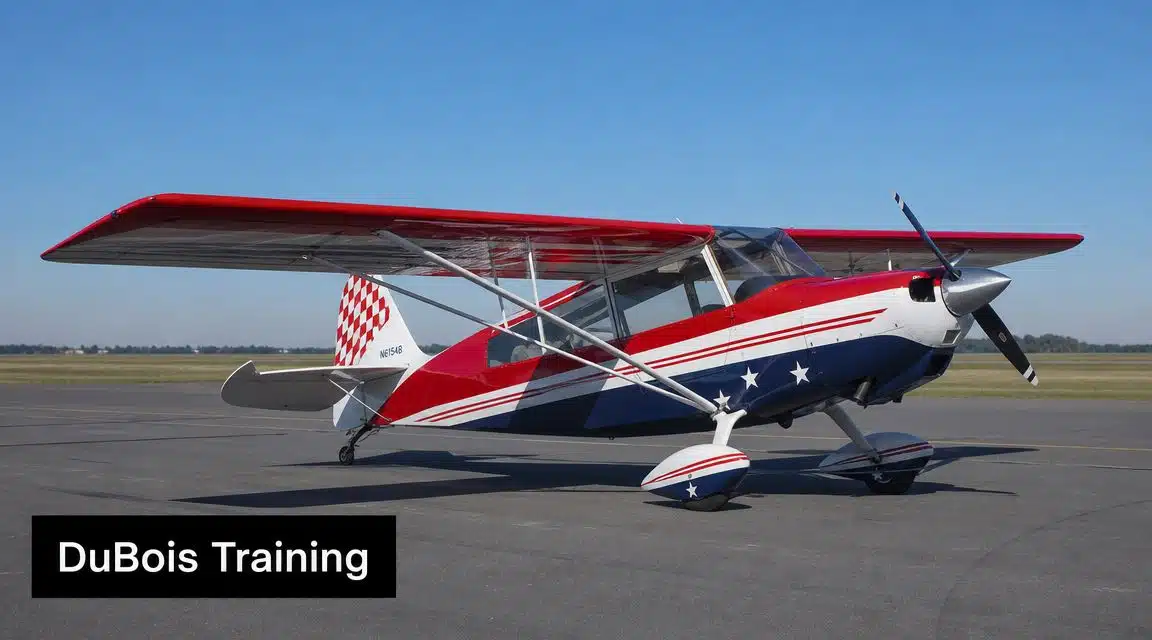
At DuBois Aviation, students can connect classroom discussion, simulator work, and aircraft instruction within the same training environment at Chino Airport. The school operates a fleet that includes a Cessna 150, multiple Piper Cherokees, a Mooney M20B, a Piper Apache, and both Robinson and Enstrom helicopters, along with an in-house simulator and one-on-one instruction.
That matters because spin awareness is never just about one maneuver. In a trainer like the Cessna 150, the lesson may center on clean recognition of stall cues, rudder discipline, and recovery flow in an aircraft commonly used for foundational stick-and-rudder work. In a more advanced transition context, the same awareness helps a pilot respect how quickly task loading can build during go-arounds, traffic pattern compression, or unfamiliar aircraft handling.
What a student should look for in any provider
Whether you train locally or elsewhere, evaluate the program on specifics:
- Approved aircraft and procedures that match the lesson being offered
- Instructor experience with stall, spin awareness, and upset prevention
- A structured syllabus rather than a one-off “demo flight”
- Scenario-based teaching that connects the maneuver to takeoffs, arrivals, and go-arounds
A good pathway leaves you with more than a memory of rotation. It leaves you with better timing, better coordination, and better judgment in the phases of flight where pilots are busiest.
Next Steps From Advanced Training to Aircraft Ownership
A lot of pilots reach a point where basic training no longer feels like the whole picture. They've earned a certificate, built some time, and started thinking bigger. Maybe that means an instrument rating. Maybe it means transition training into a faster airplane. Maybe it means finally buying the aircraft they've been shopping for.
That's where spin awareness becomes more than an “advanced topic.” It becomes part of ownership readiness.
The FAA has emphasized in its safety material that the most common loss-of-control accidents involve an aerodynamic stall that progresses into a spin during critical phases like base-to-final turns or go-arounds, and that effective training focuses on stall recognition under load and distraction management in those moments, as discussed in the FAA Safety Briefing magazine. Those are exactly the skills that matter when you move from supervised training flights to operating your own aircraft.
A safer path into buying an airplane
A smart buyer usually focuses on the machine first. Is the airplane clean? Is the engine time acceptable? Does the panel fit the mission? Those are valid questions, but they aren't enough by themselves.
Your training plan matters just as much. Before buying, think through:
- Transition risk if the aircraft is more capable than what you've been flying
- Mission realism so your purchase matches your true experience and not just your ambition
- Recurrent training because ownership rewards consistency, not occasional heroics
- Decision habits such as when you go around, when you decline a flight, and how you handle pressure
That same logic applies to helicopter buyers. Rotorcraft operations demand disciplined energy management, precise control, and honest self-assessment. A pilot who already treats loss-of-control prevention as a daily habit enters ownership with a stronger safety foundation.
What buying the safe way looks like
“Buying the safe way” usually means slowing the process down. Train first. Transition thoroughly. Get current in the type you plan to operate, or in something close enough to clearly reveal the workload. Ask whether your recent flying supports the mission you want to take on.
A safer ownership path often includes:
- Refresher and advanced proficiency work before shopping seriously
- Mission-based aircraft selection instead of buying the biggest step-up you can afford
- Type-specific transition training after purchase and before regular use
- A standing plan for recurrent training so proficiency doesn't fade after the excitement of closing the deal
The safest airplane purchase is the one that matches both your mission and your present skill, then gives you room to grow with training.
Spin awareness fits into that pathway because it trains humility in a useful way. It reminds you that airplanes don't care what you intended to do. They respond to angle of attack, yaw, coordination, and energy. A pilot who keeps those basics sharp is usually the pilot who buys more wisely, transitions more smoothly, and flies longer with fewer surprises.
If you're planning your next rating, preparing for transition training, or thinking about buying an airplane or helicopter, DuBois Aviation can be part of that progression with one-on-one airplane and helicopter instruction, simulator access, and training at Chino Airport that connects proficiency work to real-world operations.


