
A student turns downwind at a busy towered airport, hears two fast radio calls, spots traffic late, and starts chasing the airplane. A more experienced pilot in the same moment has already pictured the pattern, expected the call, and adjusted early. That difference is situational awareness.
When people ask what is situational awareness in aviation, they usually expect a short definition. The real answer is more useful than that. It’s the skill of noticing what matters, understanding what it means, and staying mentally ahead of what happens next, whether you’re taxiing for a first lesson, shooting an instrument approach, or evaluating an airplane you may buy.
More Than a Buzzword Why Situational Awareness Matters
A pilot on base leg hears tower say, “Traffic short final, caution wake turbulence, continue, I’ll call your turn.” Nothing is technically wrong yet. But a pilot with good situational awareness has already noticed the larger airplane ahead, understood where its wake will drift, and started planning spacing instead of waiting for the runway to disappear under stress.
That’s what instructors mean when they say, “Stay ahead of the airplane.” They don’t mean fly faster. They mean keep a current mental picture of the aircraft, the traffic, the weather, the runway, the radio flow, and your next likely decision.
Why this matters on every flight
Situational awareness is not just an advanced concept for airline crews. Student pilots need it on the very first taxi, because flight training is full of rapidly changing cues. A heading changes. Another aircraft reports a position you didn’t expect. Winds shift. A simple checklist item gets interrupted by radio traffic.
The safety stakes are high. Approximately 75% of all aviation accidents and incidents stem from human failures in monitoring, managing, and operating systems, which is why situational awareness sits so close to the center of safe flying, as noted in this situational awareness editorial from Clay Lacy Aviation.
Practical rule: If you’re surprised by something in the cockpit, ask yourself whether the surprise came from missing information, misreading information, or failing to think one step ahead.
Ahead of the airplane versus behind it
New pilots often get confused because they think situational awareness means “looking around more.” Looking matters, but SA is bigger than scanning.
A pilot who is behind the airplane is reacting:
- Late on radio calls because mental workload is already maxed out
- Late on checklists because each task interrupts the next
- Late on traffic recognition because attention is stuck inside the cockpit
A pilot who is ahead of the airplane is anticipating:
- Expected instructions before ATC gives them
- Expected configuration changes before the airplane demands them
- Expected threats before they become emergencies
It’s perishable, but trainable
Good situational awareness isn’t a personality trait. It’s a trainable safety habit. Some days it’s easier. Fatigue, distraction, stress, and rushing can erode it fast. But pilots can strengthen it with disciplined scan habits, better briefings, scenario practice, and honest debriefs after each flight.
That’s why experienced instructors care so much about it. Smooth landings look impressive. Strong situational awareness keeps pilots alive long enough to master the rest.
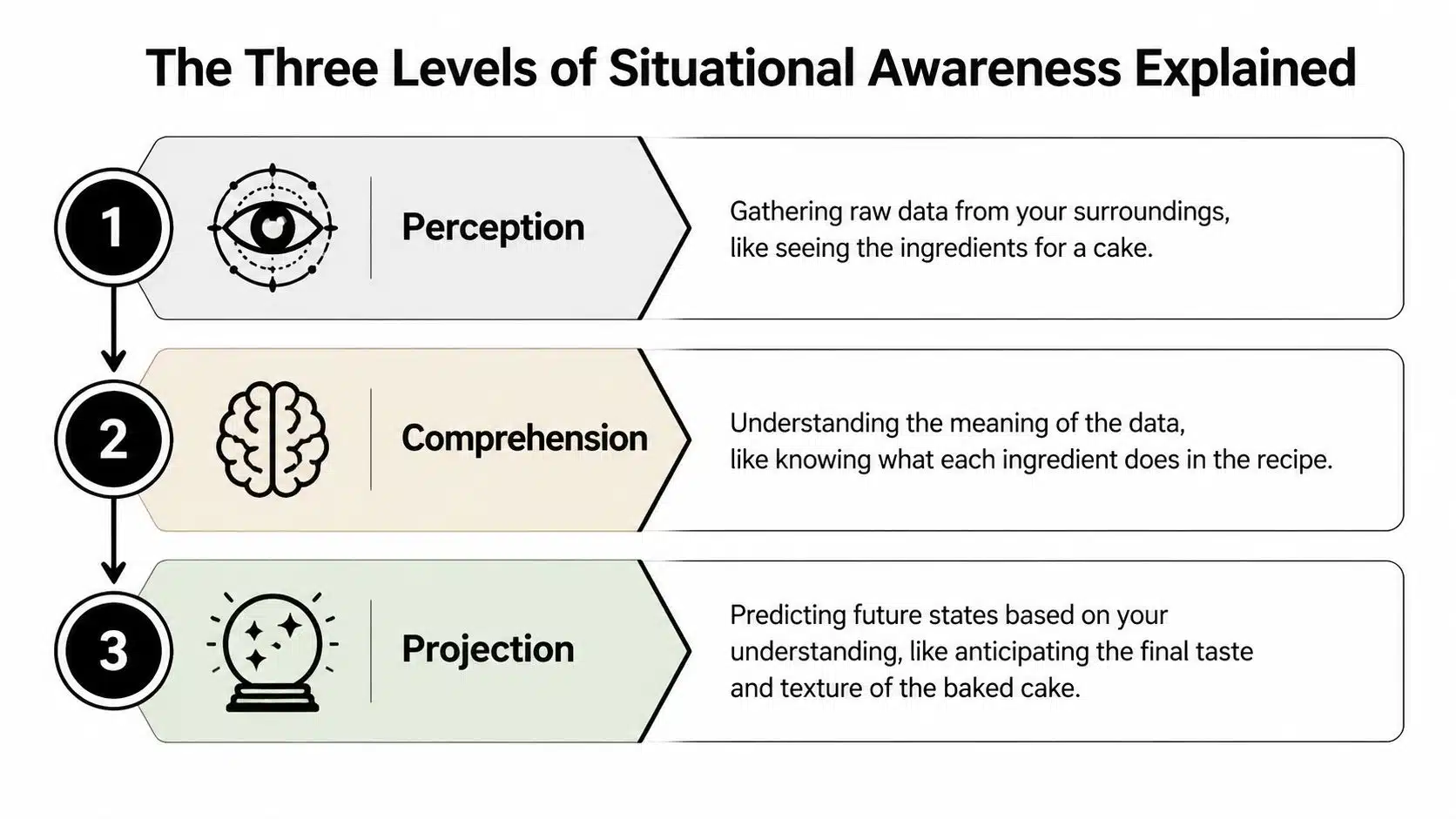
The Three Levels of Situational Awareness Explained
The cleanest way to understand situational awareness is through a simple three-part model. Think of baking a cake.
You look at the counter and see flour, eggs, sugar, butter, and a pan. That’s one step. You realize those ingredients form a cake recipe. That’s the next step. Then you recognize you’d better preheat the oven now, or dinner will be late. That’s the third step.
Level 1 perception
Perception means noticing the relevant pieces of information around you.
In flying, that includes the obvious and the subtle. You see an aircraft entering on the 45. You hear tower clear another airplane for takeoff. You notice your altitude drifting. You catch that the wind is pushing you wider on downwind than usual.
Students often think perception is easy because the data is “right there.” It isn’t always. Under workload, pilots miss things in plain sight. The classic trap is fixation.
The Endsley model (1988), widely adopted in aviation, shows how failures cascade; for instance, perceptual tunneling, fixating on one instrument amid high workload, leads to 76% of SA-related general aviation accidents, per FAA human factors analyses, as summarized in this Pilot Institute explanation of situational awareness.
A common training example is the student who becomes so focused on holding altitude that they stop looking outside. Another is the pilot who stares at the moving map and misses conflicting traffic in the pattern.
Level 2 comprehension
Comprehension means understanding what the information means in context.
Raw data transforms into a usable picture. Seeing traffic is perception. Realizing that traffic is faster than you, is above you, and will turn inside your path is comprehension.
At a busy towered airport, this matters constantly. A student hears, “Report midfield downwind, number two following a Cherokee on base.” If the student doesn’t identify the Cherokee, they may technically hear the instruction but still lack comprehension. They have words, not understanding.
Here’s another way to think about it:
| What you notice | What it means |
|---|---|
| Your groundspeed is higher than expected | The tailwind may affect spacing and descent timing |
| A helicopter is operating near the pattern | Your visual scan and expectations need to widen |
| ATC sounds busy and compressed | You should prepare mentally for shorter, faster instructions |
Comprehension is where judgment starts. It answers, “So what?”
Level 3 projection
Projection means predicting what is likely to happen next if nothing changes.
This is the part new pilots usually underuse. They’re so busy processing the present that they don’t think forward. But projection is what gives a pilot time.
You see a slower airplane ahead. You understand it may still be on the runway when you turn final. Then you project the likely outcome: extended downwind, go-around possibility, or a delayed turn. That forecast lets you plan instead of scramble.
Projection is what keeps a pilot from getting trapped by normal events. Noticing lowering clouds is good. Understanding they may complicate your route is better. Predicting that continuing now could remove your outs is real situational awareness.
A training pattern example
Let’s put all three levels into one ordinary VFR scenario.
You’re approaching the pattern to enter left downwind.
Perception
You hear two airplanes reporting positions. You spot one on downwind and another turning base. You notice your own altitude is slightly high.Comprehension
You realize the downwind traffic will likely be in front of you, and your high altitude could make your entry sloppy or force an unstable descent.Projection
You decide early to widen slightly, descend before entry, and be ready for tower to sequence you behind the traffic.
That’s what a good instructor wants to see. Not perfect control inputs. A stable mental picture.
Pilots lose situational awareness gradually. First they stop noticing. Then they stop understanding. Finally they start reacting to surprises they could have predicted.
When Awareness Fails Common Breakdowns and Human Factors
Loss of situational awareness rarely feels dramatic at first. It usually starts small. A pilot gets task-saturated. One item grabs too much attention. The mental picture narrows. Then a normal problem turns dangerous because the crew is no longer seeing the whole situation.
The crash near Cali
A sobering example is American Airlines Flight 965. In 1995, the crew entered the wrong waypoint into the flight management system, the airplane deviated from the published path, and it collided with a mountain near Cali, Colombia, killing 159 of 163 aboard, as described in the earlier Clay Lacy source.
This accident still matters because it wasn’t caused by a total lack of technology. The aircraft had advanced navigation tools. The failure came from how the information was handled and cross-checked.
Where the SA chain broke
The three-level model helps explain the breakdown.
Perception failed because the crew’s attention narrowed around programming and managing the system instead of maintaining a complete position picture relative to terrain and the published procedure.
Comprehension failed because the route change and resulting track were not fully understood in time. The airplane was no longer where the crew believed it was in the larger terrain environment.
Projection failed because once that mental model drifted, the crew could no longer accurately predict where the aircraft was heading next relative to rising terrain.
A simple summary looks like this:
| SA level | Breakdown in the accident | Training lesson |
|---|---|---|
| Perception | Critical cues were not fully integrated | Don’t let one task consume the whole scan |
| Comprehension | Aircraft position was misunderstood | Verify route changes against the big picture |
| Projection | Future terrain conflict wasn’t recognized in time | Ask constantly, “Where will this put us next?” |
Human factors that quietly erode awareness
Most SA failures in training aircraft don’t look like a major airline accident. They show up as runway incursions, unstable approaches, wrong taxi turns, altitude deviations, and poor weather continuation decisions. But the human factors are often similar.
Several problems show up again and again:
Fixation
A pilot stares at one gauge, one checklist line, one radio issue, or one tablet page and loses the outside picture.Automation overtrust
GPS, glass displays, and autopilots are helpful. They don’t remove the need to verify what the airplane is doing.Stress and time pressure
Pilots under pressure tend to rush rather than widen their scan.Fatigue
Tired pilots often don’t notice how much their mental processing has slowed.Incomplete communication
A clearance heard but not fully understood can poison the rest of the plan.
One of the best correctives is shared verification. Even in two-pilot operations, SA can degrade if nobody challenges an assumption. That’s one reason crew resource management in aviation training matters so much. It teaches pilots to compare mental models, not just divide tasks.
A cockpit gets dangerous when one pilot is managing details and no one is guarding the big picture.
What this means for student pilots
You don’t need to fear every flight. You do need to respect how ordinary distractions can stack up.
A student in the pattern can lose awareness by fumbling a checklist, missing a traffic call, and then trying to salvage a bad approach instead of going around. An instrument student can get buried in frequencies and forget to ask the most important question: “Does this still make sense?”
Situational awareness failures usually begin before the obvious mistake. That’s why smart pilots look for early warnings such as confusion, surprise, silence, rushing, and the feeling that the airplane is getting ahead of them.
How to Build Superior SA Practical Training Techniques
The good news is that situational awareness responds well to practice. Pilots can build it the same way they build landings or radio skills, through repetition, structure, and feedback. The key is to train awareness on purpose instead of hoping it appears with experience.
Build the picture before engine start
Pilots with strong SA usually start before taxi. They brief the flight, imagine likely problem areas, and decide what they’ll prioritize when workload rises.
Use a short preflight mental setup:
- Airport flow
Study the runways, likely taxi route, and where traffic tends to compress. - Weather effect
Don’t just read the conditions. Think about what those conditions will do to climb, pattern spacing, and workload. - Personal readiness
If you’re mentally rushed, distracted, or tired, your SA margin is already thinner.
Students often struggle because they treat preflight as a paperwork phase instead of a thinking phase. Awareness is easier to maintain when you’ve already built a rough script for the flight.
Use a disciplined scan, not random glances
A good visual and instrument scan keeps your attention moving before fixation sets in. In VFR flying, that means looking outside consistently and returning inside only long enough to confirm what you need.
Try these habits:
- Anchor the outside scan by dividing your view into sectors instead of sweeping aimlessly.
- Touch the instruments briefly to confirm altitude, attitude, airspeed, and trend.
- Return outside before your attention hardens into a stare.
For instrument students, the principle is the same. Scan in a pattern. Don’t camp on one instrument because it feels urgent.
Cockpit habit: If your eyes have stayed in one place too long, your situational awareness is already shrinking.
Train prediction into every radio call
A useful drill is to treat each ATC call as a clue about what will happen next. If tower tells another aircraft to line up and wait, what might that mean for you? If approach slows traffic ahead, how could that affect your spacing?
This sounds simple, but it changes how students listen. Instead of hearing only their own callsign, they start building a moving picture of the whole airport.
One effective way to reinforce this between flights is spaced review. Radio phraseology, airport signage, pattern entries, and emergency memory items fade if you cram them once and move on. A tool built around the spaced repetition study technique can help students keep key knowledge fresh so more mental bandwidth stays available for real-time awareness in the airplane.
Use simulation to recover faster from overload
Simulation is one of the safest places to build SA because instructors can increase workload without increasing real-world risk. Partial panel work, reroutes, unexpected traffic conflicts, and abnormal procedures all force the pilot to rebuild the mental picture.
For trainees in aircraft like the Cessna 150 or Robinson helicopters, simulator-based practice yields 35% faster SA recovery times during emergencies like partial panel failures, according to Airline Pilot Standards training data, summarized in this SKYbrary discussion of situational awareness and decision-making.
That matters because a strong pilot isn’t the one who never gets overloaded. It’s the one who recognizes overload early and reconstructs the picture quickly.
If you’re pursuing instrument flying training, this kind of practice becomes even more valuable. Instrument flying can feel deceptively tidy until one missed cue starts a chain reaction.
Four drills you can use on your next lesson
Say the next two steps out loud
On downwind, verbalize what you expect next. Example: “Abeam point. Carb heat if equipped. Power reduction. Watch traffic on base.” This keeps projection active.Pause before checklist completion
Don’t race the checklist. After each major phase, ask, “Do I still know where I am, what traffic is doing, and what’s next?”Mentally label threats
Use plain language. “Sun glare on final.” “Faster traffic behind us.” “I’m getting fixated on the tablet.” Labeling a threat makes it easier to manage.Debrief the moment you fell behind
Every student has one on nearly every lesson. Find it. Was the issue scanning, comprehension, projection, or workload control?
Protect your attention in high-workload phases
Pilots don’t need total silence to build SA, but they do need to protect attention when it matters most. Taxi, takeoff, approach, landing, and complex reconfiguration points deserve a quiet, deliberate cockpit.
Checklist use helps here too. The best pilots don’t use a checklist as a desperate catch-up tool. They use it as confirmation after a well-practiced flow. That difference keeps the mind free for awareness instead of forcing it into constant recovery mode.
Applying SA to Buying and Selling Your Aircraft
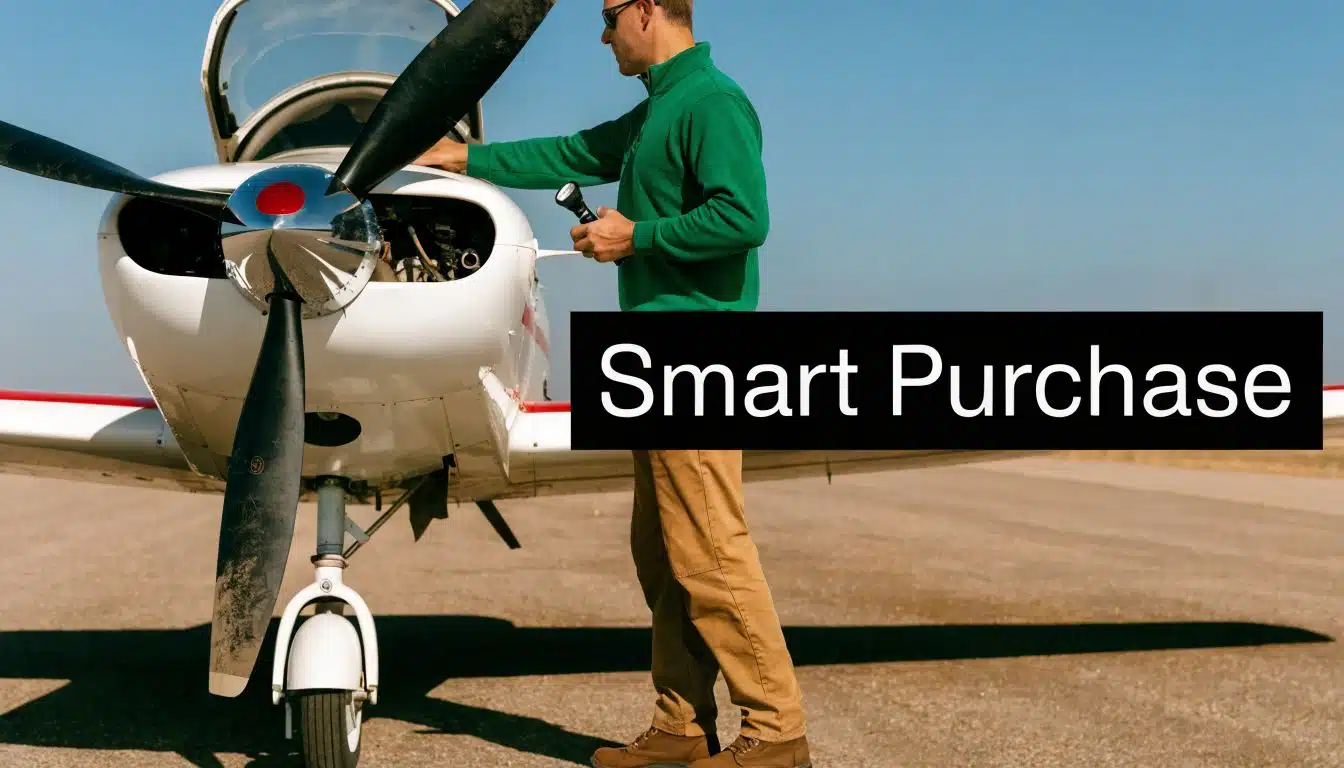
Situational awareness doesn’t stop mattering when the engine shuts down. It also applies when you’re buying or selling an airplane or helicopter. In fact, aircraft ownership decisions are full of the same cognitive traps pilots face in flight: fixation, assumption, incomplete cross-checking, and optimism without projection.
If you’re buying, the safest mindset is this. You are not shopping for a machine. You are evaluating a future operating environment.
Use perceive, comprehend, project during a pre-buy
The same three-part model works surprisingly well in aircraft transactions.
Perceive means gathering the facts carefully. Review logbooks, maintenance entries, avionics configuration, damage history, corrosion signs, interior wear, tire condition, and evidence of recurring squawks. During a demonstration flight, watch engine indications, trim behavior, radio clarity, and how the seller describes discrepancies.
Comprehend means translating those observations into operational meaning. A cosmetic flaw may be minor. A vague maintenance gap may not be. An attractive panel may look modern but still be a poor fit if it increases your workload rather than simplifying it.
Project means asking where the aircraft will put you six months from now. Will this airplane support your actual mission, training goals, and comfort level? Or will it create hidden workload, maintenance friction, and transition risk?
Buying safely means resisting the urge to fall in love during the first walk-around.
Glass cockpits and safety awareness
Avionics deserve special attention because they directly affect situational awareness. Buyers often focus on whether a panel looks “modern,” but the fundamental question is whether it helps them maintain a better mental picture.
That’s where technically advanced aircraft can matter. In general aviation, technically advanced aircraft with glass cockpits have fewer than half as many takeoff and climb accidents compared to the overall fleet, attributed to enhanced SA from integrated displays, as noted qualitatively in the earlier source discussion.
That doesn’t mean every buyer should chase the newest panel. It means you should evaluate avionics by fit, not fashion.
A practical comparison:
| Buying question | SA-focused way to think about it |
|---|---|
| Is the panel upgraded? | Will I actually use the information well under workload? |
| Is there a moving map? | Does it improve orientation without inviting fixation? |
| Are there integrated engine displays? | Will they help me detect trends earlier? |
If you’re weighing common training aircraft, a side-by-side review like this Piper Cherokee versus Cessna 172 comparison can help frame the decision around mission and handling rather than impulse.
How to buy an airplane the safe way
A safe aircraft purchase usually includes the following habits:
Bring an independent mechanic
A true pre-buy inspection needs a skeptical eye, not a casual glance.Read the logs for patterns, not just completeness
Repeated discrepancies can tell a bigger story than a single major repair.Match the aircraft to your real mission
If you mainly want local proficiency flying, don’t buy complexity you won’t use well.Evaluate transition workload realistically
A faster, more complex aircraft may be desirable, but it also changes the SA burden.Plan the first year, not just purchase day
Insurance requirements, recurrent training, avionics learning curve, and maintenance access all affect safety.
Sellers need situational awareness too
Sellers also benefit from the same model. Perceive buyer skill level during demonstration flights. Comprehend when enthusiasm is outrunning competence. Project where risk may appear during test flying, unfamiliar systems use, or rushed scheduling.
A careful seller briefs the airplane clearly, sets boundaries, and treats demonstration flights like real risk events. That’s not overcautious. It’s good aviation judgment.
How DuBois Aviation Forges Aware and Proficient Pilots
Strong situational awareness doesn’t usually come from memorizing one definition. It develops when training places students in realistic situations, gives them time to think through those situations, and then debriefs what happened with precision.
That’s why the training environment matters so much. A student who learns only in low-pressure conditions may control the airplane well but still struggle when radio traffic gets busy, sequencing changes quickly, or an instructor introduces a surprise.
Real-world repetition beats abstract familiarity
Training at a busy towered airport forces pilots to organize information sooner. They have to track taxi instructions, traffic flow, runway use, pattern spacing, and changing clearances while still flying the aircraft accurately. That pressure can feel demanding at first, but it builds exactly the kind of awareness pilots need later in more complex operations.
One-on-one instruction strengthens this process because the instructor can catch the moment awareness starts to narrow. Instead of only correcting the outcome, the instructor can ask better questions: What did you miss? What did you think was happening? What should you have anticipated?
Why simulators and debriefs matter
A simulator helps because it freezes the safety consequences while keeping the mental demands. Instructors can create reroutes, instrument failures, unusual traffic patterns, and workload spikes that reveal how a student builds or loses the big picture.
The debrief is where the learning sticks. Students often remember a mistake as “I got behind.” A good debrief turns that into something useful such as, “I stopped scanning outside during checklist work,” or “I heard the clearance but didn’t build a picture of where the traffic was.”
That same mindset shows up in well-designed coaching systems outside aviation too. If you want a simple model for structuring skill growth, these strategic training plan examples are helpful because they show how consistent repetition, review points, and measurable milestones support improvement.
Students improve faster when training names the exact point where awareness broke down.
Variety builds adaptable awareness
Pilots become more adaptable when they train across different tasks and aircraft types. A student who learns only one routine can become comfortable without becoming broadly aware. Change the mission, weather, pace, or cockpit layout, and hidden weaknesses appear.
Training that includes private, instrument, commercial, and simulator work gives students more chances to practice the same core skill in different forms:
- Private training teaches visual scan, traffic awareness, and pattern judgment.
- Instrument training sharpens mental modeling when outside references disappear.
- Commercial preparation adds precision and workload management.
- Aircraft transitions teach pilots to rebuild the picture in unfamiliar layouts.
For helicopter students, the same principle applies. Low-level operations, hover work, confined areas, and traffic integration place different demands on awareness than fixed-wing pattern work. The underlying skill is still the same. Notice, understand, project.
The bigger outcome
The best result of this kind of training isn’t just a pilot who can pass a checkride. It’s a pilot who catches errors early, makes calmer decisions, and knows when to slow the situation down.
That’s what people are really asking when they search what is situational awareness in aviation. They’re asking how safe pilots think. The answer is that safe pilots build a moving mental picture, protect it under pressure, and refresh it constantly.
Conclusion Your Path to Becoming a Safer Pilot
Situational awareness is one of the most important skills a pilot can develop because it connects everything else. It links scan habits to decision-making, radio work to traffic avoidance, checklist discipline to workload control, and aircraft knowledge to safe judgment.
The simplest way to remember it is still the best. Perceive. Comprehend. Project. Notice what matters. Understand what it means. Predict what happens next.
That pattern applies in the traffic pattern, under the hood, during a go-around, in a simulator, and even during a pre-buy inspection. It also explains why some pilots look calm in busy airspace. They aren’t guessing less. They’re building a better mental picture.
If you’re a new student, don’t worry if this doesn’t feel natural yet. Nobody starts with polished situational awareness. It grows through repetition, honest debriefs, and the habit of asking better questions before the airplane forces them on you.
If you’re already flying, this is a useful standard to revisit. Every pilot can improve scan discipline, planning depth, and big-picture thinking.
Situational awareness isn’t a buzzword. It’s the practical skill that helps pilots avoid preventable surprises and make better decisions earlier, when they still have time and options.
If you want to build that kind of judgment from the start, DuBois Aviation offers flight training in a real-world towered airport environment with airplane, helicopter, instrument, and simulator instruction designed to help students become safer, more aware, and more proficient pilots.


