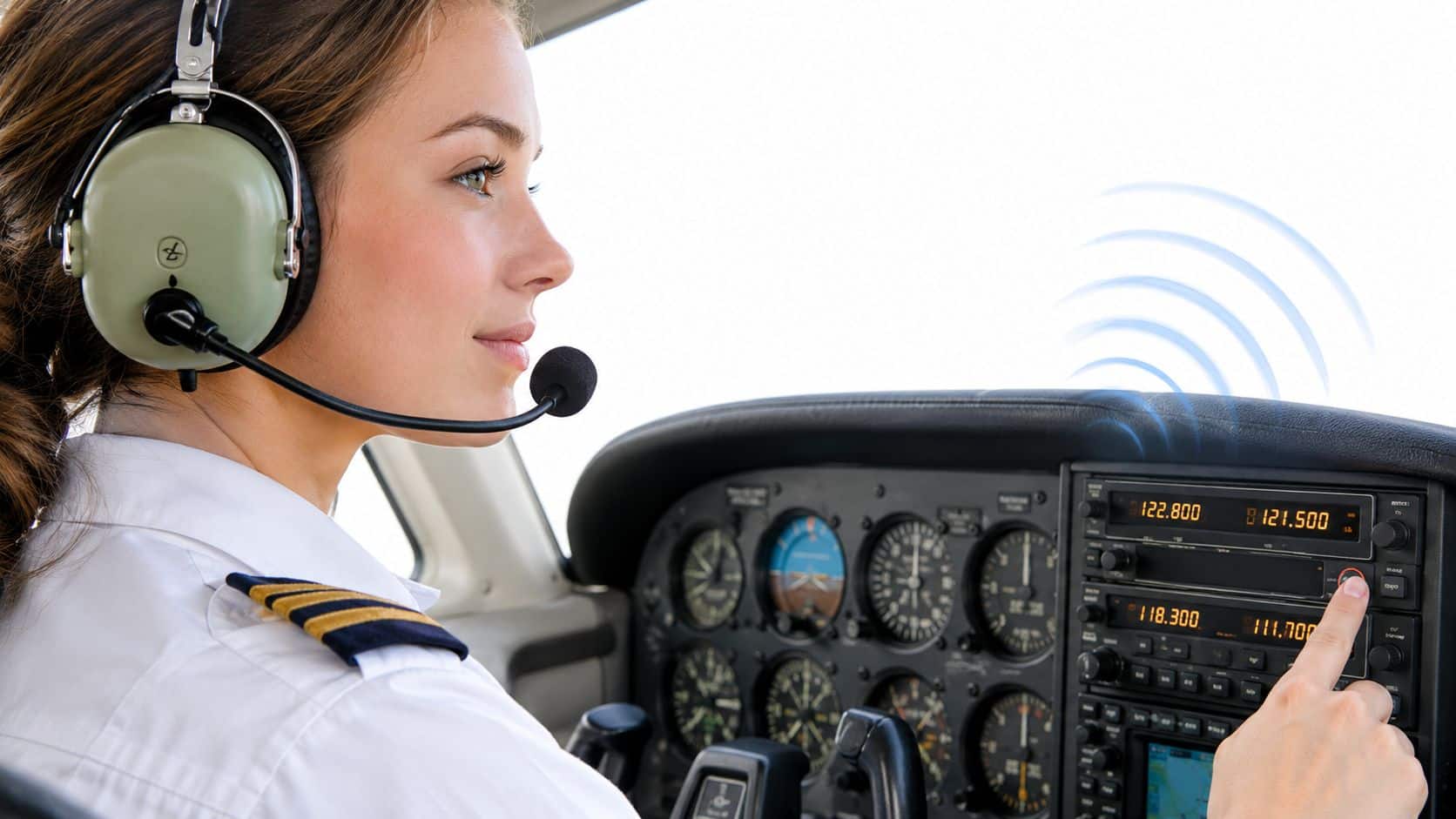
A student pilot sitting on the Chino ramp may know the words for a ground call and still freeze with a hand on the push-to-talk switch. Radio communication training turns that hesitation into a repeatable skill by teaching pilots to identify who they are, where they are, what they need, and how to verify the controller's response. The objective isn't to sound polished. It's to make every transmission clear enough for a controller to act on while the pilot continues to fly, follow the route, and monitor the surrounding traffic.
Table of Contents
- Your First Call to the Tower
- Why Standardized Phraseology Exists
- Building the Pilot-Controller Loop
- Staged Learning From Ground School to Solo
- The Real Problem Is Workload, Not Vocabulary
- Emergency and Abnormal Communications
- Practicing Radios in the DuBois Environment
- Radio Training Questions Pilots Actually Ask
- Does a student pilot need a certificate before making a towered call?
- When is Class D communication mandatory?
- What should a pilot do with an unfamiliar accent or rapid transmission?
- What happens after a missed or partial clearance?
- How can students rehearse at home?
- Which readback errors deserve the most attention?
Your First Call to the Tower
The engine isn't running yet. A student pilot in a Cessna 172 has completed the cockpit setup, tuned the radios, checked the airport information, and is now rehearsing the first call to ground. The push-to-talk switch feels more important than it did during practice because this time the transmission will be heard by the controller and every aircraft monitoring that frequency.
Two practical options worth comparing
These are specific products pilots commonly compare for this type of flying. Confirm compatibility with your aircraft and instructor before ordering.
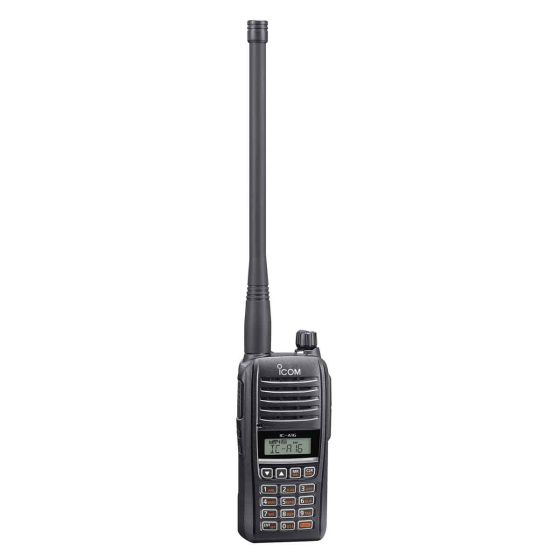 Backup communicationsIcom IC-A16B Bluetooth VHF Airband Handheld RadioCheck current availability on Amazon (paid link)
 Night flyingFlight Outfitters Dual-Color Pilot HeadlampCheck current availability on Amazon (paid link)
A radio call is a short, ordered message sent over a specific frequency. The controller receives it while maintaining a mental picture of aircraft on the ramps, taxiways, runway, and nearby airspace. A useful call helps that picture become more precise.
The controller needs three answers:
- Who is calling? The facility needs the aircraft identification.
- Where is the aircraft? A ramp, hangar, taxiway, runway, or pattern position gives the transmission context.
- What does the pilot want next? The request might be taxi clearance, departure, a pattern entry, or updated instructions.
A first call from a ramp at a towered airport might follow this basic shape:
“Chino Ground, Cessna 12345, south ramp, with information Alpha, request taxi for closed traffic.”
The exact call depends on the aircraft's location, airport information, and intended operation. The structure remains useful because the controller can connect the aircraft identity to its position and planned movement.
The controller's point of view
A technically correct phrase can still be ineffective if it arrives without the information needed to act. A long explanation about the student's plans may hide the actual request. A transmission without a position may force the controller to ask another question, while a transmission without an aircraft identification may be difficult to associate with a target.
The quality of the call is measured by what the listener can do with it, not by how impressive the words sound. A short pause before transmitting is often more valuable than rushing into a call that must be corrected.
Students preparing for towered operations also benefit from understanding airport traffic patterns and radio expectations. The more familiar the traffic flow and local terminology become, the less attention the pilot must spend reconstructing basic context on the frequency.
Why Standardized Phraseology Exists
Standardized phraseology developed because aviation needed a common communication framework across borders, languages, and operating environments. ICAO radiotelephony standards, procedures, and phraseologies trace to the 1940s, and the organization continued revising them as aviation operations became more complex. The framework gives pilots and air traffic services a shared baseline for clearances, taxi instructions, departures, arrivals, and safety information. (ICAO guidance on improving radiotelephony communication)
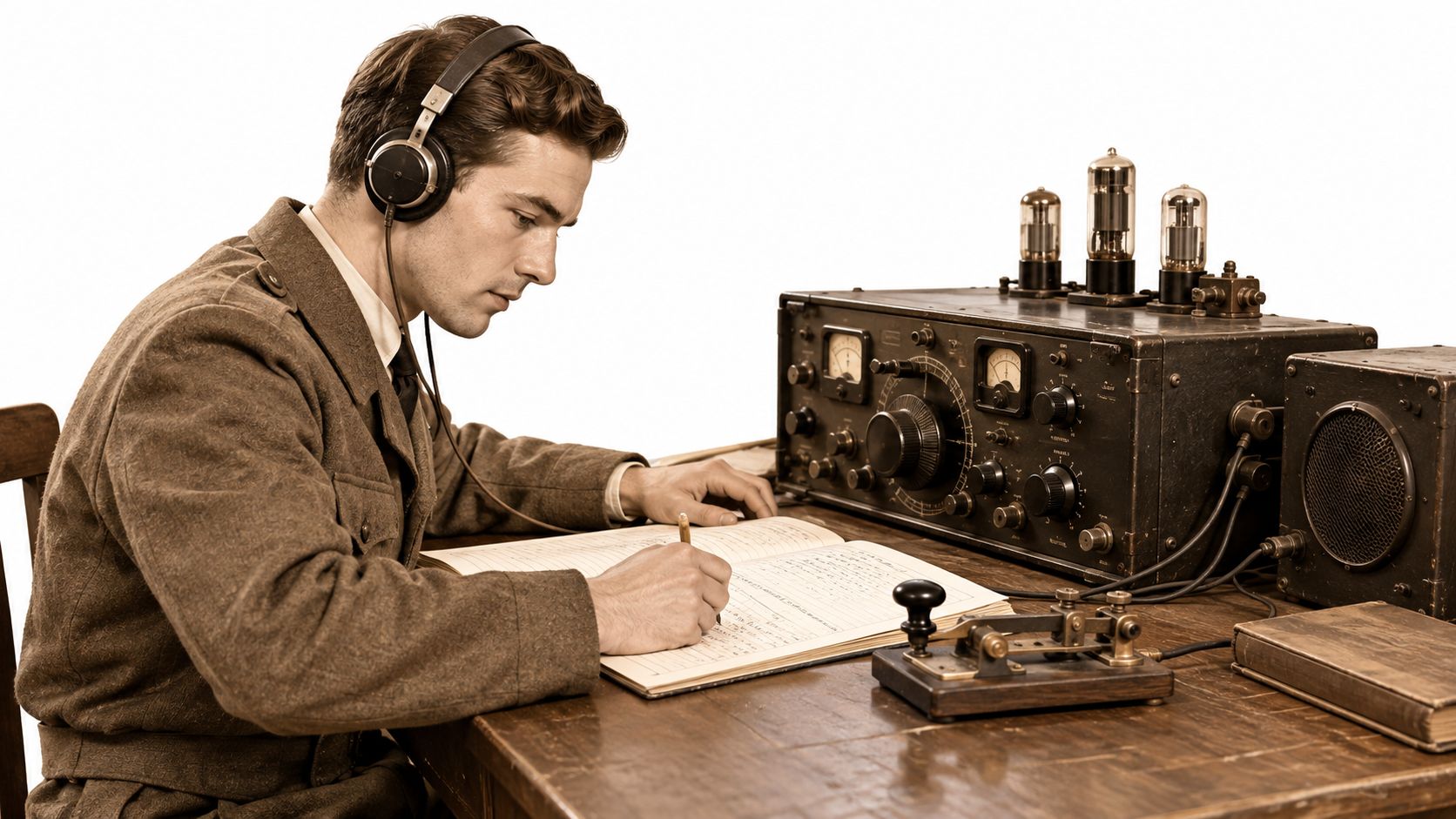
This history matters to a student because phraseology isn't a collection of ceremonial words. It's a communication design built for narrow bandwidth, background noise, accents, interruptions, and limited time. Standard expressions reduce the number of possible interpretations, especially when a clearance includes a runway, heading, altitude, or frequency.
Phraseology and plain language work together
ICAO language training distinguishes between two related abilities:
- Standardized phraseology: The approved expression is used when one exists.
- Plain language: Sufficient ordinary language is available when a situation doesn't fit a predictable script.
A pilot who memorizes pattern calls but can't explain an unfamiliar problem hasn't completed radio training. Language proficiency also involves pronunciation, structure, vocabulary, fluency, comprehension, and interaction, not only the ability to repeat a model transmission.
That distinction becomes important during an abnormal event. A pilot may know how to report position and intentions in a routine call but need different words to describe smoke, an uncertain clearance, a medical concern, or a navigation problem. Concise phraseology remains the starting point, but clarity takes priority when the standard expression isn't enough.
Precision is a safety behavior
FAA guidance treats standardized phraseology, correct terminology, and disciplined brevity as professional practices. It also warns against jargon, slang, and unnecessary chatter, while recognizing that concise wording may not adequately communicate every situation. (FAA guidance for pilot and controller communications)
The practical lesson is simple. Students should learn the standard call first, understand the information it conveys, and then develop the language needed to depart from the script safely when circumstances require it. That combination prepares a pilot for both an ordinary taxi clearance and an unexpected instruction that needs clarification.
Building the Pilot-Controller Loop
A towered-airport exchange works as a closed loop. The pilot sends a call, the controller responds, the pilot reads back safety-critical information, and the controller or pilot confirms that the instruction was understood. This process is more important than a particular accent or vocal style.
At KCNO, a student can rehearse the loop using a simple sequence:
- Who: State the facility and aircraft identification.
- Where: Give the aircraft's position, altitude, or operating context.
- What: State one clear request.
- Listen: Receive the controller's response without transmitting over it.
- Read back: Repeat the clearance or instruction that affects safety.
- Confirm: Acknowledge corrections or additional instructions using standard terminology.
A pilot doesn't need to repeat every conversational word. If the controller assigns a runway, taxi route, hold short instruction, altitude, heading, or frequency, the student should capture and read back the relevant details. If a number was spoken, the number deserves special attention. If an instruction includes a condition, that condition belongs in the readback.
Calls students can rehearse
A taxi request might sound like this:
“Chino Ground, Cessna 12345, south ramp, request taxi for departure to the east, with information Alpha.”
A departure call should identify the aircraft and make the intended operation clear:
“Chino Tower, Cessna 12345, holding short of Runway 26R, ready for departure, closed traffic.”
A pattern call should provide the aircraft's position and identification:
“Chino Tower, Cessna 12345, left downwind Runway 26R, touch-and-go.”
If the controller issues a clearance, the readback should preserve the elements that control the aircraft's movement:
“Cessna 12345, hold short Runway 26R, taxi via Alpha.”
“Hold short Runway 26R, taxi via Alpha, Cessna 12345.”
Students working toward instrument privileges can reinforce this listening and readback discipline with modern test prep for pilots, particularly when reviewing clearances, instrument procedures, and the terminology that appears in training scenarios.
Sample Towered Radio Calls and Expected Readbacks
| Call Type | Student Transmission | Expected Readback |
|---|---|---|
| Taxi request | “Chino Ground, Cessna 12345, south ramp, request taxi for departure.” | The controller's assigned route, runway, and any hold short instruction |
| Ready for departure | “Chino Tower, Cessna 12345, holding short, ready for departure.” | The assigned runway and any takeoff, delay, or traffic instruction |
| Pattern position | “Chino Tower, Cessna 12345, left downwind, touch-and-go.” | Any sequencing, runway, spacing, or pattern instruction |
| Touch-and-go acknowledgement | “Cessna 12345, cleared touch-and-go Runway 26R.” | “Cleared touch-and-go Runway 26R, Cessna 12345.” |
The controller is evaluating whether the loop closes. A pilot who misses a call should ask for it again. A pilot who isn't certain about a clearance should clarify before acting. Pretending to understand creates a larger problem than admitting that a transmission was missed.
Staged Learning From Ground School to Solo
Radio work should develop in stages, with each stage tied to a skill a CFI can observe. Students shouldn't be expected to move from memorized vocabulary to independent tower operations in one jump.
Ground school establishes the basic building blocks. Students practice the phonetic alphabet, number pronunciation, time expressions, airport terminology, and the meaning of common light signals and radio phrases. They can then rehearse self-announced calls at non-towered airports, where the exercise emphasizes position, intention, and listening for other aircraft.
A practical training ladder
First, build recognition. The student identifies letters, numbers, runway designations, call signs, and common facility names without a long pause. This supports accurate copying and reduces the temptation to guess.
Next, build format. The student delivers a short call with the facility, aircraft identification, position, and request in the correct order. The CFI can evaluate whether the transmission answers the controller's three basic questions.
Then, introduce live timing. During dual instruction, the instructor may handle the radio while the student listens for when calls occur, how controllers sequence aircraft, and which instructions require a readback. Listening is an active skill, not a passive break from flying.
Once the student understands the rhythm, the student makes the first call. The instructor can prompt only when necessary, allowing the learner to experience the timing of a real frequency while preserving safety.
From supported calls to independent operation
Progress continues through increasingly complete tasks:
- Initial contact: The student identifies the facility, aircraft, position, and request.
- Taxi instructions: The student copies the route and identifies hold short instructions.
- Run-up communication: The student makes the appropriate call without delaying other operations.
- Departure and pattern work: The student manages position reports, sequencing, and changing instructions.
- Solo preparation: The student performs the entire exchange, including corrections and readbacks, while maintaining aircraft control.
A CFI can mark each milestone only after the student demonstrates it consistently. The point isn't to create a rigid script for every flight. The point is to verify that the student can organize information, listen accurately, and close the loop before the radio becomes part of a larger workload.
Practical rule: A student is ready for more radio responsibility when the call remains organized while attention is also divided between aircraft control, traffic, checklists, and navigation.
The Real Problem Is Workload, Not Vocabulary
Memorizing more phraseology won't automatically solve radio failures. A pilot can know the correct wording and still miss a call while configuring the cockpit, scanning for traffic, completing a checklist, changing frequencies, or copying a clearance.
A human-factors study found that radio communication consumed roughly 10% to 35% of instructor and evaluator workload, averaging about one-fifth of training and evaluation effort. The same research found that role-play reduced the communication workload experienced by pilots, which creates a training trap. A simplified practice session may make radio work feel easier because the instructor has removed the interruptions and competing demands that make live operations difficult. (FAA human-factors and communication workload material)
An advanced air-mobility study recorded a total communication error rate of 20.6%, while pilots transmitted on the wrong frequency in 40.8% of calls overall. Those figures point toward a workload and system-management problem, not merely a vocabulary gap. (NASA communication error findings in advanced air mobility)
Why the cockpit gets saturated
Consider a typical departure sequence. The student is checking the engine instruments, confirming the flight controls, watching for vehicles and aircraft, tuning the next frequency, listening for a clearance, and preparing to taxi. If a controller amends the route or another aircraft transmits at the same time, working memory can fill quickly.
The result may be a broken sentence, an incomplete readback, a missed frequency change, or a call made before the pilot is ready. The student may then focus on sounding correct instead of protecting the aircraft's immediate priorities.
Train the decisions around the call
Effective radio communication training includes deliberate workload management:
- Configure early: Set up the radio stack, audio panel, and expected frequencies before engine start when practical.
- Write critical information: Record taxi routes, runway assignments, headings, altitudes, and frequencies rather than relying on memory.
- Protect aircraft control: If the aircraft needs attention, stabilize it before transmitting.
- Ask for time: Use an appropriate request for a repeat, slower transmission, or clarification.
- Rehearse ahead: During a quiet phase, prepare the next likely call without transmitting prematurely.
- Use a priority order: Apply aviate, monitor, communicate when several tasks compete for attention.
The workload management strategies used in flight training should include missed calls, frequency congestion, amended clearances, and uncertainty about runway entry. A student who can communicate only in a quiet scripted exercise hasn't yet demonstrated the skill required in a busy terminal environment.
Emergency and Abnormal Communications
Emergency radio training begins with aircraft control. The pilot stabilizes the airplane as much as possible, identifies the immediate problem, and communicates the information ATC needs to provide assistance. A transponder-equipped aircraft in a distress or urgency condition should squawk Mode 3/A code 7700 with Mode C altitude reporting and immediately establish communication with ATC. (FAA emergency transponder procedures)
The transmission should be organized so ATC can act even if the call is interrupted. A distress call begins with “MAYDAY,” preferably repeated three times. An urgency call begins with “PAN-PAN,” used in the same manner. (FAA distress and urgency communications)
A usable emergency structure
A student can rehearse the following order on the ground:
- Address the station: Name the facility being called.
- Identify the aircraft: State the call sign and aircraft type.
- Name the problem: Describe the failure or condition plainly.
- Give position and altitude: Include heading when useful.
- State intentions: Explain the intended landing, diversion, or other immediate action.
- Request assistance: Tell ATC what support is needed.
- Add useful information: Weather, fuel remaining in minutes, and the number of people aboard may help controllers coordinate assistance.
For example, a practice call might follow this pattern:
“Mayday, Mayday, Mayday, Chino Tower, Cessna 12345, engine problem, five miles west of the airport at two thousand feet, landing Runway 26R, three persons aboard.”
The wording must reflect the actual situation. A pilot shouldn't delay a necessary transmission while searching for a perfect script. The FAA identifies 121.5 MHz and 243.0 MHz as emergency frequencies when necessary, although their range is generally limited to line of sight. Pilots should use the frequency already in use or an ATC-assigned frequency when possible.
Emergency Squawk Codes and When to Use Them
| Squawk | Call Type | Typical Scenario |
|---|---|---|
| 7700 | General emergency or distress condition | A situation requiring immediate assistance, paired with communication with ATC |
The engine failure procedures used in flight training should include both the cockpit actions and the radio work that follows. Practice should continue after the aircraft is stabilized, with a debrief of what information was transmitted, what was omitted, and whether the call gave ATC a clear picture of the pilot's intentions.
Practicing Radios in the DuBois Environment
At a busy towered airport, radio work is part of the flight task from the moment the aircraft leaves the ramp. KCNO provides a working environment in which students encounter ground movement, tower instructions, pattern communication, changing traffic priorities, and the need to listen before transmitting.
A staged program can begin away from the live frequency. Ground instruction establishes local phraseology, taxi routes, nearby airspace, and traffic-pattern expectations. Students can then practice self-announced calls at nearby non-towered practice areas before adding the extra communication loop required at the towered airport.
Simulation before live frequency work
The in-house Frasca simulator gives students a place to rehearse ground, tower, and approach communications without leaving the pattern. A simulator session can pause after a missed call, repeat a congested exchange, or introduce an amended instruction without creating pressure during an actual flight.
That environment is useful for isolating one skill at a time. A student may first practice copying a clearance, then add checklist activity, navigation, and aircraft-control tasks. The instructor can evaluate whether the learner asks for clarification appropriately or guesses at missing information.
Transfer across aircraft
Radio management changes as students move between aircraft with different layouts and avionics. A Cessna 150, Piper Cherokee, Mooney M20B, Piper Apache, Robinson helicopter, and Enstrom helicopter may present different audio panels, frequency controls, transmit switches, and cockpit workload patterns.
The words used on the frequency remain governed by the same communication principles, but the physical actions differ. Students training for private, instrument, commercial, multi-engine, CFI, CFII, MEI, or helicopter add-on operations need to transfer the closed-loop habit rather than memorize a single cockpit routine.
Debriefing makes the skill visible
After a flight to or from Chino, a CFI can review specific questions:
- Was the first call complete?
- Did the student identify the aircraft's actual position?
- Were runway, taxi, heading, altitude, and frequency assignments read back?
- Did the student recognize when a call was only partially heard?
- Did workload cause a missed transmission or an unnecessary one?
- Did the pilot keep aircraft control while communicating?
This makes towered radio practice a discrete training stage with observable milestones, not an incidental result of accumulating flight time.
Radio Training Questions Pilots Actually Ask
Does a student pilot need a certificate before making a towered call?
The radio call itself is a training task performed under the supervision and responsibility of the flight instructor. The instructor should determine when the student is ready to transmit and should remain responsible for the flight's legal and operational requirements. Students shouldn't treat the first live call as a test of independence. It's a supervised step in learning to communicate while flying.
When is Class D communication mandatory?
For operations in Class D airspace, 14 CFR § 91.129 requires two-way radio communication with the controlling ATC facility before entry and continuous communication while inside the airspace. A pilot arriving or transiting through Class D must establish contact before entering. Departures from the primary or a towered satellite airport must establish and maintain communication with the tower and follow ATC instructions, while departures from an untowered satellite airport must establish communication with the responsible facility as soon as practicable after takeoff. (14 CFR § 91.129)
What should a pilot do with an unfamiliar accent or rapid transmission?
Listen for the aircraft identification, position, runway, altitude, heading, frequency, and requested action. If a safety-critical element isn't understood, ask the controller to repeat or clarify it. A pilot shouldn't infer a clearance from a few familiar words.
What happens after a missed or partial clearance?
Keep the aircraft in a safe state, avoid acting on uncertain information, and ask for the clearance again. Read back the critical elements once received, then correct any misunderstanding immediately. If the frequency is congested, the pilot can wait for a transmission gap rather than interrupting another aircraft unless the situation requires urgent communication.
How can students rehearse at home?
Students can write short who-where-what calls for taxi, departure, pattern, arrival, and abnormal situations. Live ATC audio and desktop simulation can help with listening rhythm, but the practice should include pausing, copying instructions, identifying runway and altitude information, and reconstructing a clearance after hearing it only once. The exercise becomes more useful when a second task, such as checklist review or navigation planning, is added.
Which readback errors deserve the most attention?
Common errors include omitting the aircraft call sign, repeating the wrong runway, dropping a hold short instruction, confusing a frequency or altitude, and accepting an instruction that wasn't fully heard. Instructors at Chino can reinforce correction by having students identify the missing element, request clarification, and complete the loop before moving the aircraft.
DuBois Aviation provides one-on-one airplane and helicopter instruction, simulator-based radio practice, towered-airport training at KCNO, aircraft rental, and pathways through private, instrument, commercial, multi-engine, and instructor ratings. Pilots can visit DuBois Aviation to ask about course availability, schedule a school tour, or request a training plan built around radio proficiency and workload management.