

You keep looking up when a small airplane passes overhead and thinking the same thing: I should finally do this. Then you open a few flight school websites, see unfamiliar terms, and realize flying has its own language, costs, rules, and culture.
That's where many people stall out.
A flying club can be a much better first doorway than people expect. It often combines training, aircraft access, and a community of pilots who are already living the path you're trying to understand. East Hill Flying Club is a useful case study because it shows how that model works in practice, from first lesson through advanced flying, and even into the bigger decisions pilots eventually face about aircraft ownership.
Your Journey to the Skies Starts Here
Most new pilots don't begin with a clean plan. They begin with scattered questions.
Do you need to buy a headset right away? Is a flight club different from a flight school? Will you train once a week, or try to move faster? If you're still sorting out the basics, a practical starting point is learning how to get your pilot's license so the process feels less mysterious.
East Hill Flying Club sits in that early-decision zone for many people in Ithaca. For someone who wants more than a one-time introductory ride, the club model can be appealing because it doesn't feel like stepping into a faceless training pipeline. It feels more like entering an aviation community.
That matters more than beginners often realize. Flying is technical, but it's also social. You learn from instructors, of course, but you also learn from the pilot who just finished an instrument lesson, the member planning a weekend cross-country, and the owner who can explain why maintenance logs matter.
Flying gets easier to understand when you can see the whole ladder, not just the first rung.
East Hill is a good example because it connects several parts of a pilot's life in one place. A person can start as a curious non-pilot, become a student, grow into a renter, and eventually begin asking ownership questions. Those ownership questions matter whether you're thinking about a simple trainer airplane or, later on, a more specialized airplane or helicopter.
A lot of club articles stop at “join and fly.” That's too narrow. A smart pilot thinks farther ahead. This broader journey includes training, access, proficiency, and eventually the question many active pilots ask: should I keep renting, stay in a club, or buy an aircraft of my own?
Understanding the Flying Club Model
A flying club is not just a cheaper flight school. It's a different structure.
The club model spreads aircraft access across a membership base. In many clubs, members share resources, follow club rules, and participate in a culture that values safe operations and responsible scheduling. When the club is organized as a not-for-profit, the philosophy usually shifts even more toward access and continuity rather than margin.
What “at cost” usually means
East Hill Flying Club was established in 1952 and operates as a not-for-profit organization that provides aircraft “at cost,” a model tied to its long community history in Ithaca, as described in East Hill's Yelp profile.
That phrase, at cost, can confuse new pilots. It does not mean free flying, and it does not mean every expense disappears. It usually means the organization is trying to price aircraft access around actual operating needs rather than maximizing profit.
A commercial school and a not-for-profit club may both offer instruction. The difference is often in intent and structure:
| Model | Main focus | What a new pilot usually notices |
|---|---|---|
| Commercial flight school | Training as a business service | More straightforward customer relationship |
| Not-for-profit flying club | Shared access, training, and community | More member rules, but often more community involvement |
Why clubs last
East Hill's history matters because aviation organizations don't stay active for decades by accident. They survive because members keep using them, instructors keep teaching, and aircraft operations remain structured enough to support safe flying over time.
That long continuity also tells you something about the role clubs play in general aviation. A club can serve as:
- A training gateway for a first-time student pilot
- A proficiency base for certificated pilots who still need regular flying
- A social network where pilots trade practical knowledge
- A stepping stone to future ownership or partnerships
A beginner often thinks the only decision is, “Which school should I use?” A more useful question is, “Which environment will help me stay in aviation long enough to become competent and current?” Clubs can answer that question well when they're organized clearly and operated consistently.
A Look Inside East Hill Flying Club Operations
East Hill Flying Club is large enough to feel like a serious aviation organization, not a casual group of hobby flyers. According to the club's about and FAQ page, it reports about 250 members, nine aircraft, and ten instructors. The same page says it operates seven days a week, uses an online scheduling system, and functions as an FAA-approved Part 141 flight school using a Jeppesen training program.
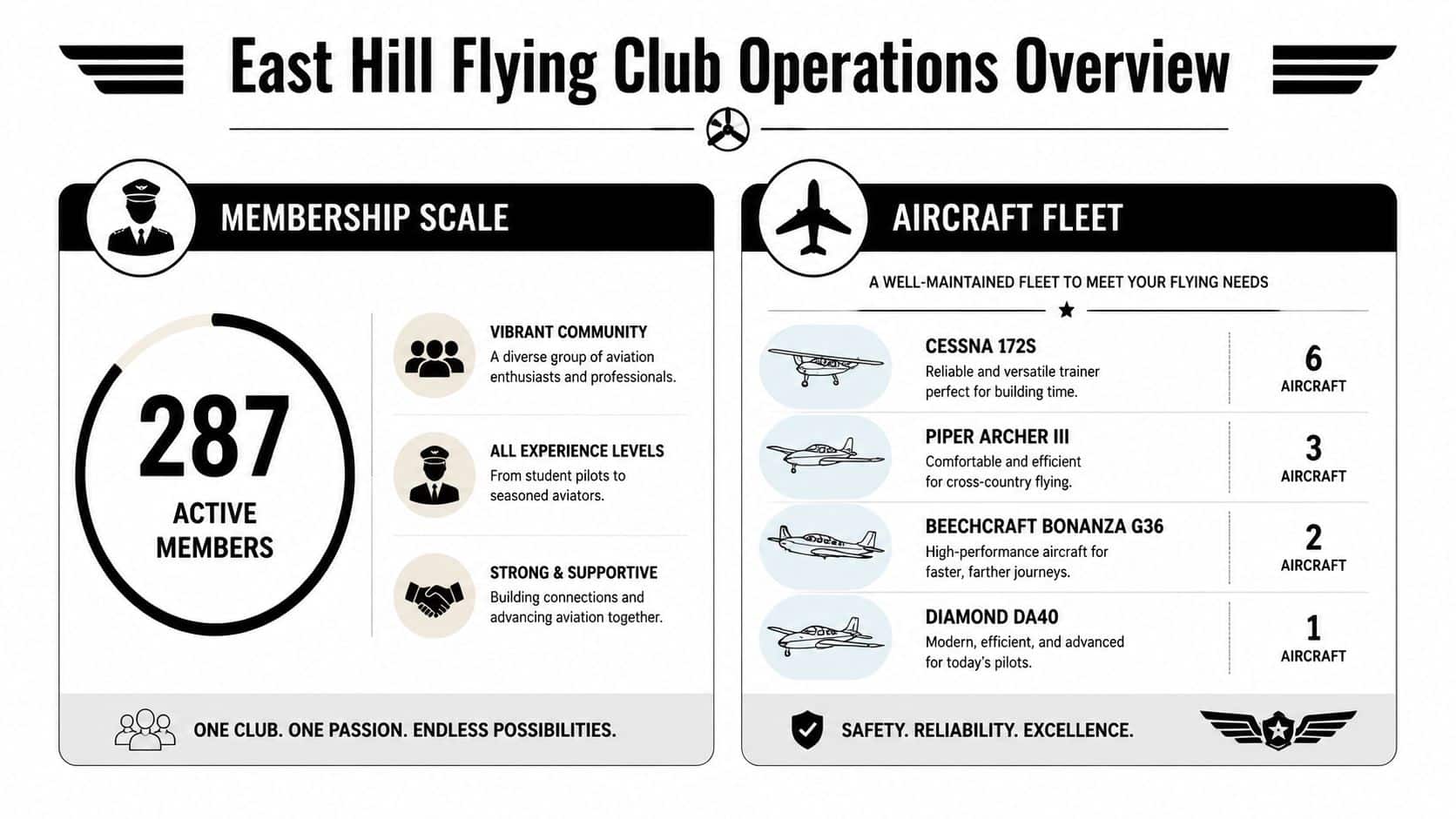
Those details give you a clearer picture of what East Hill is trying to be. It isn't only a place for a discovery flight or occasional rental. It's built to support a broad range of pilot activity, from first lessons to advanced flying.
Why Part 141 matters
Part 141 can sound like bureaucratic jargon, but the concept is straightforward. An FAA-approved Part 141 school uses an approved training structure. That usually appeals to students who want a more organized path with defined stages and curriculum control.
The Jeppesen program is part of that same picture. Jeppesen materials are familiar across professional training environments, so their use suggests East Hill is leaning toward standardized instruction rather than improvised lesson-by-lesson teaching.
Practical rule: If you learn best with checklists, milestones, and a formal syllabus, a structured training environment usually fits better than a purely ad hoc one.
What the scale means for a member
A club with multiple instructors and a fleet of several aircraft can support different kinds of flying on the same field. One member may be working on private pilot training. Another may be maintaining instrument proficiency. Another may already hold advanced certificates and need regular access to aircraft.
That breadth is one reason East Hill stands out. A community with student pilots, private pilots, and more advanced aviators creates useful exposure. You don't just learn to pass a checkride. You start seeing what aviation looks like after the checkride.
For readers comparing models, it can help to contrast East Hill with a more traditional rental-and-training operation such as Threshold Aviation at Chino, where the emphasis is on structured service from a flight business rather than a member club framework. Neither model is automatically better. The better fit depends on whether you want community membership, straightforward pay-as-you-train simplicity, or a mix of both.
Questions to ask when evaluating operations
Before joining any club, ask practical questions such as:
- Training fit: Does the school's structure match how you learn?
- Aircraft mix: Are the available airplanes appropriate for primary training and later travel?
- Instructor availability: Can you realistically get on an instructor's calendar?
- Scheduling system: Is booking simple, fair, and visible to members?
Those questions matter more than marketing language. A club becomes useful when the daily logistics support actual flying.
The Benefits and Realities of Membership
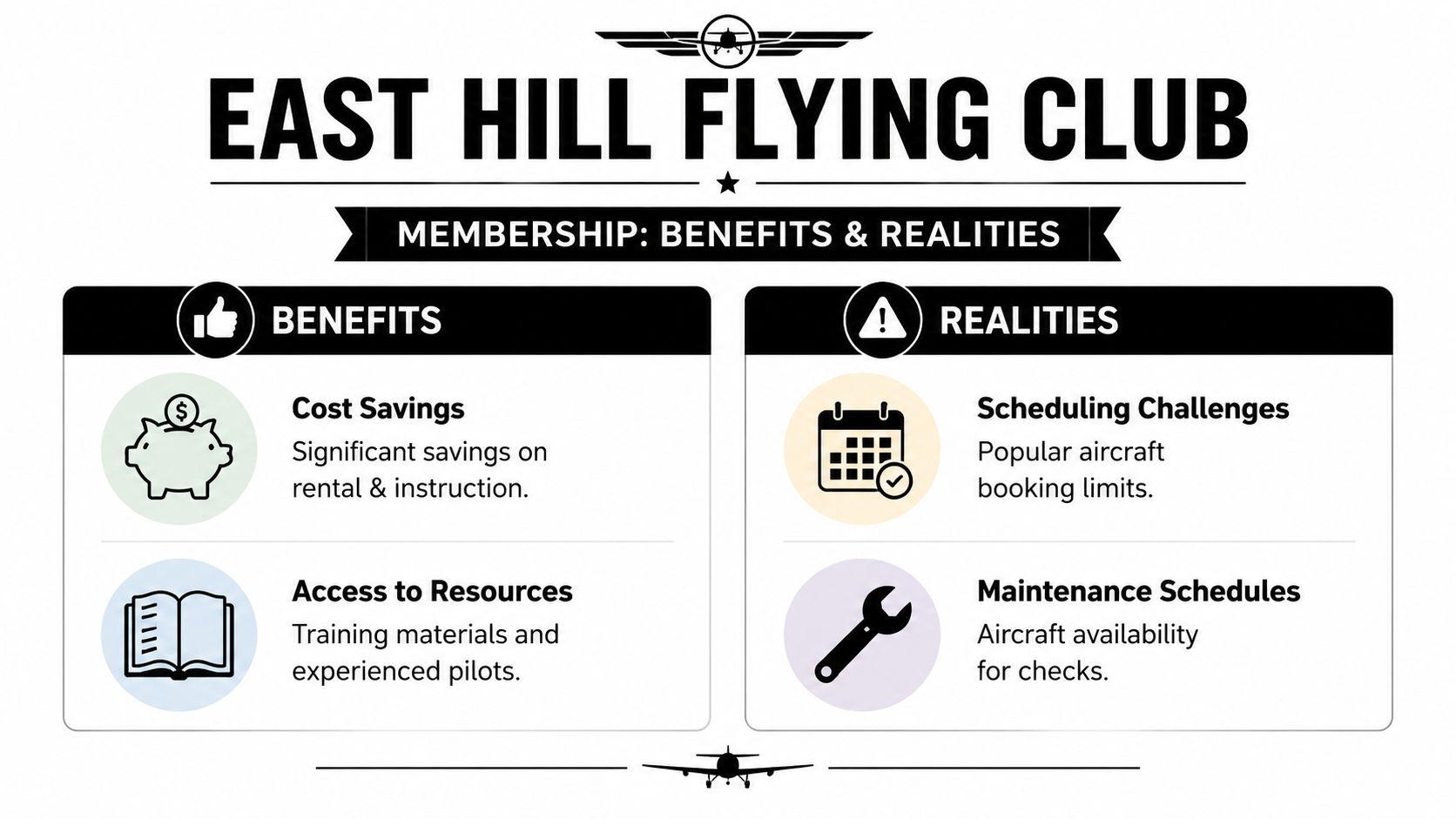
The appeal of East Hill is easy to understand. A not-for-profit club with aircraft offered “at cost” sounds like exactly what many pilots want. Lower rental pressure. A sense of belonging. More aviation, less overhead.
That appeal is real, but it's only half the picture.
The harder question is what membership feels like after the excitement wears off. Can you schedule the airplane you want? Can you maintain currency without friction? Does the low headline rate still feel low after instruction, checkout requirements, and the normal rhythms of weather and demand?
Where clubs shine
For the right pilot, club membership solves several problems at once.
- Community access: You're around people who already know the aircraft, local procedures, and training path.
- Training continuity: A student can learn in the same organization where later rental and recurrent flying happen.
- Shared aviation culture: New pilots often stick with training longer when they feel part of a real flying environment instead of a purely transactional one.
That social side matters. Pilots who stay active tend to build habits around conversation, shared planning, and regular exposure to other aviators.
Where people get surprised
East Hill's own flight training information points to the practical side prospective members need to think through. The club notes a three-hour initial and annual checkout, a four-reservation limit, and seasonal demand differences, including winter as a lull and summer as peak time, on its flight training page.
Those details matter because “affordable” and “accessible” are not the same thing.
A pilot who flies often may care less about the posted rate than about whether a preferred airplane is available on a sunny weekend. A pilot who flies infrequently may discover that recurrent checkouts and staying current require more planning than expected.
Low aircraft rates help only when you can use the airplane often enough, predictably enough, and safely enough for your flying goals.
A simple way to judge the true value
Use this practical test before joining any club.
| Question | Why it matters |
|---|---|
| Can I usually fly on the days I'm actually free? | Theoretical access isn't useful if the schedule never matches your life |
| Am I likely to stay current? | Infrequent flying often creates extra review and checkout friction |
| Do I want community involvement? | Clubs reward members who like shared norms and communication |
| Am I comparing total use, not just rates? | The cheapest posted number may not be the best real-world fit |
The phrase true cost should include more than money. It should include time, planning effort, scheduling confidence, and how often you can turn intention into actual flight time.
For some pilots, East Hill's model will be an excellent match. For others, especially those with unpredictable work schedules or narrow time windows, a club can feel more constrained than it first appears. Honest planning makes that difference clear before you join.
How to Join East Hill Flying Club
Joining a flying club feels simpler once you think of it as a sequence, not a leap. Individuals seldom arrive fully decided. They move from curiosity to commitment one step at a time.
Start with a first conversation
If you're new to aviation, begin by contacting the club and asking basic operational questions in plain language. You're not trying to impress anyone. You're trying to learn how the club handles training, scheduling, aircraft checkouts, and member expectations.
A discovery flight is often the best first move. It answers several questions quickly. Do you enjoy the cockpit environment? Do you like the instructor's teaching style? Does the airport feel manageable rather than intimidating?
Expect a membership process, not a walk-in rental
Flying clubs usually involve more onboarding than a typical one-time rental counter. That's normal. A club is protecting its aircraft, instructors, members, and operating culture.
A practical sequence usually looks like this:
Initial contact
Ask about membership requirements, training options, and whether the club fits your current experience level.Discovery lesson or introductory visit
Use this to observe the tone of the organization. Pay attention to how people brief, how instructors interact, and whether safety talk sounds routine rather than performative.Application and club approval
Clubs commonly require formal membership paperwork before full access begins.Aircraft checkout with an instructor
During this, the club confirms that you can operate within its procedures, not just hold a certificate.
What new members often misunderstand
The checkout isn't a punishment and it isn't a sign of distrust. It's a normal control point. Even experienced pilots need to learn local practices, aircraft-specific quirks, dispatch rules, and scheduling expectations.
A club checkout answers one question: can this pilot operate safely inside this specific system?
That's why it helps to arrive prepared. Bring your logbook, certificates, medical documentation if applicable, and a list of honest questions. If you haven't flown recently, say so. A good club would rather hear the truth than discover rust in the pattern.
Green flags during the joining process
Watch for these signs:
- Clear rules: The club explains procedures without vagueness.
- Calm safety culture: Members talk about standards in an ordinary, practical way.
- Accessible scheduling: You can understand how reservations and instructor booking work.
- Reasonable expectations: Nobody pressures you to rush faster than your proficiency supports.
A healthy joining process should leave you informed, not dazzled. If you finish the first steps with a clearer view of training, access, and responsibility, the club is doing its job.
A Pilot's Guide to Buying an Airplane Safely
Many pilots start in a club and eventually ask a serious question: should I buy my own airplane?
That can be a smart move, but only when you approach it like an aviation decision, not an impulse purchase. A safe aircraft purchase starts with clarity. You are not buying “a good deal.” You are buying a machine for a specific mission, with maintenance history, paperwork, and operating consequences that will follow you for years.
Step one is defining the mission
Before you look at listings, decide what the aircraft needs to do.
Will you mostly fly local proficiency flights? Do you want a simple trainer for solo time-building? Do you expect regular cross-country travel with baggage or passengers? Those are different missions, and the wrong airplane becomes expensive even if the purchase price looked attractive.
A first-time buyer often shops by emotion. They fall in love with paint, panel photos, or a brand name. Mission-first buyers do the opposite. They start with use, then narrow the field.
For example, if you're comparing common training aircraft, a resource like this Piper Cherokee vs. Cessna 172 comparison can help frame how cabin feel, handling, and mission differences affect ownership choices.
Never skip the pre-purchase inspection
This is the part buyers most want to rush, and it's the part that protects them most.
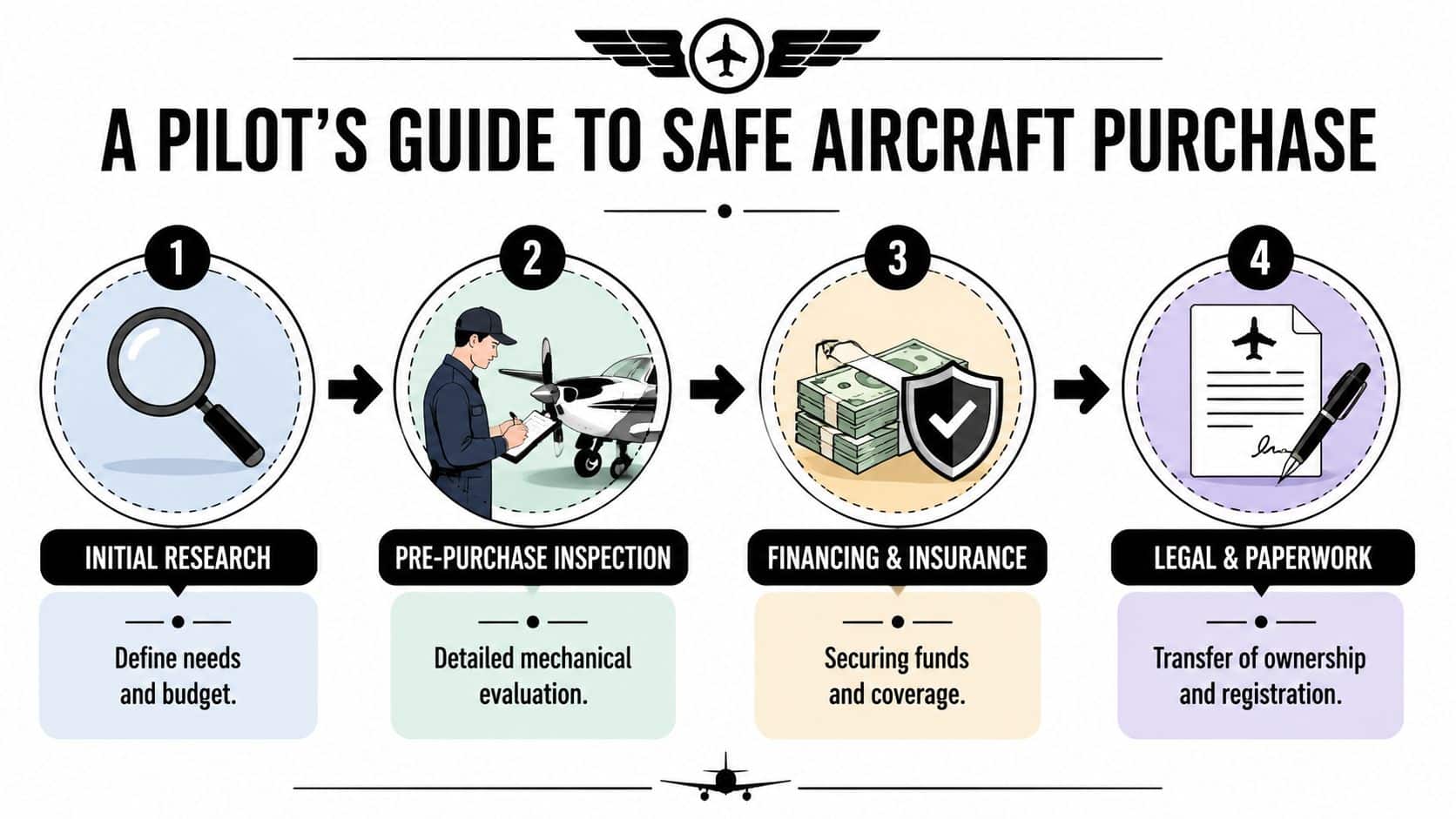
A pre-purchase inspection should be handled by a qualified mechanic who is familiar with the aircraft type and who is working for you, not the seller. The point is not just to identify obvious defects. It's to review maintenance condition, logbook continuity, installed equipment, signs of corrosion or damage history, and any mismatch between the advertisement and the airplane on the ramp.
Ownership advice: If the seller discourages an independent pre-buy, walk away.
The airplane may still be legitimate. But pressure, vagueness, or resistance around records is a warning sign.
Here's a useful visual summary of the buying process:
Paperwork is part of airworthiness reality
Buyers sometimes treat paperwork as an afterthought. That's a mistake.
You need a clean understanding of title, registration, logbooks, and any unresolved documentation issues before money changes hands. Missing entries don't always make a purchase impossible, but they do change risk. If you don't understand the records, involve an aviation attorney, title specialist, or experienced transaction professional.
Here's a safe sequence to follow:
- Match the mission first: Don't shop the market until you know how you'll use the aircraft.
- Review records early: Ask for logbooks and documentation before traveling far to inspect.
- Use an independent mechanic: The pre-buy should serve the buyer's interests.
- Sort insurance before closing: Make sure you can insure and operate the aircraft as planned.
- Plan transition training: Buying the airplane isn't the same as being ready to fly it well.
Think beyond the purchase day
Ownership adds control, but it also adds responsibility. You manage maintenance decisions, scheduling, storage, recurrent training, and resale consequences.
That's why some pilots are happier staying in a club for years. Others want the flexibility of personal ownership. There's no single correct endpoint. The safe choice is the one that matches your mission, time, and willingness to manage the aircraft as an ongoing system.
If you want guided flight training while evaluating those ownership questions, DuBois Aviation offers airplane and helicopter instruction, aircraft rental, and Jeppesen-based training at Chino Airport. For some pilots, that kind of structured environment can be a useful place to build experience before deciding whether to buy.
Key Considerations for Selling Your Aircraft
Selling an aircraft looks simple from the outside. Post photos, answer messages, agree on a number, and sign papers. In reality, the smoother sales usually come from preparation done long before the listing goes live.
Start with records and presentation
Aircraft buyers want confidence. The fastest way to build it is with complete, organized records and an airplane that looks cared for.
That doesn't mean cosmetic perfection. It means the airplane is clean, logbooks are ready, recurring maintenance status is understandable, and installed equipment is accurately represented. A buyer can accept an older aircraft. A buyer gets nervous around confusion.
Price it for the actual market, not your memory
Owners often anchor to what they paid, what they spent on upgrades, or what they hope the airplane is worth. Buyers care about current comparables, condition, logs, engine status, avionics usefulness, and how much uncertainty the airplane carries.
A strong listing usually includes:
- Clear photos: Exterior, interior, panel, and key equipment views
- Accurate description: No inflated language, no hidden omissions
- Logbook summary: Enough detail to show seriousness without overwhelming the reader
- Operational honesty: Disclose known issues early
The easiest aircraft to sell is usually the one with a clean story. Buyers can handle age. They struggle with ambiguity.
Handle buyers carefully
Not every inquiry is worth equal time. Some people are shopping casually. Some don't understand the airplane category. Some are serious and ready.
A good sales process filters without becoming defensive. Ask what mission the buyer has in mind. Ask whether they've owned before. Ask whether they plan to use financing, a mechanic, or a title service. Serious buyers usually welcome practical questions.
Closing is an aviation task, not just a handshake
Even when the negotiation feels friendly, the closing still needs structure. Purchase terms, deposits, inspection timing, document transfer, and possession date should all be clear.
A simple seller checklist helps:
| Seller task | Why it matters |
|---|---|
| Organize logs and airframe records | Reduces buyer hesitation |
| Present the aircraft cleanly | Signals care and lowers perceived risk |
| Write a factual listing | Attracts better-fit buyers |
| Define closing steps in writing | Prevents last-minute confusion |
A well-managed sale protects both sides. It also preserves your reputation in a small aviation world where people talk, compare notes, and remember how transactions felt.
Common Questions and Your Next Steps in Aviation
Even after you understand the club model, a few practical questions usually remain.
What happens if weather cancels my plans
Weather is part of normal aviation life. Clubs and schools usually expect members to adapt rather than force the schedule. The important question isn't whether weather causes cancellations. It's how clearly the organization handles them.
A good system makes it easy to reschedule aircraft and instructors, and it encourages conservative decision-making. If a club ever makes you feel rushed to go in marginal conditions, that's the wrong culture.
How does maintenance affect availability
Every aircraft eventually comes offline for inspection, repair, or unscheduled work. That's not a flaw in the system. That is the system. The practical issue is whether members have enough communication and enough alternative options when an aircraft is down.
Large clubs can sometimes soften that problem because they have more than one airplane. Smaller operations can still work well if they communicate clearly and don't pretend every aircraft is always available.
Is a club enough, or should I eventually buy
That depends on your mission and temperament.
Stay in a club if you value shared infrastructure, predictable training culture, and fewer ownership burdens. Consider ownership if you want greater control over equipment, scheduling freedom, and you're ready for the responsibility of maintenance, records, insurance, and resale strategy.
Can a club help me become a better long-term pilot
Yes, if you use it well. The club doesn't create proficiency by itself. You do that through regular flying, honest self-assessment, recurrent training, and surrounding yourself with pilots who take standards seriously.
That's why East Hill Flying Club is worth studying even if you never fly in Ithaca. It shows how a club can support the full pilot journey. You can begin with a first lesson, train in a structured environment, learn how scheduling and access really work, and then make smarter decisions later about renting, club flying, partnerships, or ownership.
The bigger lesson is simple. Aviation gets manageable when you stop treating it like one giant leap and start treating it like a series of informed decisions. First lesson. First solo. First certificate. First checkout. First serious look at ownership. Then, eventually, your first sale.
If you're in the stage where you want training, guidance, or a clearer plan for the next move, there's value in talking with a school that handles both instruction and practical aircraft operations.
If you're weighing flight training, club flying, aircraft rental, or the long path toward airplane or helicopter ownership, DuBois Aviation is one place to continue the conversation. It offers airplane and helicopter instruction, discovery flights, rental options, and Jeppesen-based training that can help you move from curiosity to a practical aviation plan.