

Turning your passion for helicopters into a paying career is an incredible journey, but it’s one that requires serious commitment. This isn't just about learning to fly; it's a dedicated path that takes you from basic maneuvers all the way to advanced commercial operations. It’s the ticket to flying professionally in exciting fields like tourism, emergency medical services (EMS), and utility work.
Is a Helicopter Pilot Career Right for You?
Let's be real: deciding to become a commercial helicopter pilot is a huge life decision. It’s a career that demands a unique blend of passion and professionalism. This job is so much more than just being in the air; it's your entry into some of the most dynamic and challenging sectors in aviation, and it can even serve as a unique stepping stone toward a career as an airline pilot.
Can you picture yourself flying an emergency medical team on a life-or-death mission? Or maybe supporting wildland firefighters from above? You could even be the one giving tourists a breathtaking view of a city skyline.
This guide will give you a no-nonsense look at what it really takes to get there, from your first ground school lesson to the day you have that commercial certificate in hand. It’s a tough road, no doubt, but the rewards are immeasurable. You'll need precision, a deep well of dedication, and the ability to stay cool when things get complicated. Before you even think about grabbing the cyclic, it's critical to understand the entire commitment.
Charting Your Course in Aviation
The path to becoming a pro pilot is a step-by-step process. Think of it like building a house—each license and rating you earn is part of the foundation for the next level. This isn't just about racking up flight hours; it's about methodically building the skill, knowledge, and sound judgment that separates a professional from a hobbyist.
A lot of people think helicopter and airline careers are worlds apart. While the machines are different, the core skills—navigation, weather, communication, aerodynamics—are surprisingly similar. It’s not uncommon for seasoned pilots to transition between rotary and fixed-wing aircraft later in their careers.
As your experience grows, you might even get interested in the business side of aviation. For example, understanding how to buy an airplane or helicopter involves a lot more than just a handshake and a check. It means digging into maintenance logs, managing inspections, and navigating the paperwork—all valuable skills if you ever decide to consult, sell aircraft, or manage a fleet.
Understanding the Career Outlook
So, is there a demand for helicopter pilots? Absolutely. The need for skilled pilots is consistently strong, especially in niche industries. The helicopter world has its own unique dynamic, largely driven by a persistent shortage of qualified pilots.
Official projections show that the overall employment for airline and commercial pilots is expected to grow by 4% over the next decade. This is driven by a wave of retirements and the simple fact that high-quality training is expensive, which keeps the pipeline of new pilots from overflowing. This creates real opportunities for those just starting out. For a deeper dive, check out the Bureau of Labor Statistics projections. All this means your commercial helicopter certificate is more than just a license—it’s a solid investment in a long-term, in-demand career.
Before we dive into the nitty-gritty of each training stage, let’s look at the big picture. Here’s a high-level roadmap of the journey ahead.
Commercial Helicopter Pilot Training Roadmap
This table outlines the typical progression, from your first license to your ultimate goal as a commercial pilot.
| Training Phase | Primary Goal | Typical Flight Hours |
|---|---|---|
| Private Pilot | Master fundamental flight skills and earn the license to fly for personal enjoyment. | 40-60 Hours |
| Instrument Rating | Learn to fly solely by reference to instruments, without visual cues from outside. | 40 Additional Hours |
| Commercial Pilot | Refine skills to a professional standard and earn the license to be paid to fly. | 150-250 Total Hours |
| Certified Flight Instructor (CFI) | Optional but highly recommended; learn to teach others to fly and build flight hours. | 200+ Total Hours |
This path is a marathon, not a sprint. Each phase builds on the last, ensuring you have the expertise and confidence needed for a successful career.
Getting Cleared for Takeoff: Your First FAA Hurdles
Before you even dream of lifting a helicopter off the ground, you’ve got to get past the first gatekeeper: the Federal Aviation Administration (FAA). Think of these initial requirements as the bedrock of your entire flying career. They aren't just suggestions—they're the absolute, non-negotiable first steps.
Nailing these down early saves you a world of headaches later on. The basics are pretty simple: you must be able to read, speak, write, and understand English. To get your commercial helicopter license, you have to be at least 18 years old. You can start training and even fly solo before that, but you can't get the official certificate until you're 18. These rules ensure everyone in the sky can communicate effectively and has the maturity to handle what's thrown at them.
The All-Important FAA Medical Certificate
Now for the big one: the FAA medical certificate. This is probably the most critical hurdle you'll face right at the start. It’s not your average physical. You'll need to see a designated Aviation Medical Examiner (AME), a doctor who is specially trained to evaluate a pilot's fitness to fly.
Simply put, without this piece of paper, you can’t legally be at the controls.
For commercial pilots, the magic ticket is a Second-Class Medical Certificate. While airline captains need a First-Class, the Second-Class is all you need for most commercial helicopter gigs, like flying tours, shooting aerial photography, or patrolling pipelines. It’s typically good for 12 months for commercial flying privileges.
So, what does the exam involve? They’ll check a few key things:
- Vision: Your eyesight is under the microscope. They'll test your acuity, color perception, and peripheral vision. Glasses or contacts are fine, but your vision must be correctable to 20/20.
- Hearing: You'll do a hearing test to make sure you can pick out radio calls from the engine's roar. It’s more important than you think.
- Overall Health: The AME will dive deep into your medical history and give you a full physical, looking at everything from your heart to your lungs to your neurological system.
How to Ace Your Medical Exam
You can find an AME near you with a quick search on the FAA's website. When you make that appointment, be ready to talk openly about your medical history. Honesty is absolutely non-negotiable here. Trying to hide a condition is a fast track to disqualification and can have serious consequences.
Certain conditions, like some heart problems or uncontrolled diabetes, can be a roadblock. But it’s not always a definite "no." The FAA has a pathway for what’s called a Special Issuance medical certificate, which might let you fly under specific conditions or after a more detailed evaluation. Getting this part right is a core piece of meeting the overall commercial pilot license requirements, which have a lot more to them.
Here's a pro tip from someone who's seen it all: Get your medical certificate before you sink a dime into flight training. It confirms you're medically cleared to be a professional pilot and gives you the peace of mind to go all-in on your dream without a medical surprise grounding you later.
A Few More Things to Consider
While these aren't official FAA rules, there are some practical realities to helicopter training. For instance, the go-to training helicopter for many schools, the Robinson R22, has a strict per-seat weight limit, usually around 240 pounds. Flight schools are also looking for students who get the sheer level of commitment this career takes.
This whole initial phase is about laying a solid foundation. By checking the boxes for age, language, and health, you’re proving you have what it takes to start the tough but incredibly rewarding journey of commercial helicopter pilot training. With that medical certificate in hand, you’re officially cleared to start logging flight time and making your dream a reality.
Your Journey Through Flight Training
Alright, once you've checked off the initial FAA requirements, the real fun begins. This is where your commercial helicopter pilot training truly takes off, moving from textbook knowledge to the hands-on skill of actually flying. You’ll be building the instincts and precision that mark a true professional. The path is a series of building blocks, with each license and rating setting you up for the next, all starting with the Private Pilot License (PPL).
Think of your PPL as the bedrock of your entire aviation career. It’s here you’ll get your first real taste of helicopter aerodynamics, learn to read weather like a pro, and digest the core flight regulations. Your instructor will walk you through everything, from the meticulous pre-flight inspections on the ground to mastering the delicate dance of a stable hover, smooth takeoffs, and controlled landings. This whole phase is about building a rock-solid foundation of confidence and skill.
This infographic gives you a quick visual on the baseline FAA requirements you’ll need to meet just to get started.
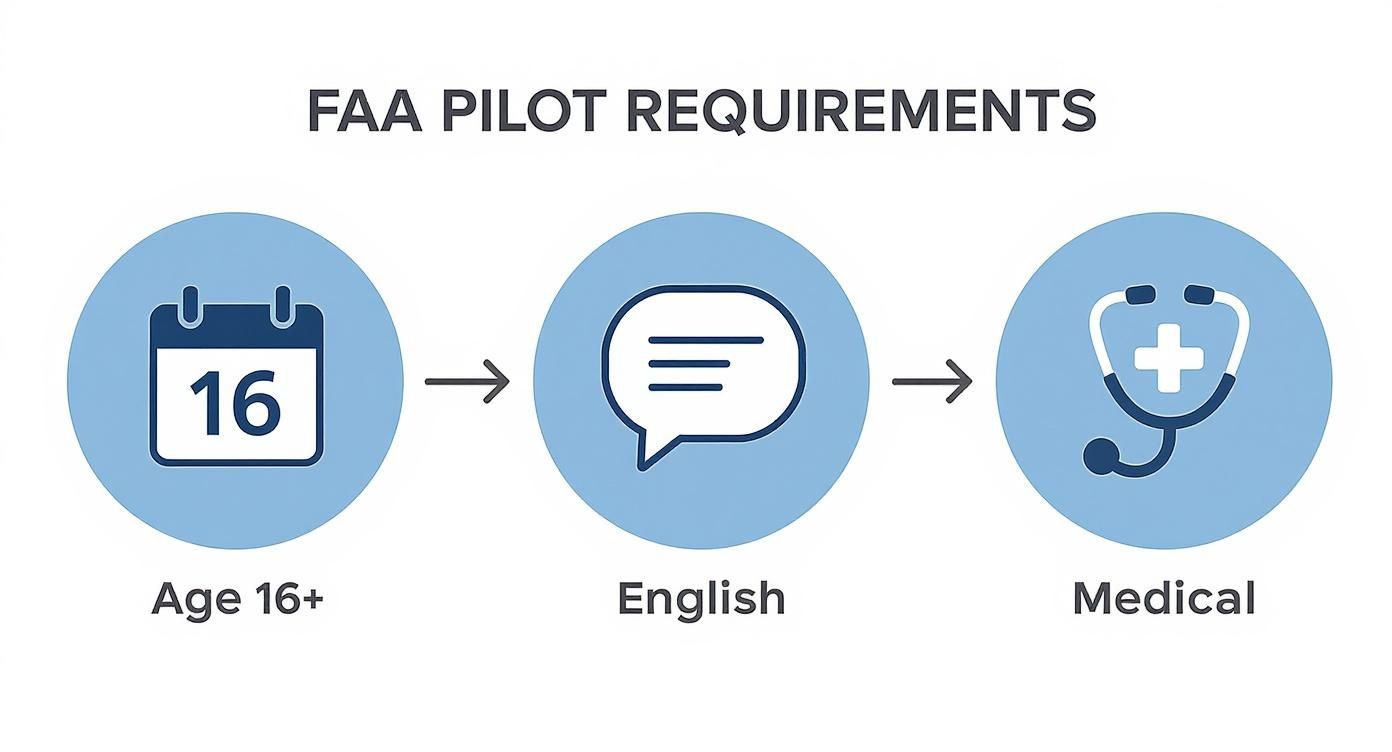
As you can see, these aren't complex hurdles, but they are non-negotiable. They ensure every single student pilot steps into the cockpit with the same fundamental qualifications for safety and clear communication.
From Private Pilot to Instrument Rated Aviator
One of the most unforgettable moments in your PPL training? Your first solo. No doubt about it. After what feels like countless hours with your instructor beside you, they’ll hop out, give you a nod, and suddenly it's just you, the controls, and the sky. It's a massive rush—a mix of pure freedom and heavy responsibility that tells you you're ready for what's next.
After earning your PPL wings, the next critical step is getting your Instrument Rating (IR). This is what truly separates the fair-weather hobbyists from the all-weather professionals. Instrument training teaches you to fly entirely by referencing the gauges in your cockpit, allowing you to navigate safely through clouds, fog, and other low-visibility situations where looking outside is no longer an option.
Picture this: you're flying at night over a remote, unlit area when a low cloud deck rolls in. Without an instrument rating, you'd be grounded. With it, you have the skill and confidence to trust your instruments to get you home safely. This training is tough and demands incredible precision, but it's an absolutely essential skill for any pilot with commercial ambitions.
Achieving Your Commercial Pilot License
With your PPL and IR secured, you're on the final leg toward your Commercial Pilot License (CPL). Interestingly, this phase isn't so much about learning brand new maneuvers as it is about perfecting everything you already know to a much higher standard. The FAA's expectation is simple: commercial pilots must operate with a superior level of precision, judgment, and knowledge.
During your CPL training, you’ll be focused on:
- Polishing your maneuvers to meet much tighter tolerances for things like altitude, heading, and airspeed.
- Mastering advanced emergency procedures so you can react calmly and correctly to any situation that comes your way.
- Deepening your understanding of commercial flight operations, especially the regulations around carrying passengers or cargo for hire.
You’re stepping into a field with serious momentum. The global pilot training market, which includes both helicopters and airplanes, was valued around $9.37 billion and is projected to hit $24.86 billion by 2032. A big driver for this is a forecast shortage of 61,000 helicopter pilots by 2038, which points to a strong, sustained demand for skilled aviators. You can dig into the numbers yourself in the full industry analysis on Fortune Business Insights.
The biggest shift from PPL to CPL is mental. You stop thinking like a student and start thinking like a captain. Every single decision, from your pre-flight plan to how you manage risk in the air, gets filtered through the lens of professionalism and absolute safety.
Beyond the Cockpit: The Business of Aviation
While stick-and-rudder skills are your main focus, a truly successful career comes from understanding the bigger aviation picture. Many flight students eventually become interested in the business side of aviation, such as buying, selling, or managing aircraft. Learning the ins and outs of how to buy an airplane or helicopter is far more involved than just writing a check. It means knowing how to meticulously review maintenance logs, what to look for during a pre-purchase inspection, and how to navigate the complex FAA paperwork. This knowledge is invaluable, whether you dream of one day owning your own aircraft or moving into a management role at a charter company or airline. For a broader look at the career path, check out our guide on how to become a commercial pilot.
Planning Your Training Budget
Embarking on your commercial helicopter pilot training is a serious investment in your future. Having a solid financial plan is just as critical as your flight plan. Understanding the numbers upfront helps you avoid nasty surprises down the road and lets you focus on what really matters—learning to fly.
The final cost isn't one single figure; it's a combination of several key parts that shift depending on your chosen school, your pace, and even the aircraft you fly.
The biggest line item on your budget, without a doubt, will be the helicopter itself. You’re paying by the hour, and different machines come with different price tags. The Robinson R22, a workhorse in flight training circles, is typically the most budget-friendly option. If you train in something bigger like the Robinson R44, your hourly rate will go up, but that experience might be valuable for certain career paths.
On top of the aircraft rental, you’ll also be budgeting for your instructor's time—both in the air and for ground instruction. Every hour you spend with a Certified Flight Instructor (CFI) is a direct investment in your skill and safety. These two things, aircraft and instructor time, make up the vast majority of your training expenses.
Breaking Down The Core Expenses
So, what specific costs can you expect? While flight and instructor fees are the heavy hitters, a handful of other essentials contribute to the final bill. Building a realistic budget means accounting for all of them from day one.
You’ll need to factor in the costs for:
- Study Materials: This includes everything from textbooks and online ground school courses to charts and flight planning software.
- Essential Gear: A quality headset is non-negotiable. You’ll also need flight bags, kneeboards, and other pilot supplies.
- Exam and Checkride Fees: Every FAA written knowledge test and practical flight exam (the checkride) has a fee you'll pay directly to the testing center or the Designated Pilot Examiner (DPE).
A classic mistake new students make is underestimating these "smaller" costs. An exam fee might seem minor compared to an hour of helicopter time, but these expenses absolutely add up over the full journey from private to commercial pilot.
This is where your choice between a Part 61 and a Part 141 flight school really starts to matter financially. A Part 141 program follows a rigid, FAA-approved syllabus which can often get you to your goal in fewer flight hours, potentially saving you a good chunk of change. Part 61, on the other hand, offers more flexibility but can sometimes lead to more hours if your training schedule is inconsistent.
Comparing Part 141 And Part 61 Costs
To put some real numbers to this, I've put together a sample breakdown of what you might expect to pay. Keep in mind, these are just estimates—the actual costs can vary wildly based on your location, the specific school, and how quickly you progress.
Estimated Cost Breakdown for Commercial Helicopter Training
This table offers a side-by-side look at the potential costs for both Part 141 and Part 61 training routes, from zero experience all the way to a Commercial Pilot License.
| Cost Item | Part 141 School (Estimate) | Part 61 School (Estimate) |
|---|---|---|
| PPL Flight & Ground Training | $18,000 – $22,000 | $20,000 – $25,000 |
| Instrument Rating | $14,000 – $18,000 | $15,000 – $20,000 |
| CPL Flight & Ground Training | $25,000 – $30,000 | $28,000 – $35,000 |
| Books, Supplies & Gear | $1,500 – $2,000 | $1,500 – $2,000 |
| FAA Written Exams & Checkrides | $2,500 – $3,500 | $2,500 – $3,500 |
| Total Estimated Cost | $61,000 – $75,500 | $67,000 – $85,500 |
As you can see, the highly structured curriculum of a Part 141 school can often translate to lower total costs simply by requiring fewer flight hours to meet the FAA minimums for certification.
Real-World Funding Strategies
Seeing those numbers can be a bit of a shock, but don't let it discourage you. Very few pilots pay for their entire training out of pocket. Instead, most piece together a financial plan using a mix of different strategies.
Specialized aviation loans are a popular route, as they come from lenders who understand the costs and career potential you're investing in. There's also a surprisingly large number of aviation scholarships available from organizations dedicated to supporting the next generation of pilots. It takes some legwork to research and apply, but every scholarship dollar you win is one less you have to borrow.
Finally, don't forget to ask the schools themselves. Many have their own financing plans or partnerships with lenders, which can make the process much smoother. An admissions advisor is a great resource—be sure to ask them about all the funding options they have available.
Finding the Right Helicopter Flight School
Choosing where you learn to fly is, without a doubt, the most critical decision you'll make on your journey to becoming a professional pilot. A great flight school is so much more than a place that rents you a helicopter. It's the community that will shape your habits, instill your safety standards, and ultimately define your future in the industry. This is where your dream of commercial helicopter pilot training starts to get real.
There are two main training pathways, both defined by Federal Aviation Regulations: Part 141 and Part 61. Understanding the difference is your first major checkpoint.
A Part 141 school is the traditional, structured route. The FAA approves their entire syllabus, so every lesson and flight is part of a detailed, pre-planned sequence. You'll have stage checks along the way to make sure you're mastering the material before moving on. For full-time students aiming for a career, this structured approach is often the most efficient way to get there. You can get a much deeper look into how a Part 141 flight school operates on our detailed page.
Part 61: The Flexible Alternative
On the other hand, Part 61 training offers a ton of flexibility. There's no rigid, pre-approved syllabus, which gives your instructor the freedom to tailor the training directly to your pace and learning style. This is a fantastic option if you're juggling a full-time job or other commitments, as you can fit lessons in when it works for you. The trade-off? It demands a lot of self-discipline to keep the momentum going.
The best school isn't always the cheapest or the closest. It's the one that fits your learning style, your schedule, and your career goals. Look beyond the price tag to find a training environment that sets you up for long-term success.
Vetting a School Before You Commit
Once you've got a shortlist, go visit them. Nothing beats walking onto the ramp and getting a feel for the place in person—something you'll never get from a website. This is your chance to look under the hood and ask the questions that really matter.
Here's a practical checklist of what I always tell aspiring pilots to look for:
- Fleet Maintenance: Ask to see the aircraft and their maintenance logs. Are they clean and well-kept? A school that takes pride in its fleet likely takes pride in everything else, including your training.
- Instructor Experience: Find out how long the instructors have been there. A high turnover rate is a major red flag. You want to learn from seasoned mentors who are genuinely invested in seeing you succeed.
- Safety Record: Don't be afraid to ask about their safety history. A good school will be completely transparent and eager to show you their safety protocols and culture.
- Job Placement Assistance: What happens after you get your license? Ask what connections they have and if they help graduates find that crucial first job. This shows they’re committed to your career, not just cashing your checks.
Why Your Choice Matters Globally
This decision has real-world, global implications. Right now, the Asia-Pacific region is a powerhouse in the pilot training market, making up about 40.03% of the global share. Massive growth in countries like China and India is creating a huge demand for well-trained pilots around the world.
Choosing a top-tier training program doesn't just prepare you for a local job; it positions you for a global career. The quality of your training is your ticket to being competitive in a demanding international market.
Ultimately, finding the right school is about finding a supportive, professional environment where you feel confident. A great school doesn't just teach you to pass a test; it gives you the foundation to become a captain.
Clearing Up Your Questions About Helicopter Training
It's completely normal to have a ton of questions when you're thinking about becoming a commercial helicopter pilot. As you start digging in, the path can seem a little murky. How long will it take? What kind of job can I actually get? Let's clear the air and tackle some of the most common things aspiring pilots wonder about.
Getting straight answers on these topics is key to setting yourself up for success. It helps you build a realistic roadmap for both your training and your career.
How Long Does Commercial Helicopter Training Take?
There’s no single answer here—it really comes down to your availability and the training route you take.
If you can commit to flying full-time in a structured Part 141 program, you could go from zero experience to a commercial pilot in as little as 6 to 9 months. That's an intense, heads-down approach that requires you to be at the airport almost daily.
Most people, however, fit their training around work and family. If you're learning part-time under a more flexible Part 61 instructor, the journey will likely take closer to 18 to 24 months, maybe even longer. Remember, things like weather, aircraft maintenance, and your own learning pace will always influence the final timeline.
What Job Can I Get Right After Training?
Your first job as a brand-new commercial helicopter pilot has one primary goal: build flight hours. The high-paying, high-demand gigs—think Emergency Medical Services (EMS), big corporate flight departments, or even major airlines (after transitioning to airplanes)—are looking for pilots with 1,500 to 2,000+ hours of experience. So, how do you bridge that gap?
Most new pilots cut their teeth in a few common entry-level roles that are perfect for logging time in the pilot-in-command seat.
- Tour Pilot: This is a classic first job, flying scenic routes over places like the Grand Canyon, Las Vegas, or Hawaii.
- Aerial Photographer: You'll work closely with photographers to maneuver the helicopter for that perfect shot.
- Certified Flight Instructor (CFI): This is probably the most popular path. You get paid to teach others how to fly, building your hours while sharing your passion. It’s a win-win.
Think of these jobs as the foundation of your career. They're the essential stepping stones to the more advanced roles you're aiming for down the road.
Military Training Versus Civilian Training
This is a big one: should you learn to fly in the military or as a civilian? Both are fantastic routes that produce incredible pilots, but they couldn't be more different.
Military helicopter training is an amazing deal—it’s paid for by the government, and you get some of the best, most challenging flight experience on the planet. The trade-off is a multi-year service commitment.
Civilian training, on the other hand, gives you total control. You decide where you train, when you fly, and what you learn, but you're footing the entire bill yourself. The "better" option is a completely personal choice that depends on your life goals, finances, and whether serving in the armed forces is something you want to do.
Do I Need a College Degree?
From a legal standpoint, no. The FAA does not require a college degree to issue a commercial helicopter pilot license. Your flight certificates and ratings are what qualify you to fly.
That said, some employers—especially larger corporations, government agencies, and major airlines—might prefer candidates who have a bachelor's degree. While it’s definitely not a requirement to get your license, a degree in a related field like aviation management could give you a competitive edge later on. For most pilots just starting out, the primary focus is squarely on flight training.
Ready to take the first step? At DuBois Aviation, we specialize in personalized, one-on-one helicopter and airplane flight instruction designed to help you reach your goals safely and efficiently. Learn more and book your discovery flight with us today.


