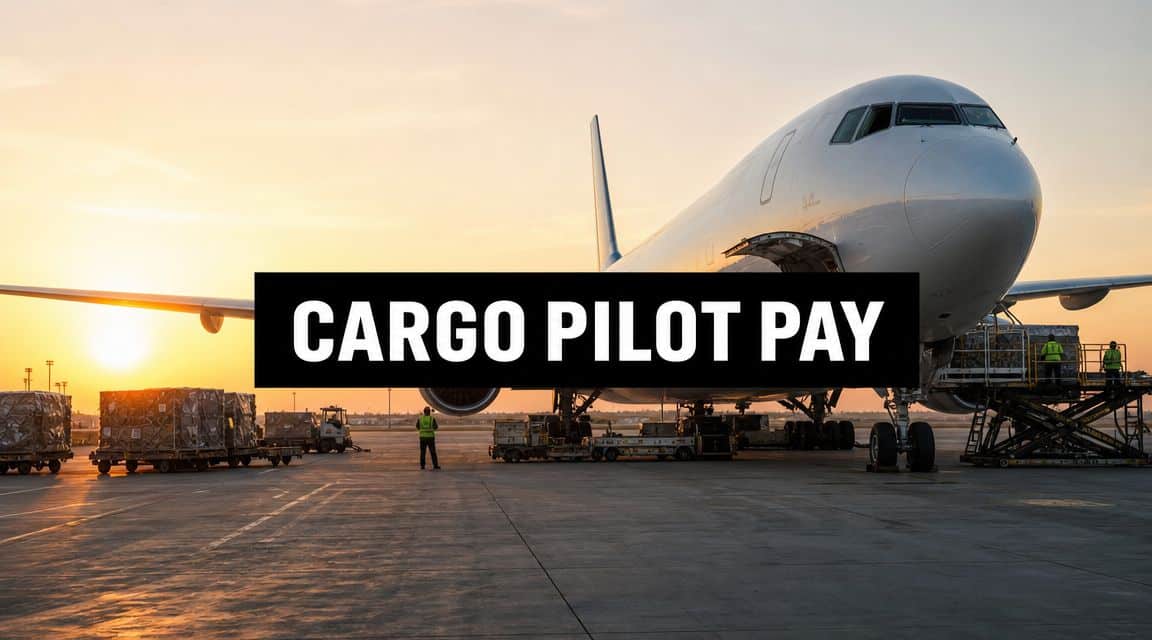
Cargo pilots in the U.S. often land around $143,142 on average, with many salaries falling between $122,979 and $211,464. At the low end, new first officers at major cargo airlines may start around $90,000 to $140,000, while senior widebody cargo captains can reach $350,000 or more.
If you're standing on the ramp as a student pilot and watching a freighter lift off before sunrise, those numbers can feel both exciting and confusing. You know cargo flying is real airline work. You know the pay can be strong. What's harder to see from the outside is how a pilot moves from private training to that right seat, then eventually to a captain seat on a large freighter.
Introduction From Flight Line to Freight Line
A lot of student pilots ask the same question in slightly different ways. Is cargo flying a good career? Does it pay like the airlines? Is it better than charter? Can you build a life around night schedules and freight runs?
The short answer is yes, cargo can be a very good career. But the better answer is that cargo pilot pay isn't one flat number. It changes with aircraft size, operator, seniority, qualifications, and the kind of network you fly.
Think about two pilots who both say, “I fly cargo.” One might be flying a smaller feeder operation, building experience, and learning how night schedules really work. Another might be flying a long-range widebody across oceans with a decade or more of seniority. Same broad job label. Very different paycheck.
Practical rule: Never judge a pilot career by one salary number. Judge it by the path, the equipment, and the upgrade potential.
That's where many aspiring pilots get tripped up. They search how much does a cargo pilot make, find a big range online, and assume the numbers are inconsistent. They aren't inconsistent. They're describing different stages of the same profession.
For a student pilot, that's good news. It means the top-end pay is tied to a roadmap you can influence. The certificates you earn, the quality of your instrument skills, whether you get multi-engine time, how you build hours, and when you reach ATP eligibility all shape where you can go next.
So instead of treating cargo pay like a mystery figure, treat it like a progression. That gives you something much more useful than a headline number. It gives you a plan.
Cargo Pilot Salary Ranges Unpacked
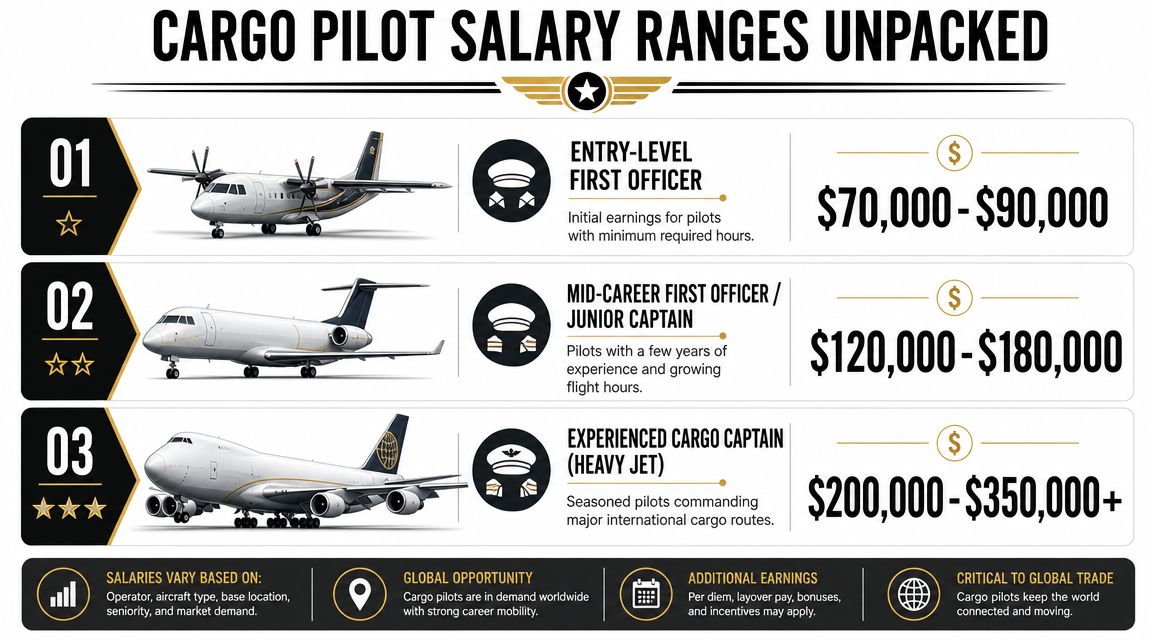
The cleanest starting point is this. Recent industry salary data places the average cargo pilot salary at $143,142 in January 2026, with many U.S. cargo pilot salaries falling between $122,979 and $211,464, and other estimates placing cargo pilots around $120,000 to $250,000+. That same salary guide notes that senior widebody captains at major cargo carriers can reach $350,000 or more in some cases, as shown in this cargo pilot salary guide.
What the range means in real life
An average is useful, but students need something more concrete. The better way to read cargo pay is by career stage.
| Career stage | Typical pay picture |
|---|---|
| Newer cargo first officer | Often starts near the lower end of published cargo ranges |
| Established line pilot | Usually moves into the middle of the broad salary band |
| Senior captain on large freighters | Reaches the top tier, especially on widebody equipment |
Confusion often stems from differing perspectives. Some people compare cargo pilots to the broader commercial pilot category and assume the pay is modest. Others compare them to major passenger airline captains and assume everyone in cargo makes top-dollar immediately. Neither view is accurate.
Entry level isn't the final answer
One industry guide reports that first officers at major cargo airlines are around $90,000 to $140,000 in 2026, while senior widebody cargo captains can reach roughly $350,000, depending on carrier and aircraft type. It also notes that larger aircraft such as Boeing 777-class freighters tend to command the upper end of the range, as explained in this cargo pilot versus airline pilot comparison.
That matters because “cargo pilot” covers a lot of jobs. A pilot flying smaller freight runs is not in the same compensation bracket as a captain on an international heavy jet. The title sounds similar. The operation is not.
A student pilot should read salary ranges the same way a mechanic reads an engine logbook. The details matter more than the label.
Why cargo salaries look wide online
Most salary pages bundle together very different jobs under one cargo label. That's why you'll see a low number, a middle number, and a top-end number that seem miles apart.
Here's the practical interpretation:
- Lower published numbers usually reflect newer first officers, smaller equipment, or earlier-career roles.
- Middle-range numbers often reflect pilots who have moved into more stable airline-style cargo operations.
- Top-end numbers almost always belong to senior captains, larger aircraft, and operators with bigger networks.
For a student, that's encouraging because the pay scale has room to grow. The career doesn't top out early. It usually expands as your qualifications and seniority expand.
Cargo pay versus other pilot categories
The broader U.S. labor picture helps make sense of where cargo sits. In the United States, the median annual wage for airline pilots, copilots, and flight engineers was $226,600 in May 2024, while the median for commercial pilots was $122,670. The U.S. Bureau of Labor Statistics also projects 4% employment growth from 2024 to 2034, with about 18,200 openings per year on average, according to the BLS outlook for airline and commercial pilots.
That comparison helps answer a common student question: does cargo pay more like airline flying or more like general commercial flying? In many airline-style cargo roles, pay tends to track the higher airline-pilot wage band, not the lower non-airline commercial category.
Key Factors That Determine Your Paycheck
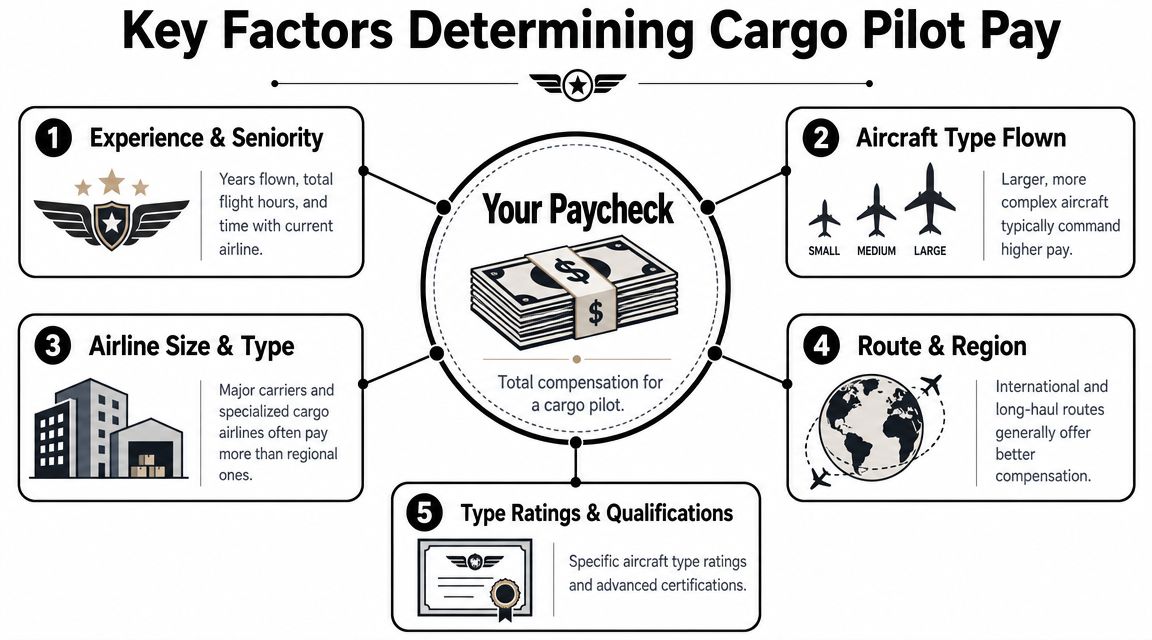
If two cargo pilots have very different paychecks, there's usually a straightforward reason. The biggest drivers are seniority, aircraft, operator, route structure, and qualifications.
Aircraft size changes the pay scale
A useful analogy is commercial trucking. A driver hauling local loads in lighter equipment isn't paid on the same scale as a driver moving specialized freight across long routes in more complex machinery. Flying works the same way.
Larger long-range freighters and high-utilization night networks generally pay more because they require more experience and support more complex operations. The same industry guide cited earlier reports first officers at major cargo airlines at $90,000 to $140,000 in 2026, while senior widebody cargo captains can reach roughly $350,000 depending on carrier and aircraft type.
Seniority is more powerful than most students realize
In aviation, seniority affects more than schedule quality. It often influences monthly earnings, trip selection, upgrade timing, and your access to better equipment.
A newer pilot may be qualified, sharp, and highly motivated, but still sit in the lower compensation band because seniority hasn't accumulated yet. A more senior pilot at the same company may hold more desirable flying and better pay because they've stayed long enough to move up the list.
The operator matters
Not every cargo company runs the same kind of flying.
Some operations focus on smaller feeder routes. Others run airline-scale systems with larger aircraft, strict dispatch reliability, and demanding overnight schedules. Those differences affect compensation because they change the required experience level and operational complexity.
Here's the simple version:
- Smaller operations often serve as stepping stones.
- Larger integrated carriers usually offer stronger long-term earnings.
- International heavy-freight flying tends to sit near the top of the compensation ladder.
Your logbook opens doors, but the kind of operation behind that door often decides the pay scale.
Qualifications help you become eligible for better jobs
Students sometimes ask if a type rating or ATP “guarantees” higher pay. Not by itself. What it does is make you eligible for jobs that pay more.
That's an important difference.
A commercial certificate lets you start working as a professional pilot. An instrument rating makes you more useful and safer in real-world operations. Multi-engine experience matters because much of serious cargo flying involves aircraft where systems knowledge, engine-out discipline, and cockpit workload are higher. ATP eligibility puts you in range of airline-style jobs where compensation is typically stronger.
Route structure changes the job
Cargo flying often means nights, hub turns, weather, time-sensitive freight, and recovery from irregular operations. That environment rewards pilots who can handle pressure, maintain precision, and stay disciplined when they're tired.
Long-haul and more complex route systems generally pay more because the responsibility level is higher. So if you want to understand how much does a cargo pilot make, don't stop at the word cargo. Ask these questions instead:
- What aircraft is the pilot flying
- What seat are they in
- How senior are they
- What kind of network does the company run
- What qualifications were required to get hired
Those answers tell you far more than the job title alone.
Your Career Path from Student to Cargo Captain
If you're starting near zero time, the cargo captain seat can feel far away. That's normal. The trick is to stop staring at the final job and focus on the next certificate.
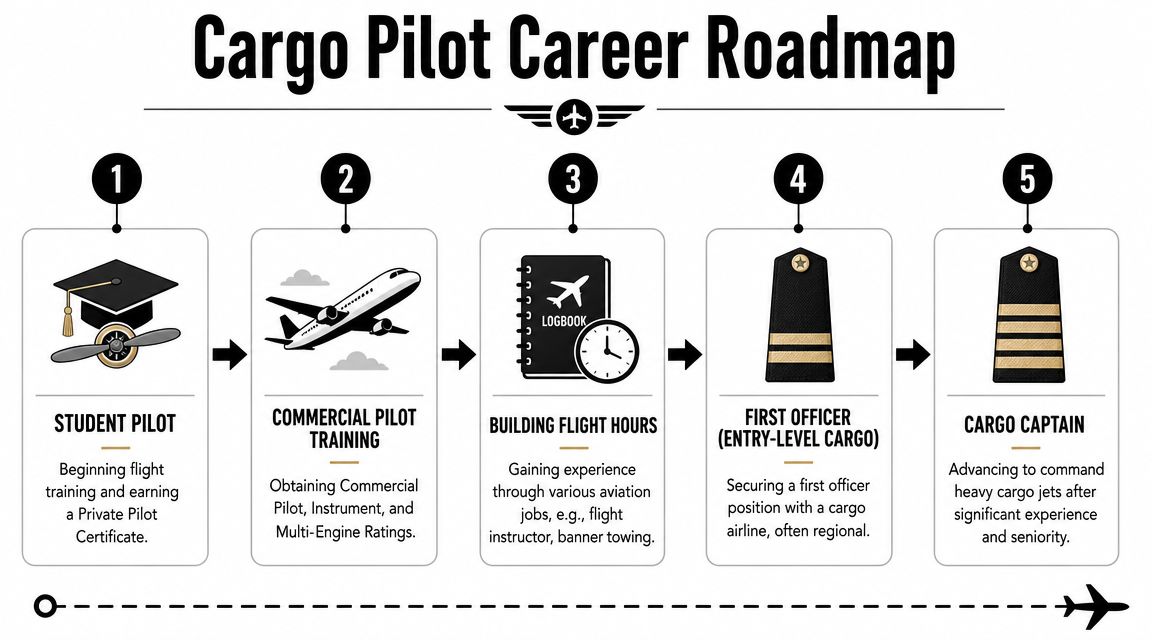
Start with solid private pilot foundations
Your Private Pilot Certificate is where you learn how to think like an aviator, not just manipulate controls. Students who rush this phase often pay for it later in instrument training.
You want good habits early. Checklist discipline. Trim awareness. Stabilized approaches. Clean radio work. Sound judgment. Cargo employers won't see your first landings, but they'll absolutely feel the quality of the training foundation behind your later performance.
Instrument training is where career-minded pilots separate themselves
If you're serious about freight, instrument flying isn't optional in any meaningful sense. Cargo operations live in the actual system. Weather, procedures, night flying, and schedule pressure all make instrument competence central to the job.
A strong instrument pilot is calmer, more organized, and better prepared for airline-style training. That's one reason students planning for professional flying usually benefit from a structured route such as an airline pilot career path.
Instructor's advice: Treat instrument training as professional training, not as another rating to collect.
Commercial and multi-engine training shape your marketability
Your Commercial Pilot Certificate changes you from a private aviator into someone who can work for compensation. But by itself, it still doesn't put you into a major cargo cockpit.
Multi-engine training matters because cargo employers often value pilots who already understand asymmetric throughst, systems management, and faster aircraft. A school that offers access to multi-engine aircraft such as a Piper Apache, plus training that connects directly to airline-style progression, can help make that transition more practical. DuBois Aviation offers that kind of training environment through its multi-engine capability and airline-focused program structure.
Building time is part of the profession
Most pilots don't go straight from commercial training into a freight jet. They build experience first. Common routes include instructing, aerial work, or other commercial flying that grows judgment as well as hours.
The key isn't just to build time. It's to build useful time.
Here's what usually helps most:
Instrument proficiency
Stay current and sharp. Employers care about how you fly in the system.Multi-engine exposure
Even a modest amount of good multi-engine time can matter because it shows you've started working in a more demanding environment.Professional habits
Logbook accuracy, briefing discipline, callout consistency, and checklist use all become part of your reputation.
Later in the process, this becomes the gate that matters most. To qualify for airline-style flying, pilots usually need the ATP certificate or to be on the path to it. That's why time-building jobs aren't detours. They are the bridge.
For students who like to hear the larger job-market context, this short video gives a useful overview of the professional pilot path.
The first cargo job usually isn't the final one
A pilot's first freight job may involve a smaller operation, an unusual schedule, or a route structure that looks nothing like the long-term dream. That's fine. You're building turbine experience, operational maturity, and the kind of record that supports future applications.
The pilots who eventually reach the upper pay bands usually do a few things well:
- They train efficiently but thoroughly
- They avoid avoidable checkride issues
- They build a clean, credible logbook
- They keep progressing toward more complex equipment
That's the career view students need. You're not trying to win aviation in one move. You're trying to make the next move strong enough to earn the one after it.
Beyond Salary The Full Compensation Package
A common mistake is to compare pilot jobs using only the base salary number. That gives you an incomplete picture.
Public salary pages often quote broad ranges such as $90,000 to $350,000 for cargo pilots, but top-end earnings can rise much higher when overtime, per diem, and bonuses are included. That distinction between base pay and total compensation matters a lot, as explained in this overview of commercial pilot salary and total compensation.
Base pay isn't the whole story
When a pilot says, “I make X,” they may be talking about base pay, or they may be talking about total annual compensation. Those are not the same thing.
A cargo pilot's package can include items such as:
- Per diem for time away from base
- Overtime or premium pay when trips extend or open flying is picked up
- Bonuses tied to company policy or contract terms
- Benefits such as health coverage and retirement contributions
That's why two job offers with similar base numbers can feel very different in real life.
Career planning has to include personal finance
This becomes important once your income starts climbing. Pilots often move from training budgets and hour-building jobs into much stronger earnings, and that shift changes financial decisions fast. For pilots preparing for a home purchase, resources such as home loans for pilots can help you understand financing options built around aviation careers.
The same principle applies when you compare airline and cargo paths. A compensation package with stronger long-term earning potential may look more attractive when you review the full picture, not just the first number on the page. If you want a broader comparison of airline compensation pathways, DuBois Aviation also has a guide to the best-paying airlines for pilots.
A smart pilot reads a job offer the same way they read a dispatch release. Don't look at one line. Read the whole document.
What students should remember
If you're still in training, don't get discouraged by the fact that entry-stage earnings and top-end compensation are far apart. That's normal in aviation.
The meaningful question isn't just “what does a cargo pilot make.” It's “what does a cargo pilot make at this stage, in this seat, on this equipment, with this contract.” Once you ask it that way, the profession makes much more sense.
Owning Your Wings A Primer on Buying an Airplane
Some pilots pursue cargo as a career and later start thinking about another aviation goal. Aircraft ownership.
That might mean buying a simple airplane for personal travel, building proficiency, or keeping access to flying outside the airline schedule. Some pilots also look at helicopters for utility, training, or personal use. Whatever the aircraft, the buying process has to be handled carefully.

The safe way to buy an airplane
A safe purchase starts before money changes hands. You need independent verification of the aircraft's condition, paperwork, and legal status.
Use this checklist:
Get a true pre-buy inspection
Hire a trusted A&P or IA who works for you, not the seller. A pre-buy should examine logs, airframe condition, engine status, corrosion risk, avionics reality, and deferred maintenance.Verify title and records
Make sure ownership is clear and liens are addressed. Paperwork problems can turn a “good deal” into a long headache.Use aviation escrow
Escrow adds structure and protects both sides of the transaction.Confirm insurance before closing
Some buyers wait too long on this. Don't. Insurance requirements can affect who may fly the aircraft and under what conditions.
Buy the mission, not the fantasy
Students and newer pilots often shop emotionally. They picture cross-country freedom, a polished panel, or a bargain price. Those things can distract from the mission.
Ask better questions:
- Will this aircraft do the flying I plan to do
- Can I afford the maintenance standard it deserves
- Do the logs support the story the seller is telling
- Will my experience level and insurance requirements match this airplane
If you're early in your professional journey, you may also want to understand how regional airline experience fits into long-term flying goals before taking on ownership. This overview of what a regional airline is gives useful context for pilots mapping out training, career progression, and future financial choices.
Aircraft buyers who may use an airplane in a business setting sometimes also review broader tax guidance, including articles on tax breaks for business vehicles, to understand how business asset rules are discussed in adjacent industries. That isn't aircraft-specific legal advice, but it can help frame the kinds of tax questions worth taking to an aviation-savvy CPA.
The instructor view on ownership
Ownership can be rewarding. It can also magnify every shortcut.
Don't buy the airplane you hope the inspection will justify. Buy the airplane that still makes sense after the inspection tells the truth.
That mindset keeps you safe, financially and operationally.
Frequently Asked Questions About Cargo Pilot Careers
Is the cargo pilot lifestyle harder than passenger flying
It depends on what kind of life you want. Cargo often means more night flying, more circadian disruption, and more time working during standard sleeping hours. Some pilots dislike that immediately. Others prefer it because the flying can feel more focused and less customer-facing.
For disciplined pilots, the lifestyle can be a strong fit. You need to manage sleep, nutrition, and routine seriously.
Do major cargo carriers require a four-year degree
Hiring standards can change by company and over time, so students should always verify current requirements directly with employers. In practice, what consistently matters is strong training, clean records, good judgment, and the qualifications needed for the job.
A degree may help at some employers. It is not a substitute for pilot skill, professionalism, or experience.
Is cargo flying less prestigious than passenger airline flying
No. It's different. Cargo pilots move critical shipments, operate on demanding schedules, and often fly in complex nighttime and weather conditions. Inside the profession, serious pilots understand that freight flying is real airline work.
Some pilots even prefer cargo because the operation is centered on flying and logistics rather than passenger service.
Is cargo a good path for long-term earnings
Yes, especially if your path leads to larger aircraft and long-term seniority at a strong operator. The upper end of cargo compensation can be very attractive, but it usually comes after years of progression, not immediately after training.
That's why students should think in phases. Learn well. Build time carefully. Move into better equipment. Upgrade when ready.
Are job prospects still worth pursuing
Yes. The broader pilot labor market remains large enough that an ambitious student can take the profession seriously. The BLS projects continued openings for pilots over the coming years, and that supports the value of building toward airline-style roles.
The practical point is this: if you train well and stay professional, there is still a real runway ahead.
Is Southern California a good place to begin training for this path
It can be. Busy airspace, towered operations, instrument exposure, and frequent radio work all help students develop cockpit discipline early. Training in a real-world environment tends to make the jump to professional flying less abrupt.
That doesn't guarantee a cargo career by itself, but it can shape the habits that support one.
What should a student pilot focus on first if cargo is the goal
Start with fundamentals and consistency.
Here's the order I'd emphasize:
Private pilot skills first
Learn to fly accurately and make sound decisions.Instrument proficiency next
Cargo flying rewards pilots who are calm and precise in the system.Commercial and multi-engine progression
These move you toward employability in more demanding operations.Professional habits every day
Show up prepared, fly stable profiles, keep accurate records, and take instruction well.
Students who do those things usually make better long-term career decisions because they understand not just how to fly, but how to build a career in aviation.
If you're aiming at a professional cockpit and want a structured place to begin, DuBois Aviation offers airplane and helicopter training, multi-engine instruction, and an airline career pathway built around practical progression from student pilot to professional flying.