
A lot of people chase the airline dream by looking at one number. Captain pay. The better question is how that pay is built, and what choices early in training make it more likely that you’ll reach the better schedules, aircraft, and upgrade opportunities later.
For United, that top end is eye-catching. Under the 2026 pay structure, senior widebody captains can reach about $425,856 annually at 80 monthly hours according to Airline Pilot Central’s United pay data. That figure changes the way many students think about training. A lesson in a Piper Cherokee stops feeling like an isolated expense and starts looking like the first brick in a long runway.
Soon they realize the actual roadmap includes aircraft type, upgrade timing, seniority, training discipline, and even practical money decisions outside the airline world, such as how to buy or sell an airplane safely if ownership enters the picture later.
The united airlines captain pilot salary topic also gets confusing fast. People mix hourly pay with annual pay. They compare first officers to captains without accounting for aircraft type. They hear “top pay” and assume every captain earns it. That’s not how airline compensation works.
It's comparable to learning instrument flying. You don’t start with the whole approach plate at once. You learn one element at a time. Altitude. Course. Timing. Power. Pay works the same way. Hourly rate is one piece. Monthly credit is another. Equipment matters. Seniority matters. Bids matter.
Introduction to United Airlines Captain Pilot Salary
A student working toward an airline career often sees the finish line as a uniform and a jet. The more useful picture is a pay statement tied to a specific seat, aircraft, and stage of career.
At United, the difference between an early captain and a senior widebody captain is large enough that it should shape how you think about training from day one. If your long-term goal is the left seat of a Boeing 787 or 777, your habits now matter significantly.
Why the pay number alone can mislead
A captain’s paycheck isn’t one flat salary. It’s built from a published hourly rate, then shaped by the kind of airplane flown and how many monthly hours are credited. That’s why two captains at the same airline can earn very different amounts.
A narrowbody captain and a widebody captain don’t sit on the same pay step. A year-one captain and a year-twelve captain don’t either. If you skip that distinction, the whole subject becomes muddy.
Practical rule: Never compare airline pilot pay without asking three questions first. What seat? What aircraft? What seniority?
Why aspiring pilots should care early
This matters before you ever touch a transport-category jet. Students who build strong instrument habits, finish ratings efficiently, protect their training record, and learn to operate consistently in busy airspace tend to be better positioned for the hiring and upgrade path later.
That’s the actual connection between training and compensation. The first logbook entries don’t determine your final paycheck by themselves, but they influence how smoothly you move through the ladder that eventually leads to captain bids and higher-paying equipment.
There’s also a practical money side. Pilots who plan ahead often think beyond airline payroll. Some will rent for years. Some will buy an airplane or helicopter. Some will sell one. Knowing how to evaluate aircraft value and transaction risk is part of being financially literate in aviation, not a separate hobby.
United Captain Pilot Salary Structure
United’s current captain compensation framework is easiest to understand if you treat it like a checklist. First identify the aircraft category. Then identify the pay year. Then apply the monthly guarantee or typical credit.
How the 2026 pay scale works
United captains operate under a pay scale effective January 1, 2026, and on widebody aircraft, year-one captains earn $356.46 per hour, rising to $382.47 per hour by year 12, with senior captains able to reach $443.85 per hour. The same data shows annual compensation up to $425,856 at 80 monthly hours on top-end widebody captain pay, according to Airline Pilot Central’s United Airlines page.
That tells you two important things immediately.
First, United pay is strongly equipment-based. Widebody flying commands higher rates. Second, annual earnings are not guessed from a vague “salary band.” They are produced by multiplying an hourly rate by credited flying time.
A simple table to make the pay mechanics visible
| Aircraft Type | Year 1 Rate | Year 12 Rate | Top Rate | Annual Salary Estimate |
|---|---|---|---|---|
| Narrowbody captain | $265.19/hour | Progresses through seniority ladder | Not listed in this source section | Approximately $222,659 annually at 70 hours/month |
| Widebody captain | $356.46/hour | $382.47/hour | $443.85/hour | Approximately $299,027 annually at 70 hours/month starting pay |
| Senior widebody captain | Not applicable | Not applicable | $443.85/hour | Approximately $425,856 annually at 80 hours/month |
The biggest point in that table is not just the top figure. It’s the gap between categories. Narrowbody command is a major achievement. Widebody command is a different earnings tier.
How to think about hourly pay without getting lost
Students often hear “per hour” and assume that means the same thing as a normal office wage. It doesn’t. Airline pilot pay is tied to credited flight hours and contractual minimums, not a simple clock-in system.
A clean way to picture it is this:
- Hourly rate gives the value of each credited hour.
- Monthly guarantee gives a floor.
- Aircraft assignment changes the value of each hour.
- Seniority moves the rate upward over time.
That’s why a pilot can hold the same title, captain, and still have a very different annual income than another captain at the same airline.
Why the structure matters for career planning
For a student mapping out a long-range path, this pay structure teaches a bigger lesson. Airline income doesn’t rise in a smooth straight line. It rises in steps tied to milestones. Ratings lead to jobs. Jobs lead to turbine time. Turbine time and seniority support upgrade. Upgrade opens captain rates. Better equipment can raise earnings again.
If you like comparing compensation systems across fields, broader global pay data and salary benchmarks can be useful for context. Airline pay stands apart because the ladder is unusually transparent once you know how to read the seat, aircraft, and seniority combination.
A student who understands the pay table early tends to make more deliberate choices about training pace, time-building, and long-term airline targets.
Factors That Influence Captain Pilot Salary
A United captain’s pay isn’t controlled by one lever. It’s more like a cockpit panel. Several switches affect the outcome, and some matter more than others.
According to AviationInterviews pay rate data for United, narrowbody captains start at $265.19 per hour and progress to $388 per hour by year 12, while widebody captains fall in a $385.40 to $443.85 per hour band, creating an annual range of $290,700 to $420,480 at 80 hours per month plus per diem.
That one sentence captures the biggest salary drivers.
Aircraft type changes the value of the same month
A captain can work a full month in either domestic or international equipment, but the same title doesn’t mean the same pay. Widebody flying sits in the stronger pay band. If your long-term goal is maximizing earnings, the equipment you eventually hold matters.
This is why students shouldn’t think only in terms of “becoming captain.” The more precise target is becoming a captain on equipment and schedules that support the compensation range you want.
Seniority shapes more than pride
Airlines run on seniority. That affects pay rate, bidding power, trip quality, and access to more desirable flying.
Here’s where readers often get confused. Seniority does two jobs at once:
- It moves you up the published pay scale over time.
- It helps you bid for more desirable positions and lines.
That means seniority doesn’t just raise the number on the chart. It can also improve the kind of flying attached to that number.
Monthly hours and per diem add texture
The annual range in the verified data assumes 80 hours per month, plus per diem. In plain terms, that means total pay is not built from rate alone.
A captain with a higher-paying aircraft assignment and strong monthly credit can land near the upper end of the published range. A captain on lower-paying equipment or with lower credited time won’t.
The salary question is really a scheduling question, a seniority question, and an aircraft question all at once.
What pilots can control and what they can’t
Pilots can’t control every pay factor. They can’t force an early widebody bid, and they can’t skip the seniority system. But they can control the preparation that keeps them competitive and upgrade-ready.
Some of the controllable factors include:
- Training quality: Strong instrument and multi-engine performance make later transitions smoother.
- Professional record: Attendance, judgment, and consistency matter more than many students expect.
- Career pacing: Efficient progress through ratings and time-building keeps momentum intact.
- Interview readiness: A pilot who presents clearly and professionally is easier to hire and easier to trust with future upgrade opportunities.
For readers thinking about compensation discussions in any profession, this guide on how to negotiate a salary offer is useful background. Airline pilot pay itself is largely contract-driven, but understanding how compensation frameworks work helps you read the bigger picture.
Career Progression From First Officer to United Captain
The jump from first officer to captain is where many pilots first feel the career shift in a concrete way. Responsibility increases. Decision-making authority increases. Pay increases too.
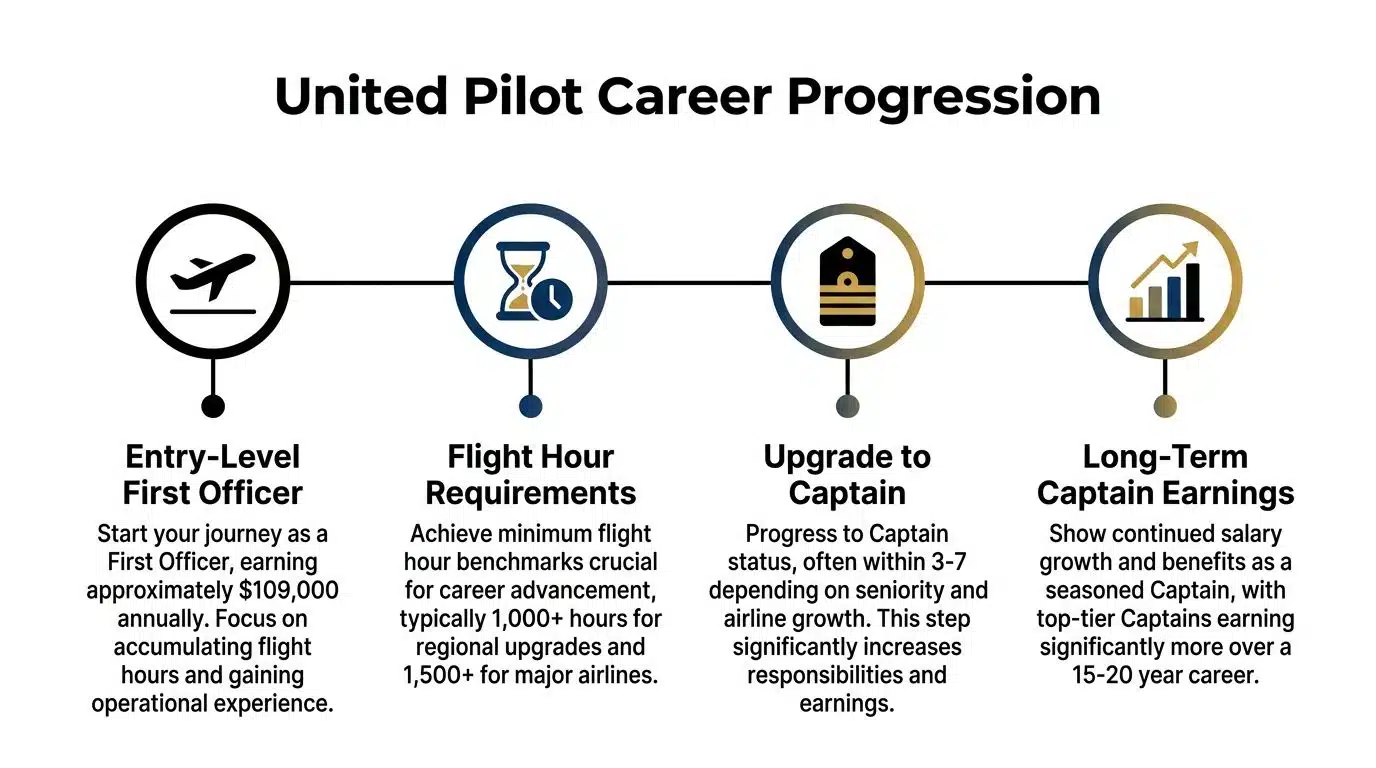
At United, first officers start at roughly $109,000 annually, then new captains earn about $329 per hour in year one, and senior widebody captains can exceed $438 per hour after 12 years, according to Thrust Flight’s United salary overview.
The ladder is built one certificate at a time
Most students imagine the career ladder as one leap from flight school to a major airline. In reality, it’s a sequence of smaller upgrades. Each one prepares you for the next.
A useful way to picture it looks like this:
- Private and instrument training build the base.
- Commercial and multi-engine work add professional capability.
- First officer employment builds operational experience in a crew environment.
- Captain upgrade arrives when experience, company need, and seniority line up.
That’s why your early training standard matters. The left seat isn’t won by one impressive flight. It’s built on years of repeatable performance.
Where students usually get confused about timing
People often ask for a fixed timeline to captain. Aviation doesn’t work like a train schedule. Upgrade timing depends on airline growth, pilot movement, fleet needs, and your position on the seniority list.
The reliable principle is simpler. Pilots who move steadily through training, build strong experience, and protect their record are in better shape when upgrade opportunities open.
A practical comparison helps. In training, one student rushes and repeats lessons because the foundation is weak. Another student progresses cleanly because the basics are solid. Airline careers behave similarly. Quality early training often saves time later even when no one can promise an exact upgrade date.
The first officer stage matters more than many think
Some students treat the first officer years like a waiting room. That’s a mistake. Those years are where pilots sharpen crew communication, checklist discipline, line judgment, weather decisions, and systems thinking.
If you want a useful baseline for that stage of the career, this overview of first officer pay can help frame the progression: https://duboisaviation.com/first-officer-salary/
What to prioritize if captain is the goal
The pilots who become strong captain candidates usually share a few traits:
- Consistent procedures: They don’t improvise where standardization matters.
- Calm communication: They brief clearly and don’t create extra workload for the crew.
- Solid instrument habits: They stay ahead of the airplane rather than reacting late.
- Professional maturity: They show up prepared, rested, and reliable.
“Captain” is not just a pay category. It’s a judgment category.
That’s the part students should remember. The salary jump is real, but airlines upgrade people who can carry command responsibility, not just people who have enough time in a logbook.
Benefits And Bonuses for United Captains
Hourly pay gets the attention, but a captain’s compensation picture is wider than the line rate. Benefits affect long-term financial value in a way many new pilots underestimate.
Retirement and long-range value
The verified data indicates that retirement contributions can amplify total compensation meaningfully for senior captains under the broader contract framework discussed in the United pay materials. The practical lesson is simple. A pilot shouldn’t evaluate the job using flight pay alone.
Retirement planning matters because airline careers are long. The pilot who understands how retirement contributions, protected benefits, and contract terms fit together usually makes better decisions about budgeting, lifestyle inflation, and career patience.
Per diem and contract extras
The AviationInterviews pay material also notes that annual compensation ranges are calculated plus per diem, which means the complete compensation picture includes more than the base hourly figure already discussed earlier.
For students, the important takeaway isn’t to memorize every contract line item. It’s to understand that airline pay packages often have layers:
- Base captain pay
- Trip-related pay elements
- Retirement components
- Contract protections and quality-of-life items
These layers don’t all hit your bank account the same way, but they still shape the total value of the job.
Why union contracts matter so much
Pilot compensation at a major airline isn’t random and it isn’t based on ad hoc manager discretion. It’s structured through negotiated agreements. That gives pilots a level of clarity many professions don’t have.
That clarity matters for planning. A student evaluating airline pathways can make more informed choices because pilot pay scales are tied to published rates, years of service, and aircraft categories rather than vague performance promises.
Benefits are part of career quality, not just pay
A strong compensation package also affects lifestyle. Health coverage, retirement contributions, schedule rules, and contract language all influence how sustainable the career feels over decades.
That’s why a narrow reading of united airlines captain pilot salary misses part of the picture. Two jobs can sound similar in annual pay, yet feel very different in long-term value when one has stronger retirement support and clearer contractual structure.
Instructor note: Pilots who focus only on headline pay often overlook the parts of compensation that matter most after many years in the industry.
Preparing for a United Captain Career
The best way to think about preparation is to stop aiming at “airline pilot” in the abstract. Aim at the specific habits that support eventual captain eligibility and command performance.
Build the right base before chasing speed
Early training should produce clean fundamentals, not rushed certificates. That means strong checklist use, stable approaches, accurate instrument scans, clear radio calls, and repeatable decision-making.
The verified United pay data tied to career pathways also highlights the value of instrument and multi-engine proficiency for pilots targeting higher-level airline progression. That point matters. Captains on premium equipment don’t get there by being casual about technical standards.
A practical training path should include:
- Instrument discipline: Learn to trust procedures, not just your instincts.
- Multi-engine competence: Engine-out thinking changes how you manage workload and risk.
- Crew mindset: Even in single-pilot training, act like standardization matters.
- Busy-airspace comfort: Towered airport operations make you sharper and more concise.
One factual option students can consider is DuBois Aviation, a Chino-based flight school at KCNO that offers airplane and helicopter instruction, an in-house simulator, and training in aircraft including Piper Cherokees and a Cessna 150, all in a busy Class D environment.
Treat reliability like a flight skill
One of the most overlooked captain-building traits is reliability. Airlines want pilots who can be counted on, not just pilots who can pass a maneuver.
That means your training habits matter now:
- Show up prepared.
- Keep your logbook organized.
- Know your flows and callouts.
- Don’t build a reputation for excuses.
- Recover from mistakes without becoming defensive.
Those are command habits long before they become captain habits.
Use simulator work for the right reasons
A simulator is most useful when you use it to sharpen thought process, not just to repeat button pushes. Good sim sessions help you practice abnormal procedures, instrument workload management, and cockpit organization.
A little later in your preparation, interview work becomes just as important. Technical answers matter, but so does how you communicate under pressure. This resource on airline interview preparation is worth reviewing: https://duboisaviation.com/airline-pilot-interview-questions/
Here’s a useful visual primer for aspiring airline pilots.
A training checklist that supports long-term earnings
If your eventual target is a better captain bid and stronger earning potential, your training choices should support upgrade readiness years before the upgrade becomes available.
Use this checklist as a practical filter:
- Choose schools and instructors that emphasize procedures: Sloppy habits become expensive later.
- Prioritize instrument confidence early: Airline flying rewards precision under workload.
- Get comfortable in real-world radio environments: Busy airspace sharpens communication.
- Build multi-engine judgment, not just hours: Employers notice the difference.
- Practice professional briefing language: Captain candidates sound organized before they ever hold command.
- Protect your attendance and training record: Reliability is part of employability.
Students often ask whether they should focus more on speed or polish. The answer is disciplined efficiency. Move steadily, but don’t cut corners that create retraining later.
Safe Aircraft Buying And Selling Tips
Many pilots who pursue airline careers also become aircraft renters, partners, buyers, or sellers at some point. The safe way to buy an airplane or helicopter is the same way you plan a good flight. You verify before you commit.
Start with records, not paint
A clean exterior can distract buyers from what matters. Begin with logbooks, maintenance entries, airworthiness history, and paperwork continuity.
When records are incomplete, stop and slow down. Missing history doesn’t always kill a deal, but it should change how cautiously you proceed.
The safest buying sequence
Use a simple sequence and don’t skip steps:
- Define the mission clearly. Cross-country trainer, time-builder, personal travel aircraft, or helicopter platform all lead to different choices.
- Review the logs early. Look for gaps, recurring discrepancies, and signs of poor documentation.
- Order a title search. Ownership problems can become your problem after closing.
- Schedule a pre-buy inspection with a qualified mechanic. Use someone who works for you, not the seller.
- Use escrow for funds and documents. Clean process prevents ugly surprises.
- Match condition to price. Price should reflect reality, not hope.
A pre-buy inspection is not a formality. It’s your reality check.
What sellers should do before listing
Selling safely also takes preparation. Organized records, clear maintenance status, and honest disclosure reduce wasted time.
A seller should gather:
- Complete logbooks
- Recent maintenance documents
- Equipment lists
- Airworthiness and registration paperwork
- Clear notes on known issues
That helps serious buyers evaluate the aircraft without guessing.
How this connects to airline career planning
This topic may seem far from united airlines captain pilot salary, but it isn’t. Pilots who manage money carefully tend to preserve more of what they earn. Buying the wrong aircraft, skipping due diligence, or overpaying for cosmetic appeal can undo a lot of financial progress.
If you’re still in the regional or time-building stage, understanding that world also helps you evaluate career stepping-stones more realistically. This overview of what a regional airline is gives useful context for the part of the path many pilots travel before reaching a major: https://duboisaviation.com/what-is-a-regional-airline/
The same safety mindset applies in every part of aviation. Verify the details. Respect the paperwork. Trust qualified inspections more than optimism.
Conclusion and Next Steps
The united airlines captain pilot salary story becomes much clearer when you stop treating it as one giant number. It’s a system. Aircraft type matters. Seniority matters. Monthly credit matters. Career progression matters.
That’s good news for aspiring pilots because systems can be learned. You don’t need to guess your way through the path. You can build the qualifications, habits, and judgment that support the kind of opportunities that eventually lead to captain pay on stronger equipment.
The long view matters most. A student training today may focus on private pilot skills, instrument accuracy, and multi-engine competence. Those don’t feel like salary topics in the moment. They are. They shape how efficiently you move through the career ladder and how ready you are when the left-seat opportunity arrives.
Keep your next steps practical:
- Review captain pay tables carefully and learn how hourly rates become annual earnings.
- Build strong instrument and crew-style habits now, not later.
- Take simulator work seriously.
- Keep your record clean and your professionalism obvious.
- Treat aviation finances with the same discipline you use in the cockpit.
Aviation rewards people who prepare early and think clearly. The pilot who understands both the flying side and the financial side is usually the one who makes better choices over the full arc of a career.
If you want help turning those early training decisions into a clear airline plan, DuBois Aviation offers flight training, simulator access, aircraft rental, and career-focused instruction at Chino Airport. Explore your next step at DuBois Aviation.


