

Those who search how to become a corporate jet pilot are staring at the same thing. A sleek business jet on the ramp. The crew walking out in pressed uniforms. A cabin door closing on passengers who expect the trip to be smooth, private, and exactly on time.
What they usually don’t see is the part that matters. The pilot who gets that job didn’t just collect licenses. They built judgment, radio discipline, instrument habits, customer skills, and a reputation. Corporate aviation rewards polish. It also exposes weak spots fast.
The View from the Ramp Your Journey Begins Here
A lot of aspiring pilots start with the wrong mental picture. They think the path is: get a license, build time, apply to a jet job. That’s incomplete. In corporate flying, the pilots who get hired are usually the ones who treated every early stage like preparation for a professional cockpit, not like a box-checking exercise.

If you’re at the beginning, your roadmap is straightforward in broad strokes. Earn the core certificates. Build quality time. Learn how the business side of flying works. Then make yourself visible to the people who hire in this niche. If you want a useful outside view of how the career field looks from the employer side, this overview of private jet pilot careers is worth reading alongside your training plan.
The practical part starts with choosing an environment that teaches you to think like a working pilot early. A busy towered field gives you more than takeoffs and landings. It teaches pacing, communication, traffic awareness, and how to keep your scan and your composure when the frequency gets busy. That’s why an overview like what it takes to become a pilot matters before you spend real money on training. You want to understand the full path, not just the first lesson.
Corporate flying doesn’t go to the pilot with the coolest logbook story. It usually goes to the pilot others trust with a demanding passenger, a changing schedule, and a high-value airplane.
Three phases shape the journey.
- Certification first: You need the FAA pathway done correctly and efficiently.
- Hour building next: Recruiters care about the kind of time you built, not just the total.
- Reputation last: Networking, professionalism, and reliability often decide who gets the call.
The dream is real. So is the standard.
Building Your Foundation The Essential Pilot Certificates
The FAA path is not mysterious. It is demanding, sequential, and unforgiving if you rush the wrong parts. For a corporate track, the order matters because each certificate solves a different problem you’ll face later in business aviation.
According to this FAA pathway overview for private jet pilots, the normal progression is Private Pilot License, Instrument Rating, Commercial Pilot License, and Multi-Engine Rating, with 1,500 total hours as the target for entry-level corporate roles. That same source notes that the PPL requires at least 40 hours total flight time, though 50 to 70 hours actual is typical, and that 40% of initial checkride failures come from weak emergency procedures.
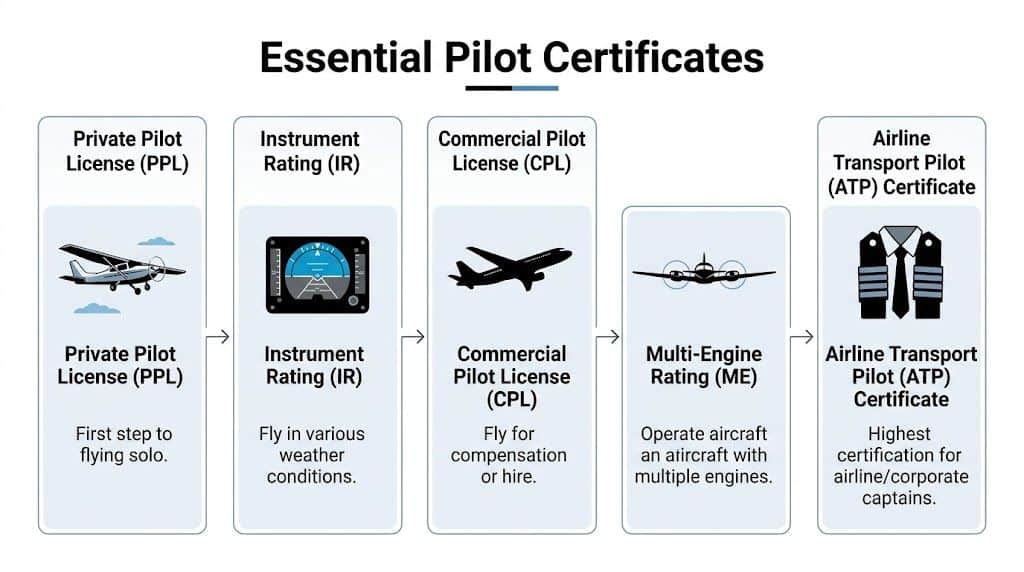
A good way to think about this progression is the same way other industries think about professional certification. The credential itself matters, but its value is whether the training changed how you perform under pressure.
Private Pilot License means learning command
Your Private Pilot License is where you stop being a passenger and start becoming responsible for outcomes. The FAA minimum is only the floor. The core of the job here is learning control discipline, checklists, radio work, airspace habits, weather respect, and aeronautical decision-making.
At this stage, bad habits get baked in fast. Sloppy trim use. Unstable approaches. Delayed checklist flow. Wandering radio calls. Those don’t disappear later because the airplane got faster.
Focus on these habits early:
- Fly stabilized patterns: Don’t normalize chasing altitude and speed on final.
- Treat checklists as workflow tools: Read, do, verify. Don’t mumble through them.
- Build radio precision: Corporate pilots spend their careers sounding calm and concise.
- Take abnormal procedures seriously: Weak emergency recall shows up on checkrides and later in interviews.
Instrument Rating is where professionals separate themselves
If I had to point to one rating that changes a pilot’s ceiling, it’s the Instrument Rating. Corporate aviation runs on schedule pressure, weather decisions, airspace complexity, and procedure discipline. Instrument training teaches you to trust process over emotion.
Simulator time is highly valuable. Used correctly, a simulator sharpens scan, flows, holds, approaches, missed approach execution, and workload management. It also lets you repeat mistakes without burning fuel. For pilots training in Southern California or any busy environment, a structured program like an instrument rating course can make a major difference because consistency is everything in IFR training.
Practical rule: Your instrument training should make you boring in the best way. Predictable callouts. Predictable briefings. Predictable corrections. Flight departments love predictability.
The common mistake is treating instrument work like a phase to survive. Don’t. Corporate recruiters notice the pilot who can brief cleanly, stay ahead of the airplane, and manage changing instructions without sounding rattled.
Commercial Pilot License turns skill into employability
The Commercial Pilot License is where flying becomes a profession. Under Part 61, the cited pathway calls for 250 hours. But the useful takeaway isn’t just the number. It’s that this rating demands higher precision, better aircraft control, and a stronger standard of judgment.
Commercial training should do three things for you:
| Focus area | What it builds | Why it matters later |
|---|---|---|
| Precision maneuvers | Aircraft control and energy management | Jets punish sloppy control inputs |
| Cross-country planning | Route judgment and operational thinking | Corporate trips often involve changing constraints |
| Professional standards | Briefing, checklist use, and consistency | Employers want a pro before they hand over a jet |
A pilot can pass commercial training and still not look employable. That usually happens when the pilot can fly a maneuver but can’t explain a decision.
Multi-Engine Rating is your bridge to jet logic
Most aspiring corporate pilots underestimate the Multi-Engine Rating. They think it’s just another add-on. It isn’t. It’s your first serious exposure to asymmetric throughst, higher workload, system management, and the need for immediate, disciplined responses.
Twin-engine training teaches respect for performance margins. It also teaches a lesson that carries into turbine equipment. The airplane won’t save you from delayed action.
If you plan to fly business aircraft, this rating should not be treated like a quick checkride sprint. Use it to sharpen:
- Engine-out memory items
- Configuration discipline
- Directional control
- Systems awareness
- Approach planning under higher workload
ATP is the threshold that opens doors
For many corporate jet roles, the path eventually points toward the Airline Transport Pilot certificate. The cited FAA pathway places 1,500 hours as the target for that threshold. Even when a specific operator can hire below what a major department wants, ATP-level maturity remains the benchmark.
Pilots who train efficiently tend to move faster than pilots who train intensely for a month, disappear for weeks, then return half-current. Inconsistent training is expensive. It stretches timelines and erodes confidence.
That’s why the foundation phase matters so much. Get the sequence right, train consistently, and use each rating to build the habits the next one depends on.
The Art of Strategic Hour Building
A commercial certificate gives you permission to work. It does not make you competitive for corporate aviation by itself. The hard middle is where many pilots stall. They get licensed, then drift. They chase any hour they can get, end up with a messy logbook, and wonder why interviews don’t materialize.
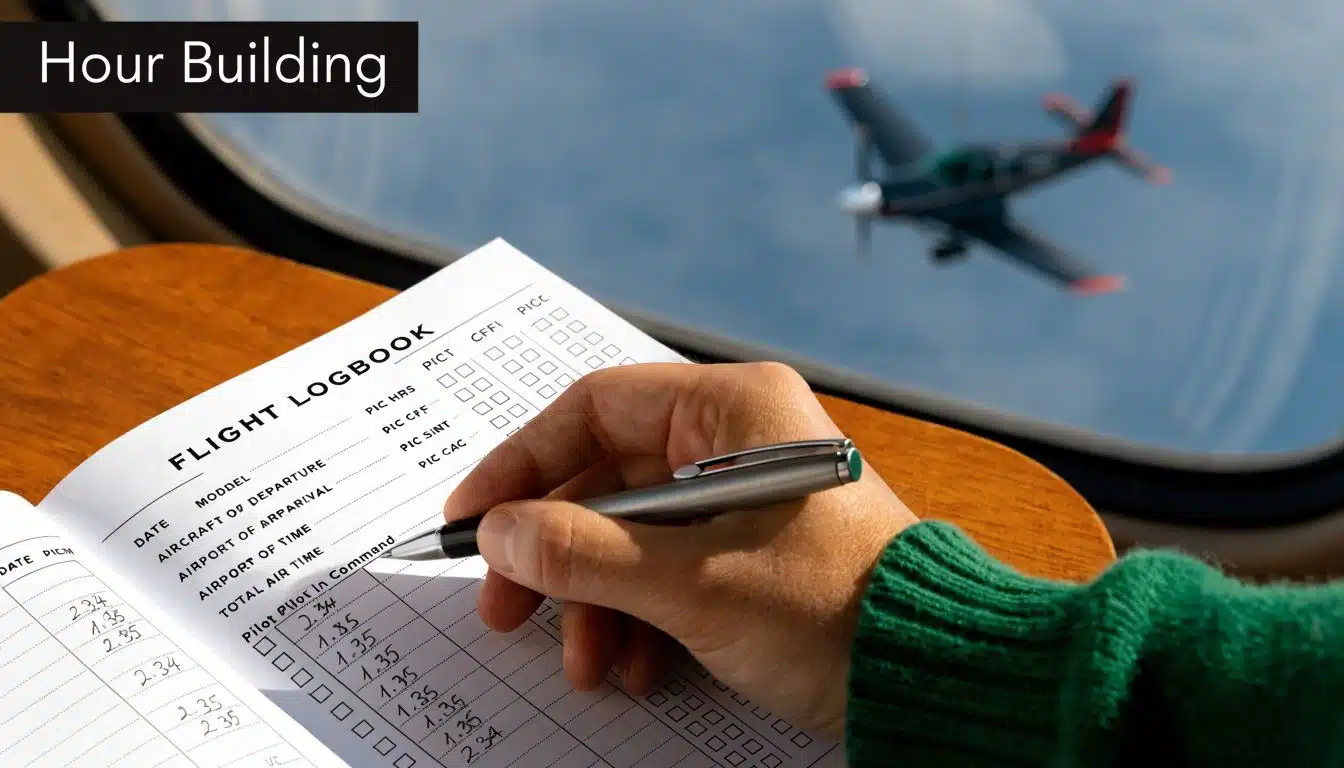
According to this corporate pilot entry analysis, 70 to 80% of low-time pilots struggle with visibility, and 60% of successes come through personal networks rather than cold applications. That same source says an emerging trend has produced a 25% boost in contract opportunities for pilots with 500 to 1,000 hours who market themselves effectively.
That tells you something important. The problem isn’t only total time. The problem is being unknown, unconnected, or forgettable.
Why instructing still works
Becoming a flight instructor remains one of the strongest paths because it builds more than hours. Teaching forces you to explain systems, catch mistakes early, and make calm corrections while someone else is behind the controls. That develops command presence.
A structured look at flight instructor requirements is useful if you’re deciding whether the CFI route fits your timeline. For many pilots, it does. Not because it’s glamorous, but because it creates disciplined repetition.
What quality hour building usually looks like:
- Frequent IFR exposure: Approaches, holds, briefings, and weather decisions age well on a resume.
- Cross-country variety: Different airports, different procedures, different workload levels.
- Multi-engine time when possible: Even small amounts help if the time is meaningful.
- PIC judgment: Employers like pilots who’ve made real decisions, not just watched someone else make them.
What bad hour building looks like
Not all logged time carries the same weight in an interview. Some pilots spend months adding low-value hours without improving the skills that matter in corporate flying.
Avoid these traps:
- Mindless pattern laps: They add time but not much operational depth.
- Long gaps in training or flying: Skill fades faster than people admit.
- Chasing totals over substance: A thick logbook with weak instrument habits won’t impress a chief pilot.
- No relationship building: If no one can vouch for you, your application gets colder.
Low-time pilots often think they need a perfect path. They need a visible path. Someone has to know your name before they trust your seat.
A lot of pilots also underestimate how much presentation matters. Keep your logbook clean. Track instrument approaches accurately. Record multi-engine time precisely. Be able to explain where your experience came from without rambling.
Here’s a practical discussion that complements the strategy side of this phase:
The unconventional routes can work
Traditional time-building is still the backbone, but it isn’t the only lane. Some pilots break through by making themselves useful in niche ways. Contract support, safety pilot work, ferry assistance, right-seat opportunities in smaller turbine operations, and networking with local operators can all create momentum.
The key is professionalism. If you want contract or referral work, people need to believe three things about you:
| What operators want to know | What you need to show |
|---|---|
| Can this pilot be trusted? | Reliability, good communication, clean records |
| Will this pilot reduce workload or add to it? | Preparation, punctuality, paperwork discipline |
| Can this pilot fit our operation? | Professional attitude and strong people skills |
Many talented aviators fail at this point. They market certificates instead of usefulness. Nobody hires a low-time pilot because the pilot wants an opportunity. They hire when they believe the pilot can solve a need without creating new problems.
Build a reputation before you need one
Corporate flying remains relationship-driven. Introductions matter. Recommendations matter more. If you wait until you hit a target hour mark to start networking, you’re late.
Practical networking looks like this:
- Stay in touch with instructors and examiners: They often hear about openings first.
- Show up where pilots and operators gather: Not to ask for favors, but to become familiar.
- Keep your online presence professional: Aviation is a small world and people look.
- Respond fast and clearly: Reliability in communication signals reliability in flight ops.
The pilots who move through the hour-building phase well usually do one thing differently. They treat every flight as part of their reputation, not just part of their total time.
Making the Leap to the Right Seat
A corporate interview does not end when the technical questions are over. In many departments, that’s where the core evaluation starts. The crew already assumes you should know the airplane, regulations, weather basics, and IFR procedures. What they want to learn next is whether they can put you in front of executives and trust your judgment.
According to this corporate pilot training overview, 65% of hiring decisions hinge on soft skills interviews, and corporate pilots can spend up to 40% of their time on non-flying duties like passenger coordination and catering. That matches what line pilots already know. The job is part aviator, part operator, part concierge.
Your resume and logbook need to tell a clean story
Most pilot resumes fail because they read like a records dump. Corporate flight departments don’t want every possible detail. They want relevance. Put the experience that predicts success at the top.
That usually includes:
- Instrument credibility: Approaches flown, IFR environment, real-world decision making.
- Multi-engine and turbine exposure: Even limited experience matters if it was operationally meaningful.
- Teaching or leadership roles: CFI time often signals maturity and communication skill.
- Customer-facing work: Any role where you handled people calmly under pressure helps.
Your logbook should support that story. If the interviewer asks about hard-weather decision making, diverted flights, or handling schedule changes, you should have clear examples ready.
Corporate departments hire for fit, not just for flight time
Airline-minded applicants sometimes miss the mark. Airlines can absorb a more standardized personality profile. Corporate operations often can’t. The crew may be tiny. The passengers may know you by name. A chief pilot is not only hiring a stick-and-rudder operator. They’re hiring someone who can represent the department.
You can be technically sharp and still lose the job if the department thinks you’ll create friction with passengers, schedulers, maintenance, or the other pilot.
The behaviors that matter are simple, but not easy:
- Discretion: You hear private conversations. You don’t repeat them.
- Adaptability: Departure times move. Catering changes. Destination details shift.
- Composure: If something goes sideways, your tone stays level.
- Service mindset: Small details matter because passengers notice them.
Interviews test your judgment in subtle ways
A good corporate interview often includes more than one filter. There may be a technical review, a simulator session, and a scenario discussion built around schedule pressure, weather, maintenance, or passenger expectations.
What they’re really asking is whether you can balance service and safety without letting one erode the other.
Use this framework when you prepare:
- Answer operationally: Don’t recite definitions if they asked for a decision.
- Think in crew terms: Show how you communicate, brief, and cross-check.
- Protect the standard: Never imply you’d cut corners to satisfy a passenger.
- Stay concise: Long answers often sound less confident, not more.
Your online presence also matters more than many pilots realize. Keep it professional. Aviation is networked enough that chief pilots, line pilots, recruiters, and referral sources often check before they call.
If you want the right seat in a corporate jet, become the person a captain wants to spend a difficult duty day with. That’s a higher standard than “qualified,” and that’s the point.
Mastering the Jet and Advancing Your Career
Getting hired is not the finish line. It’s admission to a more demanding phase. Once you enter turbine corporate flying, training gets narrower, faster, and more exact. The airplane is more capable, the systems are deeper, and the margins for sloppiness get smaller.

According to this step-by-step guide to corporate pilot advancement, corporate flight departments typically look for 2,000 to 3,000 total hours and 500+ multi-engine hours for captain roles. The same source says entry-level First Officer salaries start around $60K to $90K, can rise to over $150K for captains with 5,000 hours and a type rating, and that networking through NBAA can lead to 2x faster career advancement.
Your type rating changes the game
A type rating is the aircraft-specific qualification that lets you fly a particular jet model. Consequently, systems knowledge becomes granular. Electrical architecture, fuel logic, pressurization, autoflight modes, limitations, abnormal procedures, and memory items all move to a higher standard.
The pilots who do well in type school usually arrive with disciplined study habits. The ones who struggle often rely on raw flying skill and underestimate the systems workload.
Prepare for type training like this:
- Know your flows cold: Cockpit choreography matters.
- Study limitations early: Don’t leave hard memory items for the last minute.
- Brief clearly: In jets, a poor brief multiplies workload.
- Use simulator sessions to sharpen CRM: The best crews distribute tasks well.
Recurrent training is part of the lifestyle
Corporate pilots don’t train once and coast. Recurrent training keeps standards high and catches erosion before it turns into an operational problem. Every cycle is a reminder that professionalism is perishable.
The corporate pilot who stays valuable is the one who treats recurrent as practice for the real job, not as a hurdle to clear.
That mindset matters because business aviation can be deceptive. Some weeks are quiet. Then a trip drops in with weather, short notice, passenger changes, and a demanding destination. Recurrent training helps keep you from being surprised by your own rust.
Career growth depends on more than hours
Moving from First Officer to Captain is partly about experience, but not only about experience. Departments look for decision quality, crew leadership, maintenance awareness, passenger handling, and whether the pilot can carry the full operational picture.
A practical career ladder looks like this:
| Stage | What matters most |
|---|---|
| First Officer | SOP discipline, learning pace, CRM, reliability |
| Senior FO | Operational depth, stronger systems knowledge, passenger confidence |
| Captain candidate | Judgment, leadership, conservative decision making |
| Captain | Command authority, department trust, consistency |
Lifestyle matters too. Corporate schedules can be excellent in one department and chaotic in another. Ask hard questions before accepting a job. How often are trips added late. How is duty managed. Who handles trip support. What’s the expectation when executives change plans.
The pilots who last in this niche are usually the ones who like both halves of the work. They enjoy flying advanced aircraft, and they’re comfortable with the service and schedule realities that come with them.
Beyond the Cockpit The Path to Aircraft Ownership
Aviation careers often open a second track. Once you’ve spent enough time around airplanes and operators, you start seeing something else. Pilots who understand mission planning, maintenance realities, and operating risk become valuable not only in the cockpit, but also in aircraft acquisition, sales support, and ownership advising.
The labor market supports that long-term possibility. The U.S. Bureau of Labor Statistics overview for airline and commercial pilots lists a median annual wage of $226,600 for airline pilots and $122,670 for commercial pilots as of May 2024, while Boeing’s outlook in that same source projects 123,000 new pilots needed in North America over 20 years. Strong earnings and continued demand give experienced pilots room to move into ownership and acquisition work over time.
How to buy an airplane the safe way
Buying an airplane safely starts with honesty about mission. Not dreams. Mission. If you mostly fly short trips with one passenger and light bags, don’t shop like you need a cabin-class machine. If your trips involve weather, mountains, or schedule pressure, don’t buy the cheapest airframe and pretend capability will appear later.
Use this order:
Define the mission clearly
Range, payload, runway needs, weather exposure, and passenger count come first.Build a realistic ownership budget
Purchase price is only the entry ticket. You also need room for insurance, maintenance, storage, training, and unexpected downtime.Choose the right ownership team
A good mechanic, aviation-savvy escrow support, and a title professional matter more than a slick listing.Insist on a true pre-buy inspection
This should be done by a trusted shop that works for you, not for the seller. A cosmetic airplane can still hide expensive problems.Verify paperwork and records
Missing logbooks, unclear damage history, weak maintenance documentation, or title problems should slow the deal down immediately.
What buyers get wrong
The most common mistake is emotional buying. The second most common is confusing a pre-buy with a casual look-over. Don’t let either happen.
Watch for these warning signs:
- Incomplete records: If you can’t verify history, you can’t price risk properly.
- Seller pressure: Urgency usually benefits the seller, not the buyer.
- Unclear maintenance status: Deferred items have a way of becoming your problem fast.
- Mission drift: Buyers often stretch into the wrong airplane because the listing feels attractive.
Helicopters follow the same discipline
The same logic applies if you’re looking at a helicopter. The machine, mission, maintenance profile, and training requirements are different, but the buying discipline is not. Define use first. Inspect thoroughly. Verify records. Get category-specific expertise before money moves.
Pilots who understand ownership from both seats become unusually valuable. They can talk to a buyer like an operator, not like a brochure.
If you’re serious about building a path into corporate aviation, DuBois Aviation offers training across the certificates and ratings that matter, including private, instrument, commercial, multi-engine, and instructor pathways, plus access to a towered airport environment and simulator resources that support disciplined progression. The right school won’t hand you a jet job. It can give you the structure, repetition, and operational habits that make the rest of the journey go a lot better.