
You’ve finished your commercial training. Your landings are solid. You can plan a cross-country, brief an approach, and carry yourself like a professional pilot. Then the next question shows up fast: What now?
For many commercial pilots, the answer is becoming a flight instructor.
That choice matters for more than time-building. Teaching forces you to understand flying at a deeper level than almost any other step in training. You stop asking, “Can I do this maneuver?” and start asking, “Can I explain it clearly, catch an error early, and keep the flight safe while someone else learns?” That’s a different level of mastery.
Two practical options worth comparing
These are specific products pilots commonly compare for this type of flying. Confirm compatibility with your aircraft and instructor before ordering.
 Premium ANR headsetLightspeed Zulu 4 ANR Aviation Headset - Dual GA PlugCheck current availability on Amazon (paid link)
 Premium headsetBose A30 Bluetooth Aviation Headset - Dual PlugCheck current availability on Amazon (paid link)
A good CFI shapes habits that stay with a pilot for years. Checklist discipline. Radio confidence. Decision-making under pressure. Respect for weather. Calm corrections instead of rushed reactions. Those habits start in the right seat.
If you’re considering that move, you’re in the right place. The FAA’s rules can look dense at first glance, and many articles reduce them to a bare checklist. That doesn’t help much when you’re trying to map out your actual path from commercial pilot to instructor. What follows is a practical guide to flight instructor requirements, the training flow behind them, and how that path looks in a real training environment at Chino Airport.
From Right Seat to Left Seat Starting Your CFI Journey
Most pilots reach the commercial certificate and feel two things at once. Relief, because they’ve worked hard to get there. Uncertainty, because the next step isn’t always obvious.
The CFI certificate often gets described as a stepping stone. That’s true, but it’s incomplete. A better way to think about it is this: your instructor certificate is where you stop being only an operator of the airplane and start becoming a professional educator in it.
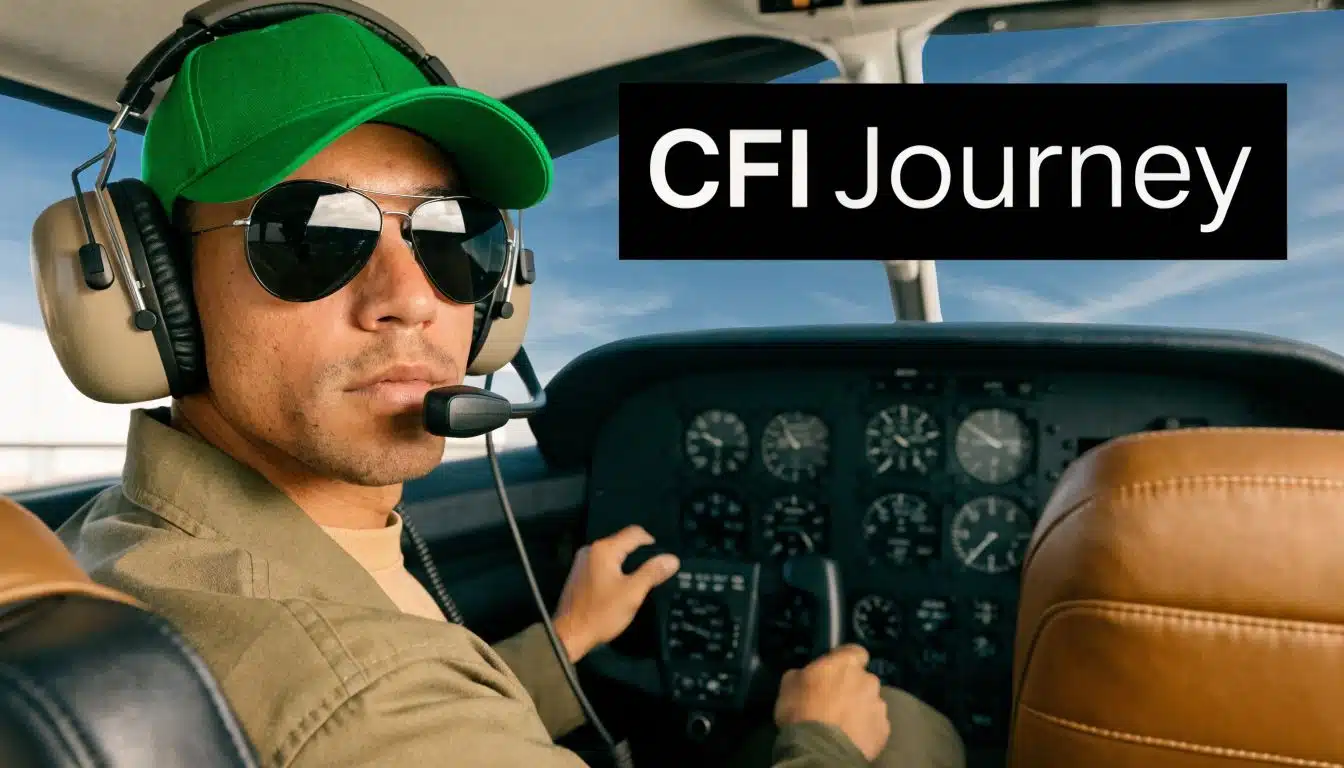
I’ve seen strong commercial pilots struggle at first with one simple shift. In commercial training, you prove performance. In CFI training, you prove performance and explanation. You need to fly the airplane, manage risk, and teach with structure.
That’s why the process is so rewarding.
Why the CFI certificate changes you
A student can copy your control inputs without understanding them. A future instructor can’t get away with that. You have to know why the airplane behaves the way it does, why a student makes the same mistake three times in a row, and how to correct it without overload.
That brings teaching theory into the cockpit. If you want a simple non-aviation primer on how adults absorb and retain new information, this overview of adult learning styles is worth your time. It’s useful because many CFI applicants underestimate how much of the job is communication, pacing, and adapting.
A polished maneuver doesn’t make you an instructor. A clear correction, delivered at the right time, does.
What changes when you sit in the left seat
Your responsibilities widen quickly:
- You model standards: Students copy how you brief, taxi, talk, and debrief.
- You manage attention: A beginner can only process so much at once.
- You protect margins: Teaching means staying ahead of the airplane and ahead of the student.
- You translate complexity: Good instructors turn a confusing lesson into one clear next action.
That’s why many experienced pilots call the CFI one of the most demanding certificates they’ve earned. It asks you to combine technical skill with judgment and teaching discipline.
For the commercial pilot wondering what comes next, this is often the most logical answer. It sharpens your own flying, builds experience that employers respect, and gives you work that matters every day you show up.
Meeting the Core FAA Flight Instructor Requirements
The FAA does not treat instructor certification as an add-on. It treats it as a professional qualification. That’s the right mindset for you, too.
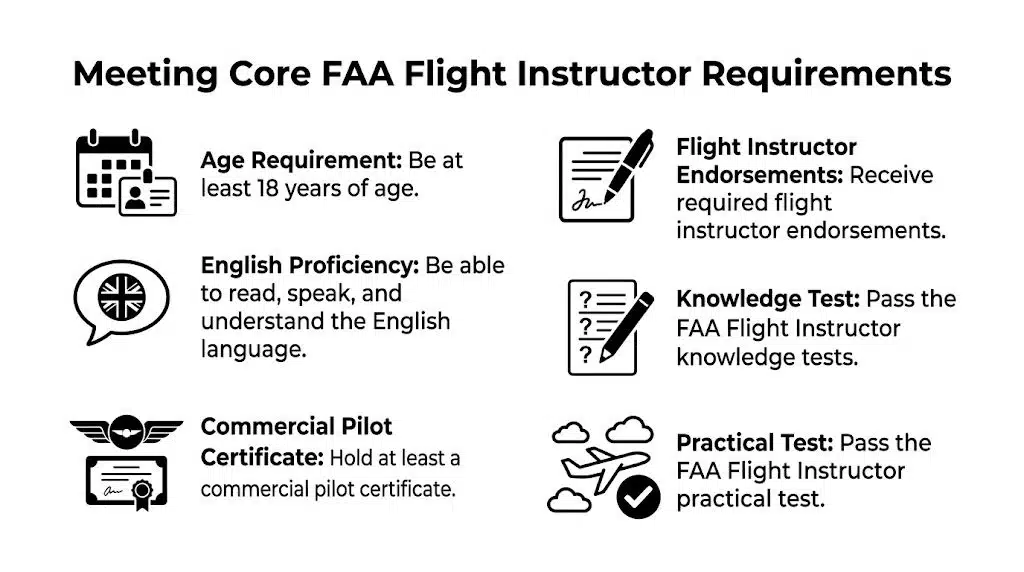
At the center of the flight instructor requirements are a few non-negotiables. You must be at least 18 years old, able to read, speak, write, and understand English, and hold a commercial pilot certificate or ATP certificate with the appropriate category and class rating, plus an instrument rating, as described in Pilot Institute’s overview of becoming a flight instructor.
Many pilots also think first about total time. That matters, but it’s only part of the picture. The same Pilot Institute guide notes that applicants generally need at least 250 hours of total flight time, or 190 hours for graduates of FAA-approved Part 141 schools, because that threshold comes from the commercial pilot minimums.
The basic eligibility checklist
Here’s the plain-English version of what the FAA is looking for.
Age and language
You must be old enough and able to communicate clearly in English. That’s not paperwork filler. Instructing depends on precise communication.
Commercial or ATP certificate
The FAA wants you teaching from a professional skill base, not a private pilot foundation.
Instrument rating
Even if your first instructing work is in visual conditions, instrument knowledge is part of being a complete instructor.
Required endorsements
These include the instructional endorsements tied to the fundamentals of instructing, flight proficiency, and spin-related training for airplane applicants.
Knowledge testing
You’ll need to pass the FAA knowledge test work associated with becoming an instructor, including the Fundamentals of Instructing, often called FOI.
Practical test
The checkride tests your flying and your teaching. You won’t just demonstrate. You’ll instruct.
If you want a broader view of how this fits into the overall training ladder, DuBois Aviation has a useful page on pilot certification levels.
The endorsements that confuse people most
Applicants often get tangled up here. They know they need endorsements, but they aren’t always sure what each one does.
Some of the key pieces include:
- FOI endorsement: An authorized instructor signs you off after preparing you on the fundamentals of instructing.
- Flight proficiency endorsement: This confirms you’ve been trained in the required areas of operation for the instructor practical test.
- Spin training endorsement: For airplane applicants, specific logbook endorsements confirm competence in stall awareness, spin entry, spins, and recovery in a spin-certified aircraft.
Those entries are not administrative trivia. They document that your instructor has verified you’re ready for responsibilities unique to teaching.
Why the FOI matters more than many commercial pilots expect
A lot of strong pilots walk into CFI prep thinking the technical flying will be the hard part. Often, the FOI is what humbles them first.
FOI covers the mechanics of learning. How people build habits. Why they plateau. How stress affects performance. How to organize a lesson. How to correct errors without creating confusion or defensiveness.
Practical rule: If you can explain a maneuver only one way, you’re not ready to teach it yet.
That’s why the FAA includes both knowledge testing and practical evaluation. It wants instructors who can transfer skill, not just display it.
To help you see one explanation from a training perspective, this video is a useful supplement to your reading.
What the practical test is really checking
The practical test with a Designated Pilot Examiner is not a normal ride. You’ll be expected to teach through topics and maneuvers as though the examiner were your student.
That means you need to do four things at once:
- Set up the lesson
- Explain the objective
- Demonstrate or supervise the maneuver
- Identify and correct errors
The candidates who struggle usually don’t fail because they can’t fly. They struggle because they haven’t learned how to teach under pressure.
Choosing Your Path CFI CFII and MEI Explained
Once you understand the baseline flight instructor requirements, the next question is which instructor ratings fit your goals.
The three most common paths in airplane training are CFI, CFII, and MEI. They build on each other, but they’re not interchangeable. Each one expands what you can teach and what kind of instructor you become in daily practice.
What each rating means in real life
A CFI is your core instructor certificate for airplane training. This is the rating that puts you into primary and commercial instruction. You teach takeoffs, landings, maneuvers, traffic pattern work, cross-country procedures, and the decision-making habits that keep early pilots safe.
A CFII adds instrument instruction. That changes the teaching environment significantly. You’re no longer working only with visual references and basic handling. You’re teaching scan, workload management, instrument procedures, navigation systems, and the discipline required when the outside world isn’t available.
An MEI adds multi-engine instruction. That introduces asymmetric throughst, engine-out procedures, Vmc awareness, system management, and much more precise teaching around risk and judgment.
Comparison of Flight Instructor Ratings
| Rating | What You Can Teach | Key Training Focus | Best For |
|---|---|---|---|
| CFI | Primary and advanced airplane training in the category and class held | Lesson delivery, maneuver instruction, student error correction | Commercial pilots beginning an instructing career |
| CFII | Instrument instruction for the aircraft category held | Instrument procedures, scan development, approach teaching, IFR decision-making | Instructors who want to teach instrument students and expand schedule options |
| MEI | Multi-engine instruction | Multi-engine aerodynamics, engine-out teaching, systems management | Instructors pursuing complex aircraft instruction and advanced professional pathways |
CFII adds a new layer of teaching discipline
Instrument students can look calm while falling behind quickly. That’s why CFII work demands a different teaching style.
Under FAA-linked guidance summarized in the regulation reference for 14 CFR § 61.195, CFII applicants must pass an additional FAA knowledge test and checkride, and they typically require 10 to 15 dual hours. The same verified material states that under structured Part 141 programs that integrate simulators, first-time pass rates can reach 90%, compared with 75% under Part 61.
Those numbers shouldn’t be read as a promise for any individual applicant. They do show why structure matters in instrument instructor training. Repetition, scenario work, and disciplined briefing make a difference.
MEI sharpens systems knowledge and judgment
Multi-engine instruction is often attractive because it broadens your professional profile. But the true value of the MEI isn’t just access to another aircraft type. It’s the precision it demands.
You have to teach:
- Engine-out control priorities
- Directional control during high-workload moments
- Configuration discipline
- Airspeed awareness
- Systems management without fixation
That’s why pilots considering this step often look closely at where they’ll train and in what aircraft. If multi-engine instruction is part of your long-term plan, the aircraft and syllabus matter a great deal. This page on multi-engine rating requirements gives a practical overview of that side of the path.
The best time to think about CFII or MEI isn’t after your initial CFI ride. It’s while you’re designing your training path so each step supports the next one.
Which rating should you pursue first
For most commercial pilots, the order is straightforward.
Start with CFI. It teaches you how to teach. That is the foundation.
Then consider CFII if you want broader instructing utility and stronger instrument teaching ability. Add MEI if multi-engine instruction fits your career goals, available aircraft, and the kind of students you want to work with.
Here’s the practical way I’d frame it:
- Choose CFI first if you need the core instructional skill set.
- Choose CFII next if you enjoy instrument flying and want to teach higher-workload, procedure-heavy lessons.
- Choose MEI after that if you want to move into complex aircraft instruction and expand your professional range.
The wrong approach is chasing letters. The right approach is building instructional competence in layers.
Your CFI Training Plan at Chino Airport
A strong CFI candidate doesn’t train in fragments. Ground, flight, lesson planning, and teaching practice have to reinforce each other.
At Chino Airport, that becomes very concrete. You’re not learning in isolation from real airspace. You’re working in a busy towered environment where communication, sequencing, and situational awareness are part of the lesson from day one.
If you’re evaluating the airport itself as part of your training decision, this overview of the Chino Airport flight school environment helps show how that setting affects everyday learning.
What a practical training week looks like
A good week of CFI prep usually blends three kinds of work.
First, there’s ground preparation. You organize lesson plans, practice teaching from them, and tighten up your command of regulations, aerodynamics, systems, and FOI topics.
Second, there’s flight training. That includes maneuver demonstrations from the instructor seat, error recognition, and learning how to talk while flying without letting either task degrade.
Third, there’s debriefing. Many candidates improve the fastest through debriefing. A sharp debrief turns “that didn’t go well” into a precise correction for the next lesson.
Why a towered airport helps future instructors
New instructors often underestimate how much of their future job involves reducing student workload.
At a towered field, that starts immediately. You’re hearing instructions, planning taxi routes, managing spacing, and teaching communication in a live environment. That experience pays off later when your students start to feel behind the airplane. You’ll have a larger mental margin because you trained with those demands built in.
A place like KCNO also gives you repeated exposure to:
- Radio discipline in a busy pattern
- Multiple runway operations
- Airspace awareness during transitions
- Approach planning in an active environment
- The habit of briefing clearly before the workload rises
The value of simulator and structured ground work
Not every teaching problem belongs in the airplane first.
Simulator sessions are useful for instrument scenarios, procedural repetition, and emergency discussions where stopping and resetting has value. Ground sessions do the same for lesson delivery. A candidate who rehearses a stall lesson on the whiteboard before flying it usually teaches it more cleanly in the aircraft.
This is also where materials matter. A structured curriculum such as Jeppesen gives you a framework for consistency. It doesn’t replace judgment, but it helps new instructors learn how to sequence information rather than improvising every explanation.
Students rarely need more words. They need better sequencing.
What to expect from your own preparation
Your CFI training plan should include more than flights on the schedule. It should also include quiet work you do on your own.
That usually means:
- Building lesson plans you can teach from
- Practicing short whiteboard explanations
- Reviewing endorsements and logbook language carefully
- Rehearsing how to identify and correct common student errors
- Learning to brief a maneuver in a calm, repeatable format
One factual option in this space is DuBois Aviation, a full-service flight school and aircraft rental provider at KCNO that offers one-on-one airplane and helicopter instruction, uses Jeppesen learning materials, and operates a fleet that includes Piper Cherokees, a Cessna 150, a Mooney M20B, a Piper Apache, and both Robinson and Enstrom helicopters, along with an in-house simulator.
That kind of setup matters because future instructors benefit from seeing how a training operation works, not just how to pass a ride.
The rhythm that helps candidates succeed
The candidates who progress smoothly usually follow a steady rhythm.
They study before the lesson. They teach out loud, not just mentally review. They fly with a clear objective. Then they debrief candidly instead of protecting their ego.
That matters more than trying to look advanced.
You do not need to sound like a chief instructor on day one. You need to build professional habits that you can repeat under pressure, in the airplane, with a student watching everything you do.
Avoiding Common Pitfalls on Your CFI Journey
Most CFI applicants don’t run into trouble because they lack talent. They run into trouble because they prepare for the wrong test.
They prepare as pilots being evaluated, when the examiner is really evaluating a pilot who must also teach. That distinction explains many of the common mistakes.
Pitfall one underestimating FOI
Commercial pilots often want to spend almost all their time on the airplane. That’s understandable. It’s also a mistake.
FOI can feel abstract at first, but once you start instructing, it becomes practical fast. Students bring stress, overconfidence, hesitation, distraction, and inconsistent retention into the cockpit. If you don’t understand the basics of how people learn, your technical knowledge won’t land well.
A weak FOI foundation usually shows up in lessons that are too long, poorly sequenced, or packed with corrections the student can’t absorb.
Pitfall two demonstrating instead of teaching
Some applicants fly beautifully during CFI prep and still don’t present like instructors.
They brief the maneuver. They demonstrate it. But they don’t monitor what a student would likely do wrong, and they don’t coach in a way that changes behavior.
That’s a problem because real instruction is active. It sounds like this:
- “Notice your pitch trend.”
- “Hold the sight picture, not the number alone.”
- “You’re leading with aileron. Fix the rudder first.”
- “Let’s pause and reset what you’re prioritizing.”
Those are teaching interventions, not polished monologues.
If your explanation would sound the same no matter what error the student made, it isn’t instruction yet.
Pitfall three weak lesson presentations
A CFI candidate needs organized ground lessons. Not downloaded pages they barely know. Not rambling memory dumps.
Strong presentations usually have three traits:
- A clear objective: The student knows what success looks like.
- A logical flow: One idea leads to the next without leaps.
- A usable summary: The student leaves knowing what to practice and what to watch for.
The fix is simple, though not easy. Build your own lesson materials, then teach them out loud until they sound natural.
Pitfall four ignoring instructor limits and currency
Professionalism includes knowing where your authority stops.
Under 14 CFR § 61.195, flight instructors may not conduct more than 8 hours of flight training in any 24-consecutive-hour period, according to the current regulation text in the Electronic Code of Federal Regulations. That limit exists to reduce fatigue and protect safety.
The same regulation section also places qualifications on instructors for specialized instruction and for those training initial CFI applicants. If you’re choosing a mentor, don’t look only at personality or schedule availability. Check whether that instructor is qualified for the training you need to receive.
Pitfall five choosing convenience over mentorship
A lot of applicants think any current instructor can take them to a CFI checkride. That’s too casual an approach.
For initial CFI applicant training, the FAA has specific qualification standards on the instructor side. Some instructors can give excellent commercial training yet still not be the right person for initial CFI prep.
Choose a mentor who can do three things well:
- Teach from structure, not improvisation
- Explain what the examiner is really looking for
- Correct your teaching, not just your flying
That last one is the key. Your own landings may be acceptable. Your lesson delivery may still need work. The right mentor sees both.
Your Next Horizon Buying or Selling an Aircraft
A lot of career pilots eventually start thinking beyond certificates and jobs. They think about ownership.
Sometimes that means buying a simple airplane for personal travel and proficiency. Sometimes it means stepping into a partnership. Sometimes it means selling an aircraft they’ve outgrown and moving to something that better fits a new mission. The safest approach is the same in every case. Slow down and define the mission before you fall in love with the machine.
Start with mission, not paint or panel
The first question isn’t “What airplane do I want?” It’s “What do I need this aircraft to do?”
That answer shapes everything else.
- Local proficiency flying: You may value simplicity, lower operating complexity, and ease of scheduling maintenance.
- Cross-country travel: Cabin comfort, speed, range, and avionics become more important.
- Instructional use: Dispatch reliability, parts support, and insurability deserve extra weight.
- Helicopter ownership: Mission, operating environment, and maintenance support need even more careful review.
When buyers skip this step, they often end up with the wrong aircraft for their real life.
Build a realistic ownership budget
The purchase price is only the opening number.
You also need to think through:
- Insurance
- Maintenance
- Storage or hangar costs
- Fuel
- Charts, database updates, or avionics support
- Unexpected repairs after delivery
You don’t need an elaborate spreadsheet at first, but you do need honesty. A good aircraft at the top of your budget can still become the wrong aircraft if the ongoing costs create pressure to defer maintenance or fly less than planned.
Never skip the pre-purchase inspection
This is the single most important protection step in an aircraft purchase.
Use a trusted A&P mechanic who works for you, not the seller. That inspection should include the aircraft’s condition, records, compliance status, engine history, and any signs of damage or poor maintenance practice.
If the seller resists an independent inspection, treat that as information.
Buy the records as much as the airframe. Clean logbooks, consistent maintenance, and clear documentation often tell you more than a fresh detail job.
Handle the paperwork carefully
Aircraft transactions are not handshake purchases.
You should verify:
- Registration status
- Title status
- Any liens or unresolved ownership issues
- Consistency between records and represented equipment
- Bill of sale details before funds move
Many buyers also choose to work with an aviation title company, escrow service, or reputable broker to reduce the chance of paperwork mistakes.
Selling requires discipline too
Sellers make avoidable mistakes as well.
If you’re selling, gather and organize your logs, maintenance records, equipment list, and recent inspection history before you advertise. Buyers get nervous when records appear incomplete or scattered. Clear documentation builds trust and helps good buyers move faster.
A careful sale is not just about getting the aircraft listed. It’s about presenting the aircraft accurately and making it easy for a serious buyer to verify what you’re offering.
Launch Your Career as a Professional Flight Instructor
The CFI path asks more of you than another rating usually does. That’s exactly why it matters.
You’re not just earning authority to sign logbooks. You’re learning how to think ahead for another pilot, how to manage risk while someone else is still learning, and how to turn your own knowledge into someone else’s skill. That’s a high standard. It should be.
By this point, the shape of the journey is clearer. The flight instructor requirements start with eligibility, certificates, ratings, endorsements, and testing. Then the process becomes more personal. Which instructor path fits you. How you’ll train. Who will mentor you. What habits you’ll carry into your first year of teaching.
What good instructors keep working on
Earning the certificate is not the finish line.
The instructors who grow fastest keep evaluating themselves after each lesson:
- What did the student understand?
- Where did I overload them?
- Did my briefing make the flight easier or harder?
- What should I change next time?
That habit of reflection is one of the marks of a mature instructor. If you want a practical teaching resource outside aviation, this guide to Reflective Practice for Teachers is worth reading. The classroom examples are different, but the mindset carries over well to flight instruction.
Why this step is worth it
The CFI certificate gives you something the earlier certificates can’t give in the same way. It forces ownership.
You can no longer hide behind “I know how to do it.” You have to prove, calmly and consistently, that you can help someone else do it safely. That process usually makes you a better pilot, a better communicator, and a more disciplined professional.
If you’re a commercial pilot standing at that crossroads, this is one of the most rewarding directions you can take.
If you’re ready to turn commercial flying skill into professional teaching ability, talk with DuBois Aviation about your next step. A thoughtful CFI training plan, the right mentor, and a real-world airport environment can make the path much clearer.