
Buying your first Robinson, stepping into a shared ownership deal, or flying one hard as a renter usually starts the same way. You look at the purchase price or hourly rate, think you understand the economics, and then somebody mentions the overhaul clock. That's the moment Robinson helicopter maintenance stops being an abstract mechanic problem and becomes your problem.
New owners often focus on what they can see. Clean paint, a tidy cabin, smooth starts, no obvious leaks. The expensive mistakes usually live in the records, the calendar, and the parts life remaining. A helicopter can look sharp on the ramp and still be one inspection cycle away from a very painful bill.
For dedicated renters and flight schools, the trap is different. People assume maintenance is the shop's responsibility alone. In practice, dispatch reliability, safety, and operating cost all depend on how well pilots report discrepancies, how well managers track recurring issues, and whether the operation treats documentation like a controlled system instead of a pile of PDFs.
Beyond the Preflight Your True Maintenance Responsibility
The pilot walkaround matters. Oil, fuel, blade condition, leaks, hardware security, general condition. All of that is real. But with Robinsons, the bigger responsibility starts after the preflight.
A common scenario goes like this. Someone buys an R44 because the aircraft has a decent panel, a clean interior, and flies well on the demo. Then they learn the machine is approaching a major time-based maintenance event and that the critical ownership decision should have started with records review, component status, and overhaul planning. The disappointment isn't caused by bad maintenance. It's usually caused by poor maintenance understanding.
What owners and renters miss first
Robinson helicopter maintenance is built around predictability. That's a good thing, but only if you manage it on purpose. If you don't, small administrative misses become expensive operational problems.
The essentials are simple:
- Know the calendar status: Time matters even when the aircraft isn't flying much.
- Know the component status: Life-limited parts aren't a suggestion.
- Know the paperwork status: Missing or stale records can hurt value and delay dispatch.
- Know the discrepancy trend: Repeated “minor” squawks often point to one underlying issue.
Practical rule: If a discrepancy has shown up more than once, stop treating it like a nuisance item and start treating it like a system problem.
For a flight school or club, this gets harder because several pilots may write up the same symptom in different words. That's why smart operators create a living knowledge base for repeat discrepancies, document revisions, and model-specific maintenance habits. The goal isn't bureaucracy. The goal is catching patterns before they become downtime.
Safety and cost usually fail in the same place
Owners like to separate safety decisions from cost decisions. In practice, they're tied together. Deferred troubleshooting leads to repeat labor. Incomplete records slow down inspections. Poor discrepancy reporting creates parts swapping instead of diagnosis. Every one of those raises cost and lowers confidence in the aircraft.
That's why Robinson maintenance has to be treated as an operating discipline, not a bill you pay after something breaks.
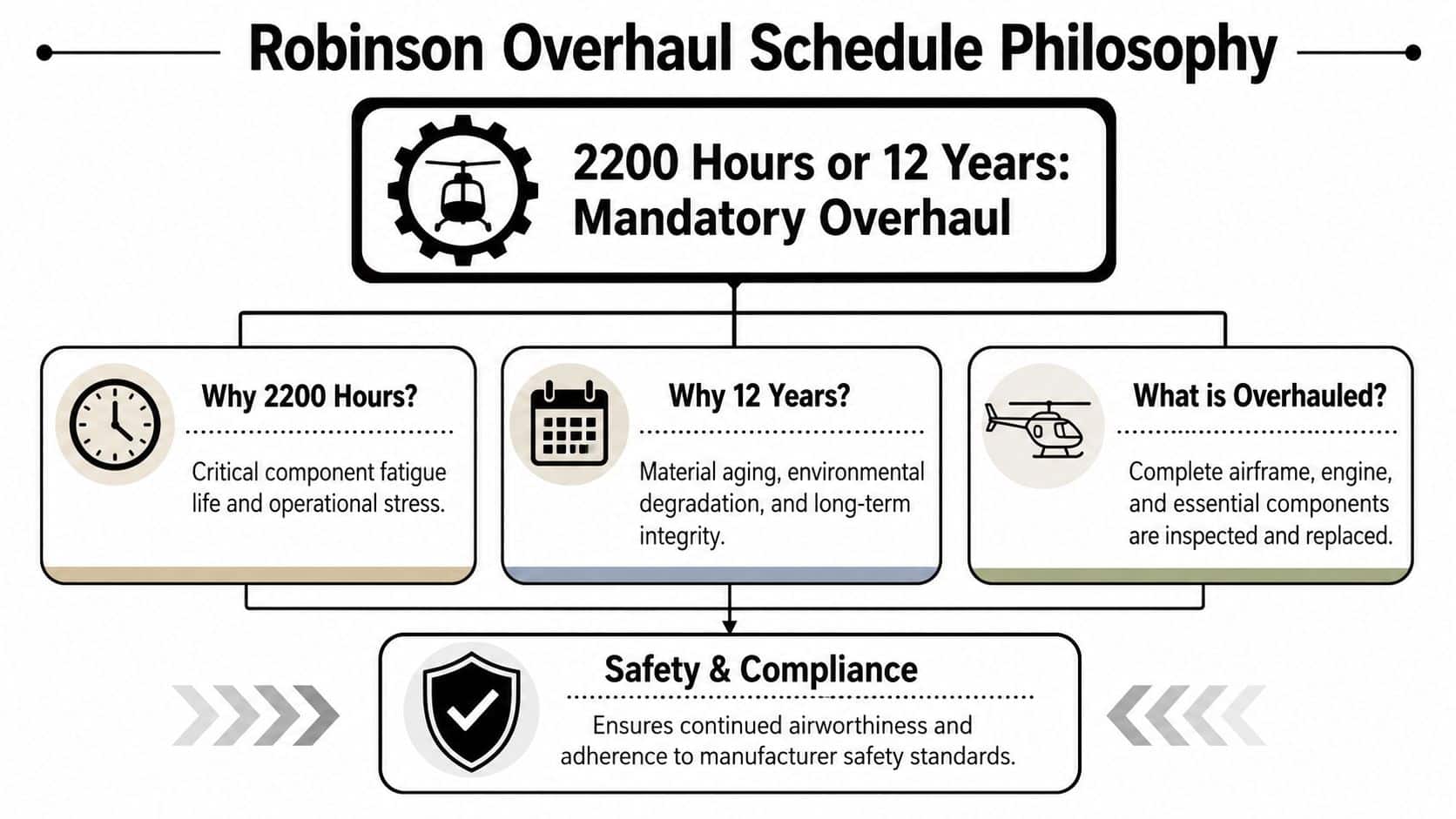
The Robinson Philosophy 2200 Hours or 12 Years
Most aircraft owners understand hour-based maintenance. Robinson adds another layer that catches people off guard. Time itself is a maintenance driver.
Robinson Helicopter's maintenance model is built around a 12-calendar-year preventative maintenance schedule for the airframe on its current piston-powered R22 and R44 models and the turbine R66, which makes the calendar a major planning benchmark for operators, not just the tachometer, according to AVweb's maintenance course coverage.
Why this philosophy matters
If you come from airplanes, this can feel strict. Many airplane owners get used to evaluating some items by condition, trend, and inspection findings. Robinsons demand a different mindset. Certain maintenance decisions are made before visible wear becomes obvious enough to start a debate.
That approach has two practical effects.
First, it makes long-term planning clearer. You know major maintenance is coming, and you can build a reserve around it. Second, it protects resale value because serious buyers always look at remaining time and calendar status before they care about cosmetics.
Maintenance on a Robinson is easiest when you stop asking, “Can I stretch this?” and start asking, “How do I schedule this cleanly?”
Hours are only half the story
A low-time helicopter is not automatically the bargain people think it is. If the aircraft has spent years sitting, the calendar still matters. Materials age. Seals, bonding, finishes, and other parts of the machine don't pause just because the owner isn't flying.
That's why a low-hour aircraft near a calendar limit can be less attractive than a higher-time aircraft with better maintenance timing and cleaner records. Buyers who miss that distinction often overpay.
For a visual overview of the overhaul logic, this short video is useful:
What works and what doesn't
What works is planning the aircraft around its maintenance lifecycle. Owners who do well usually know their next major event long before it arrives, and they avoid stacking optional upgrades on top of mandatory maintenance unless the downtime already makes sense.
What doesn't work is buying on monthly payment logic, ignoring the calendar, and assuming a smooth-running helicopter today equals a cheap helicopter tomorrow. On Robinsons, the maintenance philosophy is the economics.
Decoding Inspection Intervals and Common ADs
Routine Robinson maintenance is where operators either stay ahead or get trapped in recurring downtime. The schedule itself isn't the hard part. The hard part is respecting how quickly small issues turn into grounded aircraft when an operator gets casual about inspection discipline, discrepancy writeups, or compliance tracking.
For most owners and renters, the recurring checkpoints that shape the year are the 50-hour, 100-hour, and annual inspections. The exact task list belongs with the current maintenance data and your mechanic, but the operating lesson is straightforward. The 50-hour event is where shops often catch wear, leaks, adjustment drift, and early signs of trouble. The 100-hour inspection matters heavily for aircraft used in training or rental. The annual is where record quality and prior maintenance habits get exposed.
What these inspections usually mean in practice
A clean 100-hour inspection rarely happens by luck. It usually reflects pilots catching issues early and a shop that isn't forced to discover everything at once.
Here's how I explain it to owners:
- 50-hour inspection: Think of this as trend control. You're looking for early wear, hardware security issues, leaks, belt condition, and anything that's drifting away from normal.
- 100-hour inspection: This is the workhorse inspection for high-use aircraft. If a training helicopter reaches this point with a long unresolved squawk list, the labor bill usually grows.
- Annual inspection: Weak paperwork, inconsistent maintenance habits, and deferred fixes become evident.
A helicopter doesn't become expensive on the day of the annual. It becomes expensive in the months before it, when people keep flying past obvious clues.
Why ADs and approved changes matter
Robinson operators also need to understand that fleet requirements evolve. Airworthiness Directives and approved changes can materially affect planning, parts status, and operating cost. That's one reason a buyer should never rely on “it's been maintained” as a complete answer.
One good example is the R66. The FAA approved an increase in selected component service life from 2,000 to 4,000 hours and extended the calendar life for the main and tail rotor blades from 12 years to 15 years, a change Robinson and Vertical Magazine said could cut operating costs by 6% and reduce hourly overhaul reserves by 25%, as reported by Vertical Magazine's R66 approval coverage.
That kind of change matters because it can reshape reserve planning, affect how you compare aircraft, and alter the actual value of a specific serial number depending on how it's configured and documented.
Robinson maintenance comparison R22 vs R44 vs R66
| Item | R22 Beta II | R44 Raven II | R66 Turbine |
|---|---|---|---|
| Core maintenance philosophy | Time-limited maintenance planning is central | Time-limited maintenance planning is central | Time-limited maintenance planning is central |
| Major calendar benchmark | Airframe tied to Robinson's 12-calendar-year preventative maintenance model | Airframe tied to Robinson's 12-calendar-year preventative maintenance model | Airframe tied to Robinson's 12-calendar-year preventative maintenance model, with some later FAA-approved service-life changes on selected components |
| Typical recurring inspections operators plan around | 50-hour, 100-hour, annual | 50-hour, 100-hour, annual | 50-hour, 100-hour, annual |
| Buying focus | Training use, component tracking, overhaul timing | Utility, rental, and private-use maintenance history | Selected component status, blade calendar life, approved configuration details |
| Common operator mistake | Buying on low total time without calendar analysis | Underestimating recurring inspection discipline in high-use service | Assuming all aircraft benefit equally from approved service-life changes without records verification |
The mistake that costs the most
Operators get in trouble when they treat inspections as isolated appointments. The better approach is continuous maintenance awareness. If a pilot reports a change in vibration, a belt issue, a fluid stain, or a recurring system quirk, that report should shape the next maintenance decision immediately. Waiting for the next scheduled event often adds labor and risk.
Budgeting for Maintenance Typical Costs and Failure Points
The first budgeting mistake is trying to guess exact numbers from somebody else's aircraft. That rarely helps. Condition, utilization, operating environment, record quality, shop familiarity with the model, and parts availability all change the bill.
The second mistake is treating maintenance as only two categories: routine inspections and the big overhaul. Real operating cost lives in the space between those two. That's where repeat discrepancies, wear items, troubleshooting, and avoidable downtime eat the budget.
Build a reserve around events you know are coming
You already know the maintenance clock is strict on Robinsons. Use that to your advantage. Budgeting works best when you separate known major events from probable recurring issues.
A practical reserve plan usually includes:
- Scheduled inspection reserve: Funds set aside for recurring inspections and routine findings.
- Unscheduled discrepancy reserve: A separate amount for the things pilots report during normal flying.
- Major maintenance reserve: Money dedicated to the overhaul cycle and life-limited component planning.
- Downtime reserve: Cash for the hidden cost of a grounded aircraft, especially if you depend on it for training or travel.
Owners who keep only one blended “maintenance bucket” often spend too freely when the aircraft is flying well. Then a larger event lands and the money is gone.
The wear items that deserve your attention
Even on a well-run aircraft, some categories deserve more attention than others. Belts, actuators, controls, seals, vibration-related discrepancies, and any repeating rotor or drivetrain complaint should never live too long in the squawk book.
What works is immediate, specific reporting from pilots and renters. “Slight vibration in cruise” is weak. “Noticeable change from normal during climb and at pattern power settings” is useful. Good descriptions save diagnostic labor.
What doesn't work is flying with a known annoyance because the helicopter is “still airworthy enough for today.” That mindset creates two costs. The eventual repair usually takes longer, and the aircraft tends to come out of service at the worst possible time.
Shop-floor reality: Most expensive downtime starts as a symptom somebody normalized.
A better way to think about cost
Don't ask, “What does Robinson helicopter maintenance cost?” Ask three narrower questions instead.
- What is the aircraft likely to need on schedule?
- What unresolved discrepancies are already trying to become larger repairs?
- How much value is left before the next major maintenance event?
That framework changes buying decisions, rental planning, and school scheduling. A cheaper aircraft can be the expensive one if its records are weak or its maintenance timing is ugly. A more expensive aircraft can be the better buy if it has cleaner logs, clearer component status, and fewer signs of deferred troubleshooting.
For schools, availability matters as much as invoice total. One helicopter that flies reliably often supports the business better than two aircraft with chronic, low-grade maintenance drama.
Your Role vs Your Mechanic's Role in Airworthiness
Pilots and mechanics often misunderstand each other's lane. Pilots think the mechanic owns airworthiness. Mechanics think pilots are giving them poor information. Both problems show up in the logs.
The pilot's job starts with a real preflight, not a memorized ritual. If something changes, write it up clearly. If the helicopter was hard to start, if a vibration changed, if a caution light behavior looked different, or if a door latch, clutch behavior, or fluid level trend seems off, say so in plain language. A mechanic can only chase the trail you leave.
What belongs to the pilot
Pilots and renters carry practical responsibility for:
- Accurate discrepancy reporting: Describe what happened, when it happened, and under what conditions.
- Respecting maintenance grounding decisions: If the aircraft is down, it's down.
- Reviewing aircraft status before flight: Don't assume somebody else checked the logs.
- Using current operating information: Stale procedures create preventable mistakes.
What belongs to the mechanic
The A&P or appropriately qualified maintenance provider handles the inspection, troubleshooting, repair, and return-to-service decision. That includes determining whether a symptom points to a simple adjustment or something deeper in the system.
Where operators often stumble is document control. Robinson continuously publishes updates for manuals, checklists, and safety notices, and the company recommends using current online maintenance manuals and illustrated parts catalogs, making document revision tracking part of maintenance quality, as reflected in the R44 maintenance manual publication material.
The aircraft may be mechanically sound, but if the shop or the operator is using stale data, the maintenance system isn't sound.
Shared responsibility in a training environment
This matters even more in rental and training use, where many hands touch one aircraft. A school that offers private pilot helicopter training or aircraft rental has to standardize how pilots report discrepancies and how maintenance status is communicated. Otherwise, one pilot writes “minor shake,” another says “felt normal,” and the shop wastes time trying to decode the difference.
The best operations remove ambiguity. Current manuals. Controlled revisions. Clear squawk entries. A clean status board. Those aren't office niceties. They're airworthiness tools.
How to Buy a Used Robinson the Safe Way
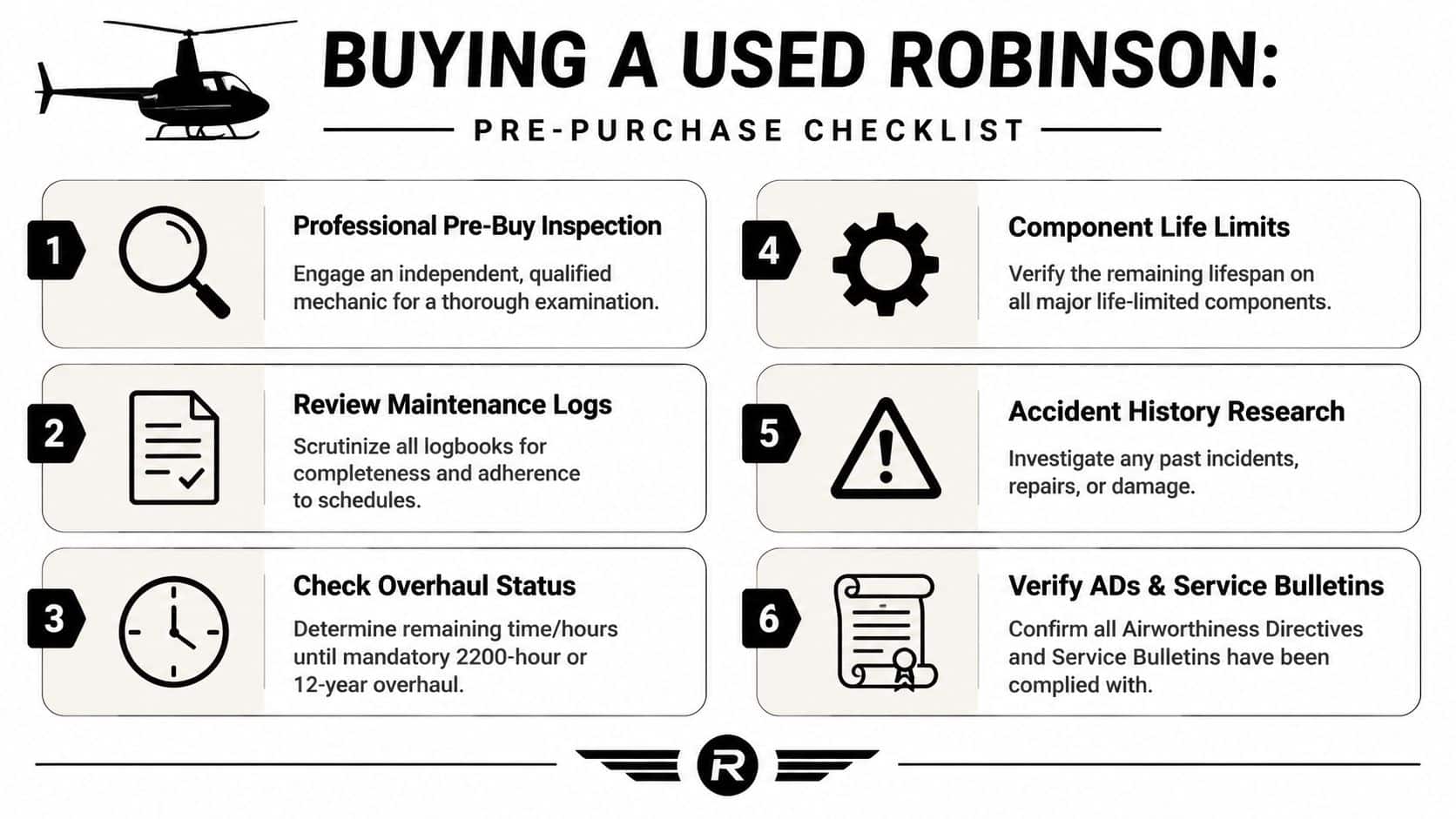
A used Robinson purchase should be treated as a maintenance evaluation with a price attached, not a sales transaction with a quick inspection attached. If you don't start there, you can buy a helicopter that looks affordable and then inherit deferred maintenance, weak records, and poor overhaul timing.
The pre-buy inspection should be independent. Not “my friend who knows helicopters.” Not “the same person who's trying to close the deal.” You want a mechanic who understands Robinsons, knows where these aircraft hide trouble, and has no reason to smooth over findings.
The records matter as much as the helicopter
If the logs are incomplete, disorganized, or unclear about component status, that's not a paperwork annoyance. That's a valuation problem and a safety problem. A Robinson buyer needs to know exactly what life remains and exactly what has been complied with.
Here's the minimum review list I'd insist on:
- Total record continuity: Airframe, engine, and component records should tell one coherent story.
- Life-limited component status: You need remaining time and calendar status, not rough estimates.
- AD and service compliance: Verify what has been done and how it was documented.
- Damage and repair history: A repaired aircraft isn't automatically a bad aircraft, but undocumented or poorly documented damage should stop the deal cold.
- Corrosion and storage exposure: Environment matters, especially if the aircraft sat for long periods or lived in harsher conditions.
The biggest buying error
Most buyers focus on purchase price first and overhaul timing second. That order is backward. The truer number is acquisition cost plus whatever maintenance reality arrives after closing.
A good seller should be comfortable with a deep maintenance review. If a listing gets vague when you ask for logbooks, component status, or compliance details, move carefully. There are always more helicopters for sale.
Buy the records first, then the machine.
If you're actively evaluating the market, it helps to compare listings through a maintenance lens rather than by panel and paint alone. An aircraft marketplace such as DuBois Aviation's aircraft sales page can be one place to start, but every candidate still needs a Robinson-savvy pre-buy and a hard look at maintenance timing before money changes hands.
Finding a Qualified Mechanic and Official Resources
The right mechanic saves you money by preventing bad decisions, not by offering the cheapest invoice. Robinson work is model-specific. Experience matters. Process matters. Familiarity with current factory information matters.
Robinson's official factory maintenance course is an 8-day classroom program in Torrance, California, and Robinson says classes run from 7:45 a.m. to 4:00 p.m. with a listed fee of $1,900 per person, according to Robinson's maintenance course information. That doesn't automatically make every attendee the right mechanic for your aircraft, but it does tell you what serious standardization looks like.
What to ask before you trust a shop
A useful shop conversation is direct:
- Model familiarity: Ask how much hands-on experience they have with your specific Robinson model.
- Document discipline: Ask how they track manual revisions, service notices, and parts data.
- Inspection consistency: Ask who performs repeat inspections and how discrepancies are handed off.
- Owner communication: Ask how findings are documented and how they prioritize must-fix items versus monitor items.
You should also ask other Robinson owners where they go when they want the job done once instead of twice.
For operators in Southern California, a school and rental provider such as DuBois Aviation's Chino facility may be relevant if you're trying to understand how a Robinson-based training environment is organized around dispatch, instruction, and fleet use. Whether you use a school, independent mechanic, or service center, the standard is the same. Clear records, current data, and experienced Robinson hands.
If you're comparing helicopters, training in Robinson models, or trying to evaluate a used aircraft before you buy, DuBois Aviation is one factual place to start. They operate helicopter training and rental at Chino Airport, which makes them relevant for pilots who want exposure to real Robinson operating environments while learning what good maintenance discipline looks like.


