
Taking your first commercial flying lesson is a huge milestone. It’s the moment you stop flying just for the love of it and start building a real career in the cockpit—a career that could take you anywhere from the right seat of an airliner to the controls of a helicopter over a scenic coastline.
This is where the real work begins. Getting your Commercial Pilot License (CPL) involves meeting specific FAA requirements, choosing a training path that fits your goals, and logging hundreds of hours before you’re ready for the final exams.
Your Path From Student to Professional Aviator
Earning a commercial pilot certificate is a serious commitment, but it’s an incredibly rewarding one built on skill, dedication, and a deep understanding of aviation. If your dream is a career in the sky, the CPL is your ticket.
Think of it this way: your Private Pilot License (PPL) is like a driver's license—it lets you fly for fun. The CPL, on the other hand, is the professional credential that allows you to be paid for your skills as a pilot.
And there has never been a better time to pursue it. The demand for qualified pilots is booming. In the United States alone, there are now over 1,105 flying schools, an industry that has been growing at 5.4% annually since 2021. This isn't just a random spike; it's driven by a massive need for professional aviators. Projections show North America will need over 123,000 new pilots in the coming years.
The First Steps on Your CPL Journey
Before you can even think about advanced maneuvers or cross-country flights, you have to cover the basics. The FAA has a few non-negotiable prerequisites every aspiring professional pilot must meet:
- You must be at least 18 years old to earn a commercial certificate.
- You have to be able to read, speak, write, and understand English fluently.
- You must already hold a Private Pilot License. This is the foundation all your advanced training will build upon.
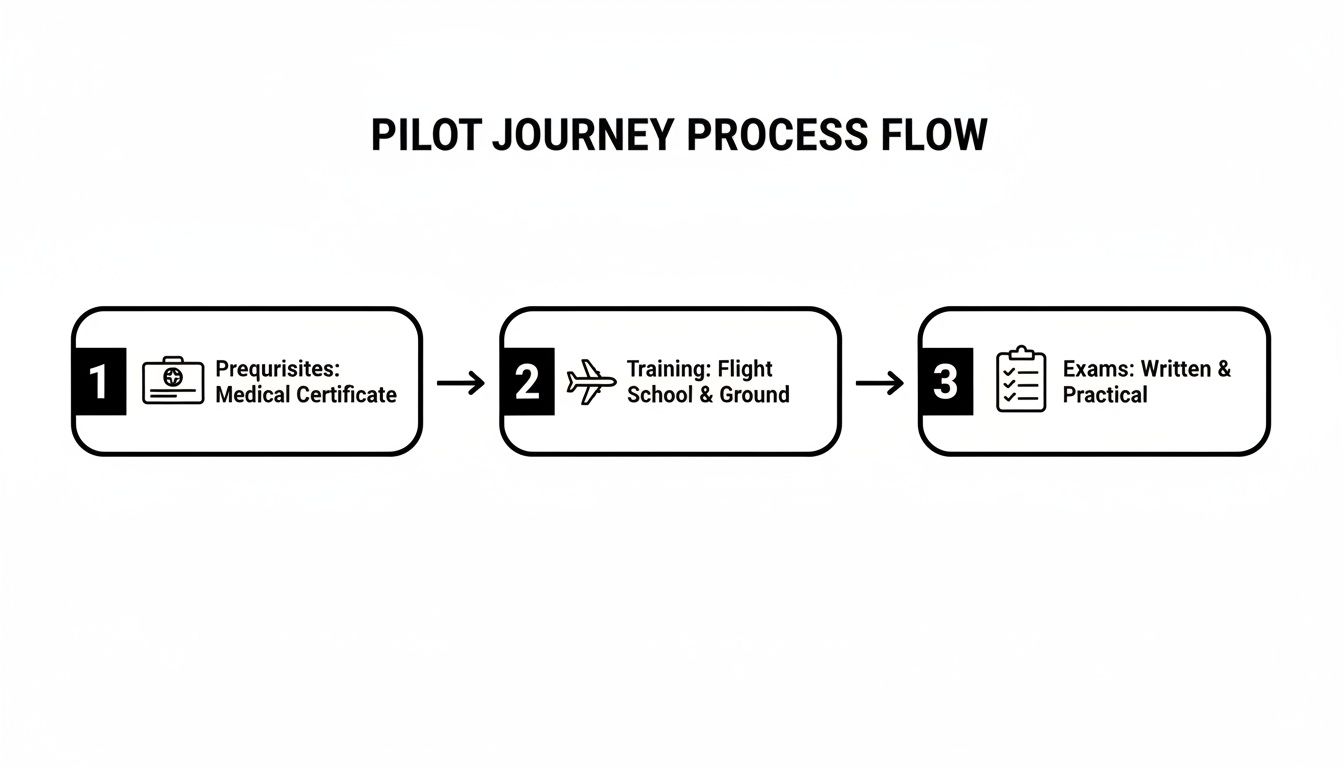
This journey is a structured progression. You start with the prerequisites, move into intensive flight training, and then prove your skills in the final exams.
To see exactly how the CPL fits into the broader world of aviation credentials, check out our guide on pilot certification levels.
FAA Commercial Pilot Certificate Minimum Requirements (Part 61)
The FAA outlines the specific flight experience you need to be eligible for your checkride. Here's a quick look at the minimums required under the Part 61 regulations, which offer the most training flexibility.
| Requirement | Minimum Hours / Specification |
|---|---|
| Total Flight Time | 250 hours |
| Pilot-in-Command (PIC) | 100 hours |
| PIC Cross-Country | 50 hours |
| Instructional Flight Time | 20 hours of dual instruction, including 10 hours of instrument training and 10 hours in a complex or TAA aircraft. |
| Solo Flight Time | 10 hours, including specific cross-country and night flight requirements. |
| Cross-Country (Long) | One solo cross-country flight of at least 300 nautical miles total distance, with landings at a minimum of three points, one of which is a straight-line distance of at least 250 NM from the original departure point. |
| Night Flights | 5 hours of night VFR conditions with 10 takeoffs and 10 landings (with each landing involving a flight in the traffic pattern) at an airport with an operating control tower. |
These are just the minimums, of course. Most pilots will have more hours by the time they're truly ready and proficient enough for their checkride.
Choosing Your Training Path: Part 61 vs. Part 141
One of the first big decisions you'll make is whether to train at a Part 61 or a Part 141 flight school. These numbers simply refer to the sections of the Federal Aviation Regulations that outline how pilot training can be conducted.
The real difference between Part 61 and Part 141 comes down to structure versus flexibility. Both paths lead to the exact same FAA license; the best choice is the one that fits your life, learning style, and career timeline.
Part 141 schools follow a highly structured, FAA-approved syllabus. This is often the path for full-time students who thrive on a set curriculum and are aiming for an airline career as quickly as possible.
Part 61 schools, on the other hand, offer more flexibility. You and your instructor can tailor the training schedule and lesson plan to your specific needs and pace. No matter which you choose, the end goal is the same: to master the material and pass your written and practical exams with flying colors.
Mastering the Commercial Pilot Syllabus
This is where flying stops being a hobby and starts becoming a profession. Your commercial pilot training is designed to build on your private pilot foundation, sharpening your skills to a level where people will pay for your expertise in the cockpit. It’s about transforming you into a precise, decisive, and highly competent aviator.
During your commercial ground school, you'll dig into topics that were only touched on before. We’re talking about advanced aerodynamics, high-altitude weather, and the complex aircraft systems you’ll soon be managing. Knowing this stuff inside and out is what separates a weekend flyer from a professional who can confidently handle a flight in demanding conditions.
Advancing Your In-Flight Skills
But the real test—and the most rewarding part—is what happens in the air. You’ll be expected to master a new set of commercial maneuvers that push your control of the aircraft to its limits. These aren't just for show; they’re practical exercises that build the finesse and muscle memory needed to fly with absolute authority.
You'll get intimately familiar with maneuvers that demand a deep understanding of energy management and flight dynamics. A few key ones include:
- Chandelles: A maximum-performance climbing 180-degree turn. It’s all about wringing every last bit of performance out of the airplane.
- Lazy Eights: A smooth, flowing maneuver that perfects your coordination across a wide range of airspeeds and attitudes. It feels like dancing in the sky when you get it right.
- Eights on Pylons: A notoriously challenging maneuver that sharpens your ability to pivot the aircraft around a fixed point on the ground. It requires incredible precision.
Mastering these proves you have the stick-and-rudder skills of a pro. This is also the stage where you’ll likely transition to a complex aircraft—one with retractable landing gear, a controllable-pitch propeller, and flaps.
Unlocking Career Doors with Advanced Ratings
While earning your Commercial Pilot License (CPL) is a massive achievement, the pilots who get the best jobs don't stop there. Adding specialized ratings to your certificate is what truly opens doors to better aircraft, more diverse opportunities, and higher pay.
For any aspiring professional pilot, the two most critical additions are the Instrument Rating and the Multi-Engine Rating. Each one serves a distinct purpose in rounding out your qualifications.
An Instrument Rating lets you fly in the weather, and a Multi-Engine Rating lets you fly the bigger, faster aircraft. Together, they are the foundation for nearly every professional piloting career.
The Power of Instrument and Multi-Engine Training
The Instrument Rating (IR) is, without a doubt, the most important rating you'll earn after your private. It gives you the skills to fly without any visual reference to the ground, relying solely on your instruments. This is an essential skill for operating safely in clouds or low visibility. To see what’s involved, check out the details of an instrument rating course and understand how it builds true all-weather confidence.
Adding a Multi-Engine Rating is your ticket to the world of transport-category aircraft. Training in a twin-engine plane, you’ll learn the unique aerodynamics and emergency procedures for handling an engine failure. This rating is a non-negotiable for almost every airline job, proving you can manage the complexity and performance of multi-engine aircraft. It’s what puts you squarely on the path to a career in the right seat of an airliner.
Figuring Out the Cost of Your Commercial Pilot License
Pursuing your commercial pilot certificate is one of the most significant investments you'll ever make in your career. Before you dive in, it’s crucial to have a clear financial plan. The first step is looking past the sticker price of an aircraft rental and understanding all the costs that go into earning those wings.
The total cost isn’t a single, fixed number. It’s a moving target influenced by the school you choose, how often you can fly, and the specific aircraft you train in. A full-time student at a structured Part 141 school will likely have a different timeline and budget compared to someone flying part-time in a more flexible Part 61 program.
This is a path many are taking. Commercial Pilot License (CPL) training is the backbone of the aviation industry and is projected to make up 60% of the market share by 2026. With the entire flight training market expected to grow from USD 10.61 billion to a staggering USD 24.86 billion by 2033, it's clear the demand for qualified pilots is soaring. This isn't just an expense; it's an investment in a high-demand career.
Breaking Down the Core Training Costs
When a flight school hands you a cost estimate, you need to know exactly what's baked into that number. While flight hours make up the biggest slice of the pie, they're far from the only expense.
- Aircraft Rental: This is your biggest variable. Your costs will be much lower if you're training in a classic workhorse like a Cessna 150 versus logging hours in a more complex aircraft with retractable gear and a constant-speed prop.
- Instructor Fees: You’re paying for a professional’s guidance, both in the air and on the ground. This fee covers your flight instruction as well as the essential pre-flight and post-flight briefings where so much learning happens.
- Ground School: This could be a formal classroom setting or dedicated one-on-one sessions with your instructor. It’s where you’ll master advanced aerodynamics, FAA regulations, and complex weather theory.
- Exams and Checkride: Don't forget to budget for the FAA written exam fee and the Designated Pilot Examiner’s (DPE) fee for your final practical test.
The FAA sets the minimum required hours, but here’s a tip from experience: almost no one gets it done in the absolute minimum. A smart move is to budget for 10-15% more hours than the minimum requirement. This gives you a financial cushion and takes the pressure off as your checkride approaches.
Your Timeline and How to Fund the Dream
How long will it take? That’s almost entirely up to you and your schedule. A full-time student who can fly several times a week might finish their training in just three to six months. If you’re flying part-time, say once a week, it could take a year or longer.
The key is consistency. Flying often helps you retain what you learn, meaning you spend less time (and money) on review lessons.
The good news is, you probably don't have to fund this entire journey on your own. There are several paths to make your professional pilot goals a reality. Many students piece it together with specialized aviation loans, personal savings, or a pay-as-you-go approach to minimize debt.
On top of that, numerous aviation scholarships are out there, offered by organizations eager to support the next generation of pilots. For a deep dive into all your options, take a look at our guide on financial aid for pilot training. Building a detailed budget and exploring these funding avenues will set you up for success from day one.
Choosing a Flight School That Fits Your Career Goals
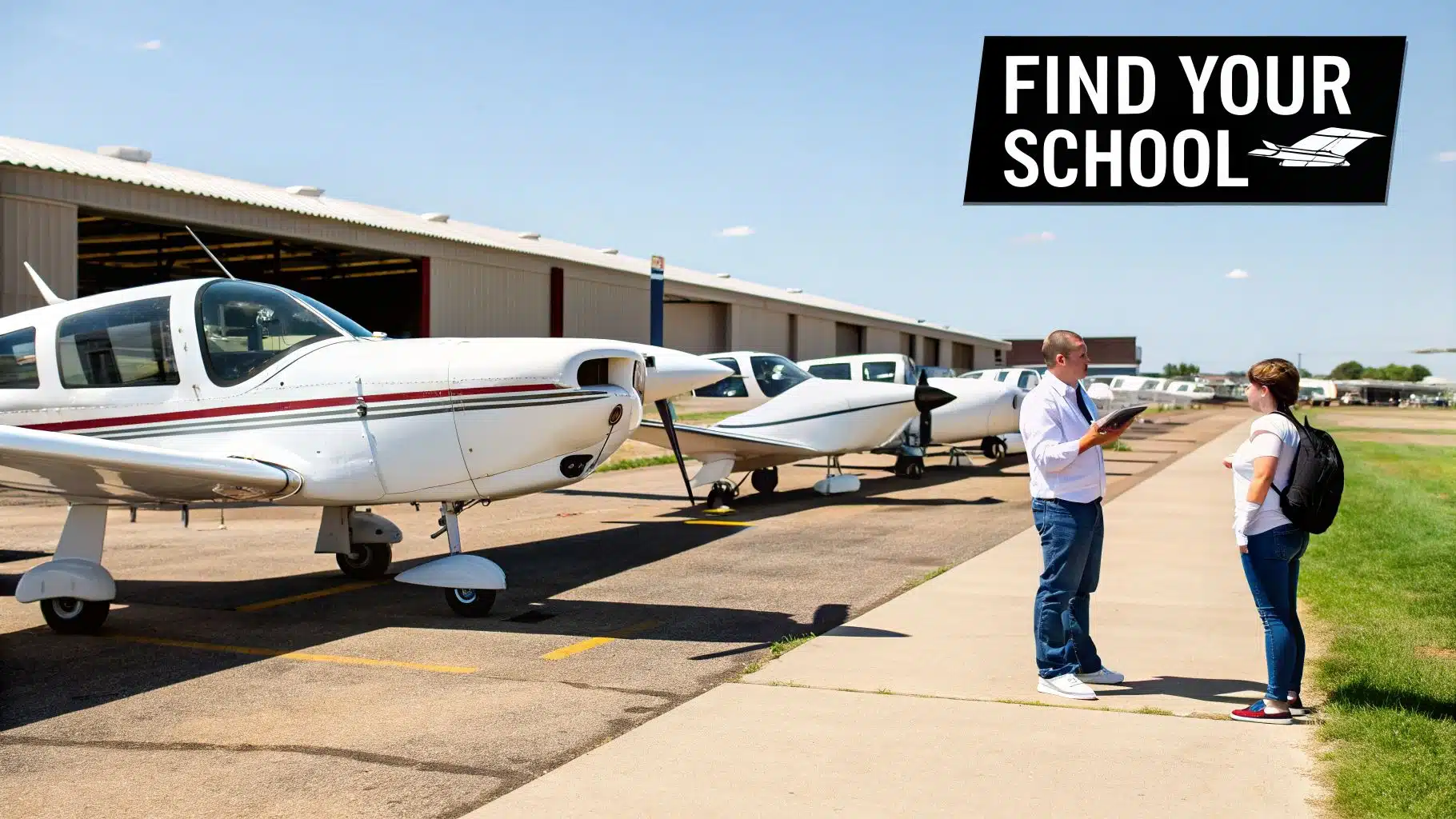
This is, without a doubt, one of the biggest calls you'll make in your entire aviation journey. Picking a school for your commercial flying lessons isn't just a logistical step—it’s the decision that sets the entire tone for your professional career. A great school doesn't just get you through a checkride; it molds you into the kind of pilot airlines and charter operators are actively looking to hire.
Forget about just shopping for the cheapest hourly rate. You need to look at the whole picture: the instructors, the planes, and the airport you’ll be calling home for hundreds of hours. The right fit is where the school's training philosophy and resources line up perfectly with your end goal.
Airport Environment and Real World Experience
The airport you train at has a huge, often underestimated, impact on how prepared you are for the real world. Sure, you can learn the basics at a quiet, uncontrolled field. But if your goal is a professional cockpit, training at a busy, towered airport throws you into the deep end from day one—and that's a good thing.
Take an airport like Chino (KCNO), for example. It's a Class D airport with three runways and a slew of instrument approaches. Flying here means you have no choice but to get sharp on the radios, sequence with all kinds of traffic, and manage a high-workload environment from your very first lessons. You'll be talking to Air Traffic Control (ATC) constantly.
This isn't just a "nice to have." It's a massive advantage. Pilots who are comfortable in busy airspace right out of the gate have a much easier time transitioning to airline operations, where crisp, confident radio work is the absolute standard.
This kind of daily practice builds the reflexes and situational awareness you just can't simulate at a sleepy grass strip. It prepares you for the pace and professionalism of a commercial flight deck.
Instructors, Fleet, and Community Support
Okay, so the airport is important. But what about the school itself? The people you learn from and the aircraft you fly are the core of your training. When you're checking out a school, get answers to these questions:
- Who are the instructors? You want a school with seasoned CFIs who have seen it all. Do they have plenty of instrument (CFII) and multi-engine (MEI) instructors on staff? An experienced teacher brings practical wisdom to the cockpit that you'll never find in a textbook.
- What's the fleet like? A well-maintained and diverse fleet is non-negotiable. Having access to basic trainers like a Cessna 150, complex single-engine planes for your commercial maneuvers, and a multi-engine trainer like a Piper Apache gives you a complete education. And always ask about their maintenance—safety is everything.
- Is there a community? The best flight schools feel like a second home. It's a place where students and instructors are genuinely passionate about flying, help each other out, and create a positive vibe. This network will be one of your most valuable assets long after you get your certificate.
By digging into the airport, the instructors, the aircraft, and the career support, you’ll find a school that’s truly invested in your future—not just in getting you a license.
How to Safely Buy Your First Airplane or Helicopter
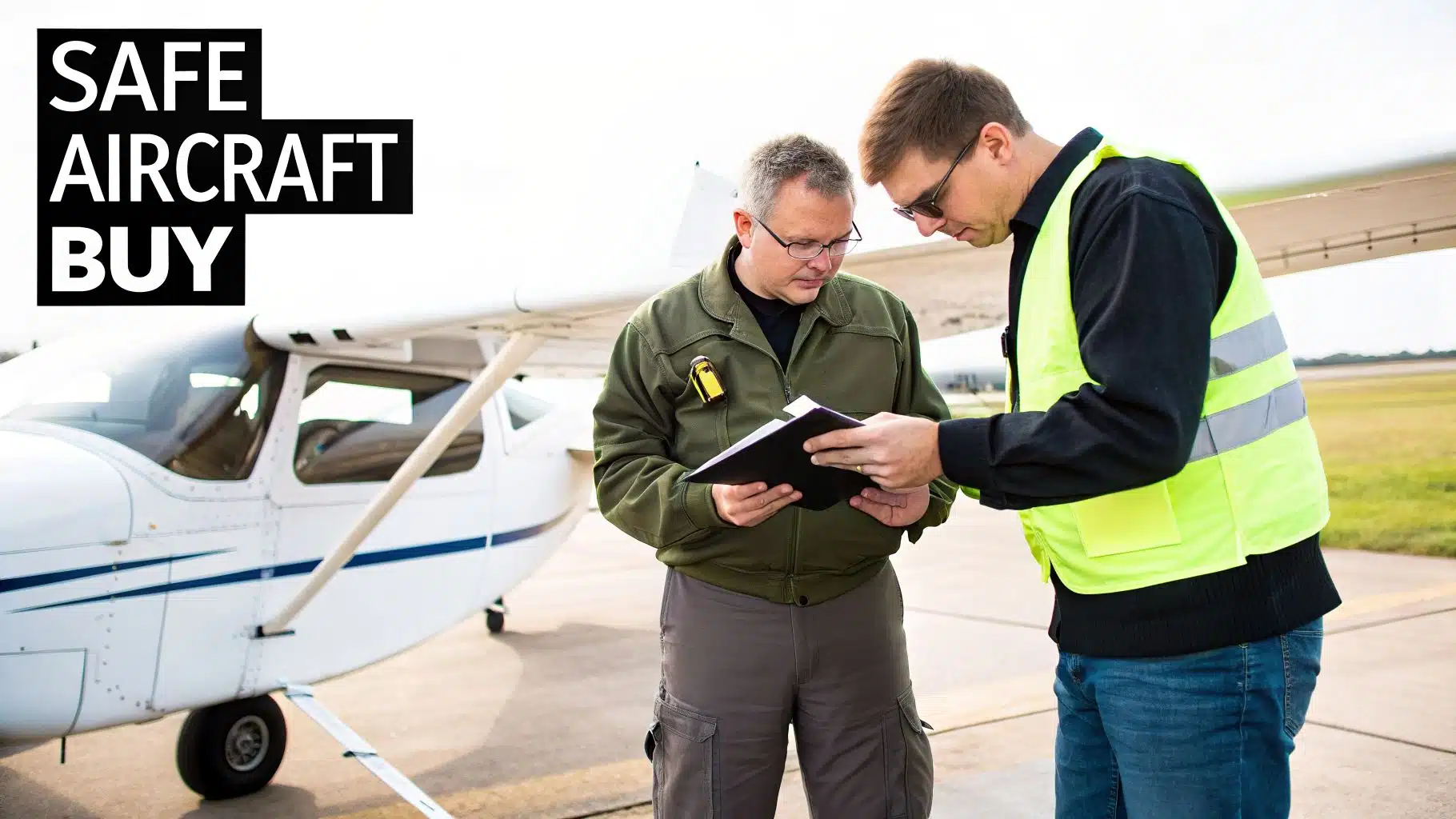
Earning your commercial certificate is a huge milestone. For many pilots, the ink is barely dry on their new ticket when the next big goal comes into focus: owning your own airplane or helicopter. This is more than just a dream of flying whenever you want; it can be a smart career move.
Owning an aircraft can significantly speed up your journey to the airlines by making it more affordable and efficient to build the necessary 1,500 hours. It gives you total control over your schedule and career path. But let's be clear: buying an aircraft isn't like buying a car. It's a complex process where being cautious and doing your homework are absolutely essential.
Defining Your Mission Before You Buy
Before you even glance at the first classified ad, you need to answer one fundamental question: what is the mission? How you answer this will shape every single decision you make from here on out.
- Building Time for a Career? If your main goal is logging hours for your Airline Transport Pilot (ATP) certificate, you'll want something efficient, reliable, and cheap to fly. Think of workhorse single-engine planes like a Cessna 172 or Piper Cherokee.
- Business or Personal Travel? Need to cover long distances with speed? You should be looking at faster, more complex aircraft like a Mooney, a Bonanza, or even a light twin-engine plane.
- Specialized Flying? Maybe you’re a helicopter pilot aiming for aerial photography or survey contracts. A versatile rotorcraft like a Robinson R44 might be the perfect tool for that specific job.
Without a clear mission, it’s far too easy to buy an aircraft that’s too expensive to fly or simply wrong for what you actually need. Be brutally honest with yourself about your goals and your budget right from the start.
The Critical Steps to a Safe Aircraft Purchase
Once you’ve defined your mission and have a type of aircraft in mind, it’s time to tackle the buying process. Rushing this part is the biggest mistake a first-time buyer can make, period.
The single most important step is the pre-buy inspection. This isn't a quick once-over; it's a deep-dive, nose-to-tail examination of the aircraft and its maintenance logbooks. It must be done by an independent Airframe & Powerplant (A&P) mechanic that you hire—not the seller's mechanic. You need someone in your corner who can give you an unbiased assessment.
A thorough pre-buy inspection isn't just a good idea; it's your only real defense against buying an unsafe aircraft or one with hidden, wallet-draining problems. Never, ever skip this, no matter how great the deal looks.
Beyond the physical condition, the paper trail is just as vital. You absolutely must perform a title search to make sure the seller legally owns the aircraft and that there are no liens against it. Using an aviation escrow service is also a non-negotiable for me. They act as a neutral third party, holding your money safely until the title is officially transferred, which protects both you and the seller.
Budgeting for the True Cost of Ownership
The sticker price is just the cover charge. The real cost of owning an airplane is in the ongoing expenses. A smart budget plans for everything, not just the initial purchase.
| Expense Category | Key Considerations |
|---|---|
| Hangar or Tie-Down | A hangar offers the best protection from the elements but costs significantly more than an outdoor tie-down. |
| Insurance | Your rates will be based on your flight hours, the aircraft type, and its insured value. Get multiple quotes. |
| Annual Inspection | This is a mandatory, in-depth inspection every year that can easily run several thousand dollars or more. |
| Maintenance Reserve | Set aside money specifically for unexpected repairs. Something will inevitably break; being prepared is key. |
| Fuel and Oil | This is your main variable cost, directly tied to how much you fly and the current price of avgas. |
Thinking ahead like this is especially crucial right now. A massive global pilot shortage is driving incredible demand for commercial flying lessons. Industry forecasts predict a need for 660,000 new commercial pilots worldwide by 2045. Because of this, more pilots are buying aircraft to build time, creating a very competitive market. You can learn more about these trends in Boeing’s detailed aviation outlook. A solid financial plan isn’t just good practice—it's what will set you up for success.
Common Questions About Commercial Pilot Training
Once you start thinking seriously about flying for a living, the questions really start to pile up. That’s a good thing. It means you’re moving beyond the hobby stage and looking at the practicalities of a professional career. Let's tackle some of the most common questions we hear from pilots who are right where you are now.
What Does "Commercial Privileges" Actually Mean?
This is probably the most fundamental question, and the answer is simple: it means you can legally get paid to fly. It's the official green light from the FAA that says you possess the skill, knowledge, and judgment to act as a pilot-in-command for compensation or hire.
Your Private Pilot License lets you fly for fun and split the costs—like gas for a weekend trip—with your passengers. You can't make a penny of profit. A Commercial Pilot License removes that barrier completely. This certificate is your entry ticket into professional aviation, turning a passion into a paycheck.
How Does a CPL Differ From an Airline Transport Pilot License?
Think of your Commercial Pilot License (CPL) as the certificate that gets your professional career off the ground. The Airline Transport Pilot (ATP) certificate is what gets you into the cockpit of a major airline.
With a CPL, you can get paid for jobs like flight instruction, banner towing, or aerial photography. The ATP, on the other hand, is the highest certificate a pilot can earn and is a non-negotiable requirement for flying for scheduled airlines. It demands significantly more experience—a minimum of 1,500 total flight hours—and a much tougher series of exams.
Essentially, you earn your CPL to start working and building time, all with the goal of eventually qualifying for your ATP.
What Does an Examiner Really Look For on the Checkride?
Let's clear the air on this one: the examiner isn't out to get you. Their job isn't to trick you; it's to verify that you meet the FAA's standards for a safe and competent commercial pilot, as laid out in the Airman Certification Standards (ACS).
They expect you to perform the flight maneuvers well, but what they're really assessing is your command and decision-making.
- Risk Management: Do you see a potential problem, like changing weather or a minor mechanical issue, and make a smart, safe plan to deal with it?
- Situational Awareness: Do you have a clear mental picture of what’s happening with the aircraft, the airspace, the weather, and your route at all times?
- Single-Pilot Resource Management (SRM): How well are you using every tool available? This includes your instruments, checklists, weather briefings, and your own knowledge to manage the flight safely and efficiently by yourself.
An examiner's number one priority is safety. They need to feel confident that when they sign you off, you won't be a hazard to yourself or the public. They want to see you think like a captain, act with authority, and fly with precision, especially when things get complicated.
If you can demonstrate that you are a safe, proficient, and professional pilot, you'll walk away with your new certificate.
Should I Get a Multi-Engine Rating Now or Later?
While a multi-engine rating is essential for an airline career, timing is everything. For nearly everyone, the smartest path is to earn your commercial certificate in a single-engine aircraft first. This lets you focus entirely on mastering the commercial maneuvers without the added complexity—and significant cost—of a twin-engine plane.
Once you have your commercial certificate in hand, you can pursue a multi-engine add-on rating. This training is much shorter, usually just 10-15 hours, and is laser-focused on multi-engine aerodynamics, systems, and emergency procedures like handling an engine failure. Doing it this way is the industry standard because it's the most efficient and cost-effective approach.
What Are the First Jobs I Can Get with a New CPL?
With your freshly printed commercial certificate, your main goal is to start building flight time toward the 1,500 hours required for the ATP. By far, the most popular and effective first job is becoming a Certified Flight Instructor (CFI).
Teaching is a fantastic way to get paid to fly every day while mastering the fundamentals. You really don't know a subject until you have to teach it. Other common entry-level pilot jobs include:
- Banner Towing: A great time-builder, especially in seasonal tourist areas.
- Aerial Survey/Photography: Flying specific patterns for mapping or real estate requires real precision.
- Pipeline Patrol: A steady job flying over infrastructure to check for issues.
- Skydiver Hauling: Flying jumpers means lots of takeoffs and landings, which builds experience fast.
The best path for you will depend on your goals and local opportunities. For many, instructing at the same school where they trained is a natural and rewarding way to launch their professional flying career.
Ready to take the next step and turn your dream of a professional flying career into a reality? At DuBois Aviation, we provide the one-on-one instruction, modern fleet, and real-world experience at a busy airport to prepare you for success. Explore our programs and get started today at https://duboisaviation.com.


