
You’re probably in the same spot a lot of Southern California students hit. You’ve done a few discovery-flight searches, looked at prices, maybe driven by Cable Airport or Chino, and now you’re trying to answer the question that matters.
Where should you train, and what path makes sense if you don’t want to waste time or money?
That decision gets harder in the Inland Empire because the options aren’t all built for the same pilot. Some places are pure flight schools. Some are clubs. Some work well for a brand-new student but not for a renter after the checkride. Some are great for casual weekend flying but weak if you want a tightly managed training plan.
foothill flying club deserves a serious look because it sits right in that conversation. It’s based at Cable Airport in Upland, at the base of the San Gabriel Mountains, and it offers the kind of access and club atmosphere many pilots want once they realize aviation is more than logbook entries. But a flying club isn’t automatically the best answer for everyone. Sometimes a structured school is smarter. Sometimes ownership is smarter. Sometimes joining a club first is the safest move before buying your own airplane.
I’m going to treat this the way a local instructor should. No brochure talk. No dreamy fluff. Just practical advice for students, renters, and future aircraft owners trying to make smart decisions in SoCal.
Your Guide to Flying in the Inland Empire
A typical Inland Empire student starts with the same rough plan. Get the private pilot certificate. Fly on weekends. Maybe take family to Palm Springs, Santa Barbara, or out toward the desert. Then reality shows up.
Weather, aircraft scheduling, instructor fit, airport environment, and total cost all matter more than the first glossy website you click.
The question most new pilots ask too late
Many ask, “How much is a lesson?”
They should ask, “What environment will keep me training consistently enough to finish?”
That’s a different question. A cheap hourly rate doesn’t help if the airplane is down all the time, the schedule is a mess, or the operation feels so transactional that you stop showing up.
Practical rule: Choose the setup that makes it easiest to fly often, stay organized, and keep momentum.
Cable Airport gives you a strong local training setting. It’s active enough to teach useful habits, but it still feels approachable compared with bigger, busier fields that can overwhelm a beginner on day one. That matters. Students who feel comfortable coming to the airport keep training. Students who dread the logistics drift out of the process.
Three paths that usually make sense
You’re generally choosing among these:
- A traditional flight school if you want a clearly managed curriculum, steady instructor support, and less ambiguity.
- A flying club if you want community, flexible access, and aircraft rental that feels less like a checkout counter.
- Ownership if you already know you’ll fly often enough, can handle maintenance realities, and want control over availability.
Foothill flying club is useful as a case study because it sits right at the crossroads of those choices. You can look at it and ask the right questions about club life, training value, dispatch reliability, and whether renting there makes more sense than buying your own airplane too early.
That’s the right way to approach aviation in Southern California. Not emotionally. Strategically.
An Overview of Foothill Flying Club at Cable Airport
Foothill Flying Club is based at Cable Airport (KCCB) in Upland and operates as a 24/7 flight school and flying club focused on safe, proficient pilot training, with electronic key dispatch, online scheduling, unrestricted fleet access, and a private pilot lounge at 1749 W. 13th Street, Unit 3, Upland, CA 91786 according to the club’s about page.

That combination tells you a lot before you even talk to anyone. This isn’t just a place where you show up, grab a key from behind a counter, and leave. It’s designed to function like a club first and a rental operation second.
What Cable Airport adds to the experience
Cable has its own personality. It feels like real general aviation, not a sterile training pipeline.
That matters more than beginners realize. When you train in a place with active local pilots, visible hangar life, and a community rhythm, aviation starts feeling normal. You stop seeing flying as a one-off lesson and start seeing it as part of your routine.
Foothill leans into that. The private lounge, 24/7 access, online scheduling, and electronic dispatch all reduce friction. Less friction means fewer excuses. In training, that’s a big deal.
A pilot lounge stocked with complimentary coffee, water, and snacks isn’t the reason to join. But it does tell you something about how the operation thinks. They want people to stay, talk, plan, and come back. That’s healthy club culture.
Why 24 7 access matters
A lot of students underestimate this point.
If you work a normal job, have kids, or train around shifting schedules, rigid office-hour access can drag out your progress. Foothill’s access model is one of its strongest practical advantages. You can fit flying around life instead of trying to force life around a front desk.
That doesn’t replace good planning. It does remove one of the common bottlenecks.
Here’s a quick look at what stands out.
| Feature | Why it matters |
|---|---|
| Cable Airport location | Good base for Inland Empire pilots who want local convenience and realistic SoCal flying |
| Electronic key dispatch | Cuts down on pickup friction and makes early or late flights easier |
| Online scheduling and payments | Better for self-managed students and licensed renters |
| Private lounge access | Supports club culture, preflight planning, and downtime between flights |
| Cafe next door | Small detail, but it makes long training days easier |
One thing I like is that the environment appears designed for pilots to treat the place as a base, not just a billing point. That mindset helps students stay engaged.
A closer look at the club atmosphere helps too.
What kind of pilot fits here best
Foothill flying club makes the most sense for people who value access, community, and independence.
That includes:
- New private pilot students who want club culture instead of a big-school feel
- Rated pilots who want a rental home base
- Owners-in-waiting who aren’t ready to buy yet but want something closer to an ownership-style experience
- Pilots returning after a break who need a practical place to get active again
Train where you’ll enjoy spending time. Students who like the airport environment stay in the game longer.
If you need constant hand-holding and a tightly choreographed academic pipeline, you may want to compare this with more formal programs before committing. But if you like autonomy and want aviation to feel personal, foothill flying club has the right ingredients.
Decoding Membership Tiers Fleet Access and Costs
Let’s be blunt. If you don’t understand the money side before you join a club, you’ll make bad decisions.
The mistake I see all the time is students focusing on one number. Usually the hourly rate. That’s incomplete. You need to think in terms of total flying cost, training continuity, and aircraft availability.
Start with the airplane, not the brochure
Foothill’s Piper Cherokee 180 is the aircraft detail worth paying attention to. The club lists a 1964 Piper Cherokee 180 (PA-28-180) with a zero-time engine overhaul and new propeller completed in August 2024, and the aircraft cruises at 124 knots according to its aircraft page.
That overhaul matters because old training aircraft don’t just cost money. They cost continuity. A grounded airplane wrecks lesson flow, delays solos, and stretches out the entire training process.
The same club aircraft information notes that older aircraft at other facilities can see 10 to 20% annual fleet unavailability, while this updated Cherokee setup is meant to reduce maintenance-related cancellations on that airframe through better dispatch reliability on the club side of the operation. That’s a practical win, not a marketing flourish.
Why the Cherokee 180 is a smart training platform
A Cherokee 180 is a solid airplane for a private pilot student who wants a stable trainer that also feels like a real traveling machine. It’s not just a traffic-pattern tool.
For Inland Empire flying, that matters. You’re dealing with terrain, density altitude awareness, changing conditions, and the need to get comfortable moving between quieter airspace and busier nearby airports. A capable cross-country trainer is useful from day one.
If you’re comparing types, this Piper Cherokee vs Cessna 172 breakdown is worth reviewing because aircraft fit affects comfort, sight picture, landing feel, and long-term rental preference.
How to think about cost when details aren’t fully published
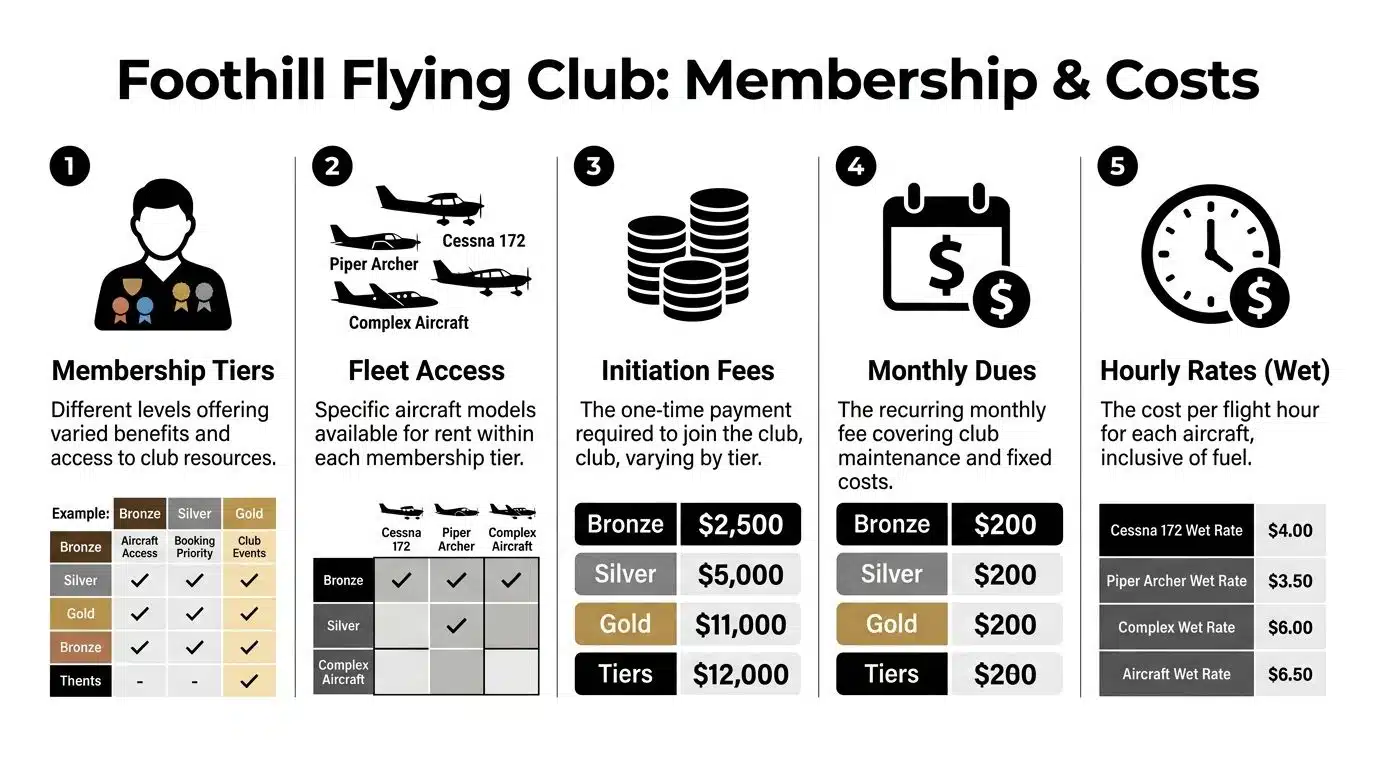
Here’s the honest answer. If the club hasn’t publicly published every initiation fee, monthly due, or membership tier detail in a way you can verify, don’t guess. Ask for the current sheet in writing.
When you do, evaluate it this way:
One-time club entry cost
Ask what you pay to join, what’s refundable, and what isn’t.Recurring monthly dues
Fixed dues matter because they punish inactivity. If you only fly occasionally, dues can make “cheap flying” expensive.Wet rental rate
Confirm whether fuel is included. Wet rates are easier to budget.Instructor cost
Club aircraft cost and instructor cost are separate issues. New students sometimes miss that.Minimum use rules
Check whether there are daily minimums for overnight trips or weekend reservations.
A simple decision table
| Your situation | Best question to ask |
|---|---|
| Brand-new student | Can I get regular bookings with the same instructor and airplane? |
| Licensed renter | How easy is it to reserve aircraft for day trips or overnights? |
| Returning pilot | What’s required for checkout and recurrent proficiency? |
| Possible future owner | Will club flying help me delay a purchase until I know my real mission? |
My recommendation on cost discipline
Don’t join any club because it feels cheaper in theory. Join because the usage pattern fits your life.
If you’re going to fly regularly, a club can be smart. If you’re going to disappear for months at a time, monthly dues can become dead weight.
Money test: Ask yourself whether you’ll fly often enough to justify dues before you get excited about access.
I’d also push any prospective member to ask these direct questions on day one:
- What aircraft are available most often
- How far ahead members typically book
- What happens when an airplane goes down
- Whether student training gets priority or competes evenly with recreational use
- How checkout standards work for newly certificated pilots
That’s the adult way to shop for flying access.
Flying Club vs Flight School Making the Right Choice
A flying club and a flight school can both get you to a certificate. That doesn’t mean they solve the same problem.
The right choice depends on the kind of pilot you are right now, not the pilot you imagine becoming later.
If you need structure, pick structure
Some students do best with a formal path. They want a syllabus, clear milestones, and less self-management.
That’s not weakness. That’s self-awareness.
A student who works full time, has inconsistent availability, and struggles to study alone usually does better in a more organized training environment. If that sounds like you, compare clubs against schools using a clear decision framework like this guide on how to choose a flight school.
If you want community and flexibility, clubs can win
A good club works well for people who want flying to become part of life, not just a course they complete.
That includes pilots who:
- Like familiar faces and a home-airport feel
- Want rental access after training, not just during it
- Prefer flexibility over a rigid front-desk model
- See aviation as a long-term hobby or lifestyle
Foothill fits this profile well. Its appeal is less about institutional structure and more about access, culture, and convenience.
Three pilot types, three different answers
| Pilot type | Better fit | Why |
|---|---|---|
| Career-focused beginner | Often a flight school | More consistent academic structure and progression management |
| Recreational student | Often a flying club | Better long-term social fit and more natural transition into renting |
| Already certificated pilot | Usually a club | Club access often makes more sense than re-entering a student-oriented school setup |
Here’s the trade-off people ignore. Clubs can feel friendlier and more personal, but they may require more initiative from the member. Schools can be more procedural, but some students need exactly that.
Don’t choose based on vibe alone. Choose based on what will keep you flying steadily for the next year.
My opinion as a local-training advisor
For many new students, the biggest risk isn’t picking the wrong airplane. It’s picking the wrong learning environment.
If you thrive on independence, a club model can be excellent. If you need accountability, don’t pretend you’ll create your own structure later. You probably won’t. Pick the system that matches your habits now.
That’s how you avoid becoming one more almost-pilot with a half-finished logbook.
A Pilot's Guide to Buying Your First Airplane Safely
A lot of pilots romanticize ownership too early. They get frustrated with rental schedules, start browsing listings at night, and convince themselves buying will fix everything.
Sometimes it does. Sometimes it hands you an expensive maintenance project with wings.
Buy for your mission, not your ego
Your first airplane should match what you’ll do.
Weekend breakfast flights, private pilot time-building, and local proficiency work call for one type of machine. Family cross-country flying, mountain flying, complex endorsements, or business travel may point you somewhere else.
Many first-time buyers overspend on capability they won’t use. That’s a mistake. More airplane means more cost, more insurance complexity, and often more training burden.
The pre buy inspection is not optional
Never buy an airplane because the seller seems honest and the paint looks clean.
Use a trusted A&P mechanic who does not answer to the seller. The pre-buy should review airframe condition, engine status, propeller condition, avionics reality, corrosion risk, logbook continuity, and signs of past damage or poor repair work.
If the seller resists a serious inspection, walk away.
A bad pre-buy decision can cost more than years of club flying.
For local buyers comparing maintenance ecosystems, facilities, and support environments around the region, this look at Threshold Aviation at Chino can help you think more clearly about where ownership support really lives.
What to look for in the logbooks
Logbooks tell you whether the airplane was cared for, neglected, or patched along just enough to sell.
Check for these issues:
- Missing entries that create timeline gaps
- Damage history that isn’t clearly explained
- Repeated squawks suggesting unresolved recurring problems
- Inspection consistency that looks sloppy or rushed
- Major component work without supporting detail
Don’t just ask whether the aircraft has damage history. Ask how it was repaired, who signed it off, and whether the records are complete.
A practical buying sequence
Define the mission
Be specific. Training, time-building, local fun, family travel, or eventual instrument work.Shortlist realistic models
Stick to aircraft with parts support, known maintenance patterns, and insurance options you can live with.Talk to insurance before making an offer
Don’t assume you’ll be insurable on acceptable terms.Review records before travel
A seller should be able to provide scans or organized documentation before you spend time going to see the aircraft.Schedule the pre-buy with your mechanic
Not the seller’s regular shop, unless your mechanic agrees and controls the process.Budget for catch-up work immediately after purchase
Even a good airplane may need items corrected once it becomes yours.
Red flags that should slow you down
| Red flag | Why it matters |
|---|---|
| Incomplete logs | Hurts value and can hide maintenance history |
| Fresh cosmetic cleanup with weak records | Sellers sometimes polish first and explain later |
| Pressure to close quickly | Good airplanes still require disciplined review |
| Seller discourages outside mechanic | Usually a sign to stop |
| You’re stretching your budget just to buy | Ownership gets more expensive after closing, not before |
My advice for first-time owners
If you haven’t yet flown enough to know your real mission, don’t buy. Rent first. Join a club first. Learn what kind of flying you do.
Ownership works best when it solves a known problem. It’s a poor cure for impatience.
How to Sell Your Airplane or Helicopter in California
Selling an aircraft is easier when you start preparing before you list it.
Most owners do the opposite. They decide to sell, snap a few weak photos, post a bare-bones ad, and then wonder why serious buyers either disappear or come in low. Buyers pay for confidence. Your job is to reduce uncertainty.
Get your paperwork clean before the first phone call
The fastest way to scare off a decent buyer is disorganized records.
Before you list, assemble maintenance logs, airworthiness documentation, equipment lists, recurring inspection history, major repair documentation, and any supplemental paperwork tied to avionics or modifications. If you’re selling a helicopter, be even more careful. Rotorcraft buyers and mechanics look hard at component history and compliance detail.
A buyer shouldn’t have to dig through a cardboard box to understand the aircraft.
Fix the obvious problems
You do not need to restore the aircraft to museum condition. You do need to handle the lazy stuff.
Take care of small cosmetic issues, clean the interior, remove old trash from the map pockets, and make sure the aircraft presents like it has been owned by a careful pilot. If a simple squawk is cheap to fix, fix it. Don’t make buyers wonder what else you ignored.
Buyers don’t mind an older aircraft. They do mind signs of neglect.
Price it like an adult
Owners often price based on emotion, not market reality.
Your avionics investment, your memories, and the amount you spent over the years do not automatically set current value. Buyers look at aircraft model, engine condition, prop status, logbook completeness, avionics usefulness, cosmetic condition, and how comparable listings stack up.
Use a range, not a fantasy. If the airplane is special, document why. If it isn’t, don’t pretend it is.
Build a listing that answers real questions
A strong listing should include:
- Aircraft identity with model and configuration
- Honest equipment summary without padded buzzwords
- Clear photo set including panel, seats, exterior, baggage area, and logbook samples when appropriate
- Maintenance highlights that matter to a buyer
- Known flaws disclosed early enough to keep trust intact
If you’re selling a helicopter, include component status and operational history clearly. Don’t bury the expensive questions.
Showings and buyer screening
Not every caller is a buyer.
Some are dreamers. Some want free consulting. Some are comparison shopping with no capital ready. Screen politely. Ask what they fly now, whether they’ve arranged financing, and whether they’ll be using a mechanic for pre-buy.
That isn’t rude. It saves everyone time.
Closing the sale properly
Once you have a buyer, slow down and document everything.
Use a written purchase agreement that covers deposit terms, pre-buy terms, delivery conditions, and responsibility for discrepancies. Keep title and registration transfer paperwork organized. Make sure both parties understand when possession changes and what documents move with the aircraft.
For higher-value airplanes and helicopters, escrow is usually the sane choice. It keeps the transaction clean and lowers the chance of a miserable dispute after the fact.
My opinion is simple. A clean sale is usually the result of preparation, not negotiation talent.
How to Join Foothill and Compare Local Alternatives
If foothill flying club sounds like your kind of place, don’t overcomplicate the first step. Call, visit, and evaluate it in person.
The club lists its location as 1749 W. 13th Street, Unit 3, Upland, CA 91786 and its phone number as 909-229-7990, with phone support during 8am to 5pm, while club facilities support round-the-clock use according to the same club information on its public materials.

What to do before you join
Don’t sign up from a laptop without seeing the operation.
Do this instead:
- Visit the airport in person and pay attention to how the place feels
- Ask how new students are onboarded
- Look at the scheduling workflow so you know whether it matches your life
- Ask who the instructors are and how training continuity works
- Sit in the lounge and observe whether members use the club like a community base
If the culture is strong, you’ll notice it quickly.
Where Foothill fits, and where it may not
Foothill’s strengths are clear. It suits pilots who want a club environment, practical access, and a home base in the Inland Empire.
But not everyone should default to a club. Public materials also point to a broader local shift. FAA reports indicate a significant surge in structured Part 141 ground school enrollments in the Inland Empire, and that same discussion highlights demand for more formal pathways, including alternatives with seven-day scheduling and Youth Aviation Camps in the region, as referenced on Foothill’s site materials.
That’s your clue to think carefully about fit.
If you’re a working adult who values flexibility and community, foothill flying club may be a strong match. If you want a more regimented training pipeline, a bigger curriculum framework may suit you better. If you’re a parent looking for youth programming, compare options directly instead of assuming every operation offers the same thing.
My direct recommendation
Tour at least two places before you commit.
One should be a club. One should be a structured school. Then ask yourself one question: which place makes it most likely that you’ll still be training consistently six months from now?
That answer matters more than any sales pitch.
Frequently Asked Questions for Aspiring Pilots
Can I do a flight review at Foothill if I’m not a member
Yes. Club information states that flight reviews are available without membership requirements, and that can be done using a club aircraft or your own aircraft. That’s useful for pilots who need a legal and practical path back into currency without committing to a club first.
What should I ask about the ground school
Ask whether the current class date, format, materials, and study expectations match your schedule. Club materials mention a Private Pilot Ground School starting October 7, 2025 in one public description, while other planning references discuss Spring 2026. Treat the date as something to verify directly with the club before you plan around it.
Also ask whether the course is built mainly for written-test prep, for integrated flight training support, or for both. That changes how useful it will be for your situation.
Is Foothill a good fit for a brand-new student
It can be, especially if you want a community-focused environment and flexible access. It’s a stronger fit for self-directed students than for people who need constant academic structure.
Should I join a club before buying an airplane
Usually, yes. Club flying is a smart way to learn your real mission before you take on ownership risk. If you haven’t yet figured out whether you’ll mostly do local flying, cross-country trips, or advanced training, you’re not ready to buy intelligently.
What should I ask about rental insurance and coverage
Ask exactly what the club’s policy covers, what your liability exposure is as a renter, whether deductibles can be passed through to you, and whether they expect you to carry renter’s insurance separately. Get that answer in writing. Insurance misunderstandings turn into expensive lessons.
If you want a second opinion before choosing a training path, talk with DuBois Aviation. It’s a practical next step if you’re comparing club flying with a full-service school, airplane and helicopter training, or a more structured route from private pilot through advanced ratings in the Chino area.


