A prospective pilot can spend months comparing commercial pilot training programs, then discover that the key decision isn't the syllabus name. It's how flight hours, financing, instructor availability, and income timing fit together. Under FAA rules, an airplane commercial certificate generally requires 250 total flight hours under Part 61, while an approved Part 141 course can reduce the aeronautical-experience minimum to 190 hours, provided the student completes the approved curriculum and meets the same proficiency expectations. AOPA's commercial certificate overview explains the pathway difference.
The honest answer is that commercial training is a major step, but it isn't an airline job. The certificate proves commercial-level competence. The 1,500-hour ATP requirement, instructor access, and the quality of the school's hour-building plan usually determine what happens next.
Table of Contents
- Where Commercial Pilot Training Fits in Your Career
- What the FAA Requires Before You Sit for the Commercial Checkride
- Part 61 vs Part 141 Commercial Training Programs
- What a Commercial Pilot Training Curriculum Looks Like
- How Much Commercial Pilot Training Really Costs
- The CFI Year and the 1,500-Hour ATP Gap
- How to Choose a Commercial Pilot Training Program
- Putting It Together for Your Commercial Pilot Training Plan
Two practical options worth comparing
These are specific products pilots commonly compare for this type of flying. Confirm compatibility with your aircraft and instructor before ordering.
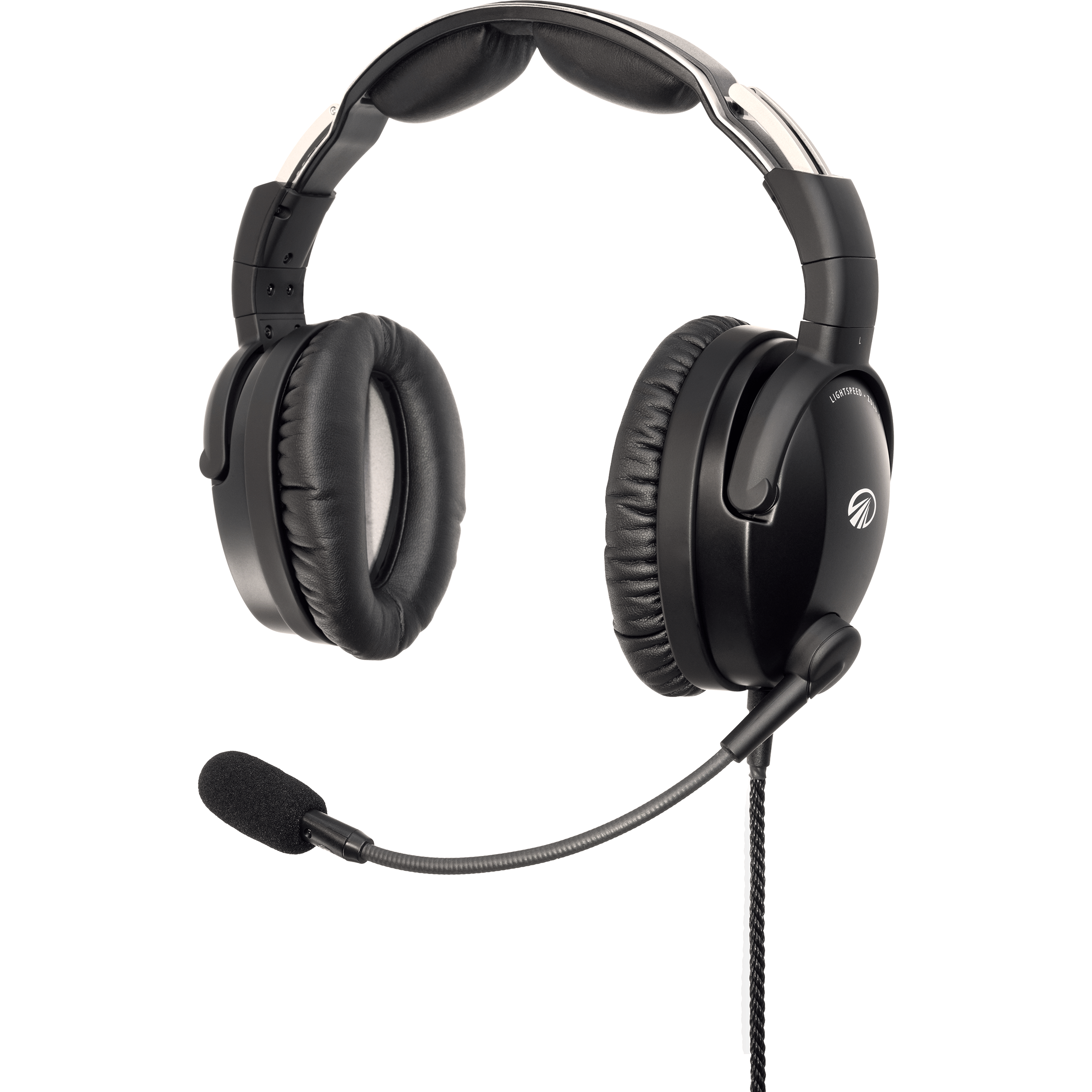 Premium ANR headsetLightspeed Zulu 4 ANR Aviation Headset - Dual GA PlugCheck current availability on Amazon (paid link)
 Premium headsetBose A30 Bluetooth Aviation Headset - Dual PlugCheck current availability on Amazon (paid link)
Where Commercial Pilot Training Fits in Your Career
A student comparing two flight-school quotes may focus on aircraft type, package names, or advertised completion speed. The better question is direct: How does this program allocate money and flight time toward employability? Under Part 61, the commercial certificate generally requires 250 total hours, including 100 hours as pilot in command and 50 hours of cross-country time, plus the required commercial training tasks. Part 141 may change the minimum-hour path, but only through an approved course and satisfactory performance. Review the full FAA commercial pilot license requirements before treating a school's advertised total as a guaranteed outcome.
Most career-track students reach the commercial certificate after private and instrument training. By then, the certificate represents a major investment of cash and flight time, but the training plan must account for what follows. Instructor certificates, paid flying opportunities, and the hours needed before airline eligibility can determine whether the student reaches a professional cockpit efficiently or spends more money waiting for work.
The certificate is a milestone, not a job offer
The commercial certificate permits a pilot to receive compensation for eligible flying. It does not qualify the pilot for airline operations by itself. The graduate still needs experience, current skills, and a job that provides useful flight time.
The standard U.S. airline path includes a 1,500-hour ATP minimum. FAA guidance on becoming a pilot describes the broader experience framework and the training connected to commercial progression. Plan for that gap before choosing a program. A school that gets you to the checkride quickly but offers no credible way to build time may leave you financing the next stage alone.
Read every quote as an hour-allocation plan
A school quote should show where each dollar and flight hour goes:
- Aircraft hours: Identify the hours planned in a basic trainer, technically advanced aircraft, or complex airplane.
- Instructional hours: Confirm what is included for flight lessons, ground training, stage checks, and checkride preparation.
- Availability: Ask whether aircraft and instructors support consistent flying, or whether scheduling gaps will stretch the timeline.
- Next certificate: Check for a practical CFI and instrument-instructor pathway after the commercial checkride.
A lower quoted total can be the more expensive choice if it leaves you without dependable access to instructor work. Choose the program that connects commercial training, CFI preparation, and hour building into one workable financing plan.
What the FAA Requires Before You Sit for the Commercial Checkride
A commercial applicant must satisfy both eligibility and aeronautical-experience requirements. The applicant must be at least 18, be able to read, speak, write, and understand English, and obtain the required instructor endorsement for ground training and knowledge-test readiness. The federal eligibility rule covers those baseline conditions.
For an airplane, single-engine commercial certificate, the core experience threshold is 250 hours of flight time as a pilot, including at least 100 hours in powered aircraft and 50 hours in airplanes. 14 CFR 61.129 provides the aeronautical-experience requirement. The same rule also specifies 100 hours of pilot-in-command time and 50 hours of cross-country time. The current eCFR text identifies the detailed experience categories.
FAA commercial pilot eligibility hours at a glance
| Requirement | FAA Minimum | Regulation |
|---|---|---|
| Total pilot flight time | 250 hours | 14 CFR 61.129 |
| Powered-aircraft time | 100 hours | 14 CFR 61.129 |
| Airplane time | 50 hours | 14 CFR 61.129 |
| Pilot-in-command time | 100 hours | eCFR 61.129 |
| Cross-country time | 50 hours | eCFR 61.129 |
| Commercial-specific training | 20 hours | FAA hourly requirements |
The 20-hour commercial training block includes at least 10 hours of instrument training and 10 hours in a complex, turbine-powered, or technically advanced airplane, according to the FAA's published requirements. Those hours exist to test procedural discipline, aircraft management, and precision, not merely to increase the logbook total.
The applicant also needs the prerequisite certificates and ratings, appropriate ground training, a passed knowledge test, and a medical certificate appropriate to the privileges sought. FAA medical guidance identifies the second-class medical certificate with commercial pilot privileges and requires MedXPress submission before the medical examination. The FAA medical certification process should be started early, before substantial training money is committed.
Part 61 vs Part 141 Commercial Training Programs
A student choosing between Part 61 and Part 141 is making a financing and hour-allocation decision, not just selecting a syllabus. Both paths can lead to a commercial certificate. The difference is how much structure the school provides, how consistently the student can train, and whether the lower Part 141 hour minimum is realistic for that operation.
The comparison that matters
| Factor | Part 61 | Part 141 |
|---|---|---|
| Training structure | Flexible, instructor and student can tailor the pace | Approved syllabus with defined progression |
| Aeronautical-experience minimum | Generally higher for the airplane commercial certificate | Can be lower in an approved commercial course |
| Stage checks | School-dependent | Built into the approved course structure |
| Schedule control | More adaptable for work and personal obligations | More predictable when the student flies consistently |
| Best fit | Self-paced or nontraditional students | Career-track and accelerated students |
| Main trade-off | Flexibility can increase total time | Structure can reduce schedule flexibility |
Part 61 gives the instructor and student room to adjust the order, pace, and frequency of training. That works well for someone balancing a full-time job or training around changing obligations. It also places more responsibility on the student to track weak areas, maintain momentum, and question whether each flight is moving the commercial preparation forward.
Part 141 operates through an FAA-approved training course outline. Stage checks and documented lesson progression create accountability, while the approved structure can support a lower aeronautical-experience minimum than the usual Part 61 route. Review the school's actual course requirements, aircraft availability, instructor staffing, and check-flight process before treating that reduction as a guaranteed saving. Students considering this route can review DuBois Aviation's Part 141 flight-school information.
Why accelerated programs usually favor Part 141
An accelerated program depends on coordinated aircraft bookings, instructors, ground lessons, stage checks, and examiner availability. Part 141 gives the school a framework for that coordination. It can also fit programs connected to military benefits, educational funding, or airline cadet pathways when those programs accept the school's approval structure.
Part 61 is usually the better operational choice for a student whose availability changes often. Part 141 generally makes stronger financial sense for a student who can protect regular training blocks and meet the school's progression standards.
Do not choose from the advertised hour minimum alone. Weather, maintenance, instructor changes, missed lessons, and weak stage-check performance can erase the theoretical savings. Ask how many students complete the course near the minimum, how often aircraft are available, and what happens when a student falls behind. The school's completion process matters more than the label on the door.
What a Commercial Pilot Training Curriculum Looks Like
A solid commercial syllabus turns a capable private pilot into a precise, disciplined operator. The work starts on the ground, where the student reviews commercial privileges and limitations, aircraft performance charts, systems, weight and balance, risk management, and operational rules relevant to professional flying.
Ground training also needs to connect flight decisions to duty and rest obligations. A student preparing for airline work should understand the purpose of FAR Part 117 rest and duty rules, even though the commercial checkride itself doesn't turn the student into an airline-qualified crewmember.
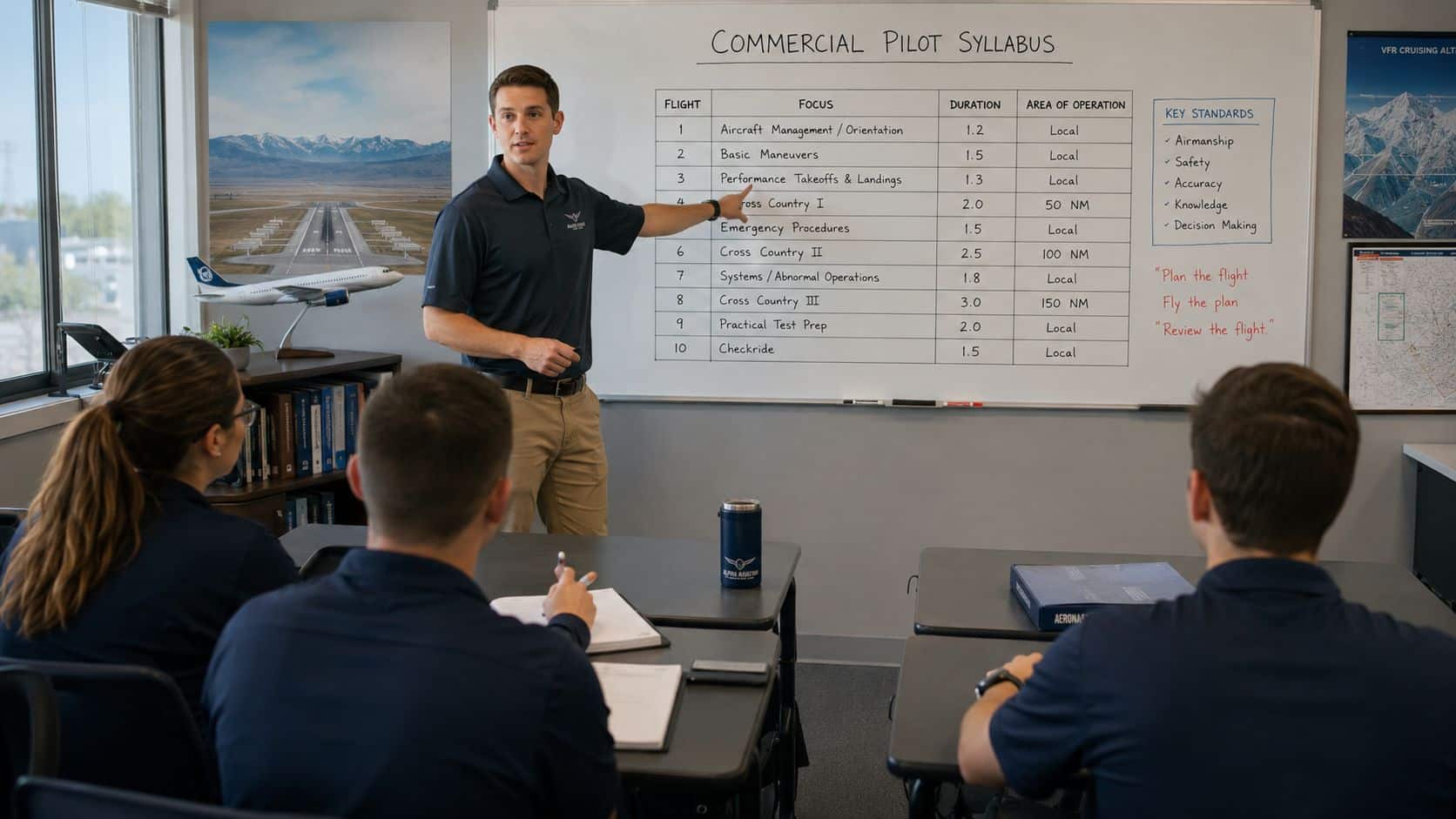
A practical sequence
The first flights usually expose gaps in aircraft control, planning, and checklist discipline. The instructor reviews systems and preflight technique, then introduces commercial maneuvers in a deliberate sequence:
- Chandelles: Maximum-performance climbing turns that demand coordinated control and energy management.
- Lazy eights: A continuous demonstration of pitch, bank, airspeed, and visual reference control.
- Eights on pylons: An altitude exercise that teaches wind correction and ground-reference judgment.
- Steep spirals: Accuracy and energy management during a descending turn around a selected point.
- Power-off 180 landings: Approach planning, glide judgment, and runway accuracy without relying on engine power.
- Short and soft field operations: Performance planning and disciplined aircraft handling during takeoff and landing.
The technically advanced or complex-aircraft block should not be treated as a box to check at the end. A Garmin G1000 aircraft, retractable landing gear, controllable-pitch propeller, and additional systems create useful opportunities to teach workload management and failure recognition.
Checkride preparation
Under Part 141, stage checks or an end-of-course test provide formal readiness gates. A strong instructor also uses mock oral questions, scenario-based planning, and repeated maneuver standards before the student books the practical test.
Full-time commercial training can sometimes be organized across four to eight weeks, but the calendar depends on aircraft access, weather, instructor availability, student preparation, and examiner scheduling. The practical test commonly requires concentrated oral and flight preparation, so the final phase should be planned as an assessment period rather than a casual final lesson.
How Much Commercial Pilot Training Really Costs
Commercial training costs are driven by aircraft access and the number of hours needed to reach a consistent standard. The bill usually combines aircraft rental, instructor time, complex or technically advanced aircraft use, ground training, simulator sessions, medical expenses, knowledge testing, and the practical-test fee.
The specific dollar figures in a school quote must be verified directly with that school because aircraft rates, instructor rates, local fees, and examiner charges change. A useful estimate separates fixed charges from flight-hour exposure instead of accepting one large package number. Students can use DuBois Aviation's flight-training cost information as one reference point when building questions for a school.
Commercial pilot training cost breakdown
| Cost Component | Typical Range |
|---|---|
| Aircraft rental | School-specific |
| Flight instruction | School-specific |
| Complex or technically advanced aircraft time | School-specific |
| Ground school | School-specific |
| FAA knowledge test | Verify current fee |
| Medical certificate | Examiner-specific |
| DPE practical test | Examiner-specific |
| Simulator or training device | School-specific |
| Contingency for additional training | Student-specific |
A school that advertises a package may include an assumed number of flight hours, but that assumption isn't a guarantee. The student should ask what happens when extra flights are required, whether unused funds expire, how cancellations are handled, and whether stage checks are charged separately.
Budget test: The most useful quote shows the aircraft rate, instructor rate, included hours, excluded fees, refund policy, and the hourly cost of going beyond the estimate.
Financing deserves the same scrutiny as the syllabus. Students may encounter private flight-training loans, education-linked financing, military or veterans' benefits, or school payment plans. Any loan should be evaluated by total repayment, interest, deferment terms, credit requirements, disbursement timing, and what happens if training takes longer than planned.
A fleet-backed school can sometimes coordinate instructors, aircraft, and maintenance more effectively than a fragmented arrangement. That doesn't remove the student's financial risk, but it can make scheduling and cost tracking easier. The strongest programs explain the assumptions behind their price instead of hiding risk inside a “guaranteed” package.
The CFI Year and the 1,500-Hour ATP Gap
Finishing the commercial certificate is not the finish line for the standard U.S. airline route. The ATP pathway generally requires 1,500 total flight hours, and the commercial certificate only places the new professional pilot at the beginning of the experience-building phase. FAA hourly requirements for becoming a pilot describes the broader requirements and the role of structured experience.
That gap changes the financial calculation. A student can spend heavily to earn commercial privileges, then struggle if the school can't provide a dependable path to instructor certificates and regular flying. The school's CFI quality may matter more than a polished commercial maneuver syllabus because instructors often become the bridge between training and paid flight time.
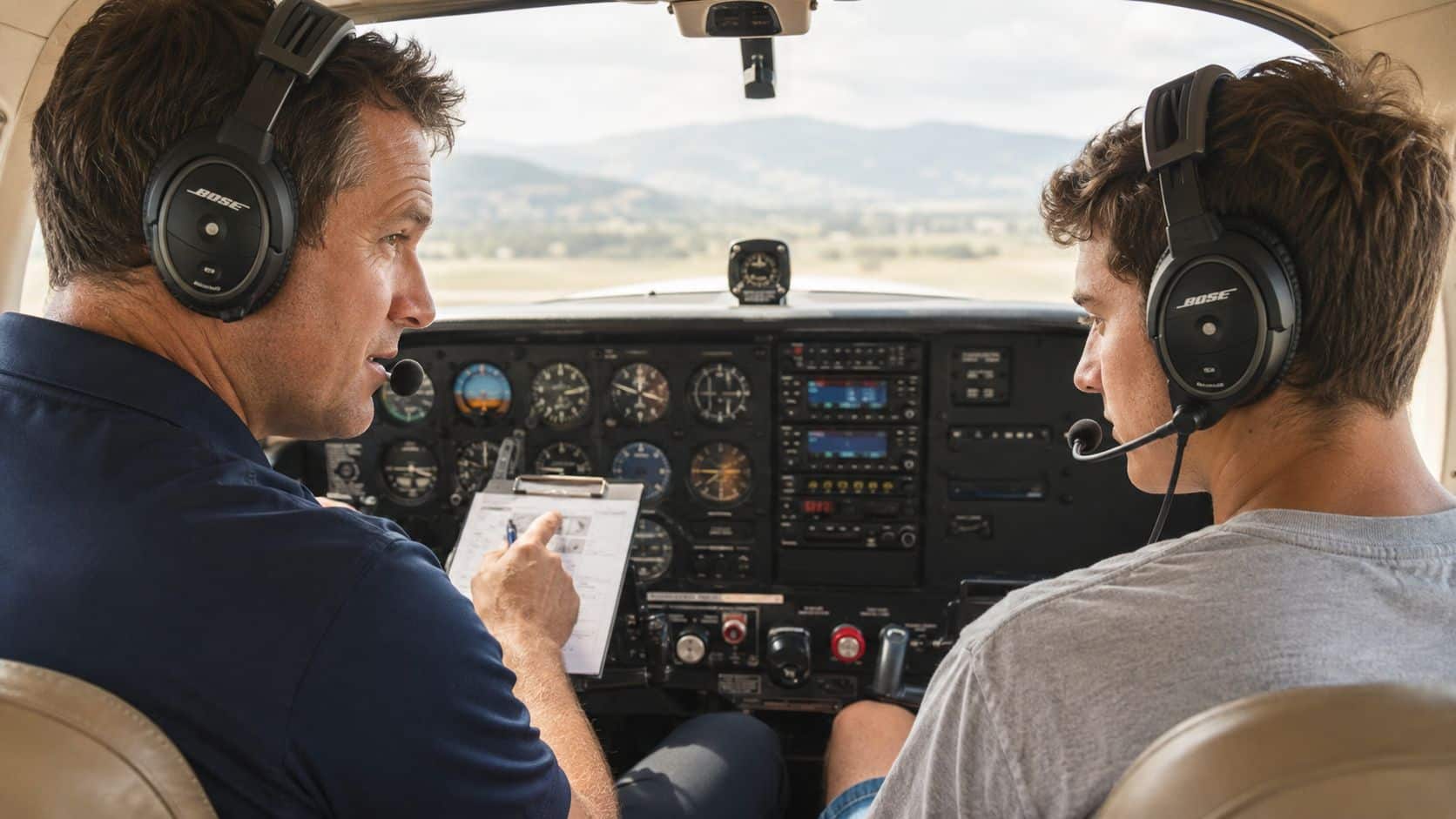
Why instruction is the standard hour-building route
The CFI certificate lets a commercial pilot teach within the privileges and limitations of the certificate. Adding the instrument instructor qualification broadens the instructional work and keeps instrument procedures central to the pilot's professional development.
Instruction can build both dual-given time and pilot-in-command time while producing income. It also forces the new pilot to explain aerodynamics, weather decisions, regulations, abnormal procedures, and risk management clearly. That teaching responsibility often exposes weak knowledge faster than another solo hour would.
The gap needs a written plan
Students should ask a prospective school:
- Hiring path: Does the school regularly consider its own graduates for instructor positions?
- Instructor progression: Is there a defined route from commercial training to CFI, instrument instructor, and multi-engine instructor qualifications?
- Aircraft access: Can instructors obtain consistent flight time with students?
- Operational exposure: Does the local airport provide meaningful radio, tower, traffic, and instrument experience?
- Attrition risk: What happens if instructor demand changes or a student needs additional training?
Some pilots may qualify for restricted ATP pathways based on approved academic training or military experience. Those alternatives must be checked against the applicant's exact records and the current FAA rules. They don't eliminate the need for sound experience, proficiency, and a credible hiring plan.
How to Choose a Commercial Pilot Training Program
Choose a commercial pilot training program by examining how it allocates your money, aircraft access, and calendar time. A polished tour proves little. Review the documents, take a discovery flight, and ask how the school moves students from commercial training into instructor work and the experience needed for the ATP path.
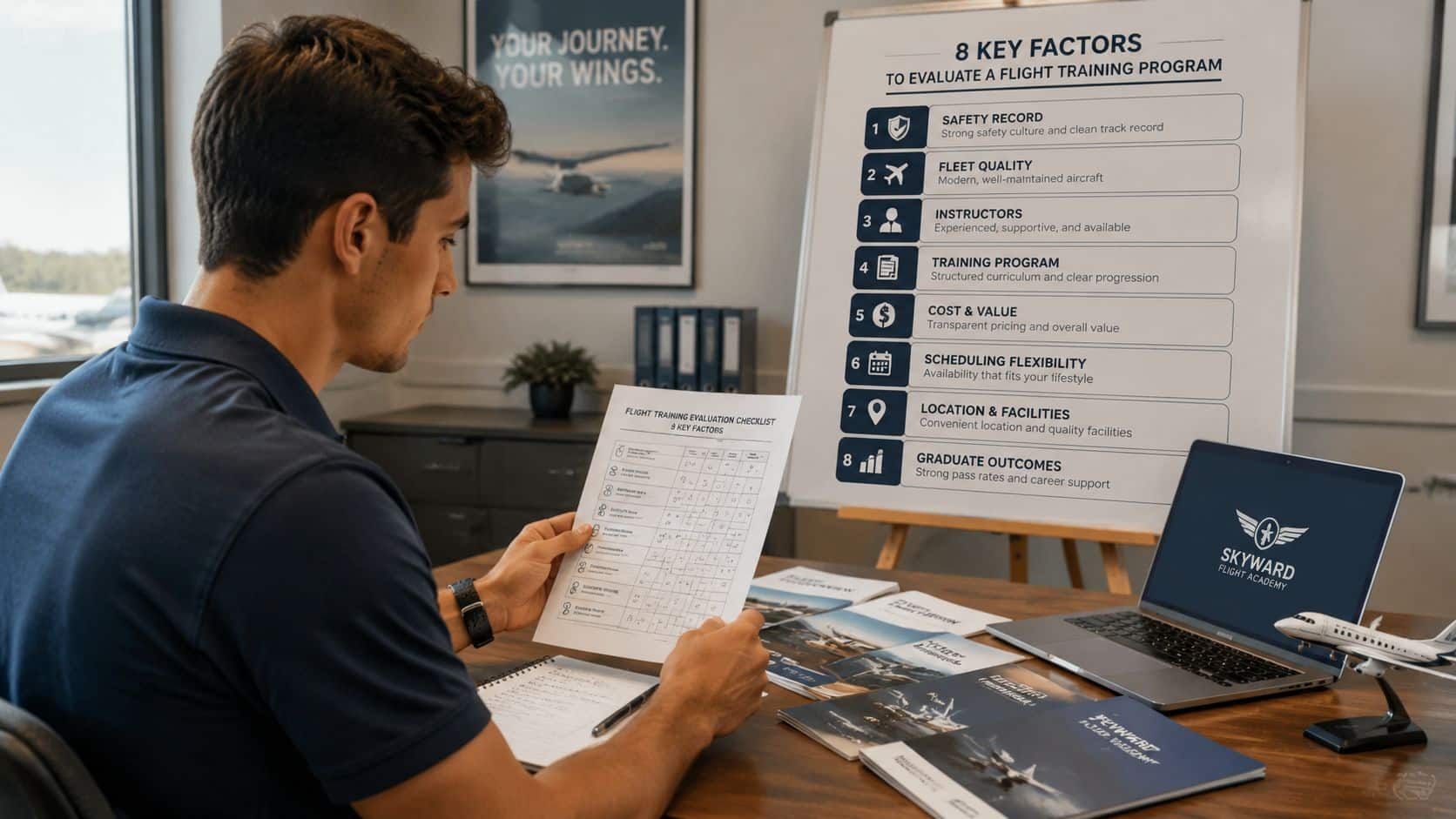
Eight checks before signing
Instructor quality: Ask whether instructors work full time or part time, how often students change instructors, and how stage checks are conducted. Confirm how the school provides access to appropriately authorized examiners.
Fleet relevance: Inspect the aircraft used for commercial training. Confirm access to technically advanced or complex airplanes, retractable-gear experience where appropriate, and the multi-engine equipment required for your intended path. A low hourly rate means little if aircraft availability repeatedly stops your training.
Training-device access: Ask how much simulator or flight-training-device time is available, who supervises it, and which procedures the device supports. It should supplement aircraft training, not disguise a shortage of usable airplanes.
Airspace mix: A towered airport develops radio work and sequencing. Nearby uncontrolled fields, busy terminal airspace, and instrument approaches create different demands. Ask the school to show how instructors use that mix rather than treating the airport location as a selling point.
Approval status: Request the relevant Part 141 approval information, course outline, stage-check process, and completion requirements. Separate any regulatory hour reduction from savings that are only an estimate.
Career alignment: If an Airline Career Program or cadet pathway is advertised, request its written eligibility conditions. It should identify the required ratings, instructor qualifications, records, and performance standards. A pathway without those details is marketing, not a plan.
Financing exposure: Compare the payment schedule with realistic training risk. Ask whether financing is held by the school or a lending partner, whether in-house plans exist, and how extra training or a failed stage check is billed. Your budget must cover delays, not just the advertised package.
Outcome evidence: Request graduate placement information and any interview-conversion data the school can document. Vague answers should reduce the weight you give the school's outcome claims.
Students in Southern California should also judge whether the local environment supports their goals. A busy, towered airport such as Chino Airport can provide useful radio and traffic exposure, but only if instructors integrate that environment into training. DuBois Aviation offers airplane and helicopter instruction, commercial and multi-engine training, an in-house simulator, and an Airline Career Program, so a prospective student may include it in a local comparison.
The strongest program is the one that keeps aircraft flying, explains every added charge, and gives you a credible route into paid flight experience. Score schools on those facts, not on presentation quality.
Putting It Together for Your Commercial Pilot Training Plan
The decision becomes manageable when the student treats training as a financed project with milestones. Start with the current certificate level, logged experience, remaining commercial requirements, and the long-term ATP objective. Every school conversation should connect those items to aircraft availability, instructor capacity, calendar time, and the cost of additional training.
A decision sequence for the next few months
Map the logbook: Separate total time, pilot-in-command time, cross-country time, instrument time, and complex or technically advanced aircraft time. A single total-hour figure isn't enough to identify the remaining work.
Set a calendar: Build around weather, work, medical appointments, examiner availability, financing lead time, and realistic instructor access. Students who can protect regular training blocks usually have a clearer path than students relying on occasional open slots.
Build the budget: List aircraft, instructor, simulator, ground training, medical, knowledge-test, practical-test, and transportation costs. Add a contingency reserve rather than treating the school's advertised package as a guaranteed final bill.
Compare finalists: Visit two or three schools, take discovery flights, inspect the fleet, and ask for the written syllabus. Verify Part 141 status and any Airline Career Program eligibility conditions before paying a deposit.
Sequence commitments: Schedule the FAA medical, submit financing applications in parallel, request training records and policies, and choose a start date only after the school answers the availability questions.
A student who needs help coordinating study, flight lessons, and personal obligations can use a practical resource to build a realistic weekly schedule. The schedule should reserve time for oral-exam preparation, regulations, performance calculations, lesson review, and recovery between flights, not just time in the aircraft.
The U.S. pilot pipeline is expanding. In 2025, the active pilot population reached 887,519, commercial pilot certificates grew 7.8% year over year to about 118,000, and the student pilot base rose 7.2% to 370,286, according to reported U.S. flight-training sector data. That growth creates opportunity, but it doesn't excuse weak planning. A student should choose the program that makes hour allocation, financing, instructor progression, and regulatory compliance visible from the beginning.
DuBois Aviation provides airplane and helicopter instruction at Chino Airport, including private, instrument, commercial, multi-engine, CFI, and career-focused training supported by an in-house simulator and flexible scheduling. Prospective students can review the available training paths and contact DuBois Aviation to discuss course availability, schedule a discovery flight, or request a detailed training plan.