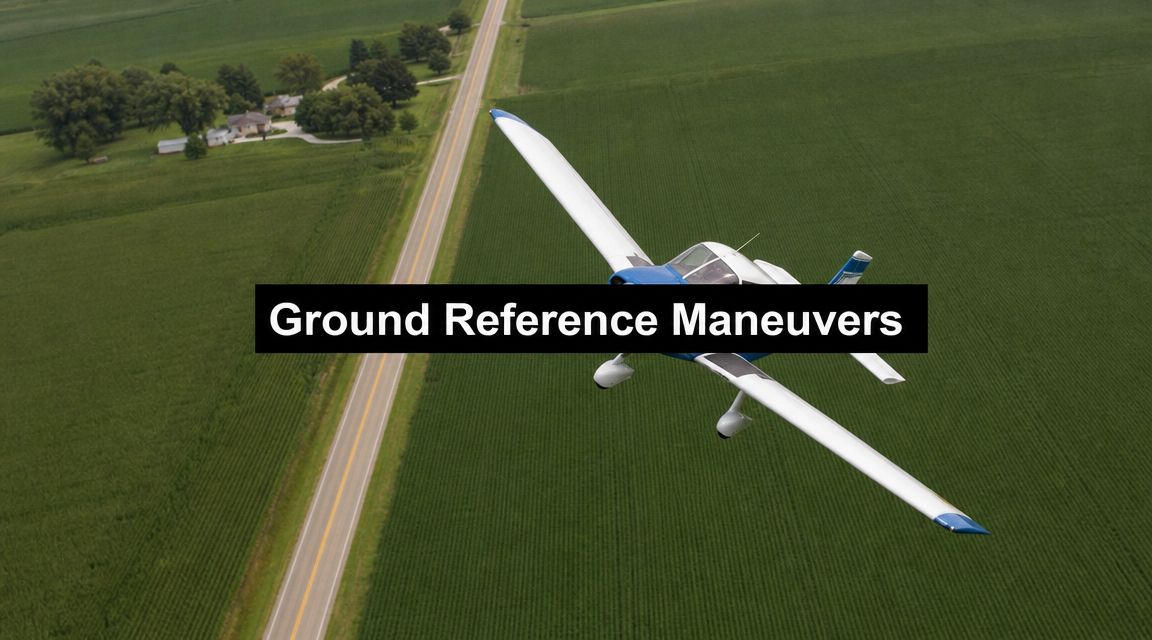
Ground reference maneuvers are where a student pilot truly learns to dance with the wind. Flying a specific pattern over the ground isn't just an academic exercise; it's the core skill that separates a novice from a pilot who is truly in command of their aircraft. These maneuvers—the rectangular course, S-turns, and turns around a point—are your foundation for precision and control.
More Than Just a Checkride Maneuver
It's easy for student pilots to dismiss ground reference maneuvers as just another item to tick off for the practical test. But trust me, their real value goes far beyond that. This is where you build the fundamental skills for wind correction, something you'll use on virtually every single flight, from nailing your traffic pattern to executing a perfect crosswind landing.
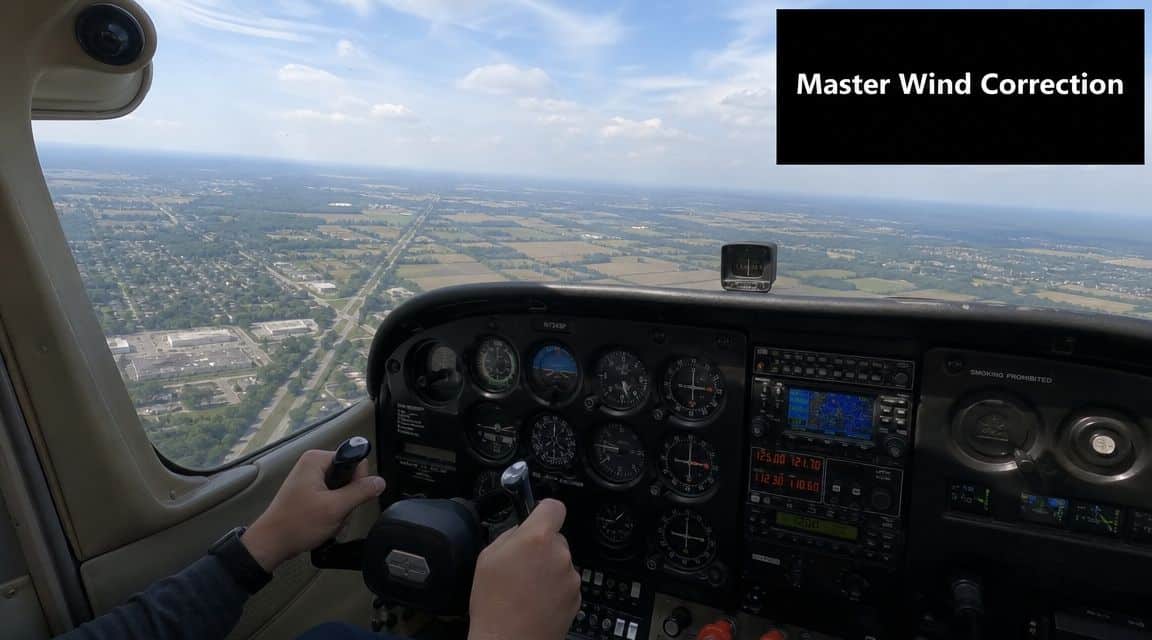
When you're out there flying an S-turn over a road, you're not just making pretty shapes in the sky. You're developing a sixth sense for how the wind is pushing your aircraft off its intended path. More importantly, you're teaching your hands to make those constant, subtle control inputs needed to fight back and maintain your ground track. This is what builds a light touch and rock-solid coordination.
Connecting the Dots to Real-World Flying
There's a very good reason these maneuvers have been a cornerstone of FAA pilot training for decades. The pilot who can fly a perfect rectangular course on a windy day is developing the exact same instincts needed to correct for a crosswind on final approach. These exercises are the critical link between basic stick-and-rudder skills and confident, real-world flying. You can read more about the foundational role of these maneuvers in flight training.
Getting these maneuvers right pays huge dividends in safety and precision. The ability to instinctively correct for wind drift means:
- Rock-solid approaches: You'll hold the runway centerline without chasing it back and forth.
- Crisp pattern work: Your traffic patterns become consistent and predictable, even when it's gusty.
- More brainpower: You'll spend less mental energy wrestling with the wind and more on flying the airplane, watching for traffic, and managing your systems.
Think of it this way: Ground reference maneuvers are to pilots what scales are to a musician. They aren’t the final performance, but they are the foundational exercises that build the muscle memory and instinct for a flawless execution when it counts.
Setting Yourself Up for Success in the Air
The secret to nailing any ground reference maneuver isn’t really in the turns themselves—it’s in the prep work you do before you even start. Think of it as setting the stage. Get the setup right, and the rest of the maneuver becomes a whole lot easier.
First, let's talk location. You'll want to be flying between 600 and 1,000 feet above ground level (AGL). This is the sweet spot: low enough to see your ground references clearly but high enough to give you a solid safety margin. When you’re scouting a practice area, look for a spot that's clear of towers and other obstacles, and try to stay away from residential areas to keep noise complaints to a minimum.
Once you’ve found a good patch of sky, you need to pick your references on the ground. Don't just pick the first thing you see; choose something you can easily keep track of.
- For Rectangular Courses and S-Turns: You can't beat long, straight references. Think country roads, prominent fence lines, or even irrigation ditches.
- For Turns Around a Point: Look for a single, unmistakable feature. A lonely intersection, a standalone tree in an open field, or a small pond are all perfect choices.
Running Your Pre-Maneuver Checklist
With your spot picked out, it's time to get the airplane—and your head—in the game. Before every maneuver, run through a pre-maneuver checklist. A great one to commit to memory is C.R.A.A.C.C. This stands for Clearing Turns, Reference, Altitude, Airspeed, Configure, and Call. It’s a simple flow that ensures the area is clear, the plane is stable, and you're ready to fly with precision.
A huge part of this setup is planning your entry, which brings us to a critical piece of technique. All ground reference maneuvers are designed to be entered on the downwind. Why? Because that’s where your groundspeed is at its highest.
Starting on the downwind forces you to make your steepest bank right away to avoid drifting away from your reference. It throws you into the deep end from the get-go, which is fantastic for building your wind correction skills. If you can nail the entry, you're setting a confident tone for the entire maneuver. You're proving that you're actively flying the airplane, not just reacting to it.
For a deeper dive into the performance numbers that come into play, check out our guide on how to calculate maneuvering speed. You can also explore the FAA's official guidance on these techniques to better understand the underlying aerodynamics.
Executing Each Maneuver with Precision
This is where the book knowledge ends and the real flying begins. Getting a handle on Ground Reference Maneuvers is all about translating the abstract idea of wind drift into concrete, precise movements of the flight controls. While each maneuver teaches a unique skill, they all share a common thread: keeping your aircraft tracing a specific, unwavering path over the ground.
Let's start with the Rectangular Course. Think of it as flying a perfect traffic pattern, but with the whole world as your airport. The trick is to stay ahead of the wind. You’ll use a crab angle to hold your line on the upwind and downwind legs, fighting the drift. The real test comes in the turns. The turn from downwind to base will demand your steepest bank, while the turn from base to final is a bit more moderate. Conversely, turning from upwind to crosswind requires just a shallow bank. It’s a continuous dance of adjusting your bank and crab to paint that perfect box on the ground.
From Straight Lines to Flowing Curves
Where the rectangular course is all about straight lines, S-Turns and Turns Around a Point introduce the challenge of maintaining a perfect curve.
For S-Turns Across a Road, your objective is to fly two flawless, symmetrical semi-circles on opposite sides of a road. The instant you cross that road with a tailwind, you need to roll into your steepest bank. As you continue the turn and the tailwind’s push subsides, you have to gradually shallow out your bank to keep the turn's radius consistent.
The secret to a graceful S-Turn isn't setting and forgetting your bank angle. It's about constant, fluid control. You are always adjusting based on what you see happening on the ground, reacting to your changing groundspeed and drift to maintain those smooth, symmetrical curves.
The infographic below shows the universal preparation that underpins success in any of these maneuvers.
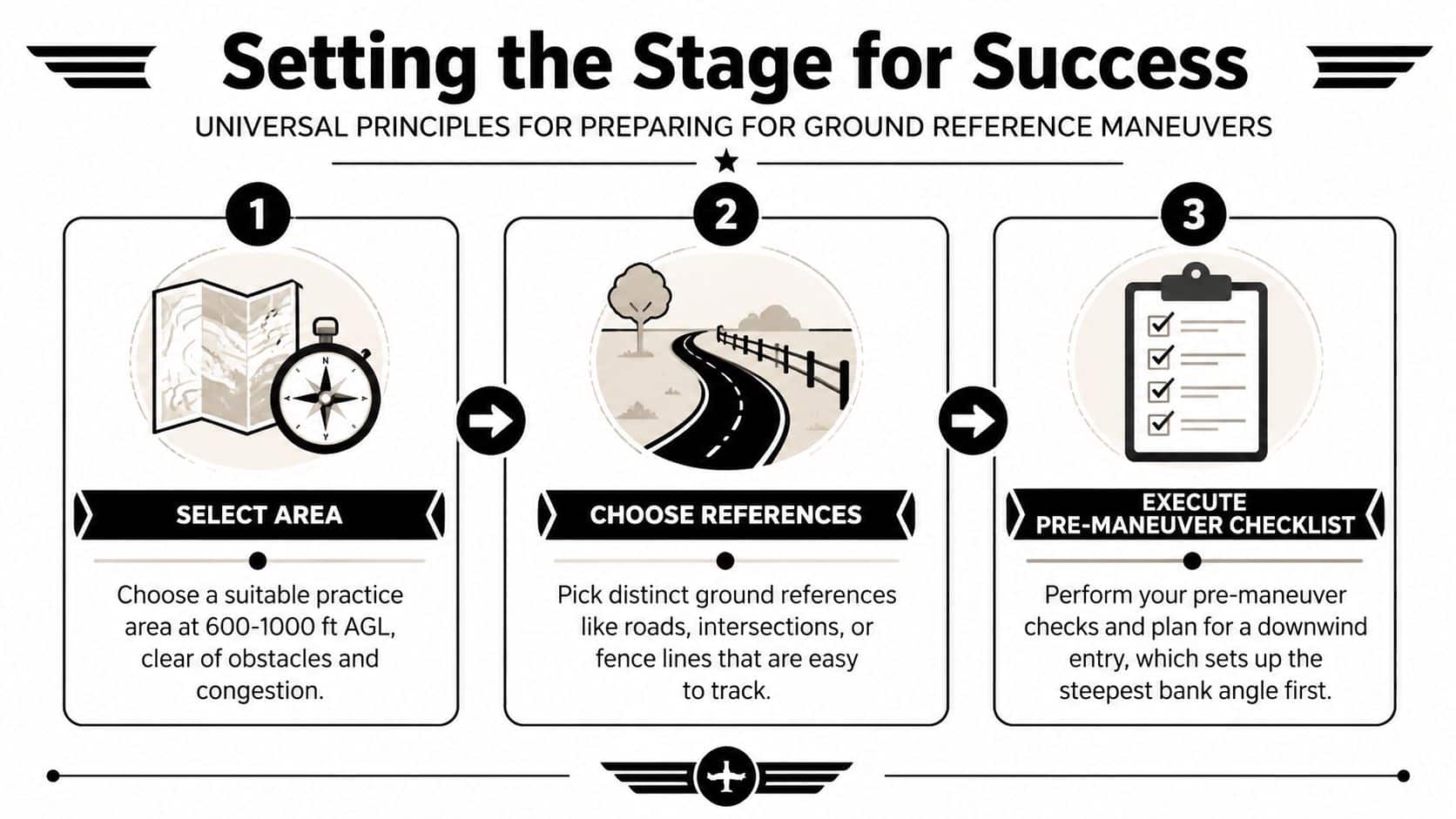
As you can see, a successful maneuver doesn’t happen by accident. It’s the direct result of smart area selection, identifying clear reference points, and having the discipline to run your pre-maneuver checks every single time.
Mastering the Constant Radius Turn
Of all the maneuvers, Turns Around a Point arguably require the most finesse. The entire goal is to fly a perfect circle with a constant radius around a single point on the ground.
Just like in an S-Turn, the maneuver starts with your steepest bank when you have a direct tailwind. As you fly around the point, your groundspeed is constantly changing—fastest with the tailwind, slowest into the headwind. This means you must continuously adjust your bank angle to compensate. Your bank will be steepest on the downwind side, shallowest on the upwind side, and somewhere in the middle during the crosswind portions. This constant adjustment is the heart of the maneuver.
It's a practical lesson in the relationship between bank, lift, and flight path. To truly master this, you need a solid grasp of basic aerodynamics. If you feel like you need a refresher on the fundamentals, you can learn more about Angle of Attack in our detailed article.
How to Impress Your Examiner and Avoid Common Pitfalls
Moving from simply performing ground reference maneuvers to truly mastering them is what separates a student from a pilot. Your Designated Pilot Examiner (DPE) isn't looking for impossible perfection; they're looking for a solid grasp of wind correction and confident control of the airplane. The good news is, impressing them often comes down to avoiding a few common, and very fixable, mistakes.
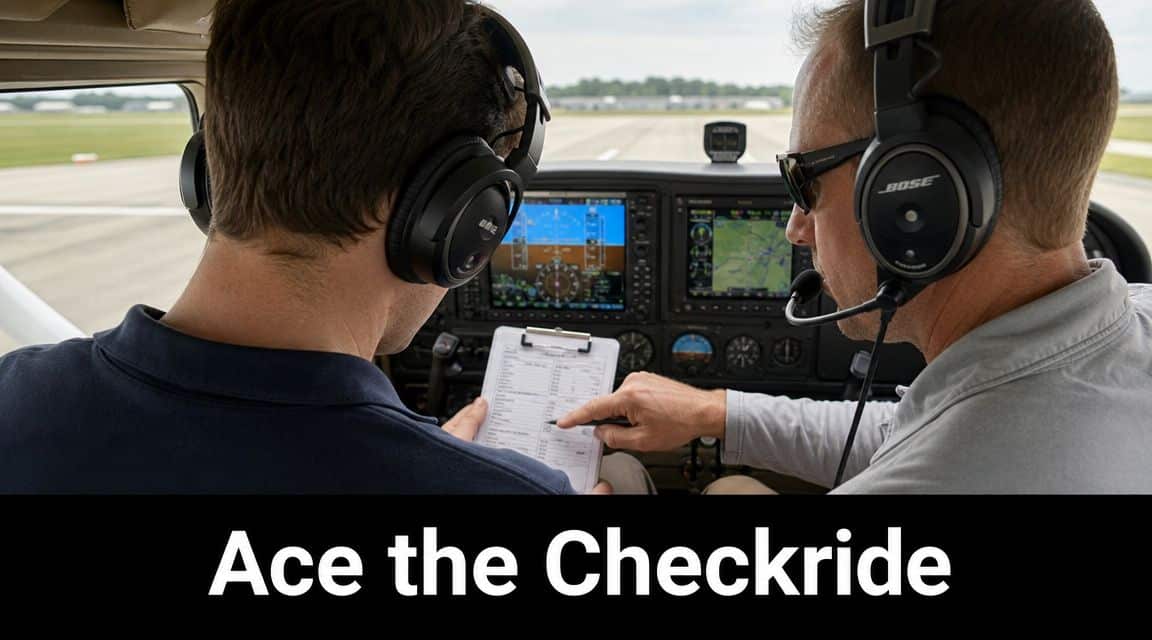
One of the most frequent errors I see is ground fixation. It’s easy to get mesmerized by that point on the ground, but when you do, two things almost always happen: your altitude starts wandering, and your bank angle gets sloppy. You absolutely have to keep your eyes moving. A disciplined scan—from the reference point to your attitude indicator, to your altimeter, and back out again—is the secret to keeping everything in check.
Another classic mistake is uncoordinated flight. When you're constantly rolling in and out of turns, it's easy to get lazy with your feet. This leads to slips and skids, which not only look bad but also show a weak grasp of fundamental aircraft control. If you want to build better habits, a deep dive into what is adverse yaw will help you understand the forces you’re fighting and how to use the rudder effectively.
From Good to Great Performance
Sure, the FAA's Airman Certification Standards (ACS) give you a target: maintain altitude within +/- 100 feet and airspeed within +/- 10 knots. But a truly great performance goes way beyond just staying inside those lines.
Your examiner wants to see you flying proactively, not reactively. This means anticipating the wind's effect and making smooth, timely corrections rather than chasing the airplane all over the sky to get back on track.
The real art of ground reference maneuvers is managing your bank angle as the wind changes. Think about it. During turns around a point, you might need a steep 30-degree bank when you have a direct tailwind pushing you, but then a shallow 10-degree bank as you turn into the headwind. Students who master this constant, fluid adjustment are the ones who demonstrate true command of the aircraft.
By showing your DPE you can make these corrections smoothly and intuitively, you're proving you have the skills needed for safe, real-world flying, not just passing a test. Discover more insights on the technical aspects of these maneuvers from Gleim Aviation.
How to Buy an Airplane or Helicopter the Safe Way
Once you start getting comfortable with ground reference maneuvers, a funny thing happens. The dream of owning your own aircraft starts to feel less like a fantasy and more like a real possibility. Making that jump from renting to owning is one of the most exciting steps in a pilot's life, but it demands a solid plan to avoid some serious pitfalls, whether you're looking at a Cessna 172 or a Robinson R44.
First things first, you have to be brutally honest with yourself about your mission. What are you actually going to do with this aircraft? Are you building hours for your commercial ticket, flying the family to the lake for the weekend, or do you need a helicopter for a specific work-related task like aerial photography or ranch management? The answer to that question will guide every other decision, from the type of aircraft you need to the budget you can realistically support.
Look Beyond the Purchase Price
I’ve seen it happen time and time again: a pilot gets fixated on the sticker price and forgets about the true cost of ownership. That initial purchase is just the down payment on a much larger financial commitment. You absolutely have to budget for the recurring expenses that come with keeping an aircraft in the air.
- Hangar or Tie-Down Fees: Think of this as your plane's monthly rent. It’s a fixed cost you can't avoid.
- Insurance: Your rates will depend heavily on your experience, hours in type, and the aircraft itself. Helicopter insurance is often significantly higher than for a comparable fixed-wing.
- Annual Inspections and Maintenance: Even the most pristine aircraft will have both scheduled and unscheduled maintenance costs. Helicopters, with their complex dynamic components, typically have more stringent and costly maintenance schedules. A good rule of thumb is to set aside a maintenance fund from day one.
- Fuel Costs: This is the big variable. It’s tied directly to how much you fly, and it adds up quickly.
The single most important step in this entire process is the pre-buy inspection. This is not just a quick look-over. It's an exhaustive, nose-to-tail examination by an independent mechanic who specializes in that specific make and model. A thorough pre-buy is the one thing that can save you from a financially devastating mistake.
When you start your search, go beyond the big online marketplaces. Find the owner groups for the specific type of aircraft you're interested in. These forums are a goldmine of real-world knowledge from people who live and breathe that plane or helicopter every day. Finally, don't dismiss the idea of working with a reputable aircraft broker. Their expertise in navigating the maze of title searches, logbook reviews, and closing paperwork can be invaluable and save you a world of headaches.
Your Questions on Ground Reference Maneuvers Answered
As you start practicing ground reference maneuvers, you’ll find they bring up a lot of questions. That’s completely normal. Let’s walk through some of the most common sticking points I see with students and get you the practical advice you need to feel confident in the cockpit.
What Is the Best Altitude for Practicing These Maneuvers?
The FAA sets the practice window between 600 and 1,000 feet above ground level (AGL), and for good reason. This range is low enough to clearly see your reference points on the ground, but it still gives you a comfortable safety margin to recover from any mistake or unexpected updraft.
Always remember that this is practice. The rules of the air still apply, so be sure you're respecting the minimum safe altitudes outlined in 14 CFR § 91.119 and staying clear of congested areas.
How Do I Pick a Good Reference for Turns Around a Point?
When you're choosing a reference for turns around a point, think "obvious and isolated." You want something that will stand out from any angle as you circle it. A sharp road intersection, a lone barn in an open field, or even a small, distinct pond are all great choices.
What you want to avoid are points that are too close to tall towers, lost in a cluster of similar-looking buildings, or located under a busy practice area. Your goal is to focus on the maneuver, not struggle to find your reference point again on the upwind turn.
The biggest mistake I see pilots make is chasing their ground track. They wait until the wind pushes them off course and then they react. True mastery is about anticipation. You have to fly ahead of the airplane, crabbing into the wind on the straightaways and constantly adjusting your bank in the turns to fly a perfect circle over the ground.
That proactive control is what separates a good pilot from a great one, and it's exactly what examiners want to see.
Why Does My Altitude Keep Changing During Maneuvers?
Welcome to the classic challenge of divided attention! It happens to every pilot. You get so zeroed-in on maintaining that perfect ground track that you forget to fly the airplane, and your altitude starts to wander.
The solution is to develop a disciplined, continuous scan. Your eyes need to be in constant motion: from your ground reference, to your pitch attitude on the horizon, to a quick glance at the altimeter, and right back outside. This rhythm creates a feedback loop that helps you manage both your ground path and your altitude simultaneously.
At DuBois Aviation, our instructors have years of experience helping students turn these challenging maneuvers into second nature. If you're ready to start your flight training with a team that's truly dedicated to your success, we're here to help you take flight.