

Which pilot job are you building toward?
That question matters more than asking which airline is hiring this month. Airline seats get the attention, but pilot hiring is spread across several lanes: regional airlines, fractionals, EMS, helicopter operations, charter, instruction, and owner-flown aircraft that can turn into business tools or income-producing assets. Each path asks for different flight time, different temperament, and a different tolerance for schedule, commuting, and risk.
The hiring market is active, but it is not evenly strong in every category. Openings come from retirements, movement between operators, fleet changes, and training pipelines that still struggle to keep up. Pilots who do well in this market usually make deliberate choices early. They build time that matches the job they want, not just time that fills a logbook.
That is where a school like DuBois Aviation fits into the bigger picture. Training is not separate from employment. It is the first hiring decision of your career. If you train in a place that gives you access to busy airspace, quality instruction, varied aircraft, and a realistic shot at staying on as an instructor, you are already positioning yourself for the next cockpit. That matters whether your target is SkyWest, NetJets, Air Methods, or a long-term plan that includes owning the right aircraft instead of renting forever.
I have seen pilots lose time by chasing brand names too early. A regional airline can be the right move. So can instructing in a high-volume environment, building turbine time through another operator, or choosing helicopter work because it fits your skills and long-term lifestyle better. The smart move is the one that lines up your training path, hour-building strategy, and eventual income model.
This list takes a wider view of companies hiring pilots. It covers airline and non-airline employers, then ties those options back to a practical training path through DuBois Aviation and, for some pilots, the ownership route that opens doors a job application never will.
1. Employment at DuBois Aviation
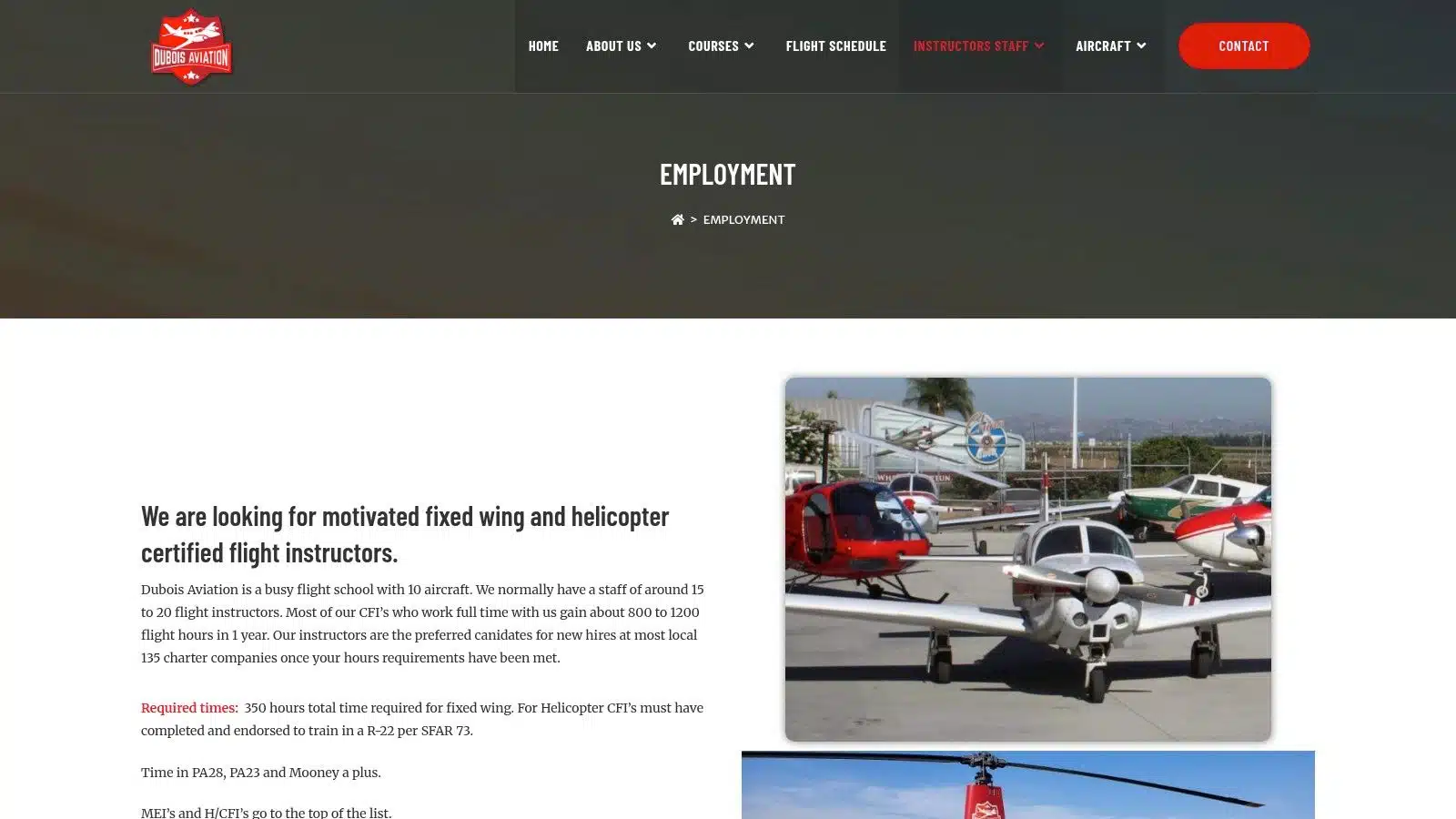
Want a pilot job that builds skill and time at the same pace? DuBois Aviation employment deserves a hard look, especially for fixed-wing and helicopter instructors who want more than a low-volume instructing slot.
A school job can either be a holding pattern or a launch point. The difference usually comes down to traffic volume, aircraft variety, instructor utilization, and whether the operation exposes you to the kind of flying that makes the next employer take your logbook seriously.
DuBois has a practical advantage here. Chino is a busy towered Class D airport, so instructors and students spend their days working radios, sequencing with other traffic, and making decisions in a faster environment than quiet untowered fields. That experience carries forward. Pilots who train only in low-pressure airspace often need extra time to get comfortable once the pace picks up.
Why this works for hour-building
Good instructor jobs are demanding. That is usually the point.
DuBois uses a mixed fleet that includes Piper and Cessna airplanes, a Mooney M20B, a Piper Apache for multi-engine work, Robinson helicopters, and an Enstrom helicopter, along with an in-house simulator and Jeppesen training materials. For a CFI or CFII, that mix can strengthen both proficiency and marketability. It gives you a better shot at logging experience that supports multiple directions later, including regional airline applications, charter work, multi-engine roles, or helicopter jobs.
I look for one thing in an instructor position. Will it make you a sharper pilot six months from now, or will it just add Hobbs time? Those are not always the same outcome.
Practical rule: If a school gives you lots of students but narrow experience, you're building hours. If it gives you lots of students, towered-airport exposure, and a varied fleet, you're building a résumé.
DuBois also fits the wider hiring picture covered in this article. Airlines, fractional operators, and helicopter employers still need pilots with solid fundamentals, clean habits, and instructing experience that holds up in an interview. If you expect to move on to a Part 121 seat, it helps to prepare early with these airline pilot interview questions and answers, because strong candidates do more than hit the minimums.
The trade-offs you should ask about
This job suits instructors who are willing to work at a steady pace. High aircraft utilization can mean long days, weather changes, student no-shows, maintenance reshuffles, and a lot of repetition. Some instructors thrive in that rhythm. Others get worn down by it.
Ask direct questions before you sign on:
- Schedule reality: What does a normal week look like in peak season and slower months?
- Student mix: Are instructors flying mostly private, instrument, career-track, or a blend of all three?
- Advancement path: Which local operators have hired instructors from the school?
- Aircraft access: How often do instructors with the right qualifications get multi-engine, simulator, or helicopter time?
One more point matters here, and not enough pilots think about it early. A school like DuBois can also teach you how aircraft ownership fits into a career plan. Some pilots eventually buy an airplane or helicopter for personal travel, leaseback, instruction, or time-building that they control themselves. That can be a smart move if the numbers, maintenance history, mission profile, and pre-buy inspection all make sense. It can also become an expensive mistake if you buy with your ego instead of your spreadsheet.
For pilots in Southern California, the location helps. You can train, instruct, rent, build time, meet local operators, and learn how the business side of aviation works from one airport. That kind of continuity is useful, especially if you are trying to connect your first instructor job to a longer plan instead of treating each step as a separate decision.
2. SkyWest Airlines
Want a regional that keeps several future options open instead of tying you to one major airline? SkyWest is usually near the top of that list. SkyWest Airlines flies for multiple major partners, and that matters for pilots who want flexibility while they build Part 121 time.
From a career-planning standpoint, SkyWest fills a specific role. It gives low-time commercial pilots and CFIs a way to turn hard-won flight time into airline experience that carries weight later. You get exposure to SOPs, crew coordination, dispatch releases, line checks, and the pace of scheduled operations. Those are the habits that make the jump to larger carriers, cargo operators, or some corporate departments much easier.
Why SkyWest appeals to a lot of new airline pilots
SkyWest tends to attract pilots who want structure and a broad operating footprint. Company-supported ATP-CTP, AQP training, and defined pathway programs reduce some of the friction that can stall pilots right at the airline entry point.
A few practical advantages stand out:
- Multiple partner relationships: That gives you more than one possible long-term direction, which is useful if hiring shifts at one major.
- Recognizable airline training: New hires get standardized Part 121 systems experience that recruiters elsewhere understand immediately.
- A solid bridge job: When major-airline movement slows, regionals like SkyWest still matter because they keep pilots progressing instead of waiting on the sidelines.
That last point deserves some honesty. A regional job is not just a box to check. If you use it correctly, it becomes the phase where you clean up your cockpit discipline, tighten your callouts, learn to operate inside a system, and build turbine time that opens doors across several sectors. That broader view matters in an article about companies hiring pilots, because the airline route is only one lane. Some pilots later move to corporate flying, charter, medevac, or aircraft ownership strategies that create more control over their schedule and mission.
Pay matters, but it should be part of a bigger calculation. Before you sign with any regional, review a realistic breakdown of commercial pilot salary paths and progression and compare that against base location, upgrade time, reserve exposure, and commuting costs.
Reserve life is far easier if you live in base. Commuting turns a tolerable first airline job into a tiring one.
Where pilots misjudge the job
SkyWest still has the same pressure points you see at other regionals. Junior pilots may spend time on reserve. Base assignments move with operational demand. The recruiting pitch can sound clean on paper, but your day-to-day quality of life often depends on whether you can afford to live near base and how much schedule control you have in year one.
I usually give pilots the same advice here. Use a regional for what it is supposed to do. Build turbine PIC or SIC time, get comfortable in a true airline environment, and keep your record clean. If you train at a place like DuBois Aviation with that plan in mind from the beginning, the path makes more sense. You are not just collecting hours. You are building toward a sequence of decisions that can lead to airlines, business aviation, rotorcraft work, or even aircraft ownership if that becomes part of your long-term strategy.
SkyWest is a strong fit for pilots who want flexibility, solid airline training, and a regional stop that can feed several different career outcomes.
3. Envoy Air
Want the shortest regional path toward American Airlines, or do you want to keep more doors open while you build time? That question usually decides whether Envoy belongs near the top of your list.
Envoy Air pilot careers is built around a clear proposition. Cadet entry, a defined relationship with American, and a progression story that is easy to explain in an interview. For a lot of CFIs, that matters. A hiring team can quickly see where you trained, how you built time, and where you intend to go.
Envoy works best for pilots who value direction over optionality. If your long-term target is American, that focus can save you from wasting energy on five different airline strategies at once. If your goal is less settled, the same focus can feel restrictive later.
Where Envoy makes sense
Pilots coming out of instructing often do well with a structured path. Clean training records, solid recommendations, and disciplined logbooks tend to fit Envoy's model. That is one reason the airline stays relevant whenever pilots compare companies hiring across the regional market.
Pay matters, but first-year numbers should never be the only filter. Review a realistic breakdown of commercial pilot pay progression by career stage, then weigh it against reserve time, base location, training reliability, and upgrade prospects. A slightly better headline rate can disappear fast if you spend months commuting or sitting junior in a base you cannot realistically live near.
I have seen pilots make good careers at Envoy because they treated it as one step in a larger plan. Train well, finish IOE cleanly, build credible airline time, and stay flexible enough to adjust if hiring conditions change. That same planning mindset matters whether you end up at a major, move into business aviation, fly rotorcraft, or start looking at aircraft ownership as part of a long-term flying career. DuBois Aviation fits into that picture on the front end because the quality of your training record follows you much farther than students expect.
What to verify before signing
Envoy's selling point is clarity, but clarity is not the same as quality of life. Before you commit, get specific answers on base awards, reserve expectations, commuter policy, training dates, and how cadet applicants are handled compared with off-the-street hires.
Use a practical filter:
- American is your clear goal: Envoy deserves serious consideration.
- You want to preserve several major-airline options: Compare Envoy against regionals with broader partner exposure.
- You want maximum control over where you live: Check the base map and junior staffing reality before you sign.
Envoy is a good fit for pilots who want a defined lane and are willing to accept the trade-off that comes with it. That trade-off is not bad. It just needs to be a deliberate choice.
4. Republic Airways
What matters more to you at the regional level: a branded pathway, or day-to-day flying in a fairly standardized jet operation? Republic Airways pilot careers usually gets the attention of pilots in the second camp.
Republic's E170 and E175 focus is a practical advantage. You get time in modern regional jets without bouncing between unrelated fleet types, and that usually makes procedures, flows, and training more consistent. For a pilot trying to build airline discipline fast, that matters.
Republic also tends to appeal to pilots who are thinking one or two moves ahead. Clean E-Jet time can help whether your long-term target is a major airline, a fractional operator, or another turbine job outside the airline track. That broader career value matters in a market where smart pilots keep more than one door open. It fits the bigger theme of this article too. Airline hiring is only one lane, and the pilots who last usually understand how regional time, business aviation, rotorcraft opportunities, and even future aircraft ownership can connect into one career plan. DuBois Aviation sits at the front end of that plan because your training habits follow you into every interview and every simulator.
Why Republic stays on shortlists
Republic remains part of the regional hiring conversation, and that tracks with what pilots see in recruiting activity and class flow. The better question is not whether a regional is hiring. It is whether the operation gives you useful time, decent training support, and a realistic path to the next step.
I put real weight on training infrastructure here. A carrier with a focused fleet and established training systems usually gives new hires a better chance to get through initial training cleanly, build good habits, and avoid turning a regional job into a setback.
A modern fleet helps. A disciplined training department helps more.
Where pilots need to press for detail
Republic's public recruiting material does not always answer the questions pilots care about once the excitement wears off. That is common in this part of the industry, but it means you need to show up prepared.
Ask direct questions about:
- Base reality: Where are junior pilots ending up, and how long are they sitting reserve there?
- Upgrade timing: What is helping upgrades happen now, and what is slowing them down?
- Training schedule: How is initial training paced, and what support is available if a new hire needs extra help?
- Quality of life: Commuter policy, trip construction, and how often schedules change.
Republic is a sensible choice for pilots who want serious E-Jet experience and who are willing to do adult-level homework before signing. That approach serves you well whether Republic is your airline bridge, your turbine time builder, or one part of a broader aviation plan that eventually includes charter flying, medevac, or buying into an aircraft of your own.
5. Breeze Airways
Want newer equipment and a shot at joining an airline before everything is locked into place? Breeze Airways jobs appeal to pilots who are comfortable with a company that is still building its long-term identity.
That matters more than applicants admit.
Breeze sits in an unusual slot in the hiring market. It is not the standard regional path, and it is not a legacy carrier with decades of settled work rules and predictable bidding patterns. For some pilots, that creates real opportunity. For others, it creates friction at home, in commuting, and in long-range career planning.
Why Breeze makes sense for some pilots
A newer airline can reward timing. Pilots who join early sometimes get better seniority positioning than they would at a more established operator, and seniority still drives a lot of your life in this business. Aircraft, base options, schedule quality, and upgrade potential all tend to improve if you enter at the right moment.
Breeze also attracts pilots who want modern airline flying without assuming the only smart move is a regional-to-major track. That wider view matters. Pilots building a durable career should look at the full range of aviation jobs for pilots, including airlines, charter, corporate, medevac, and ownership paths later on if aircraft acquisition becomes part of the plan.
Where the trade-offs get real
Growth stories sound good in recruiting copy. Daily life is less polished.
At a younger carrier, public information can lag behind reality. Base plans can shift. Schedules can change faster than a pilot with a mortgage, family, or commute would like. If you need a high-confidence picture of where you will live and how you will bid six months from now, ask harder questions before you sign anything.
Use these questions in an interview or recruiting call:
- What are junior pilots holding right now?
- Which bases are stable, and which ones are still changing?
- How often are lines rebuilt or pairings adjusted?
- What does reserve look like for new hires in practice, not in theory?
- If I join here, what kind of pilot usually does well, and who struggles?
Breeze can be a smart move for a pilot who handles change well, wants modern equipment, and understands that early-stage growth comes with some uncertainty. It is a weaker fit for the pilot who needs every detail settled before day one.
6. NetJets
Want a pilot job that is bigger than the airline track most students hear about first?
NetJets pilot careers deserves serious attention because fractional flying sits in a different part of the hiring market. The operation blends airline-level structure with business aviation service standards, and that combination fits some pilots far better than a regional or low-cost carrier ever will.
The day-to-day work is different in ways that matter. Crews see a wider mix of airports, trip lengths, passengers, and aircraft than many airline pilots do early in their careers. That variety sharpens judgment, but it also asks more of you. You need to manage changing plans, premium customer expectations, and the small professionalism details that passengers in this segment notice immediately.
For pilots building a long-term plan, NetJets also helps make an important career point clear. Strong jobs exist across several sectors, not just at the airlines. DuBois lays that out well in its guide to pilot career paths across airlines, charter, corporate, medevac, and more. That broader view matters if you want to match your flying career to your actual priorities, not just follow the default script.
NetJets can also teach you something useful about ownership. Pilots who spend time in fractional operations get a close look at how aircraft are used, managed, and valued in the market. That perspective can pay off later if you move into private management, contract flying, or aircraft acquisition for an owner or company.
The trade-offs are real.
A schedule that looks clean on a recruiting page can feel demanding once you add customer-facing pressure, irregular destinations, hotel living, and time away from home. Airline pilots deal with their own headaches, but the friction points are different. At NetJets, the service piece is part of the job, not background noise.
This path fits pilots who like variety, can stay sharp in changing conditions, and understand that polished service and disciplined airmanship go together. It is a weaker fit for the pilot who wants highly predictable trips, minimal interaction with passengers, or a career built around one aircraft and one routine.
7. Air Methods
Air Methods pilot roles represents a different aviation mindset. You're not moving passengers on a schedule or executives on demand. You're moving patients, crews, and aircraft in a mission-driven operation where discipline matters more than image.
For the right pilot, this work is profoundly meaningful. It also has little patience for weak judgment.
Who should consider EMS flying
Air Methods publishes clearer minimums than many operators, and that's useful because EMS jobs aren't entry-level in the usual sense. They often require stronger night, instrument, turbine, and command judgment than newer pilots have built yet.
If you're a helicopter pilot, this sector is worth watching closely. One 2026 hiring snapshot described an emerging surge in helicopter-specific low-hour roles and said helicopter jobs for pilots under 800 total time had risen 35 percent. That data point points to broader rotorcraft momentum, even though EMS itself still tends to favor more experienced applicants.
The reality behind the appeal
The attraction of Air Methods is straightforward. The operation is standardized, the mission is important, and the schedule model often appeals to pilots who want predictable rotations rather than a constantly shifting airline life.
Still, there are real limitations:
- Higher entry bar: Newer helicopter pilots may need more seasoning first.
- Location dependence: You improve your odds if you're willing to relocate.
- Operational seriousness: This is not the place to show up half-prepared or casual about procedures.
If you want mission flying, build your habits before you build your ambition.
Air Methods is best viewed as a target job, not a first shortcut. For a rotor-wing pilot with the right background, though, it's one of the most respected tracks in the field.
7-Company Pilot Hiring Comparison
| Organization | Implementation Complexity 🔄 | Resource Requirements ⚡ | Expected Outcomes ⭐📊 | Ideal Use Cases 💡 | Key Advantages ⭐ |
|---|---|---|---|---|---|
| Employment – Careers at DuBois Aviation | 🔄 Low, on‑page application; clear quals | ⚡ CFI (fixed/rotor); instrument/multi preferred; ability to handle high utilization | ⭐📊 Very high hour‑building (800–1,200 hrs/yr); mentorship and Part 135 pipeline | 💡 CFIs wanting rapid hour build and mixed‑fleet experience | ⭐ Mixed airplane/helicopter fleet, in‑house simulator, busy towered environment |
| SkyWest Airlines | 🔄 Medium, standard airline recruiting; reserve common | ⚡ R‑ATP/military/college pathways favored; company‑paid ATP‑CTP & AQP | ⭐📊 Transparent pay scales; clear upgrade and mainline pathways | 💡 Pilots targeting regional → mainline progression and time‑building | ⭐ Multiple major partners, published pay, training support |
| Envoy Air | 🔄 Medium, cadet program simplifies; external hires tighter | ⚡ Cadet or FO quals; paid ATP‑CTP; hub alignment (AA hubs) | ⭐📊 Contractual flow to American for eligible cadets; cadet bonuses up to $15k | 💡 Students/CFIs seeking a defined flow‑through to American Airlines | ⭐ Cadet bonuses, paid ATP‑CTP, hub‑aligned bases |
| Republic Airways | 🔄 Medium, cadet and standard pipelines; recruiting cycle | ⚡ E‑Jet experience path; full‑flight simulators and training center | ⭐📊 Extensive E‑170/175 flying time; strong simulated training resources | 💡 Pilots seeking concentrated E‑Jet experience and robust training | ⭐ Large E‑Jet fleet, dedicated simulators, partner travel benefits |
| Breeze Airways | 🔄 Low–Medium, direct applications; growing processes | ⚡ Standard FO qualifications; adaptable to expansion dynamics | ⭐📊 Growth opportunities; newer aircraft exposure; potential quicker progression | 💡 Pilots wanting faster responsibility at a young, expanding carrier | ⭐ Modern A220/E‑Jet fleet, growth‑focused culture and recognition |
| NetJets | 🔄 Medium, corporate hiring for PIC/SIC with customer focus | ⚡ Multi‑type progression; business‑aviation professionalism; varying experience by seat | ⭐📊 Stable fractional/business aviation careers; varied missions and type growth | 💡 Pilots preferring premium, customer‑facing flying and type progression | ⭐ Scale and brand stability, diverse fleet, deep training resources |
| Air Methods | 🔄 Medium, standardized, location‑dependent recruiting | ⚡ Higher rotor/fixed minima (TT, PIC, turbine, night, instrument); relocation possible | ⭐📊 Mission‑driven medevac flying; predictable 7‑on/7‑off rotations and standardized training | 💡 Experienced helicopter pilots seeking EMS/critical‑care mission roles | ⭐ Transparent minimums, centralized simulator/classroom training, benefits/union |
Your Career Starts at the End of the Runway
What kind of pilot do you want to be a year from now?
That question matters more than the logo on the tail. The seven employers above show how wide this field really is. You can build time at a flight school, move through a regional airline track, fly premium business aviation, or take on mission-driven EMS work. DuBois Aviation fits into that picture at the front end. It gives newer pilots a place to train, instruct, add multi-engine or helicopter time, and build experience that transfers well when larger operators start studying your logbook.
The hiring market can improve and still punish weak planning. As noted earlier, airlines and other operators continue to hire across multiple sectors, but demand alone does not carry a pilot very far. The pilots who benefit are the ones who show up prepared, current, and easy to trust in training.
Build time that has hiring value. Multi-engine time matters. Actual instrument competence matters. Time in busy towered environments matters. Good judgment under workload matters. If two jobs pay about the same, take the one that will leave you sharper, more current, and more competitive next year.
That same career logic applies to aircraft ownership.
Buying an airplane or helicopter can support instruction, leaseback, business travel, or personal flying, but ownership is not a shortcut and it is not passive income by default. A cheap airframe with weak logs or deferred maintenance can wipe out any expected benefit in one annual. Use a written purchase agreement. Review the logs carefully. Confirm title, liens, maintenance status, and AD compliance. Pay an independent mechanic for the pre-buy, and match the aircraft to the missions you will fly, not the missions that sound good over coffee.
Talk to working pilots before you commit. Talk to chief instructors, recruiters, and mechanics too. Compare schedules, upgrade paths, training quality, commuting burden, and the kind of flying you will do on an average Tuesday. A job with lower headline pay can still be the better move if it gives you better PIC time, better instrument exposure, or a more stable home life.
Presentation still matters. So does substance. If you are refining hiring materials, balancing resume branding with ATS requirements can help you avoid the common mistake of making a résumé look polished but harder for recruiters to process.
A pilot career does not run on one track anymore. It can start at a school, move to a regional, branch into charter or fractional flying, or settle into a specialized role like EMS. The right move is the one that builds skill, keeps options open until you have earned the right to narrow them, and puts you in a position to say yes when the right operator calls.
If you're serious about becoming a pilot, building hours efficiently, adding multi-engine or helicopter training, or stepping into an instructing role with real career value, DuBois Aviation is worth a close look. Train at a busy towered airport, learn in a varied fleet, and build the kind of experience that holds up when companies hiring pilots start reviewing your logbook.