
You passed your commercial checkride. Your temporary certificate is in your wallet. For a day or two, that feels like the finish line.
Then the question shows up. What job does this certificate qualify you for?
If you're aiming at charter, air taxi, cargo, medevac, or other on-demand flying, you’re looking at part 135 pilot minimums. That’s where many ambitious pilots get stuck. They know the destination, but the path looks scattered across regulations, logbook categories, recurrent checks, and operational rules that seem written for lawyers instead of working pilots.
It’s still a very achievable path. You just need to treat it like a professional progression, not a vague hope.
Beyond the Commercial Certificate Your Path to Part 135
A new commercial pilot usually falls into one of three mindsets.
One pilot wants the airlines and sees every flight as a step toward a transport category cockpit. Another wants to teach and build deep stick-and-rudder skill. A third wants variety: different airports, changing missions, freight one day, passengers another, and real-world decision-making from the start. That third path often leads to Part 135.

Part 135 sits in an important middle ground. It’s more structured and regulated than typical private flying under Part 91, but it’s often more varied than a scheduled airline environment. The fleet is also significant. The FAA’s study of operators regulated under Part 135 reported 10,655 authorized aircraft, and 76 percent of that fleet operated with turbine power across fixed-wing and rotorcraft categories, according to the FAA report on Part 135 operators.
That matters for career planning. This isn’t a niche corner of aviation. It’s a major professional lane.
Why pilots chase this route
Part 135 appeals to pilots who like responsibility early. You’re not just managing the airplane. You’re often dealing with weather interpretation, performance planning, customer expectations, and changing trip demands. That environment can sharpen judgment fast.
It also rewards pilots who build broad experience rather than just total time.
- Cross-country depth matters: Operators care whether you’ve experienced changing environments, not just orbited the same practice area.
- Night experience matters: Darkness raises workload, especially when weather, terrain, and schedule pressure combine.
- Instrument skill matters: Commercial polish without IFR confidence is not enough for professional charter work.
Part 135 isn’t the “easy way around” airline-style standards. It’s a different kind of professionalism.
If you’re still building the foundation, the smartest first step is understanding how your current training lines up with the commercial pilot license requirements that lead into this next stage.
What confuses pilots early
Most confusion comes from mixing up three different things:
| What pilots ask | What it really means |
|---|---|
| “Am I legal to fly for hire?” | That depends on the operation, role, and aircraft |
| “Do I have a commercial certificate?” | That’s necessary, but it’s only the starting point |
| “Do I meet Part 135 minimums?” | That depends on the specific minimums for the job you want |
A commercial certificate opens the door. Part 135 minimums decide whether you can walk through it.
The Core Requirements Decoding 14 CFR § 135.243
A pilot walks into a chief pilot interview with 1,200 hours in the logbook and still is not the right fit for the seat. That surprises a lot of commercial pilots the first time they study Part 135 closely.
Section 135.243 is the rule that turns a broad goal, “I want to fly charter,” into a specific checklist. For many pilot-in-command roles, the FAA baseline is 1,200 hours total time, including 500 hours of cross-country, 100 hours of night, and 75 hours of instrument time. The pilot also needs a commercial pilot certificate, an instrument rating, and a current medical appropriate to the operation, as summarized in Paraflight’s explanation of FAA Part 135.
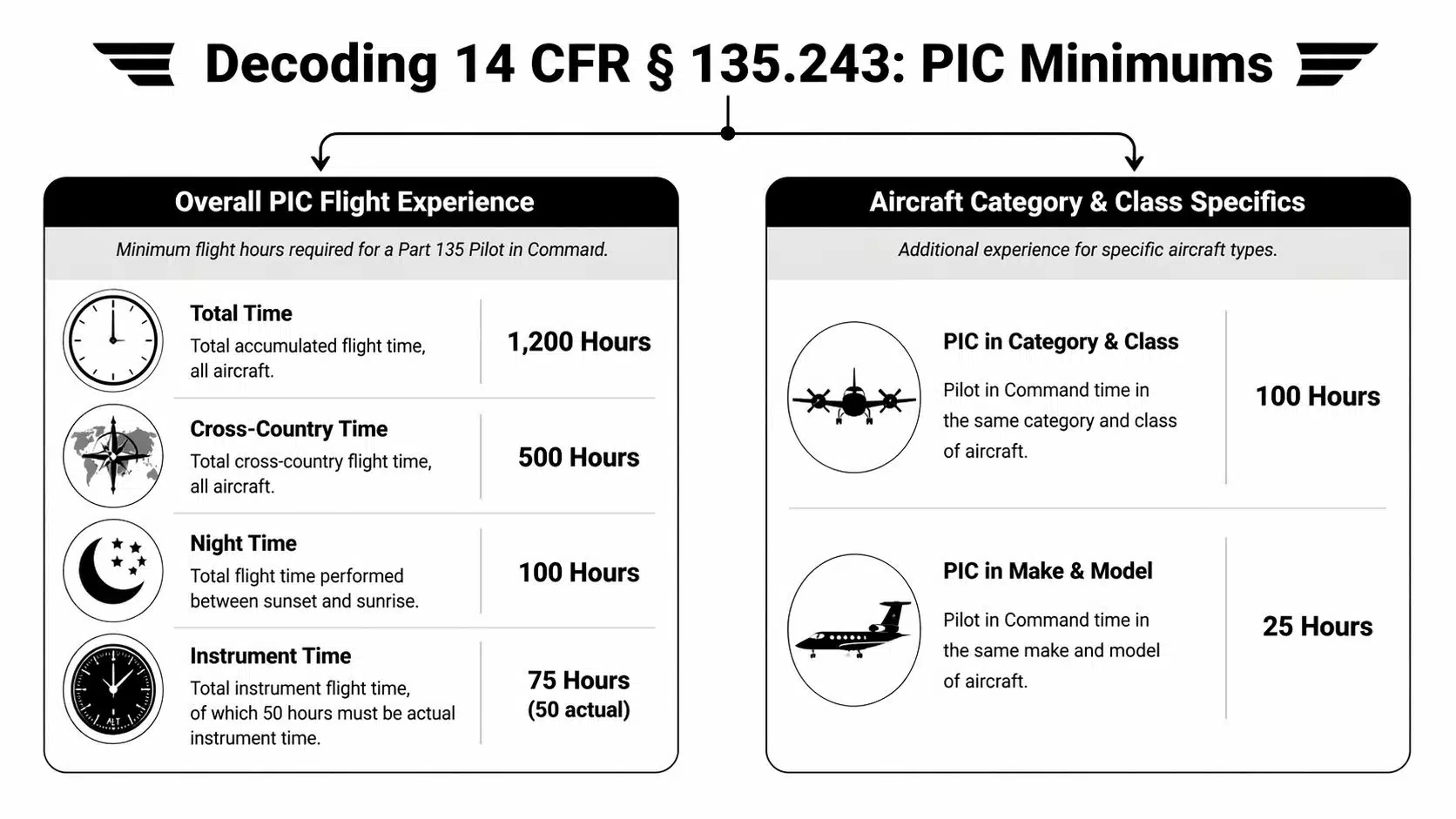
Those numbers work like ingredients in a recipe. Total time is the full meal. Cross-country, night, and instrument time are the ingredients an operator checks to see whether your experience matches real charter flying.
Here is where pilots often get tripped up. They treat all hours as interchangeable. The FAA does not.
Total time shows you have spent enough time in airplanes to build judgment, scan discipline, and consistency.
Cross-country time shows you can leave the home pattern and solve problems away from familiar landmarks. That matters in charter flying, where the job often involves new airports, changing weather, fuel decisions, and pressure to keep a trip moving.
Night time proves you have operated when visual cues shrink and workload rises. A smooth daytime arrival into a familiar airport and a night arrival into an unfamiliar one are different tasks, even in the same airplane.
Instrument time shows whether you can stay precise when the outside picture is weak or gone. If your long-term goal is charter, instrument-rated pilot training is not just another rating. It is part of your professional foundation.
That distinction matters even more if you are building time at DuBois Aviation. A busy airport environment like KCNO gives you chances to build useful experience instead of passive time. Cross-country legs in the Pipers can build planning habits. A Mooney can sharpen speed management and systems discipline. Simulator sessions let you rehearse IFR procedures and abnormal scenarios without waiting for the perfect weather window. Rotorcraft students in the Robinson or Enstrom fleet are building a different path, but the same principle applies. The logbook should show variety with purpose.
The medical requirement is simpler but easy to overlook. If you plan to exercise commercial privileges in a professional setting, keep your medical current and plan renewals before they become urgent. A missing medical can stop your progress just as effectively as a missing rating.
Recent experience matters too. Meeting the career minimums does not mean you stay current forever. Part 135 also expects pilots to maintain takeoff and landing currency, and some operations have aircraft-specific experience requirements tied to the seat and aircraft type.
A better way to read § 135.243 is to ask three questions:
- Which seat am I pursuing?
- Which aircraft will I fly?
- Does my logbook show the kind of experience that seat demands?
That last question is the one ambitious pilots miss. A chief pilot is not just checking whether you reached a number. They are checking whether your time adds up to useful judgment.
Some operations also use different experience pathways based on the aircraft and crew structure. That is why two pilots can both say, “I meet Part 135 minimums,” and still qualify for different jobs.
The practical takeaway is simple. Track your categories now, not later. If you are training at DuBois Aviation, use the fleet, simulator, and KCNO environment deliberately so your next 200 hours solve future hiring problems instead of creating them.
Duty Rest and Flight Time Limits Staying Safe and Legal
A pilot can meet the career minimums and still be illegal to fly the trip.
That’s the daily reality of Part 135. The logbook gets you hired. Duty and rest rules keep you legal once you’re on the schedule.

Under Part 135, strict duty limits such as 8 to 10 hours on the flight deck per 24 hours and a minimum of 10 consecutive hours of rest are intended to reduce fatigue risk. The source material also states these limits contribute to a 30% reduction in fatigue-related risk, and that operators with high compliance have near-zero fatigue-related hull losses, according to CT Systems’ comparison of Parts 91 and 135.
Think of duty time like a stamina bar
A lot of pilots think fatigue rules are just paperwork. They’re not. They’re operational performance limits.
You can be sharp on leg one and acceptable on leg two, then noticeably slower by the last approach of a long day. The airplane doesn’t know that. Weather doesn’t care. Passengers won’t notice until a judgment error becomes visible.
Part 135 treats fatigue as something crews must manage before it shows up in the cockpit.
- Flight time limit: You can’t treat the day as endlessly extendable.
- Rest requirement: Going home isn’t the same as getting restorative rest.
- Compliance culture: Good operators don’t “work around” these limits. They build schedules around them.
A legal day still needs to be a safe day. If you’re technically compliant but mentally spent, you’ve identified a risk, not solved one.
Where pilots get tripped up
The confusion usually comes from mixing up career experience with daily legality.
| Career question | Daily operations question |
|---|---|
| Do I have enough hours for the job? | Am I legal and fit to fly this assignment today? |
| Have I met PIC minimums? | Have I exceeded duty or flight limits? |
| Can I apply to the operator? | Can I accept one more leg tonight? |
That’s why recurrent training matters so much. The same Part 135 environment that demands prior experience also requires regular proficiency checks and ongoing operational discipline.
A useful walkthrough on the fatigue side of the rule set is below.
What professional pilots do differently
They don’t ask, “Can I squeeze this in?”
They ask:
- When did my duty day start?
- What counts as actual rest here?
- Will this final leg happen at my strongest point or my weakest point?
- If weather deteriorates, do I still have mental margin?
That mindset is one reason charter captains earn trust. Part 135 standards aren’t there to slow you down. They’re there because tired pilots make normal mistakes in abnormal places.
Weather Minimums and Alternates Making the Go No-Go Decision
Many commercial pilots discover that legal under Part 91 doesn’t automatically mean legal under Part 135.
The go or no-go decision in charter flying is less about confidence and more about disciplined interpretation. You’re not asking whether you think you can make the flight work. You’re asking whether the flight can be dispatched and completed within the rules, with enough margin to stay ahead of the airplane.
Start with the destination, not the departure
A useful habit is to begin at the end of the trip.
If the destination weather is near approach minimums, your planning should immediately move to two questions:
- Can I legally plan to land there under Part 135?
- If not, what makes an alternate legally suitable?
That sounds obvious, but pilots often spend too much time on departure weather and not enough on destination legality. In charter work, the destination drives the risk picture.
A strong planning routine also includes good chart work and route awareness. For visual route study and airspace awareness outside strict IFR chart review, many pilots also benefit from studying ICAO VFR Navigation Maps, especially when comparing terrain, reporting points, and nearby alternates during preflight planning.
The KCNO mindset
At a busy towered field such as KCNO, things happen quickly. You may be comfortable flying approaches, talking to ATC, and dealing with complex traffic flow. That’s valuable experience, but it can also create false confidence.
The legal questions remain plain:
- Is the departure legal under the operator’s authorizations?
- If conditions are low, do lower-than-standard takeoff minimums apply?
- Do I need a takeoff alternate because of the OpSpecs in play?
- Am I treating company authorization as if it were a personal privilege?
Those last two points matter more than many transitioning pilots realize.
Why LSTOM creates confusion
Recent scrutiny around lower-than-standard takeoff minimums, often shortened to LSTOM, has increased. One source states that audits rose 25% in Southern California, and notes that misuse of these OpSpecs by transitioning pilots can trigger takeoff alternate requirements that newer Part 135 applicants often miss, according to Think Aviation’s discussion of lower-than-standard takeoff minimums.
That should get your attention for one reason. OpSpecs belong to the operator, not to your confidence level.
If the operation doesn’t authorize the departure condition, good stick skills don’t make it legal.
A practical decision flow
Use a simple sequence when weather gets tight:
- Check departure authorization: Don’t assume lower minimums are available.
- Check destination legality: Read the approach and forecast with Part 135 discipline, not Part 91 optimism.
- Check alternate suitability: An alternate is only useful if it’s both legal and practical.
- Check your own currency: If your instrument proficiency is stale, the legal margin narrows fast. Reviewing IFR currency requirements is part of protecting that margin.
The real professional habit
Good Part 135 pilots don’t chase a yes. They test a planned no.
They ask, “What fact would make this trip unacceptable?” That approach keeps you from building a launch decision on hope. In commercial flying, conservative weather judgment isn’t hesitation. It’s skill.
Building Your Hours The DuBois Aviation Strategy
You hit 500 hours and feel like you are making real progress. Then you compare your logbook to a Part 135 posting and notice the problem. The total time looks decent, but the categories are thin, the instrument work is uneven, and too many entries are short local flights that did little to strengthen judgment.
That happens to motivated pilots all the time. The issue is rarely effort. It is sequence.

At DuBois Aviation, you have an advantage if you use it intentionally. The fleet gives you different tools for different jobs, the simulator lets you practice high-value IFR tasks without burning fuel, and KCNO gives you the kind of radio pace and traffic flow that can sharpen cockpit discipline faster than a quiet untowered field.
A good hour-building plan works like a balanced training syllabus. Each aircraft and each lesson block should solve a specific deficiency in your Part 135 profile.
Match the aircraft to the hour you need
If your weak area is cross-country time, a Piper Cherokee is a practical place to start. It is forgiving enough that you can focus on the habits that matter, route selection, fuel planning, weather interpretation, checkpoints, diversion planning, and clean logbook entries that qualify the way you expect.
If you need more speed and more planning pressure, the Mooney M20B changes the lesson. Everything happens sooner. Top of descent matters more. Fuel decisions come earlier. Radio work stacks up faster. That is useful because many commercial pilots do fine in a slower trainer, then get behind the airplane once the pace increases.
The Piper Apache serves a different purpose. Multi-engine time only helps if it reflects sound habits. A chief pilot reviewing your logbook wants to see that you did more than add a second engine. They want evidence that you trained in checklist discipline, engine-out thinking, systems awareness, and workload management.
For rotorcraft pilots, Robinson and Enstrom time should be structured just as carefully. Repeating local pattern-style flights may add hours, but it does not add much depth. Cross-country helicopter legs, confined-area decision-making, radio work in busy airspace, and night proficiency where appropriate build a much stronger record.
Use the simulator on purpose
Many commercial pilots treat simulator time as secondary because it does not increase total aircraft time. That is a mistake in strategy, not a misunderstanding of the rules.
The simulator is where you can rehearse the parts of IFR flying that are expensive, difficult, or inefficient to repeat in the aircraft. An experienced instrument instructor sees the same pattern often. Pilots will spend money on easy VFR hours, then avoid the concentrated instrument sessions that would improve scan, procedure flow, and cockpit management far more quickly.
Use the simulator for tasks such as:
- Approach repetition: Fly several procedures in one block without repositioning.
- Abnormal procedures: Practice partial-panel work, missed approaches, holds, and task saturation on purpose.
- Mental pacing: Learn to brief, set up, cross-check, and stay ahead of the airplane before the airplane starts making demands.
That work carries over directly to the aircraft. The simulator does not replace flight time. It makes your flight time more productive.
Use KCNO as part of the training plan
Airport environment matters.
KCNO can help you build habits that a charter operator values because it forces you to work in a busier rhythm. Ground movement, radio timing, sequencing, and changing traffic conditions all raise workload in a useful way. A local flight there can teach more cockpit management than a longer flight from a quieter airport if you brief it well and review it critically afterward.
That matters because Part 135 flying is rarely just about stick-and-rudder ability. It is about staying organized while the pace increases.
Build hours like a chief pilot reads them
A hiring manager does not stop at your total time. They read for patterns.
| Logbook pattern | What it suggests |
|---|---|
| Mostly local daytime single-engine time | Limited operational range |
| Strong cross-country spread | Useful trip planning and execution experience |
| Consistent night entries | Better readiness for schedule variability |
| Deliberate instrument practice | Lower training risk in IFR operations |
| Targeted multi-engine time | Better preparation for complex aircraft and procedures |
That table is worth studying. It shows why random flying often leaves a pilot disappointed. The hours are real, but the story is weak.
A simple DuBois-style weekly strategy
A practical schedule is often better than an ambitious one that falls apart after two weeks.
Try assigning each flight block a job:
- One cross-country flight built around planning, route changes, fuel decisions, and clean recordkeeping
- One simulator or aircraft IFR session focused on procedures, scan, and cockpit flow
- One night or higher-workload flight to build comfort when the pace and risk picture change
- Periodic Apache time if multi-engine experience is part of your target path
That approach keeps your logbook balanced while making good use of the aircraft and training environment DuBois Aviation already offers. Instead of asking, “How do I get more hours?” ask a better question. “What kind of hour am I missing, and which tool should I use to get it?”
Buying an Aircraft for Time Building and Business
Some pilots eventually ask a serious question. Instead of renting, should I buy an airplane or helicopter and control my own time building?
Sometimes the answer is yes. Ownership can give you schedule freedom, route flexibility, and direct control over how fast you build experience. It can also create maintenance, insurance, storage, and cash-flow problems faster than most first-time owners expect.
The safe answer is not “buy” or “don’t buy.” The safe answer is buy carefully.
How to buy an airplane the safe way
A disciplined purchase process protects you from two expensive mistakes. Buying the wrong aircraft, or buying the right aircraft with the wrong history.
Start with these checks:
- Get an independent pre-buy inspection: Use a mechanic who works for you, not the seller. If the airplane is a Piper, Mooney, Robinson, or Enstrom, use someone who knows that type well.
- Review the logbooks line by line: Look for damage history, missing entries, recurring discrepancies, and signs that maintenance was deferred instead of resolved.
- Verify title and ownership status: Make sure there are no unresolved liens or ownership surprises.
- Match the aircraft to your mission: A cheap airplane that doesn’t support the kind of time you need is still a poor buy.
- Price the first year, not just the purchase: Insurance, inspections, unscheduled maintenance, hangar or tie-down costs, and downtime matter more than the listing price suggests.
The pre-buy inspection is not a formality. It’s the point where many bad deals still look good on the ramp and stop looking good in the logbooks.
Ownership for hour building
Ownership can help a pilot who wants frequent cross-country flights, flexible departure times, and access without rental scheduling constraints. That can be especially useful for structured time building.
But ownership only works if the aircraft stays available. A machine that spends long stretches in maintenance won’t accelerate anything.
A simple comparison helps:
| Renting | Owning |
|---|---|
| Lower responsibility | Higher responsibility |
| Easier exit | Harder exit |
| Limited scheduling flexibility | Maximum scheduling flexibility |
| Fewer surprise bills | More surprise bills |
| No asset to manage | Asset with resale and upkeep risk |
What about leaseback or Part 135 use
Some owners eventually explore placing an aircraft with an operator through a leaseback or similar arrangement. That can sound attractive because it may create revenue while keeping the aircraft active.
Go slowly here. The operational, maintenance, insurance, and utilization realities change once the aircraft enters a business environment. If your main goal is time building, don’t let a complicated ownership structure distract from the simpler question: Will this aircraft help me fly the right hours safely and consistently?
For helicopter buyers, the same principle applies. Purchase decisions should be driven by mission, maintenance reality, and support network, not just by a low advertised price or the excitement of ownership.
Conclusion Your Next Steps Toward a Part 135 Career
Part 135 is demanding for a reason. A charter pilot needs more than a commercial certificate and good intentions. The role calls for mature judgment, broad experience, strong instrument skill, and the discipline to operate inside duty, rest, and weather rules every single day.
That’s why the path works best when you stop thinking in vague totals and start thinking in categories. Total time, cross-country, night, instrument proficiency, aircraft-specific readiness, and operational judgment all need attention. Leave one of them behind, and the finish line keeps moving.
The encouraging part is that none of this is random. The standards are high, but they’re clear. If you build your logbook on purpose, protect your instrument sharpness, and treat each flight as career preparation instead of just another hour, the process becomes manageable.
A strong Part 135 candidate usually doesn’t appear suddenly. That pilot is built one well-planned flight at a time.
If you’re serious about charter flying, take one concrete step this week. Audit your logbook. Identify which categories are weak. Set a training plan for the next block of flights. Then keep going. The pilots who reach this level aren’t the ones who guessed correctly. They’re the ones who planned carefully and stayed consistent.
Frequently Asked Questions about Part 135 Minimums
Are helicopter Part 135 minimums different from airplane minimums
Yes, the details can differ by aircraft category, seat, and mission. A helicopter pilot and an airplane pilot are both working under Part 135, but they are not always walking through the same gate. The FAA and the operator will look at the kind of aircraft you fly, the type of operation, and whether your experience matches that job.
For a DuBois Aviation pilot, that matters more than it may seem at first. Time in a Robinson or Enstrom can build valuable rotorcraft experience, just as time in the Pipers or Mooney builds airplane experience. The key is to build time that fits the direction you want your career to go, not just time that makes the total number bigger.
Can I fly Part 135 with a restricted ATP
Sometimes, but it is not a blanket yes or no. A restricted ATP is one piece of the puzzle. Seat position, aircraft type, and operator specifications still control what job you can hold.
A good way to look at it is this. Your certificate is your admission ticket, but the operator still decides whether you are qualified for that specific seat. Read the job posting, then compare it to the applicable regulation and the operator’s training requirements before you assume you are eligible.
Is SIC easier to qualify for than PIC
Usually, yes. PIC carries the final authority and responsibility, so the standards are higher by design.
SIC can be a smart entry point for pilots who are still building toward a command role. That said, operators do not treat SIC as a casual seat. They still want a pilot who is organized, instrument-capable, and easy to trust in a busy environment like KCNO, where radio work, traffic flow, and workload management can sharpen or expose weak habits quickly.
Do I need an instrument rating if I plan to fly mostly VFR
Yes. For the Part 135 pilot-in-command qualifications discussed earlier, an instrument rating is required.
That catches some commercial pilots by surprise because they picture sunny daytime charter flying. Charter work does not operate on perfect-weather assumptions. An instrument rating shows that you can manage the system, control workload, and make sound decisions when conditions tighten up. DuBois Aviation’s simulator and active airport environment are both useful for building that kind of readiness.
How often do Part 135 pilots have to stay current
Regular training and checking are part of the job. As noted earlier, recurrent training is required every 12 months, along with recent-experience requirements and other checks tied to the aircraft and operation.
Hiring minimums get your foot in the door. Currency is what keeps you in the seat. A pilot who stops sharpening instrument procedures, normal flows, and abnormal scenarios can meet yesterday’s minimums and still be unprepared for tomorrow’s trip.
What’s the biggest mistake applicants make
The most common mistake is focusing on total hours while neglecting the categories that operators care about. A logbook with purposeful cross-country flights, real night experience, consistent instrument work, and aircraft-specific progression tells a much stronger story than one filled with easy local time.
A strong professional habit is to review your logbook the way a chief pilot would. If you trained at DuBois Aviation, that can mean using Piper flights for practical cross-country building, the Mooney for faster planning and systems discipline, rotorcraft time for mission-specific goals, and the simulator to keep instrument thinking sharp between flights.
If you want a clear plan for reaching your charter or airline goals, DuBois Aviation can help you map the next step with airplane, helicopter, multi-engine, instrument, and simulator training at KCNO. The right strategy now can make your future Part 135 application much stronger.