
The advertised hourly rate is the wrong starting number for an airplane cost calculator. A useful calculator adds annual fixed costs to variable cost per hour multiplied by annual flight hours, then divides that total by hours flown. Insurance, hangar rent, and inspections don't shrink in a quiet year. Fly fewer hours, and those same bills produce a much higher effective hourly cost.
Table of Contents
- Airplane Cost Calculator Template and Annual Formula
- Step-by-Step Breakdown of Each Cost Category
- Worked Example for a Hypothetical Cessna 172
- Rental Versus Ownership at Different Flight Hours
- Training Costs for Private, Instrument and Commercial Ratings
- Confirm Your Numbers Before You Commit
Airplane Cost Calculator Template and Annual Formula
Start with the annual total, not the hourly headline. The core formula is simple:
Annual cost = fixed annual costs + (variable cost per hour × annual hours). Effective hourly cost = annual cost ÷ annual hours.
The FAA aircraft operating cost framework separates expenses into variable and fixed categories and calculates total costs by multiplying each cost element by hours flown under the relevant use, then summing the results. That framework also assumes an operator with one or two aircraft of a given model and excludes bulk purchasing discounts, which suits an individual owner better than a large fleet model.
Inputs to Date and Record
Every input needs a source and a date. Record the aircraft type, annual hours, fuel burn, local fuel price, insurance quote date, and whether each figure is in current dollars. An old quote pasted into a new spreadsheet creates false precision.
Keeping fixed and variable lines separate also shows why two airplanes with similar fuel burn can cost very different amounts each year. The annual total matters more than any single line because ownership bills arrive whether the airplane flies or sits.
Template
| Cost item | Type | How to calculate |
|---|---|---|
| Aircraft depreciation | Fixed | (Purchase price minus expected resale) ÷ years owned |
| Financing interest | Fixed | Average loan balance × annual interest rate |
| Insurance premium | Fixed | Written quote for pilot profile and hull value |
| Hangar or tiedown | Fixed | Monthly rate × 12 |
| Annual inspection and scheduled maintenance | Fixed | Shop quote spread across the year |
| Unexpected repairs | Fixed | Annual contingency allowance |
| Fuel | Variable | Gallons per hour × hours × local price |
| Oil and routine parts | Variable | Cost per hour from maintenance records |
| Engine and propeller reserves | Variable | Reserve per hour × hours flown |
| Total annual cost | Sum | Fixed costs plus variable costs |
| Effective hourly cost | Result | Total annual cost ÷ annual flight hours |
Leave the value cells blank until real quotes replace them. A placeholder copied from another owner's spreadsheet isn't a budget.
Step-by-Step Breakdown of Each Cost Category
Work through the lines in order, and don't jump to the hourly result until both totals are complete.
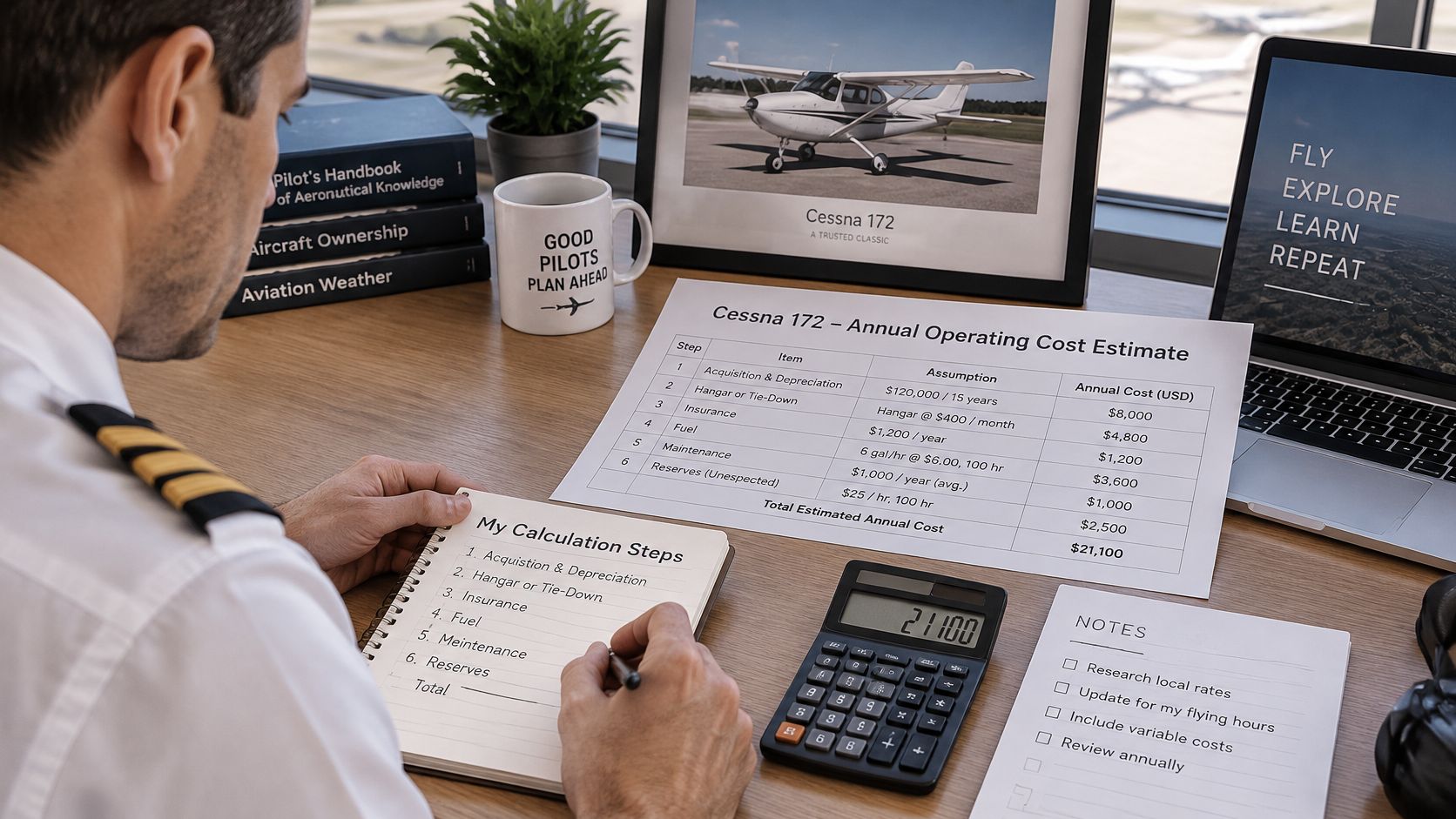
- Acquisition and depreciation: Subtract expected resale value from purchase price, divide by years owned, then add interest on the average loan balance. Principal repayment builds equity, but interest is a real ownership cost.
- Insurance: Use a written quote tied to pilot experience, hull value, and intended use, and record the renewal date. Guidance on aircraft hull insurance helps separate hull coverage questions from liability questions before requesting that quote.
- Hangar or tiedown: Multiply the monthly rate by 12 and add utilities or ramp charges billed separately. Outdoor storage can look cheaper until weather exposure and added maintenance enter the picture.
- Annual inspection: Enter the shop quote plus scheduled items coming due during the year. The base inspection price rarely covers every repair found during the inspection.
- Fuel: Multiply gallons burned per flight hour by annual hours and the price at the airport used. A national average can distort a local budget.
- Oil and routine parts: Build a cost per hour from service intervals and shop history. Tires, brakes, filters, and oil changes arrive with use, not with the calendar alone.
- Reserves: Add engine and propeller reserves per hour, plus a contingency for unscheduled repairs. Skipping reserves makes the present year look cheap by pushing a known future bill off the page.
- Totals: Add fixed costs, add variable costs, then divide the combined annual total by expected hours. That result, not fuel alone, is the figure to compare with rental.
The AOPA operating cost calculator guidance treats fuel, oil, and landing fees as direct operating costs and also lists insurance, parking, loan payments, and oil changes, reinforcing why fuel alone understates ownership. Readers scaling the same method up to turbine aircraft can review private jet ownership costs in 2026 for the larger fixed cost categories that apply there.
Two Mistakes That Skew the Result
- Brochure fuel burn: A single published figure ignores power setting, leaning, taxi time, climbs, and training patterns full of takeoffs and landings.
- One fuel price everywhere: Cross-country flying involves destination prices and fees, so a home airport price shouldn't fill every leg.
Worked Example for a Hypothetical Cessna 172
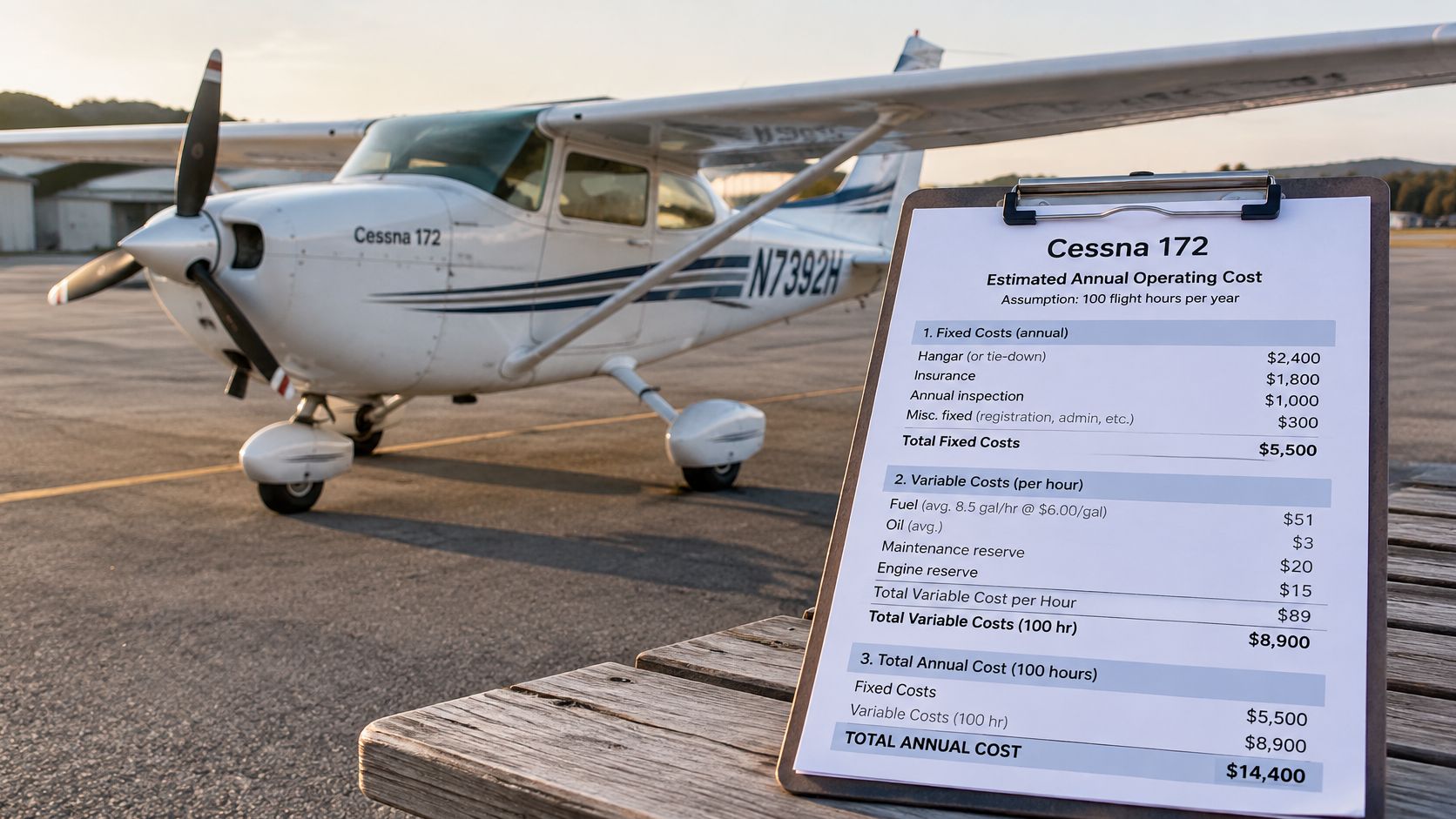
The following figures are illustrative assumptions only, not market prices. Replace every one with written quotes and operating data for the specific airplane under consideration.
Arithmetic at 100 Hours
Assume fixed costs total $18,000 per year across insurance, hangar, annual inspection, depreciation, interest, and a repair allowance. Assume variable costs total $80 per hour across fuel, oil, routine parts, and reserves.
At 100 hours, variable cost equals $80 × 100, or $8,000. Annual cost equals $18,000 + $8,000, or $26,000. Effective hourly cost equals $26,000 ÷ 100, or $260 per hour.
Same Airplane at 50 and 150 Hours
At 50 hours, the total becomes $18,000 + $4,000, or $22,000, which equals $440 per hour. At 150 hours, the total becomes $18,000 + $12,000, or $30,000, which equals $200 per hour. Annual spending rises with use, while the hourly figure falls because the same $18,000 spreads across more hours.
A lower effective hourly cost doesn't mean a cheaper year. It means fixed costs have more hours to absorb them.
For a fuel sensitivity check, assume 8 gallons per hour for illustration. A $1 per gallon increase adds $8 per hour, or $800 across 100 hours. Geography makes that test worthwhile. A 2025 Wisconsin airport survey found average 100LL at $5.15 per gallon at year end and flowage fees averaging $0.21 per gallon at airports imposing them, while a national report cited there placed December 2025 average 100LL at $6.44 per gallon.
Inputs to Collect First
- Insurance quote: Dated, with hull value and pilot requirements stated
- Storage rate: Hangar or tiedown, plus separate fees
- Inspection quote: Base price and scheduled items coming due
- Fuel data: Burn from the airplane's operating data and price at the home airport
- Reserve basis: Engine and propeller figures from maintenance planning
Rental Versus Ownership at Different Flight Hours
Renting converts nearly everything into one hourly charge. Ownership keeps the fixed bills during months with little flying. The break-even formula makes the trade-off explicit:
Break-even hours = annual fixed costs ÷ (rental rate − owner variable cost per hour)
If expected flying stays below that result, renting usually wins on cost alone. Above it, ownership can win, provided the rental rate used in the formula includes the same items as the owner total. A wet rate including fuel can't be compared fairly with an owner figure that excludes fuel. Tax treatment, insurance, and surcharges need the same check.
DuBois Aviation lists aircraft rental rates and aircraft sales on its website, and block-rate aircraft discounts there can reduce training costs, with savings tied to aircraft choice and hours flown. Its multi-engine aircraft is also available to renters who have trained with the school. A guide to understanding aircraft rental rates gives renters a way to check what a published rate includes before running the comparison.
| Annual flight hours | Likely cheaper option | Why the answer changes |
|---|---|---|
| Under 50 hours per year | Renting is often cheaper | Fixed ownership bills have few hours to absorb them |
| 50 to 100 hours per year | Test both with local quotes | Break-even point often falls inside this range |
| 100 to 150 hours per year | Ownership becomes more competitive | Fixed costs spread further, while reserves still rise with use |
| Above 150 hours per year | Ownership is often cheaper | Fixed costs are spread thin, but maintenance and reserves rise with use |
Treat those ranges as a testing framework, not fixed thresholds. Ownership also brings tax questions around depreciation and deductible expenses, and Southern California owners comparing professional help for that side of the ledger may find a San Diego tax preparer useful as a starting point for local filing support.
Recheck insurance, fuel, storage, and inspection inputs every year. A break-even answer from two renewals ago isn't evidence for a purchase decision today.
Training Costs for Private, Instrument and Commercial Ratings
A training budget starts with regulatory minimums and rarely ends there. Under 14 CFR 61.109, a private pilot applicant with an airplane single-engine rating must log at least 40 hours, including 20 hours of instruction and 10 hours of solo flight, plus 3 hours of cross-country instruction, 3 hours of night training, and a solo cross-country totaling 150 nautical miles with full-stop landings at three points and one segment over 50 nautical miles.
That 40-hour figure is a legal threshold, not a readiness guarantee. Multiplying an aircraft rate by 40 omits instructor time, ground instruction, testing, examiner fees, materials, and practice beyond the minimum.
| Certificate or rating | Regulatory minimum | Budget note |
|---|---|---|
| Private pilot, airplane | 40 hours total, including 20 instruction and 10 solo (14 CFR 61.109) | Plan above the minimum; checkride readiness differs by student |
| Commercial pilot, airplane | 250 hours total, including 100 powered and 100 as pilot in command (14 CFR 61.129) | Model separately from private pilot costs |
| Instrument rating, airplane | Verify current 14 CFR experience rule before budgeting | Check current 14 CFR requirements before budgeting |
| Multi-engine rating | Verify current 14 CFR and practical test requirements | Confirm aircraft availability and checkride costs |
| Flight instructor certificate | Verify current 14 CFR eligibility and experience rules | Include ground instruction and examiner fees |
For commercial planning, 14 CFR 61.129 sets the 250-hour total for airplane single-engine applicants, including 100 hours in powered aircraft and 100 hours as pilot in command, with airplane and cross-country sub-requirements. Approved Part 142 training can provide a reduced pathway, including a 190-hour provision when its conditions are met.
Building the Training Budget
Split the estimate into aircraft hours, instructor time, ground instruction, and checkride costs. Career-track students comparing packaged pricing elsewhere can use CFII fixed-price training costs as one reference for how a fixed-price offer is structured, then test it against an hour-by-hour local estimate.
DuBois Aviation recommends planning a budget of around $20,000 for an airplane private pilot certificate, and that figure is a planning estimate, not a fixed-price package. A breakdown of private pilot training costs helps students place that planning figure against aircraft and instructor line items. Progress still shifts with preparation, weather, and examiner scheduling.
Confirm Your Numbers Before You Commit
The decision rule is direct. Compare the calculator's effective hourly cost with the rental rate available for the same aircraft class, and treat ownership as cheaper only when expected hours clear break-even with margin left for repairs. A result that wins by a few dollars per hour can flip after one insurance renewal or one unscheduled shop visit.
Date every input. Rerun the numbers when insurance renews, fuel prices move, storage changes, or expected annual hours change. Regulatory figures belong in the same review cycle, checked against current 14 CFR text and FAA guidance rather than copied from an older spreadsheet.
Practical Next Checks
- Quotes in writing: Insurance, storage, inspection, and financing figures with dates attached
- Rate inclusions: Fuel, tax, insurance, and surcharges identified for every rental comparison
- Hours tested three ways: Low, expected, and high annual utilization
- Margin preserved: A repair allowance that survives the break-even test
Readers planning training at Chino Airport can compare programs and aircraft first, then call DuBois Aviation at (909) 597-6292 to arrange a tour, ask about training, or schedule a discovery flight. The calculator supports that conversation. It doesn't replace a quote, and it shouldn't be treated as one.
DuBois Aviation offers one-on-one airplane and helicopter instruction at Chino Airport, from private pilot training through instrument, commercial, multi-engine, and instructor ratings, plus aircraft rental for certificated pilots. Bring the completed calculator, compare it against published rental rates and current course options, and visit DuBois Aviation to ask about availability, schedule a tour, or book a discovery flight.


