

Why does the wing you check on a Cessna 172 preflight change what you feel after liftoff?
Stand under the Skyhawk and look from the root toward the tip. The reach of that wing, set against the surface overhead, is wing aspect ratio in its simplest form. It is the same proportion you notice when the airplane settles into a glide, when slow flight asks for more power, and when a roll input comes back at a familiar rate.
Table of Contents
- What Is Wing Aspect Ratio on an Airplane
- How to Calculate Wing Aspect Ratio Step by Step
- Typical Aspect Ratios for Common Aircraft
- How Aspect Ratio Changes Drag, Glide and Climb
- Common Mistakes When Reading Aspect Ratio
- Using Aspect Ratio When You Choose a Training Aircraft
- Aspect Ratio Questions Pilots Ask
What Is Wing Aspect Ratio on an Airplane
How far do the wingtips sit from the cabin, and what does that distance feel like once you leave the ramp?
Wing aspect ratio describes how long and narrow a wing is when viewed from above. On a Cessna 172 Skyhawk, those tips sit well out from the fuselage: a long reach for a small trainer. In the pattern that shape shows up as a patient roll and a glide that still wants a little power in slow flight. A sailplane stretches the same idea much farther. Its wings hold a shallow glide on very little power, and the bank builds slowly because each aileron works through a long arm. A compact fighter wing is the short, broad opposite. Roll response comes quicker, and holding a slow glide takes more power.
A student beside the trainer can still start with two observations: the distance between the wingtips and the amount of wing surface visible from above. Span and area only mean something together.

The view from above
The relevant dimensions are span, commonly represented by b, and wing planform area, commonly represented by S. Planform area means the wing's projected area as viewed from above, not the combined surface area of its upper and lower skins.
AR = b² / S
Aspect ratio is unitless. When span and area use matching units, the squared length units cancel, leaving a plain value rather than feet, meters, or square feet.
A large airplane and a small trainer can share a similar value even when weight, power, and seating differ. The value is the shape, read from span and area together.
A design choice rather than a score
Designers don't maximize aspect ratio without considering other requirements. They also have to account for structure, handling, manufacturing, and the space an aircraft occupies on the ground.
Longer, narrower wings generally offer an induced-drag advantage, all else equal. In the airplane that advantage feels like a flatter glide and less power to hold altitude in slow flight. Shorter spans can simplify storage and reduce some structural and handling penalties, including a quicker roll. No single shape suits every mission, and the value does not replace the aircraft-specific performance information a pilot needs.
How to Calculate Wing Aspect Ratio Step by Step
The calculation uses AR = b² / S, with wingspan and wing area expressed in compatible units. Feet must pair with square feet, and meters must pair with square meters.
The arithmetic is straightforward. Selecting the correct aircraft dimensions deserves more attention than operating the calculator.
Finding and using the dimensions
- Identify the aircraft precisely. Find the wingspan in the Pilot's Operating Handbook or manufacturer specifications for the applicable model and configuration.
- Find wing planform area. Use the published wing area associated with those specifications, not wetted area or an improvised estimate of the aircraft's total outline.
- Square the span. Multiply the wingspan by itself before dividing.
- Divide by wing area. Keep the original precision through the calculation, then round the final answer.
- Check the units. A result carrying a length unit signals that the inputs or arithmetic need another look.
Published wing-area conventions can include a reference portion passing through the fuselage. A student shouldn't subtract that portion independently; the correct approach is to use the manufacturer's defined reference area consistently.
A classroom calculation for a Skyhawk
For a Cessna 172 Skyhawk calculation exercise, suppose the selected handbook lists a wingspan of 36.1 ft and wing area of 174 sq ft. These are illustrative inputs for the exercise, not verified specifications for every Skyhawk variant.
The calculation is:
- Square the assumed span: 36.1 × 36.1 = 1,303.21 sq ft.
- Divide by the assumed area: 1,303.21 ÷ 174 = approximately 7.5.
- Interpret the answer: The result describes wing proportions, not glide distance, stall speed, or aircraft capability.
An instructor can make the exercise more useful by having the student locate the actual dimensions for the airplane scheduled for the next lesson. That connects a classroom formula to a specific airframe without treating an online example as authoritative aircraft documentation.
The rectangular-wing shortcut
For a rectangular wing, area equals span multiplied by chord. Substituting that relationship into the general formula leaves span divided by chord, where chord is the leading-edge-to-trailing-edge distance.
Use the shortcut only when the rectangular geometry fits. A tapered wing calls for the general span-squared-over-area calculation.
The shortcut helps explain the shape physically: stretching a rectangle sideways while making it narrower increases its slenderness. It doesn't justify choosing an arbitrary chord measurement on a tapered wing.
Typical Aspect Ratios for Common Aircraft
Why does one trainer feel steady and a bit thirsty for power in slow flight, while a sailplane seems to coast and a fighter snaps into a roll? Wing proportions are part of that feeling. Trainers, sailplanes, and fighters were shaped for different jobs, so a useful aspect ratio starts from the span and reference area of the exact model, not from the name on the tail.
| Aircraft | Design priority | What to look up |
|---|---|---|
| Cessna 150 | Everyday training: controllability, simple construction, and cost | Published span and reference wing area for the selected model |
| Piper PA-28 Cherokee | The same training job, matched to the airplane you will actually fly | Span and reference area for that variant and wing configuration |
| Schleicher ASW 28 glider | Staying aloft without continuous engine power | Manufacturer span and area for the installed wing |
| F-16 Fighting Falcon | Speed, maneuvering, and structural strength | Reference span and wing area in the applicable specifications |
Square the span, then divide by the area. Those same steps fit every row once the two inputs match the wing on the airplane.
A trainer has to be flown, parked, and maintained all week. Designers balance construction, how controllable the wing is, operating needs, and cost instead of chasing one aerodynamic target. In the pattern you feel that as power required to hold altitude in slow flight, and as a roll that does not whip the horizon around.
A sailplane puts aerodynamic efficiency first because sustained flight does not normally depend on an engine running the whole time. The long wing lowers the drag tied to making lift, which is why the glide feels patient. That span also has to be built, assembled, moved on the ground, and stored.
Fighter designers work to a different mission: speed, quick maneuvering, and structure that can take the loads. The wing stays relatively compact for those demands. Sweep is a separate caution. Span squared over area still describes the outline, but it leaves out other aerodynamic effects of a swept wing.
For the airplane scheduled on your next lesson, use its own documentation. The ratio you get is a picture of wing slenderness, which is the right starting point before you judge how that airplane feels in your hands.
How Aspect Ratio Changes Drag, Glide and Climb
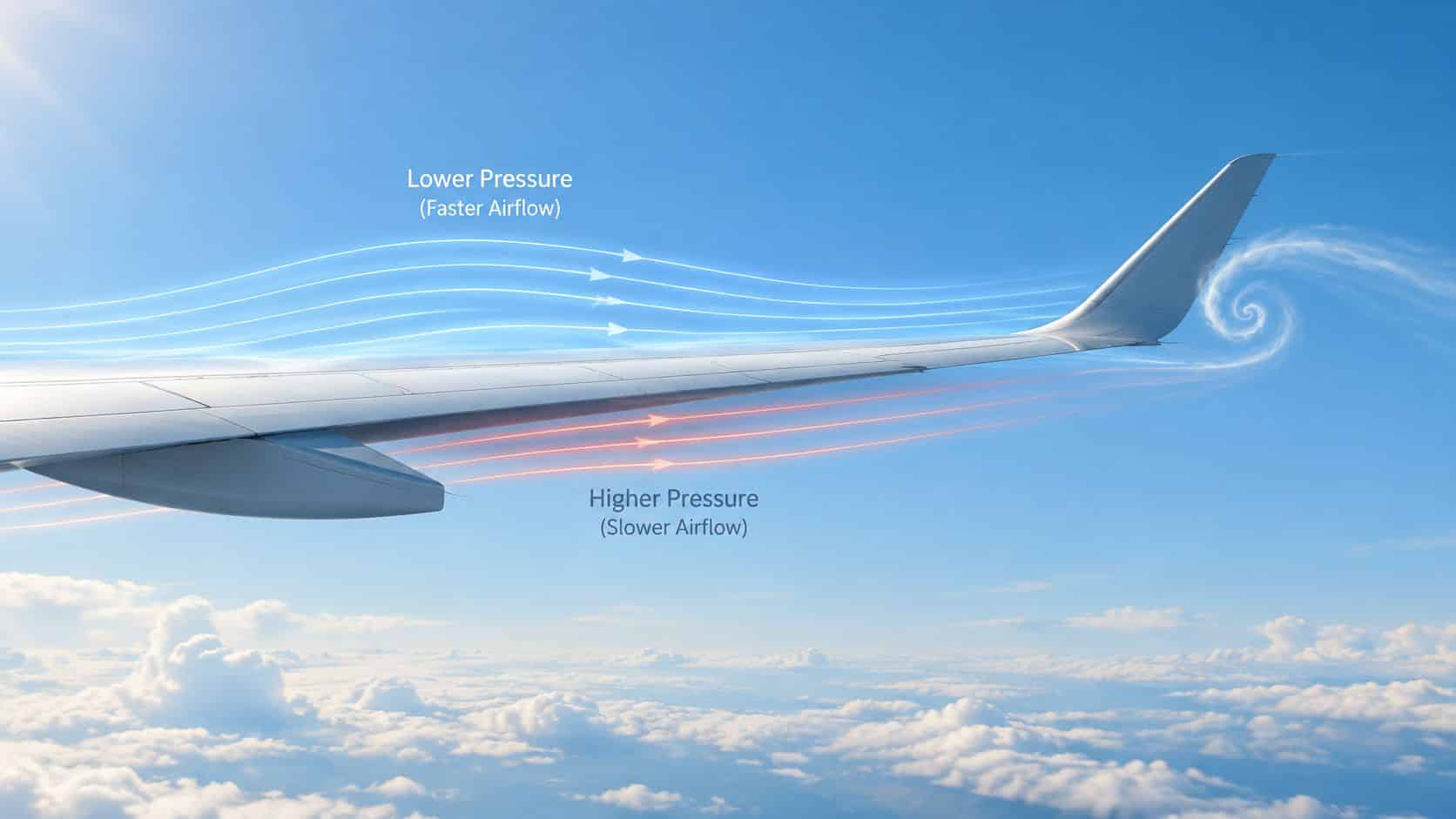
A lifting wing creates pressure differences between its surfaces. Near the tips, the airflow associated with those differences contributes to trailing vortices and downwash, which changes the direction of the aerodynamic force.
The rearward component is induced drag. It's the drag associated with producing lift, not the friction of air passing over the aircraft.
What the drag equation means
NASA Glenn Research Center's induced-drag explanation gives C_Di = C_L² / (π × AR × e), meaning that doubling aspect ratio halves the induced-drag coefficient when lift coefficient and span efficiency remain unchanged. Here, C_L is lift coefficient, and e is the span-efficiency factor.
Consider hypothetical wings with equal area of 100 sq ft and spans of 30 ft and 40 ft. Applying the formula gives aspect ratios of 9 and 16, respectively, so the longer-span wing has approximately 1.78 times the aspect ratio.
Under the same simplified assumptions, the longer wing's induced-drag coefficient is 9/16 of the shorter wing's, or approximately 44% less. That's a reduction in induced drag, not a claim that total drag falls by the same percentage.
What a student notices in flight
In a glide, a reduction in total drag relative to lift can improve the distance available for a given height loss. The distinction between wing geometry and actual aircraft performance becomes clearer when working through how to calculate glide ratio.
During slow flight, the aircraft must still produce enough lift to support its weight. Induced drag becomes an important part of the power requirement, so wing efficiency helps explain why holding altitude can require substantial power even at low airspeed.
In a climb, reduced drag can leave more excess power available. It doesn't establish a climb rate by itself, because engine output, propeller efficiency, weight, and flight conditions also matter.
High and low aspect ratio wings compared
The tendencies below assume otherwise comparable designs. Actual handling also reflects controls, mass distribution, structure, and the rest of the aircraft.
| Factor | High aspect ratio | Low aspect ratio |
|---|---|---|
| Typical examples | Gliders and long-range sailplanes | Fighter jets and some aerobatic designs |
| Induced drag | Lower under matched conditions | Higher under matched conditions |
| Glide performance | Potential for better glide ratio | Greater induced-drag penalty |
| Power needed in slow flight | Generally less under matched conditions | Generally more under matched conditions |
| Roll response | Longer spans can increase roll inertia | Shorter spans can reduce roll inertia |
| Structural bending loads | Longer spans can require stronger spars | Shorter spans can reduce bending demands |
| Storage and ground handling | More span to accommodate | Easier to fit into restricted spaces |
Parasite drag still counts. Aspect ratio doesn't guarantee lower cruise power or quicker handling when the rest of the airplane changes.
Common Mistakes When Reading Aspect Ratio
A student can recite "span squared over area" and still report the wrong number. The slip is in the inputs.
Square the span, then divide by area, and keep the length units matched to the area units. Feet belong with square feet. Meters belong with square meters. Cross the systems and the quotient no longer describes that wing.
Planform area and wetted area both get called "wing area," which is how they get swapped. Planform is the outline looking straight down, the shadow on the ramp. Wetted area adds the skin the air scrubs, top and bottom. That larger denominator pulls the result down, so a trainer looks stubbier on paper than its planform is.
A 16:9 or 4:3 label compares a screen's width with its height, a different job from wing math.
Efficiency still has to be weighed against structure, handling, manufacturing, and ramp space for a long span. Airfoil, taper, sweep, surface condition, and weight still shape the airplane, so one geometric value cannot describe the whole wing.
An online figure helps only when the model, configuration, and reference-area convention match. Change what counted as wing area and the number changes even though the wing did not.
Angle of incidence is the wing's mounting angle relative to an aircraft reference line. Aspect ratio is how slender that planform is. On an oral, name the dimensions behind each term so a memorized line does not answer the wrong question.
Put the span you squared and the planform area you divided by beside the result. Those two inputs show a unit error faster than a lone number.
Using Aspect Ratio When You Choose a Training Aircraft
A student comparing a Piper Cherokee and a Cessna 150 for a private certificate will find two different wings, and the aspect ratio calculation will confirm that. The decision, though, rarely turns on that number. Both aircraft can carry a student safely through the same syllabus, so the wing geometry becomes a way to understand what the student feels rather than a score for picking one airplane over the other.
Recall the worked Cessna 172 Skyhawk calculation from earlier in this article. That number predicted tendencies the student can sense: how willingly the airplane glides with power reduced, how much power slow flight demands, how the roll responds to aileron input. A discovery flight is where those tendencies stop being arithmetic. When the instructor demonstrates a power-off descent, the student who ran the calculation recognizes why the airplane behaves as it does. The wing number becomes the explanation behind the seat-of-the-pants feel, and that recognition is the payoff of learning aspect ratio.
A practical aircraft comparison checklist
- Fly the comparison, then calculate it. After a lesson or discovery flight in each type, work the span-and-area arithmetic for both aircraft and connect each result to what you felt in the pattern.
- Compare cockpit fit. Seating position, control reach, visibility, and instrument readability deserve attention during an aircraft visit.
- Ask about scheduling. Confirm whether the aircraft can support the frequency of lessons or rental flights being considered.
- Discuss the training path. A private-pilot student, an instrument trainee, and a pilot pursuing additional aircraft experience may have different priorities.
- Understand performance-chart use. Practicing with aircraft performance charts turns general aerodynamic knowledge into aircraft-specific interpretation.
Turning a specification into a useful discussion
The Cherokee-versus-150 comparison shows why. If one aircraft is booked solid for the next month and the other is open three evenings a week, availability shapes the training outcome far more than a modest difference in wing slenderness. If the student is tall and one cockpit forces a cramped posture, comfort wins for the same reason. Aspect ratio still matters in the conversation, because it explains glide behavior and power requirements the student will manage on every flight, but it informs the choice rather than making it.
For an existing student, the calculation makes a useful ground-lesson exercise in either airframe. The instructor can help locate the correct dimensions, check the arithmetic, and separate design tendencies from the airplane's documented capabilities.
Training priority: Choose the aircraft and instruction plan that build proficiency lesson after lesson; the wing geometry is there to help you understand the airplane you fly.
Aspect Ratio Questions Pilots Ask
Does aspect ratio determine stall speed?
No. Aspect ratio alone doesn't establish stall speed; weight, wing area, maximum lift coefficient, and aircraft configuration are central considerations. Aircraft-specific documentation remains the appropriate basis for performance information.
How does aspect ratio relate to glide ratio?
Aspect ratio describes wing geometry, while glide ratio describes distance traveled relative to height lost. A wing's induced-drag characteristics contribute to glide performance, but the complete aircraft's lift-to-drag relationship determines the result.
Where are wingspan and wing area listed?
The Pilot's Operating Handbook and manufacturer specifications are appropriate starting points. The student should confirm the model and configuration and check how the published reference wing area is defined.
Is wing loading the same as aspect ratio?
No. Wing loading is aircraft weight divided by wing area, whereas aspect ratio relates span to area. The terms describe different characteristics and shouldn't be substituted for one another during a performance discussion.
Can aspect ratio predict roll response?
Not by itself. Span can affect roll inertia, but aileron design, aerodynamic damping, mass distribution, and operating conditions also influence how the airplane responds.
DuBois Aviation offers airplane flight training and aircraft rental at Chino Airport, where students can connect wing geometry with aircraft-specific performance discussions. Visit DuBois Aviation to ask about a school tour, discovery-flight availability, and which training aircraft fits the intended certificate or rating.


