
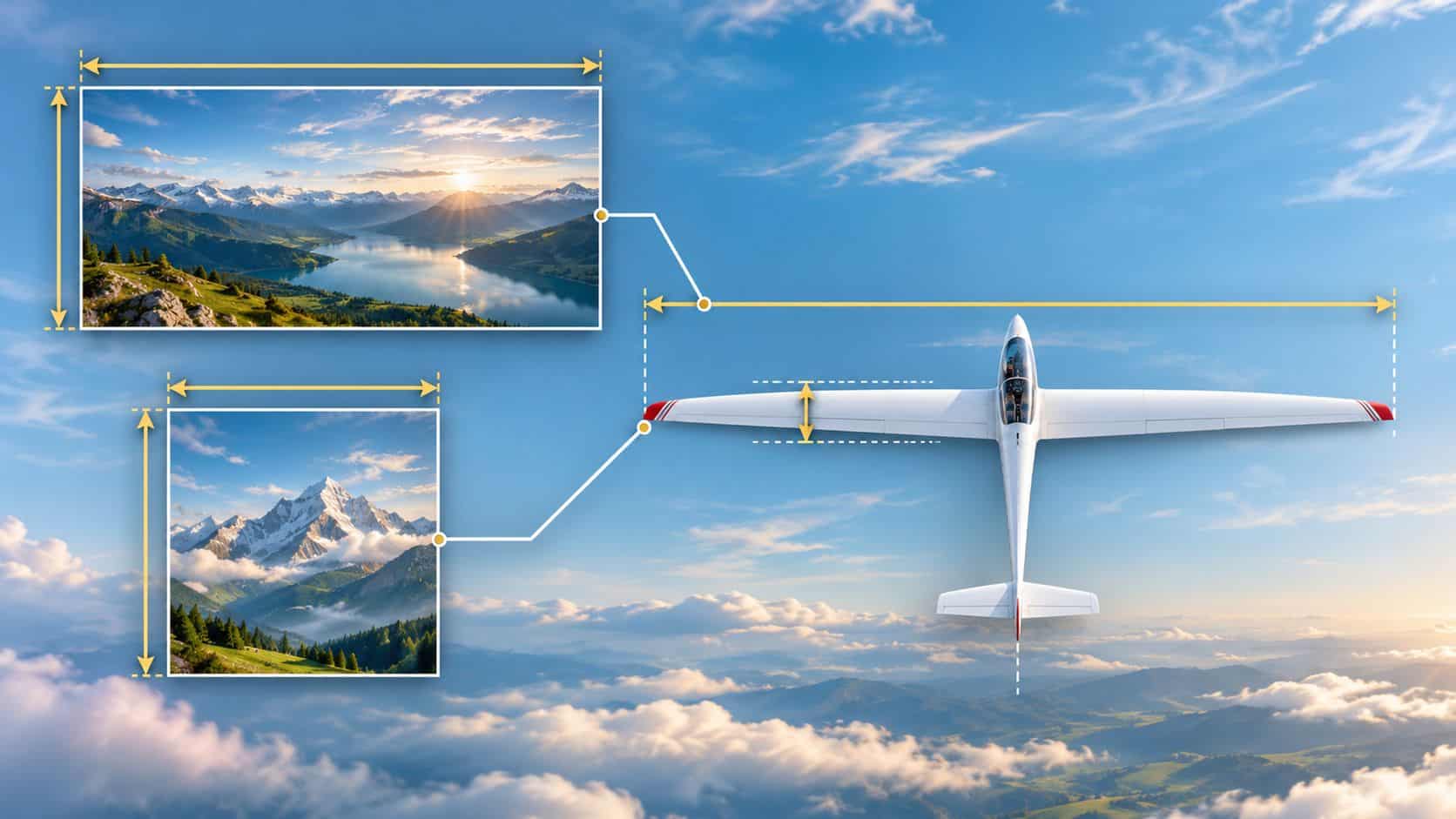
Aspect ratio is the proportion between two dimensions of a shape, written as width to height for an image, such as 16:9, and for an aircraft wing as wingspan squared divided by wing area or wingspan divided by mean chord. It describes shape, never size, so a 1920 by 1080 video frame and a 3840 by 2160 frame share the same 16:9 proportion.
A student sits in ground school with the pilot's operating handbook open to the specifications page, a calculator, and a question that sounds simple until it isn't. The wing of the trainer in the school's fleet looks stubby next to the long, slender wing of a glider parked on the same ramp, yet both aircraft fly. Someone asks why the glider's wing is shaped that way, and the honest answer runs through a single number that most introductory pages define and then abandon.
The confusion usually starts with the word itself. Aspect ratio appears in photo editing apps, video export settings, and aircraft specification tables, and the same two words describe two different measurements. Anyone asking what is aspect ratio is really asking about proportion, and proportion alone never explains performance.
Table of Contents
- What Aspect Ratio Means in Plain Terms
- Calculating Aspect Ratio with Worked Examples
- Aspect Ratio of Aircraft Wings Compared
- What Aspect Ratio Changes in Flight
- Common Mistakes When Reading Aspect Ratio
- Apply Aspect Ratio to Your Next Lesson
- Frequently Asked Questions About Aspect Ratio
What Aspect Ratio Means in Plain Terms
Aspect ratio answers one question. How long is a shape compared with how wide it is? It says nothing about size.
Take a widescreen video frame at 16:9. A frame 1920 pixels wide and 1080 pixels tall and a frame 3840 by 2160 are different sizes but identical in shape, because both divide down to the same pair of numbers. A square social post at 1:1 is the opposite case, equal on both sides no matter how many pixels it holds.

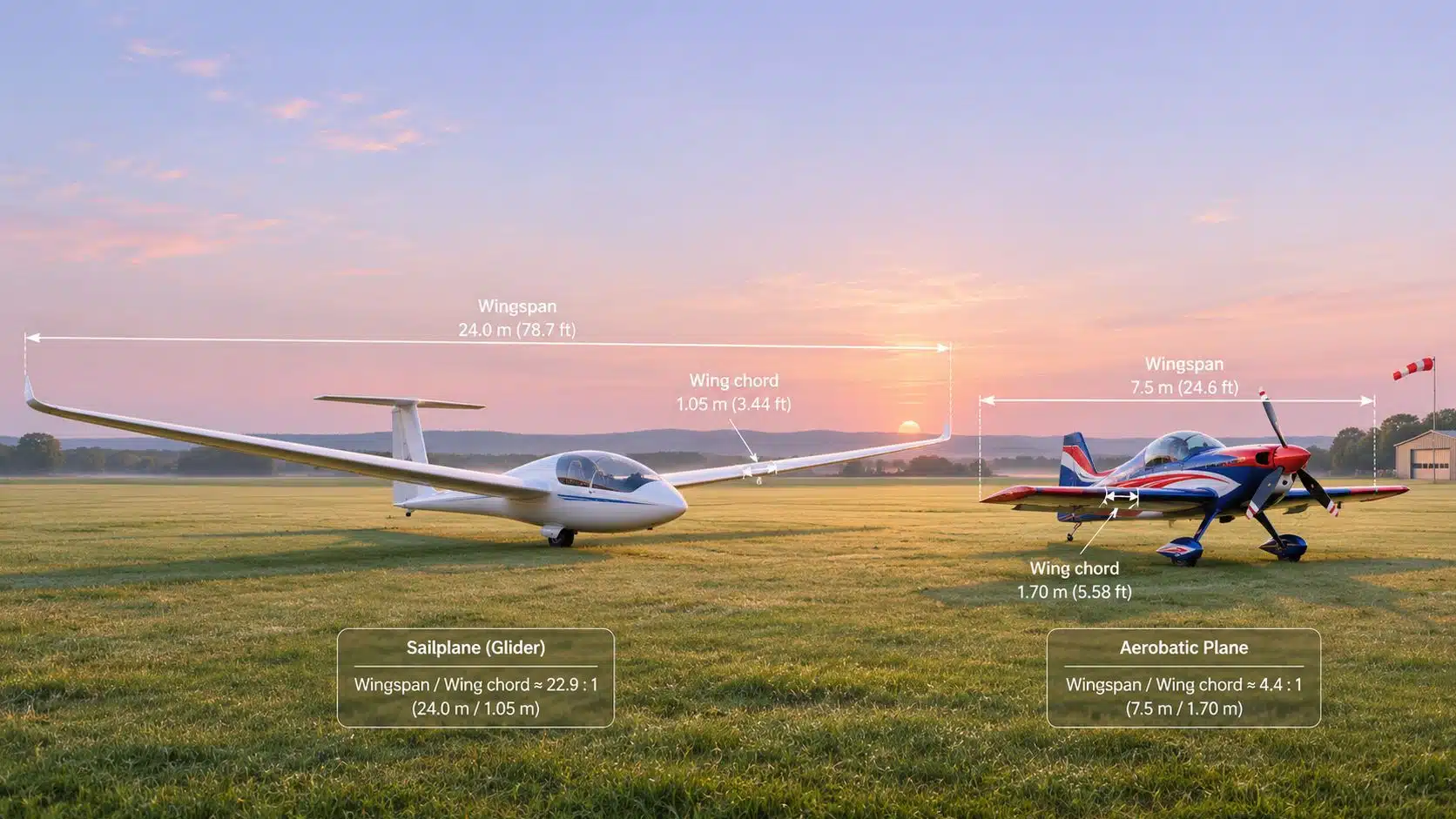
Wings work the same way, with different vocabulary. The long dimension is span, measured tip to tip. The front-to-back dimension is the chord, measured along the direction of flight. A wing with a 36 foot span and a 4.8 foot chord is 7.5 times longer than it is wide, and that 7.5 is its aspect ratio.
A comparison students recognize immediately is paddle shape. A slender sea kayak paddle is long and narrow, built to move efficiently through water with little wasted effort. A short, broad oar blade is wider relative to its length, and it suits a different job. A sailplane wing resembles the kayak paddle. A trainer wing resembles the oar blade.
Why the Ratio Has No Units
Divide feet by feet and the units cancel. Divide metres by metres and the same thing happens. That's why a wing measured in feet can be compared directly with a wing measured in metres, and why the answer is a pure number with nothing attached to it.
Keep the two meanings separate: an image ratio compares a frame's width and height, while a wing ratio compares span with chord or area. Both are proportions. They predict completely different things.
The distinction matters because the phrase sounds identical in both contexts. A 16:9 screen and a wing at ratio 16 share a number and nothing else. One describes a rectangle on a display, the other a lifting surface with weight, bending loads, and a stall behavior of its own.
Calculating Aspect Ratio with Worked Examples
The image method takes four steps, and each one is worth doing out loud the first few times.
- Measure the width in pixels, millimetres, or whatever unit the tool displays.
- Measure the height in the same unit, never a different one.
- Divide width by height to get a decimal.
- Reduce to the simplest whole-number pair by dividing both sides by their common factor.
A 1920 by 1080 frame divides down to 16:9. A 1080 by 1080 post divides to 1:1. A 1080 by 1920 phone video gives 0.56, which reduces to 9:16. Platform guidance now treats vertical 9:16 video at 1080 by 1920 as the dominant full-screen format for TikTok, Instagram Reels and YouTube Shorts, while 4:5, 3:4, 1:1 and 16:9 stay relevant for feeds, carousels and long-form video, according to Yellow Squared's breakdown of current aspect ratio guidance.
The Wing Version the FAA Uses
The aviation method uses the same division, applied to different dimensions. Wingspan divided by mean chord gives one answer. Wingspan squared divided by wing area gives the other, and the FAA treats both as valid ways to express the same geometric property.
Take a sample wing with a 36 foot span and a 4.8 foot mean chord. Dividing 36 by 4.8 gives 7.5:1. Now square the span and divide by a wing area of 174 square feet. The result is about 7.4:1.
| Example | Input measurements |
|---|---|
| Widescreen video frame | 1920 px wide by 1080 px tall, so 1920 ÷ 1080 reduces to 16:9 |
| Square social post | 1080 px by 1080 px, so 1080 ÷ 1080 is 1:1 |
| Portrait phone video | 1080 px wide by 1920 px tall, so 1080 ÷ 1920 = 0.56, which reduces to 9:16 |
| Sample wing, span and mean chord | 36 ft span by 4.8 ft mean chord, so 36 ÷ 4.8 = 7.5:1 |
| Sample wing, span and area | 36 ft span, 174 sq ft area, so 36² ÷ 174 comes to about 7.4:1 |
Why the Two Answers Differ Slightly
The gap between 7.5 and 7.4 comes from two sources. Rounding is the obvious one, since the area calculation doesn't land on a clean decimal. The other is geometry, because a wing that isn't perfectly rectangular has a mean chord that only approximates the area relationship.
Both figures must come from the same wing measured under the same convention. Pulling a span from one source and an area from another produces a number that looks precise and means nothing. The same discipline applies to training records and course outcomes, where a framework for measuring training ROI keeps the comparison honest by fixing the inputs before the arithmetic starts.
Quick sanity check: if a wing calculation returns a number below 1, one measurement is almost certainly swapped. A wing is longer than it is wide.
Aspect Ratio of Aircraft Wings Compared
The FAA glossary defines aspect ratio for aircraft as wingspan divided by average wing chord, and notes it can also be calculated as wingspan squared divided by wing area, per the FAA Pilot's Handbook of Aeronautical Knowledge glossary. In formula form, that is span ÷ average chord, or span² ÷ area.
| Aircraft | Category | Approximate aspect ratio |
|---|---|---|
| Schweizer SGS 2-33 | Training glider | about 14 |
| Airbus A320 | Narrow-body airliner | about 10.4 |
| Boeing 747-400 | Long-haul airliner | about 7.7 |
| Cessna 172 Skyhawk | Four-seat trainer | about 7.5 |
The Schweizer SGS 2-33 sits near 14 because gliders are built around long, narrow wings that stretch every foot of altitude into distance. Efficiency on a long glide is the design goal, and the wing shape serves it directly. Think of the wing as a long, thin ruler compared with a short, wide paddle, the long shape has less tip-related drag for the lift it makes.
The Airbus A320 lands near 10.4, a compromise among cruise efficiency, structural weight, and the span limits imposed by gates, taxiways and hangars. A wing can be aerodynamically elegant and still be impractical at an airport. Students often get confused: a higher number does not automatically mean the better aircraft. It means the wing is longer and narrower relative to its area.
The Boeing 747-400 has a very long span, yet its large wing area pulls the ratio down to about 7.7, close to a Cessna 172 at about 7.5. Two aircraft of wildly different size and mission arrive at a similar ratio from completely different span and area values, which is exactly why the number alone can't rank them. It also cannot predict speed, handling, payload, or fuel burn by itself. Those depend on the whole design, including weight, engines, wing shape and mission.
These values are approximate and drawn from typical published dimensions. Before using any figure in a calculation or a comparison, confirm span, chord and area in the manufacturer's data or the type certificate data sheet, because configuration and measurement convention change the answer.
What Aspect Ratio Changes in Flight
The clearest effect is on induced drag, the drag a wing creates as it generates lift. A long, narrow wing spreads lift across more span and produces less of that drag for a given amount of lift, which is why gliders fly long and narrow. The FAA's Pilot's Handbook of Aeronautical Knowledge covers induced drag and wing geometry in the aerodynamics chapters, and the relationship explains most of what a pilot notices in the air.

The cost is real. A long wing needs more structure to resist bending, so it weighs more. It also needs hangar space, taxi clearance, and parking room that a shorter wing doesn't. Shorter wings are stiffer and more compact, which suits faster or more maneuverable designs, though the trade-offs depend on the entire aircraft rather than the wing alone.
| Aspect ratio band | Typical wing | Main advantage | Main trade-off |
|---|---|---|---|
| Low (below about 5) | Short, broad wing | Structural stiffness and compact size | Higher induced drag and less efficient gliding |
| Moderate (about 6 to 9) | Many light trainers and general aviation aircraft | Balance of efficiency, weight and handling | Not optimal for long glides or very high speed |
| High (about 10 and above) | Gliders and long-span airliners | Lower induced drag and better glide efficiency | More structural weight and tighter airport and hangar limits |
Those band boundaries are a teaching convention for comparison, not an FAA rule or a performance standard.
What the Ratio Cannot Predict
Aspect ratio alone does not set stall speed, handling qualities, speed range, or safety. Airfoil choice, wing loading, weight distribution, flap design and control systems all shape those outcomes. Two wings at the same ratio can fly nothing alike.
Helicopter rotors deserve a separate warning. Rotor blades have analogous geometry, long and narrow by necessity, but their performance is governed by rotary-wing aerodynamics rather than fixed-wing rules. A student moving from a Cherokee to an R44 is learning a new set of relationships, not scaling an old one.
A high ratio favors efficient gliding. It does not automatically make an aircraft better, faster, or safer. Designers trade efficiency against weight, maneuverability, airport practicality and speed range, and every production wing reflects those choices.
Working through the numbers behind a descent, rather than the wing shape that produced them, answers a performance question, which is why glide ratio calculations belong next to any discussion of wing geometry. Simulator sessions help too, and booking full motion flight simulator hire lets a student or a group compare how different wing types feel before committing to a flight.
Common Mistakes When Reading Aspect Ratio
Aspect ratio works like a recipe ratio: it describes proportion while batch size stays open. Trouble starts when that shape number is asked for size, speed or stall behavior.
- Reading 16:9 as 16 inches by 9 inches. The numbers are a proportion. A 16:9 frame can be two inches wide or two metres wide.
- Mixing units. Span in feet and chord in metres produces a meaningless decimal, even though the arithmetic runs cleanly. Convert one measurement before dividing; otherwise the same wing can produce different ratios.
- Using the wrong chord on a tapered wing. The FAA definition calls for average or mean chord. Tip chord or root chord alone will not give the geometric ratio, because each end of a tapered wing has a different width.
- Dividing span by area. The area method requires span squared divided by area. Span divided by area leaves a unit in the result; the squared form is dimensionless.
- Comparing two aircraft without checking the convention. Different sources measure span and area differently, and loading differences make a like-for-like comparison harder than the ratio suggests. Confirm the inputs before ranking one wing above another.
- Treating a published ratio as exact. A quotient is only as precise as the span, chord and area behind it. Rounded inputs can produce a clean-looking decimal.
- Letting the ratio answer an approach-speed question. If one aircraft floats farther or feels slower on final, check weight, flap setting and wing loading before crediting wing shape.
Three-line self-check: confirm which definition is in use, confirm both measurements share units, confirm the ratio is answering a question it can answer.
That last check catches most errors. A ratio can tell you a wing is long and narrow. Stall behavior is a question for angle of attack and wing loading, which can change with weight and configuration while the wing's ratio stays fixed.
Apply Aspect Ratio to Your Next Lesson
Four steps turn this from a definition into something usable before the next flight.
- Ask your instructor how the training aircraft's wing geometry affects its glide, stall behavior and approach, and check what the aircraft's documentation says about each. The answer should reference published figures, not impressions.
- Compare the trainer with a glider or a heavier type during ground school. Note span, chord and area from manufacturer documentation for each, then compute both ratios and see how the numbers relate to what each aircraft is built to do.
- Verify wing dimensions in the aircraft's documentation before using them in any calculation or study question. Type certificate data sheets and manufacturer data are the reference, not a forum post.
- Carry the calculation into a flight-planning or performance question, then check the result against the Pilot's Operating Handbook. The handbook is the authority on what the aircraft will do.
Comparing published figures across a fleet is easier when the specifications sit in one place, and the aircraft fleet page lists current training aircraft. Students working through performance problems will find the aircraft performance charts guide a useful companion to the arithmetic.
A wing's shape explains its design intent. The handbook explains its limits. Keep both in view and neither will mislead you.
Readers who want to see how wing geometry changes the way an aircraft flies can ask about course availability, request training information, or schedule a school tour. Program structure is outlined on the flight training page, compressed schedules on the accelerated flight training page, and a first look in the air is available through a discovery flight.
Frequently Asked Questions About Aspect Ratio
How do I turn a published span and area into a ratio?
Start with the wingspan and wing area listed in the aircraft data, then square the span and divide by the area. That gives the wingspan squared divided by wing area method. It works like reducing a rectangle to one tidy proportion, except the rectangle is the planform of a wing. Use the same units for span and area, and the result stays a simple number you can compare with other wings.
Does a high ratio promise better performance on its own?
It suggests a slender wing and often points toward efficient gliding with lower induced drag. The whole aircraft still sets the result, including airfoil, power available, and total drag. Think of it as one ingredient in a recipe, useful and informative, but unable to describe the finished meal.
Where should I look for the stall-speed story?
Use the earlier discussion of what aspect ratio changes in flight. That section keeps the full set of factors together, including wing loading, airfoil, flap design, and weight. Geometry contributes to the picture, but the aircraft's performance data gives the practical answer.
What is the aspect ratio of a Cessna 172?
About 7.5, calculated from published span and area. Treat it as approximate and confirm the exact dimensions in the manufacturer's data before using it in a calculation.
Why is aspect ratio unitless?
Span and chord are measured in the same units, so the units cancel during division. The result is a pure proportion that can be compared across aircraft measured in different systems.
Which formula does the FAA use?
Wingspan divided by average wing chord, with wingspan squared divided by wing area given as an equivalent method, according to the FAA Pilot's Handbook of Aeronautical Knowledge glossary.
DuBois Aviation trains pilots at Chino Airport who want to understand not just what a number says but what it changes in the air. Whether the goal is a private certificate, an instrument rating, a helicopter add-on, or a professional flying career, instruction is built around the aircraft in the fleet and the documentation that governs it. Visit DuBois Aviation to ask about course availability, request training information, or schedule a school tour.