
You've finished the commercial ticket, maybe added instrument, maybe you're staring at your logbook and wondering what gets you into the right seat of a turbine airplane. That's the moment where a lot of pilots get bad advice. They hear “just build hours” as if every hour carries the same weight.
It doesn't.
In real pilot sic jobs, the first obstacle usually isn't what the FAA will allow. It's what an operator's insurance carrier will accept, what a chief pilot trusts, and whether your recent flying says “ready for a two-pilot environment” or “still figuring things out.” If you understand that early, you can stop chasing random time and start building the kind of experience that opens doors.
Why Your First Pilot SIC Job Is Closer Than You Think
The market is better than many low-time pilots realize. The broader pilot workforce is dealing with a succession issue, and that matters if you're trying to break in now. Pilots born between 1945 and 1981 make up most of today's workforce, while Gen Z pilots account for only 6 percent of membership, which points to meaningful hiring demand as retirements build over time, according to pilot demographic data.
That doesn't mean every new commercial pilot walks straight into a jet seat. It does mean the window is open wider than it looks from the outside.
The question most new commercial pilots ask
The question is always some version of, “What's next if I'm not at airline minimums yet?” For many pilots, the practical answer is an SIC path in charter, corporate, cargo support, air ambulance support, or a structured progression role that leads there.
The Bureau of Labor Statistics shows why people keep pushing toward that path. As of May 2024, the median annual wage for commercial pilots was $122,670, and employment of airline and commercial pilots is projected to grow 4 percent from 2024 to 2034, with about 18,200 job openings each year on average over the decade, according to the BLS pilot occupation outlook.
Those numbers don't guarantee your first job. They do confirm that aviation is still a field where advanced ratings and better qualifications can move you into stronger opportunities.
Why the right seat is a smart first target
An SIC job teaches habits that solo time alone won't. You learn callouts, check discipline, cockpit flow, how to brief a departure without rambling, when to speak up, and when to stay quiet and back up the captain. Those skills matter because chief pilots hire for crew fit as much as stick-and-rudder ability.
Practical rule: If an operator can picture you making the cockpit calmer, you're employable sooner.
A lot of pilots get stuck because they aim either too low or too high. Too low, and they drift without building relevant multi-engine or crew experience. Too high, and they apply for jobs that were never realistic for their current logbook. The better move is to study the actual aviation jobs for pilots pipeline and target the roles that connect one step cleanly to the next.
Building Your Pilot Credentials for the Right Seat
Pilot sic jobs don't start with a flashy résumé. They start with the right sequence of training, and each certificate needs to build a useful layer of judgment, not just checkride prep.
The non-negotiable foundation
A solid SIC candidate usually comes up through the same core stack:
- Private Pilot License gives you the base habit pattern. Aircraft control, radio work, traffic scanning, checklist use, and decision-making all begin here.
- Instrument Rating is where many pilots start becoming employable in a professional sense. You learn procedure discipline, scan management, and how to stay ahead of the airplane.
- Commercial Pilot License sharpens precision. Standards tighten. Landings, maneuvers, and planning all need to look intentional, not improvised.
If any one of those layers is weak, it shows later in interviews and simulator evaluations. A pilot who hand-flies well but can't brief an approach clearly still looks unfinished.
Why multi-engine time changes the conversation
For most turbine and jet SIC work, multi-engine experience is the hinge point. It's not just about adding another rating to the certificate. It tells operators you've trained in asymmetric flight, higher workload, more systems, and a cockpit environment that starts to resemble the aircraft you want to fly professionally.
That's why focused multi-engine training matters more than casual time-building. Flying a platform like a Piper Apache teaches engine-out procedures, systems discipline, and workload management in a way a simple single-engine hour just can't.
A useful guide to that transition is this look at mastering multi-engine training. The important point is not the airplane itself. It's whether your training produces confidence in engine failure procedures, Vmc awareness, and cockpit organization.
What chief pilots actually notice
Most hiring managers won't be impressed by a stack of unrelated endorsements if your core flying looks sloppy. They notice patterns like these:
| What helps | What hurts |
|---|---|
| Clean instrument procedures | Unstable approaches and rushed briefings |
| Recent multi-engine training | Old ratings with no recent relevant use |
| Consistent logbook entries | Messy records and missing detail |
| Professional radio work | Over-talking or sounding behind the airplane |
A commercial certificate gets you legal access. Professional polish gets you noticed.
If your goal is the right seat, train with that cockpit in mind. Read flows out loud. Brief every flight like someone else is listening. Practice callouts. Build habits that translate directly into a crewed airplane. That's how your ratings start functioning like qualifications instead of souvenirs.
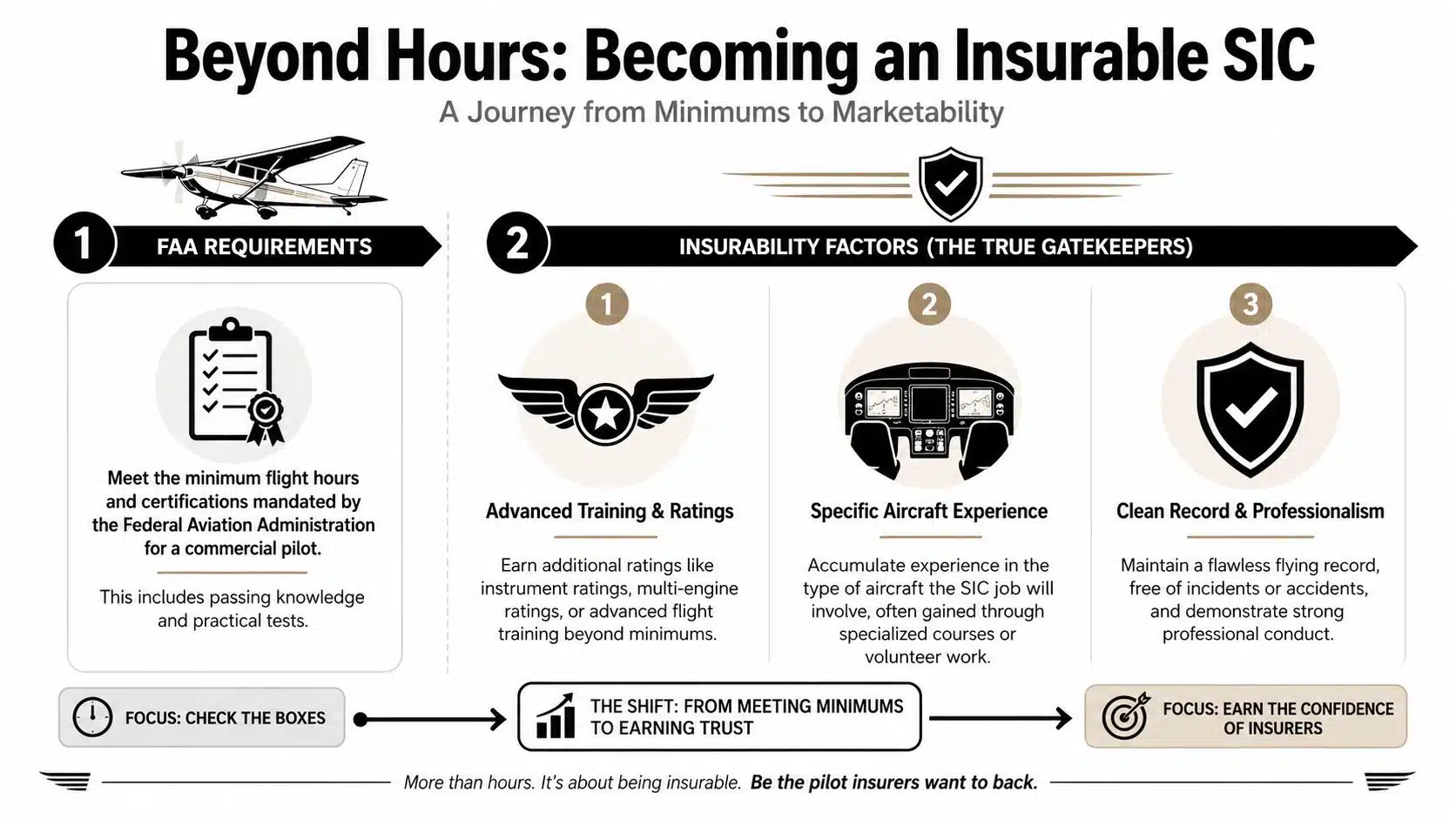
More Than Hours Becoming an Insurable SIC Candidate
A lot of low-time pilots think the formula is simple. Hit the FAA minimums, get the commercial, add multi-engine, start applying. Legally, that may be enough for some jobs. Practically, it often isn't.
Insurance companies usually act as the gatekeeper.
Industry data shows that insurance underwriters commonly want 500 to 1,000 flight hours for SIC roles in corporate or charter settings, and a documented example shows a pilot who had the needed ratings and operator support still got blocked from an Astra SIC seat because insurance wouldn't approve him. The same pilot later secured a contract copilot position on a Citation, which shows how much requirements can shift by airframe and operator, according to this review of low-time pilot job realities and insurance barriers.
What insurable actually means
When chief pilots say, “We'd hire you if insurance approves,” they usually mean your logbook has to make an underwriter comfortable with risk. That includes more than total time.
They're looking at things like:
- Relevant multi-engine time rather than generic time
- Recent training instead of old, stale qualifications
- Aircraft complexity exposure such as glass panels or turbine-style procedures
- Professional record with no pattern of incidents, carelessness, or poor judgment
A pilot can be fully legal and still be a hard no for insurance. That's one of the toughest lessons in the early career stage, but it's better to know it now.
Good time versus random time
Not all hour-building helps equally. If your goal is pilot sic jobs, the best time is time that answers an operator's next question before they ask it.
Useful paths often include:
- Flight instruction because it keeps your scan sharp, your systems knowledge fresh, and your flying current.
- Multi-engine instruction if you can get there. That time is usually far more persuasive than another block of simple single-engine hours.
- Pipeline patrol or aerial survey when it builds discipline, weather judgment, and commercial flying habits.
- Smaller Part 135 environments where the airplane and insurance profile may be more accessible than a larger cabin-class jet.
What doesn't help as much is expensive wandering. Renting an airplane and flying circles just to make the Hobbs move can pad totals without improving your case.
If your next hundred hours don't make you more insurable, they may not move your job search much at all.
The habits that quietly move you forward
Insurance approval is partly about hours and partly about credibility. Chief pilots and underwriters both get wary when a low-time candidate looks casual.
Here's what tends to help:
- Keep every logbook entry clean and traceable. Sloppy records create doubt fast.
- Stay current in instrument procedures. Many early SIC jobs care more about instrument discipline than flashy hand flying.
- Build familiarity with modern avionics. Garmin G1000 or G5000 exposure can support the larger picture of cockpit readiness.
- Train CRM on purpose. Crew resource management is not something to “pick up later.”
I've seen pilots with fewer hours get interviews because their experience made sense. I've also seen pilots with more time get passed over because their logbook looked scattered and their recency was weak.
Your Strategy for Applications Resumes and Interviews
Once your qualifications are moving in the right direction, the job search becomes a separate skill. Good pilots often lose out because they apply like everyone else, write vague résumés, and walk into interviews without prepared examples of judgment, teamwork, and error management.

Where pilot SIC jobs actually show up
Online job boards matter, but they're not enough by themselves. Pilots should watch places like BizJetJobs and Climbto350, then follow up offline through local FBOs, maintenance shops, charter desks, and instructors who know who's expanding.
The strongest early-career candidates usually do both:
- Track public postings so you know what operators keep hiring
- Build local relationships with people who hear about openings before they're posted
- Stay visible by checking in professionally, not pestering
- Ask better questions such as what aircraft are growing and what insurance minimums are blocking hires
A polished introduction at an FBO counter still works. So does helping with ferry opportunities, safety pilot work, and showing up on time every single time. Aviation is small. Reputations move faster than résumés.
Build a résumé a chief pilot can scan in seconds
Pilot résumés fail when they read like generic office résumés. Flight time needs to be instantly legible. Ratings need to be easy to find. Your recent experience needs to answer relevance questions without forcing a chief pilot to hunt.
Use a clean layout and put the operational facts high on the page:
- Certificates and ratings
- Medical status
- Total time and relevant category breakdowns
- Recent aircraft flown
- Instruction, charter, survey, or crewed experience
- Professional non-flying skills only if they add value
If you want a better layout model, review these airline pilot resume examples. If you're also trying to make the document machine-readable before a human ever sees it, this guide on optimizing your resume for 2026 ATS is worth studying.
Hiring reality: A chief pilot should know in a quick scan whether you're legal, relevant, current, and worth a phone call.
Interview prep that actually matches aviation hiring
Interview prep for pilot sic jobs has two lanes. The first is technical. The second is behavioral. Many candidates prepare only for the technical side and then stumble badly when the questions turn to CRM, conflict, workload, and judgment.
Research on pilot selection shows structured hiring assessments can reduce simulator bust rates by 19 to 28 percent, and common weak points include poor task management and weak CRM skills, according to this analysis of pilot hiring assessments and simulator outcomes.
That means you should prepare stories, not just answers.
Use a simple structure for behavioral prompts:
- Situation
- Task
- Action
- Result
Be ready for questions like:
- Tell me about a time you caught an error before it became a problem.
- Tell me about a disagreement in the cockpit or during instruction.
- Tell me about a flight where workload started to outrun your capacity.
Later in your prep, it helps to watch how pilots talk through pressure and decision-making in real interviews and training conversations:
The candidates who do well aren't always the ones with the prettiest logbooks. They're the ones who sound organized, coachable, and safe under pressure.
Part 135 vs Corporate Flying What to Expect
A lot of pilots talk about “charter” and “corporate” like they're the same thing. They're not. If you're choosing between pilot sic jobs in those worlds, the daily work can feel very different even when the aircraft are similar.
The distinction matters because the flying, schedule, and long-term progression often point in different directions. A useful breakdown appears in this comparison of Part 91 and 135 operations from Craft Pod, especially if you're trying to understand how the operating environment shapes the job.
Side by side reality
Industry guidance notes that Part 135 charter roles may have lower entry minimums and can offer faster hour-building, while corporate flight department jobs often include administrative or maintenance-related duties in addition to flying, according to this overview of low-hour commercial pilot job paths.
Here's the practical difference:
| Category | Part 135 charter | Corporate flight department |
|---|---|---|
| Schedule | Often more variable | Often more predictable, depending on company culture |
| Flying pace | Can be fast and varied | Can include periods of waiting, planning, and support work |
| Entry path | Sometimes more accessible | Often more selective on fit and polish |
| Non-flying duties | Usually lighter outside normal trip work | Often includes admin, cabin readiness, or coordination tasks |
| Career feel | Good for rapid exposure | Good for team integration and long-term stability |
Which one fits you better
Choose Part 135 if you want varied legs, changing destinations, and a faster-moving environment. It can be a strong place to learn adaptability, customer handling, and operational tempo.
Choose corporate if you like consistency, higher expectations around presentation, and being part of a small department where trust matters as much as raw flying. Some pilots love that. Others find the extra non-flying duties frustrating.
The best first SIC job isn't the one with the flashiest airplane. It's the one that builds the next qualification you'll need.
A pilot who wants quick exposure may thrive in charter. A pilot who values team continuity and polished procedures may fit a corporate department better. Neither is automatically better. They develop different strengths.
From Right Seat to Ownership How to Buy an Airplane Safely
A lot of career pilots eventually want more than a job. They want an asset they control. Sometimes that means buying a trainer to rent out, a personal cross-country airplane, or a helicopter for utility or specialized use. The process gets expensive fast when buyers shop with emotion first and discipline second.
The safest purchase starts with mission, not paint.
Start with the mission profile
Before you look at listings, define what the aircraft must do. Weekend local flights, instrument cross-country travel, instruction use, time-building, backcountry work, and business travel all push you toward different airframes.
Write down the mission in plain language:
- How many people need to fit regularly
- Whether you need IFR capability
- Typical trip length and baggage load
- Runway environment
- Whether fixed costs will be shared with partners
If you're considering a helicopter, the same rule applies. Don't buy based on novelty. Buy based on actual use, local maintenance support, and your plan for training and recurrent proficiency.
Budget beyond the purchase price
The purchase price is just the beginning. Buyers get into trouble when they budget for acquisition but not for ownership friction. Insurance, maintenance, storage, subscriptions, unexpected discrepancies, and downtime all matter.
The most important spending decision happens before closing. A thorough pre-buy inspection typically costs 1 to 2 percent of the aircraft's purchase price, and these inspections uncover $10,000 to $25,000 in previously undisclosed mechanical or airworthiness issues on average. That makes the pre-buy the single best investment in the transaction because it either gives you negotiating power or saves you from buying the wrong aircraft.
How to buy the safe way
Use this order and you'll avoid most preventable mistakes:
- Choose the mechanic before the airplane. Find a shop or technician who knows the specific make and model.
- Review records early. Gaps, vague entries, and rushed explanations usually get worse under scrutiny, not better.
- Keep the pre-buy independent. The seller's mechanic may be competent, but your inspector should answer to you.
- Treat corrosion, damage history, and deferred maintenance seriously. Cosmetic cleanup can hide expensive truth.
- Plan your first year of ownership before closing. Training, insurance approval, and maintenance scheduling should already be in motion.
Buy the airplane that has the best paperwork, maintenance history, and support network. Not the one with the most exciting panel photo.
For helicopters, this standard is even more important. Parts support, maintenance familiarity, and airframe history can make or break ownership. A cheap rotorcraft can become the most expensive machine on the field if support is weak or records are incomplete.
Pilots who buy well usually stay patient. They pass on questionable deals. They don't let a seller rush them. They understand that the safest transaction is rarely the fastest one.
If you're working toward your first commercial cockpit role, or you want structured training that supports long-term goals like multi-engine proficiency, advanced ratings, helicopter training, aircraft rental, and practical aviation mentorship, DuBois Aviation is a strong place to start. Their programs at Chino Airport give pilots a realistic training environment, individualized instruction, and a path that supports both career flying and informed aircraft ownership.