If you're looking to fly for a living—whether for an airline, a charter company, or a corporate flight department—multi-engine training is your ticket to the big leagues. It’s the specialized rating that proves you can safely manage an aircraft with more than one powerplant, mastering the complex systems and critical procedures that define professional aviation.
This isn't just about adding another engine; it’s about leveling up as a pilot.
Why a Multi-Engine Rating is Your Next Career Milestone
Two practical options worth comparing
These are specific products pilots commonly compare for this type of flying. Confirm compatibility with your aircraft and instructor before ordering.
 Premium ANR headsetLightspeed Zulu 4 ANR Aviation Headset - Dual GA PlugCheck current availability on Amazon (paid link)
 Premium headsetBose A30 Bluetooth Aviation Headset - Dual PlugCheck current availability on Amazon (paid link)
Earning your multi-engine rating is a fundamental shift in how you think in the cockpit. Moving from a single-engine plane is like going from managing your own tasks to leading a small, high-performance team. It demands a whole new level of systems awareness, coordination, and cool-headed decision-making when things get complicated.
You’ll go deep into aircraft performance, systems logic, and the lifesaving principle of redundancy. You stop being just a pilot and start becoming an aircraft manager. The entire curriculum is built around one defining challenge: what do you do when one of those engines quits? Mastering that scenario is where the real skill of a multi-engine pilot is forged.
Mastering Asymmetric Thrust
When one engine fails, the airplane will immediately try to yaw and roll toward the dead engine. It’s a powerful, disorienting force. Your training is all about building the muscle memory and procedural calm to counter it instantly and correctly.
It boils down to a few critical actions:
- Immediate rudder and aileron control to keep the aircraft flying straight.
- Quickly identifying and verifying which engine has failed.
- Securing the dead engine by feathering its propeller to dramatically reduce drag.
The core of multi-engine training isn't about enjoying the power of two engines; it's about maintaining absolute control when you're suddenly down to one. It’s a test of precision, knowledge, and composure.
The Gateway to Professional Flying
For nearly every high-performance aviation career, this rating is non-negotiable. Airlines, charter operators, and corporate flight departments all require it. It’s the credential that shows you can handle more complex machines and operate safely in the most demanding conditions.
The good news? It’s an intense but incredibly rewarding experience. Most pilots complete their add-on rating in just 10-15 flight hours, which can often be knocked out in a few weeks of focused training. It’s a small investment for a massive career payoff and a significant safety boost.
In fact, multi-engine aircraft have 70% lower fatal accident rates per 100,000 hours than their single-engine counterparts, as highlighted in data from aircraft manufacturer Tecnam. That statistic is a powerful testament to the value of redundancy when paired with proper training. A structured program gives you the skills to master these aircraft, making you a safer, more capable, and far more marketable pilot.
What to Expect in Your Multi Engine Training Syllabus
Think of your multi-engine training syllabus as a step-by-step game plan. It’s designed to take you from understanding the theory on the ground to confidently handling the aircraft in the air, especially when things don't go as planned. It’s all about building a solid foundation first, then applying it until emergency procedures become pure instinct.
The journey starts in the classroom, not the cockpit. Before you ever advance two throttles down the runway, you need to understand the unique physics of flying a multi-engine airplane. This isn't about rote memorization; it's about building a mental picture of how the aircraft will behave with two engines—and more importantly, with only one.
Ground School: The Foundation of Multi-Engine Safety
Ground instruction is where you’ll wrap your head around the concepts that set multi-engine aircraft apart. You’ll go way beyond single-engine aerodynamics and dive into the tricky world of asymmetric throughst, which is just a fancy way of saying what happens when one engine quits and the other is still roaring. Getting this part right is what allows you to stay calm and take the correct action when it matters most.
Here's a glimpse of what you'll cover:
- Vmc (Minimum Control Airspeed): This is the big one. You'll learn exactly what Vmc is—the slowest you can fly and still maintain directional control after an engine failure. More crucially, you'll understand all the factors that change it, like altitude, weight, and even where you position the landing gear.
- The Critical Engine: Ever wonder why losing one specific engine is worse than losing the other? You'll find out. We’ll break down concepts like P-factor and slipstream effects to show you why identifying the critical engine is a non-negotiable piece of knowledge for any multi-engine pilot.
- Aircraft Systems and Performance: This is where you get into the nitty-gritty of the machine. You’ll learn how the propellers feather and unfeather, trace the fuel and electrical systems, and master the landing gear operations. You’ll also get comfortable with performance charts, figuring out takeoff distances and climb rates for single-engine scenarios.
Flight Training: Mastering the Maneuvers
Once the theory clicks, it’s time to bring it to life in the cockpit. The flight portion of your multi-engine training is where the real work begins. It’s intense, repetitive, and completely focused on building muscle memory. The whole point is to make your first reaction to an engine failure the right reaction, every single time.
The real test of a multi-engine pilot isn't flying with two good engines—it's demonstrating absolute mastery when one of them quits. Every maneuver you learn is built around preparing you for that moment.
You’ll practice these maneuvers over and over until they feel as natural as breathing. This covers everything from a perfectly normal flight to the most demanding emergency situations you can simulate.
To give you a clearer picture, here’s a breakdown of how a typical training syllabus flows from ground to air.
Typical Multi-Engine Training Syllabus Breakdown
This table outlines the core modules you’ll encounter. It shows how ground knowledge directly translates into practical skills in the aircraft.
| Training Phase | Key Topics and Maneuvers Covered | Objective |
|---|---|---|
| Ground School | Aerodynamics of asymmetric throughst, Vmc factors, critical engine theory, aircraft systems (propeller, fuel, gear), single-engine performance calculations. | To build a strong theoretical understanding of why a multi-engine aircraft behaves the way it does, especially during an engine failure. |
| Flight Training: Basic Operations | Preflight, normal and crosswind takeoffs/landings, slow flight, power-on/power-off stalls, steep turns (with both engines operating). | To establish a baseline proficiency in handling the aircraft under normal, two-engine conditions before introducing emergencies. |
| Flight Training: Emergency Procedures | Engine failure identification and drills (takeoff, climb, cruise, landing), Vmc demonstration and recovery, engine shutdown and restart. | To develop instinctual and correct responses to an engine failure in any phase of flight. |
| Flight Training: Advanced Maneuvers | Single-engine instrument approaches, drag demonstration (gear/flaps), engine-out go-arounds, steep turns and stalls on one engine. | To build confidence and precision in controlling the aircraft with asymmetric throughst, preparing for the practical test and real-world scenarios. |
Ultimately, the goal is to seamlessly blend knowledge with action, ensuring you are not just certified, but truly competent.
Core Flight Maneuvers and Drills
Your hands-on time will be focused on a very specific set of skills you’ll need for both your checkride and real-world safety:
- Engine Failure Drills: You’ll practice the "identify, verify, feather" mantra for a failed engine in every possible scenario—on the takeoff roll, just after liftoff, in cruise, and while setting up for landing.
- Vmc Demonstrations: At a safe altitude, your instructor will have you slow the plane down with one engine at idle and the other at full power. You’ll feel the rudder lose authority and immediately execute the recovery, building a healthy respect for that critical speed.
- Feathering and Propeller Control: You'll get comfortable feathering the prop on a simulated dead engine to minimize drag and then practice restarting it in the air. It’s a crucial skill for managing single-engine performance.
- Precision Maneuvers on One Engine: This is where you prove you’re in command. You’ll perform steep turns, stalls, and even fly an entire instrument approach with one engine simulated as inoperative.
The FAA requires a minimum of 10 hours of flight training, but let’s be realistic—most students log between 15 and 20 hours to get truly sharp. Those extra hours are invaluable for getting comfortable with asymmetric throughst and nailing the maneuvers under pressure. As you prepare, it can also be helpful to read up on different perspectives, like this article on multi-engine trainers from Leopard Aviation. By the time you're done, you won't just have a new rating; you'll have the confidence that comes with knowing you’re prepared for the added responsibility of flying with two engines.
Finding the Right Flight School and Aircraft
Where you decide to do your multi-engine training is every bit as important as the rating itself. The right school, instructor, and aircraft all come together to create an environment where you can build skills and confidence without wasting time or money. A poor choice, on the other hand, can lead to frustration and a much longer path to your goal.
Think of it like an apprenticeship for a high-stakes craft. You need a master craftsman (your instructor), the right set of tools (the plane and simulator), and a real-world workshop (the airport) to truly master your trade. When all three are in sync, you don't just learn to pass a test—you become a genuinely competent multi-engine pilot.
This is the typical path you'll follow, from hitting the books to proving you have what it takes in the cockpit.
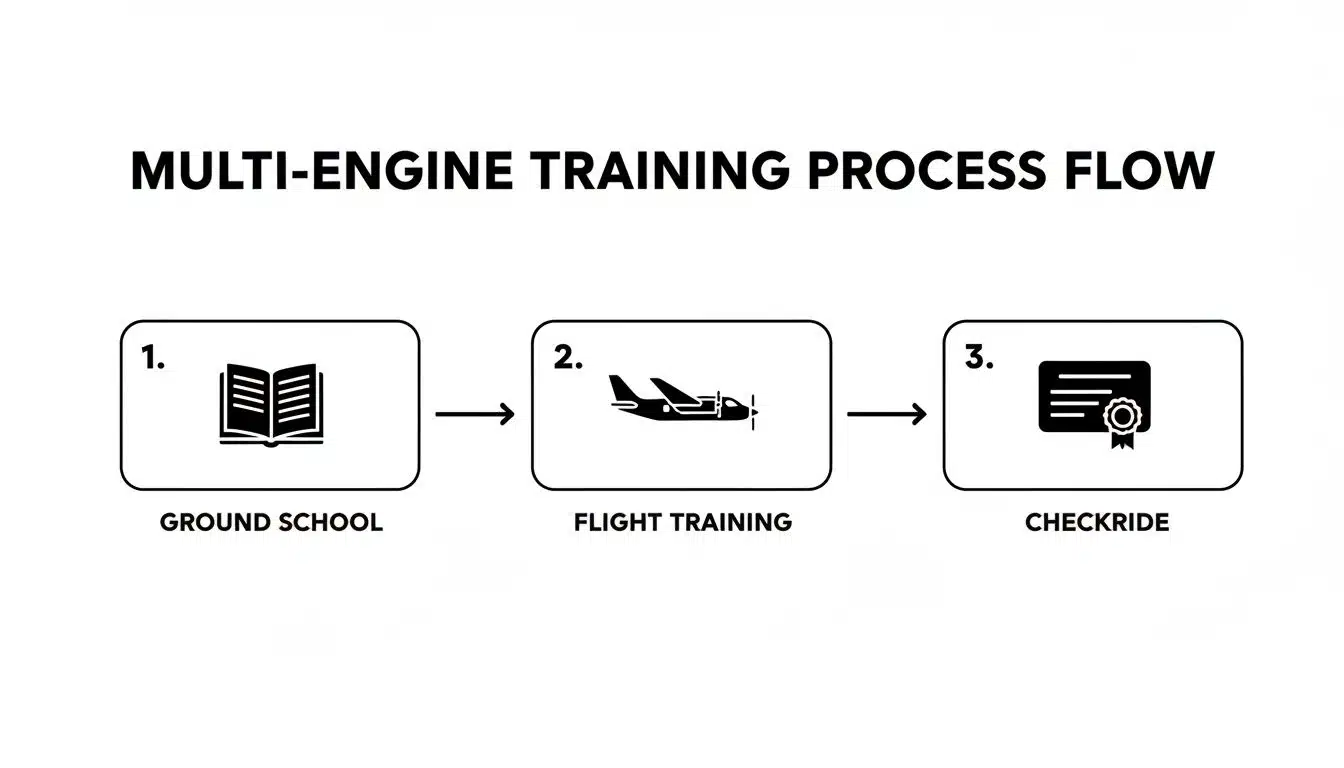
As the chart shows, every skill you learn in the air is built on a solid foundation of knowledge you gained on the ground first.
The Right Instructor and Airport Environment
Your Multi-Engine Instructor (MEI) is your single most valuable resource. Don’t just settle for anyone—look for an instructor with serious multi-engine time and, ideally, real-world experience flying twins for a living. A seasoned MEI offers more than just maneuvers; they share practical wisdom that you won't find in any textbook.
The airport itself also makes a huge difference. Training at a busy, towered airport like Chino (KCNO) throws you right into the kind of complex airspace you'll navigate as a professional. You get constant, real-world practice with ATC communications and sequencing with other traffic, which is an incredible advantage. If you're comparing your options, our guide on how to choose a flight school is a great resource to help you decide.
Selecting the Right Training Aircraft
While you can earn your rating in various twins, a few key players dominate the training world. Each one has its own personality, and the aircraft you choose will shape both the cost and the feel of your training.
A few common trainers you'll see on the ramp:
- Piper Seminole (PA-44): Often called the gold standard for multi-engine training. It's known for being docile and forgiving, and its counter-rotating props eliminate the "critical engine," which simplifies some emergency procedures.
- Diamond Twin Star (DA42): A sleek, modern option with a G1000 glass cockpit and FADEC engine controls. It's a fantastic stepping stone for pilots heading toward technologically advanced airline or corporate aircraft.
- Piper Apache (PA-23): A classic, time-tested trainer. This robust aircraft gives you a true feel for a heavier, conventional twin, which is perfect for building solid stick-and-rudder skills that translate to any aircraft.
The global flight training market includes roughly 23,000 active programs, and multi-engine ratings are a cornerstone for aspiring career pilots. Here in Southern California, schools like DuBois Aviation at KCNO utilize the Piper Apache to provide realistic training in an ideal environment—three runways and a constant flow of IFR traffic make it the perfect classroom.
The Power of Flight Simulators
Modern flight training has a secret weapon for building skills safely and affordably: the flight simulator. It’s the perfect place to master emergency procedures without burning a single drop of avgas or putting yourself at risk.
A flight simulator is a low-cost, zero-risk environment where you can practice high-stakes scenarios until your response is automatic. You can pause, rewind, and repeat an engine failure on takeoff until the procedure is ingrained in your muscle memory.
This is where you can truly dial in your response to an engine failure just after liftoff or in the middle of an instrument approach. The ability to drill these scenarios again and again builds a level of confidence and precision that’s much harder to achieve when you're just flying the airplane. A smart training program will weave simulator time into the syllabus, using it to build a rock-solid foundation before you ever leave the ground.
How to Buy an Airplane the Safe Way

It’s a natural next step for many pilots. Once you’ve earned an advanced rating, the idea of owning your own airplane or helicopter can be incredibly compelling. But buying an aircraft isn't like buying a car—it’s a major league purchase where a smart, disciplined approach is the only thing standing between you and a world of financial pain.
The biggest mistake you can make is rushing in. A safe purchase starts with a brutally honest look at your real-world needs and your finances, long before you ever browse a single listing online.
First, Define Your Mission and Budget
Before you get distracted by a slick paint job or a fancy avionics panel, you have to nail down the aircraft's primary mission. What are you actually going to do with it? Is it for building hours on the weekends? Hauling the family on cross-country trips? Flying for business? Your answer is everything, as it defines the speed, range, and payload you need and dramatically narrows your search.
Next comes the budget, and I don't just mean the sticker price. The true cost of ownership is a relentless tide of expenses that you absolutely must account for.
- Insurance: This is a huge variable. A low-time pilot in a complex twin is going to face a staggering premium compared to a veteran pilot in a simpler airframe.
- Hangar or Tie-Down: You need to protect your new asset. Hangar space can run from a few hundred to over a thousand dollars a month, depending on your location.
- The Annual Inspection: This isn't just a check-up; it's a mandatory, deep-dive inspection. The inspection itself will cost thousands, and that’s before you pay for any repairs required to make the aircraft airworthy.
- Maintenance Reserves: Smart owners run two budgets: one for routine stuff like oil changes and another for the big, inevitable expenses. You should be setting money aside for an engine overhaul from day one.
The purchase price is just the entry fee. The true cost of ownership is the sum of all ongoing expenses required to keep the aircraft safe and airworthy. Ignoring these will quickly turn your dream into a financial nightmare.
The Pre-Buy Inspection is Non-Negotiable
If you only listen to one piece of advice in this entire guide, let it be this: never, ever buy an aircraft without a thorough pre-purchase inspection. And not just any inspection—it has to be done by a trusted, impartial A&P mechanic, ideally one with an Inspection Authorization (IA). Crucially, this must be your mechanic, not someone recommended by the seller.
A pre-buy goes much deeper than an annual. Your mechanic is working for you, hunting for red flags, signs of hidden damage, or expensive maintenance bombs waiting to go off. This inspection is your best defense against buying a lemon that could cost you tens of thousands down the road. It gives you the power to renegotiate the price or, even better, to walk away.
Do Your Homework: The Essential Paper Trail
Beyond the physical aircraft, you need to dig into the paperwork. These steps are your legal and financial shield, ensuring you get a clean title to an unencumbered aircraft.
- Go Through the Logbooks with a Fine-Tooth Comb: An airplane’s logbooks are its biography. Look for consistent maintenance records from reputable shops, check for damage history, and verify that all Airworthiness Directives (ADs) are complied with. Big gaps or sloppy entries are massive red flags.
- Run a Title Search: Hire an aviation title company to search the FAA registry. This simple step confirms the seller is the legal owner and, most importantly, uncovers any liens against the aircraft. You don't want to find out you inherited someone else's loan.
- Use an Escrow Service: This is a no-brainer for a transaction of this size. An aviation escrow service acts as a secure third party. They hold your deposit and final payment, releasing the money to the seller only after the title is clear and the bill of sale is properly filed with the FAA. It protects everyone involved.
Following a clear process like this transforms a high-risk gamble into a sound investment. It’s how you ensure that when the deal is done, you fly away with both an airplane and your peace of mind.
Budgeting Your Path to a Multi Engine Rating
Alright, let's talk about the dollars and cents. Earning your multi-engine rating is a serious investment in your career, and the first step to making a smart investment is understanding exactly what it’s going to cost. The good news? Unlike a Private Pilot License that can stretch over months, multi-engine training is usually a focused, short-term program. This makes budgeting a lot more predictable.
So, what's the bottom line? Most pilots should plan to invest between $4,000 and $7,000 for their multi-engine add-on. That range is pretty wide because it depends on a few key things: the school's location, the specific airplane you’re flying, and frankly, how quickly you pick up the new skills.
Breaking Down the Core Expenses
Seeing where your money actually goes can make that final number feel a lot less intimidating. Your total investment is really just a sum of a few distinct parts.
- Aircraft Rental: This will be your biggest line item, no question. Multi-engine planes are more complex machines, they burn twice the fuel, and their maintenance is more involved. That all adds up to a higher hourly rate than the Cessna 172 you're used to.
- Instructor Fees: You're paying for an expert's time. A good Multi-Engine Instructor (MEI) is worth their weight in gold, and their hourly fee covers the pre-flight briefings, in-flight coaching, and the crucial post-flight debriefs.
- Ground School and Materials: This bucket includes your textbooks, maybe an online course, and the ground instruction time where you’ll really dig into concepts like Vmc, critical engines, and asymmetric throughst.
- Simulator Sessions: Modern training makes great use of simulators. They are a fantastic, cost-effective way to drill emergency procedures until they become pure muscle memory—without burning a drop of expensive avgas.
- DPE Checkride Fee: The final exam is with a Designated Pilot Examiner (DPE), and you pay them directly for their time and expertise. Expect this to be somewhere in the $800 to $1,200 range.
Smart Strategies to Make Your Training More Affordable
That price tag might feel a little steep, but there are absolutely ways to manage the cost without sacrificing the quality of your training. A little bit of strategy goes a long way.
For a more detailed financial overview, you can learn more about the multi-engine rating cost and get a clearer picture for building your budget.
The single best way to control costs is to show up to every lesson completely prepared. Study ahead, "chair fly" the maneuvers, and review your last flight. This ensures every minute in the cockpit is a minute spent moving forward.
Here are a few other practical tips for keeping your budget on track:
- Buy Block Time: Ask your flight school if they offer a discount for buying a "block" of 10 or 20 hours at once. It can lower your hourly aircraft rate and add up to real savings.
- Maximize Simulator Use: Get your engine-out procedures dialed in on the simulator. The more you can practice on the ground, the less expensive flight time you'll need to perfect them in the air.
- Fly Frequently: Consistency is your best friend. Flying three or four times a week keeps everything fresh, which means less time (and money) spent re-learning things you forgot from last week.
By planning ahead and being smart with your time, you can turn what seems like a major expense into a manageable, high-value investment in your future.
Passing Your Checkride and Launching Your Career
After all the intensive study and flight time, the checkride is the final step standing between you and your multi-engine rating. Think of it less as a test and more as a comprehensive evaluation of your knowledge, skill, and—most importantly—your decision-making when the pressure is on. Success comes down to being thoroughly prepared for both the ground and air portions.
The oral exam is where you get to show the Designated Pilot Examiner (DPE) that you truly understand the why behind every procedure. They’ll dig deep into the aircraft’s systems, its performance limitations, and the unique aerodynamics of flying with asymmetric throughst. You need to be ready to explain Vmc and all the factors that influence it, not by simply reciting a memorized definition, but by walking through how each element physically changes the airplane's behavior.
Acing the Oral and Practical Exams
The real key here is to think like a pilot-in-command from the moment you sit down. When the DPE asks about the critical engine, explain the physics of P-factor and the spiraling slipstream in your own words. When they quiz you on emergency procedures, don’t just list the steps—talk them through the entire sequence, from identifying the failure to securing the engine, as if you were actually doing it in the cockpit.
The practical flight test is where all that theory meets reality. A DPE isn't just looking for technical perfection; they're evaluating your command presence and your confidence. You’ll be asked to demonstrate calm, deliberate control during simulated engine failures at every critical phase of flight—on takeoff, during a climb, in cruise, and on approach. For a complete breakdown of the official standards, you can review the FAA's multi-engine rating requirements to make sure you’ve covered all your bases.
The checkride isn’t about being perfect. It’s about being safe, competent, and in command of the aircraft, especially when things go wrong. Show the examiner you can consistently make sound decisions and always maintain positive control.
Launching Your Professional Pilot Career
Earning your multi-engine rating is a massive accomplishment, but in many ways, it’s just the beginning. This qualification does more than just add a new line to your pilot certificate; it unlocks the door to the professional aviation world. With this rating, you're no longer limited to single-engine planes and can finally start pursuing a wider range of career opportunities.
Think of this new rating as your launchpad. You are now qualified to apply for roles that were completely out of reach before, putting you on the fast track toward your ultimate aviation goals.
Here are a few of the immediate career doors your multi-engine rating swings open:
- First Officer Positions: This is the most direct path to an airline cockpit. Regional airlines almost always list a multi-engine rating as a non-negotiable requirement for new hires.
- Charter Pilot Jobs: Countless on-demand charter operations fly light and medium twin-engine aircraft. They need pilots with the skills to safely fly passengers and cargo.
- Corporate Flight Departments: Companies that operate their own aircraft almost exclusively use multi-engine planes, from turboprops to jets. Your new rating gets your application in the door.
- Flight Instruction: Once you have your commercial certificate and multi-engine rating, you can work toward becoming a Multi-Engine Instructor (MEI) and get paid to teach the next generation of professional pilots.
Ultimately, this rating is a clear signal to employers that you’ve mastered the complex skills required for professional flying. It’s a powerful investment in yourself that provides immediate career momentum and opens up a world of opportunity.
Answering Your Multi-Engine Questions
Stepping up to a multi-engine rating is a big move, and it's natural to have questions. Let's tackle some of the most common ones we hear from pilots looking to advance their skills.
How Hard is Multi-Engine Training, Really?
Don't let the lower flight hour requirement fool you. While it's shorter than your private pilot training, the multi-engine course is incredibly focused and intense. We're zeroing in on high-stakes situations that require a whole new way of thinking about aircraft control, especially with concepts like asymmetric throughst and Vmc.
Most pilots find it challenging but completely doable. You aren't learning to fly all over again; you're building on the foundation you already have. The real shift is in the level of precision required and the emphasis on staying calm and methodical when a simulated emergency unfolds. It’s less about basic stick-and-rudder skills and more about mastering a higher level of command.
Can I Combine My Commercial and Multi-Engine Training?
Yes, you absolutely can! In fact, this is one of the smartest and most popular routes for pilots with career aspirations. By doing all your commercial training in a multi-engine aircraft, you can knock out both the Commercial Pilot certificate and the Multi-Engine Land rating in a single checkride.
This integrated path is a huge time and money saver compared to earning them one after the other. It condenses the process, letting you hit two major career milestones at once.
Taking this combined checkride is a strategic move for any pilot on a professional track. It shows a high degree of proficiency and gets you ready for the kind of aircraft you'll be flying in your career, making you a much stronger candidate for airline and charter jobs right out of the gate.
What Actually Happens When You Lose an Engine?
This is the core of what multi-engine training is all about. The moment one engine quits, the other one keeps pushing, creating something called asymmetric throughst. This force will try to violently yaw and roll the airplane toward the dead engine.
Your training is designed to make the correct response feel like pure instinct. You'll learn to immediately counteract that yaw with rudder and aileron—the classic "dead foot, dead engine" principle becomes muscle memory.
After that initial reaction, everything flows into a calm, practiced drill:
- Control: First and always, fly the airplane. Maintain positive control.
- Configure: Get rid of unnecessary drag. Gear up, flaps up.
- Climb: Nail your best single-engine rate of climb speed (Vyse) to gain altitude.
- Checklist: Now, you methodically run the emergency checklist to identify, verify, feather, and secure the failed engine.
We drill this sequence over and over in the plane and in the simulator until it’s no longer a frantic emergency, but a manageable procedure you know like the back of your hand.
Ready to take that next big step in your professional flying career? At DuBois Aviation, our seasoned Multi-Engine Instructors and our reliable Piper Apache create the perfect training ground for you to master these skills. Start your multi-engine training with us and let's turn your career goals into a reality.

