
A lot of pilots run into the same moment. You're planning a shoreline hop, a Catalina leg, a photo flight along the coast, or a helicopter route that spends enough time over water to make you pause over the gear question. The airplane is legal, the weather is acceptable, and the route is familiar. Then the practical question lands: What exactly do I need for life jackets, and what would help if this flight goes bad?
That question matters more than many pilots admit. Overwater planning is where legal compliance, command judgment, and survival all meet. In training environments, rental operations, and scenic flights, I've seen the same mistake repeated in different forms. People treat flotation gear as a box to check rather than a system to use.
The hard truth is that water survival usually punishes delay. In boating, the pattern is already obvious. In U.S. recreational boating accidents in 2020, 75% of fatal accident victims drowned, and of those, 86% were not wearing a life jacket, according to the U.S. boating fatality data summarized in the Water Safety Plan action database. Aviation ditching isn't boating, but the lesson carries over cleanly. A flotation device that isn't on the person, usable, and understood by the occupant can fail at the only moment that matters.
Pilots who plan carefully already know this mindset from fuel, alternates, and route selection. Overwater equipment deserves the same discipline. If you're building a route, your flotation plan should sit right alongside your weather brief and VFR cross-country flight planning workflow.
The Overwater Question Every Pilot Faces
A common general aviation scenario looks harmless on paper. A pilot rents a Cherokee for a coastal sightseeing flight. Another takes a Robinson out for a shoreline tour. A buyer evaluating an airplane or helicopter asks for a demonstration route that cuts across water because it's shorter and smoother. Nobody expects a ditching. That's exactly why this topic gets mishandled.
Why the rule matters more than the minimum
Life jacket regulations matter because they force a pilot to answer a more serious question than “Am I legal?” The critical question is, if the engine quits at the worst spot, can everyone get out and stay alive long enough to be found?
That changes how a professional pilot thinks about equipment. The vest isn't just required gear. It's part of the emergency egress plan, the passenger briefing, and the survival plan after impact.
Practical rule: If your overwater setup only works when everyone stays calm, has both hands free, and has extra time, it isn't a strong setup.
Where pilots get tripped up
The most common weak points are predictable:
- Stowed too deep: A vest packed behind baggage or under another seat may satisfy somebody's idea of carriage, but it won't help during a rushed evacuation.
- Wrong kind of device: A bulky boating vest can interfere with cockpit movement and may not be the right approved equipment for aviation use.
- No passenger practice: Passengers nod during the briefing, then freeze when asked to point to their gear or explain inflation.
- No mission-specific thinking: A scenic flight over a bay, a training leg near the coast, and a helicopter photo mission don't create the same risk picture.
For pilots buying an aircraft, this is worth checking before money changes hands. Equipment condition, placards, survival gear, and overwater suitability should be part of the same disciplined review you'd use for maintenance records and operating limitations.
Decoding the FARs on Life Jacket Requirements
Pilots often hear fragments of the rule and build the wrong mental model around them. The cleaner way to handle life jacket regulations is to start with the operation, then the route, then the occupants.
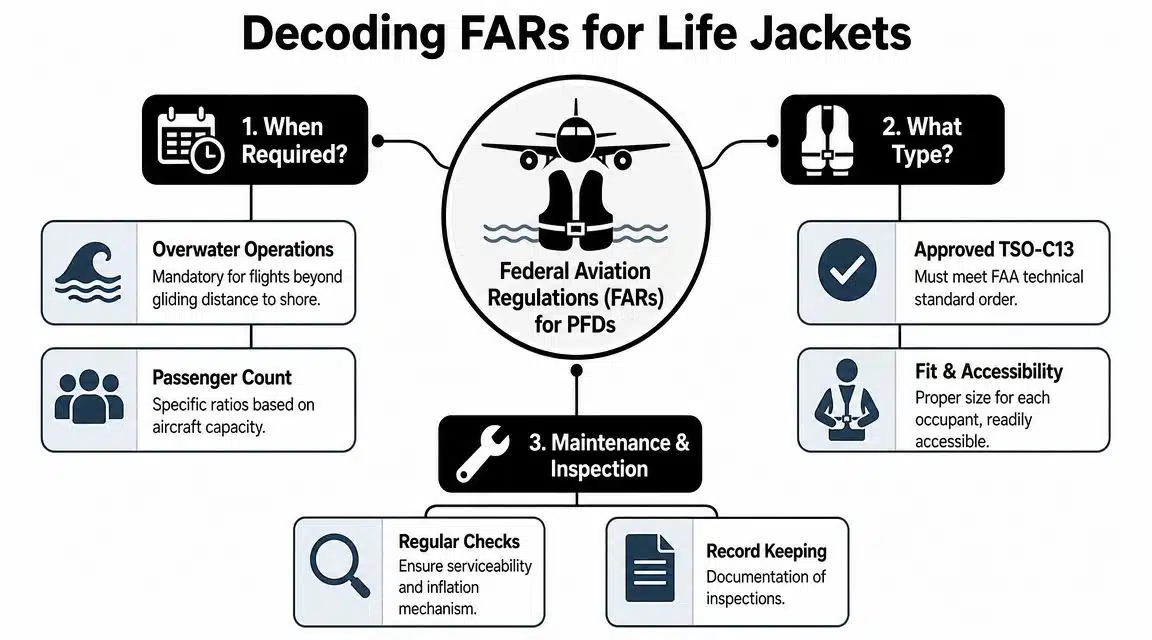
Start with the kind of flight
For most pilots reading this, the first split is simple:
- Private GA under Part 91
- Operations for hire or commercial carriage
- Specialized operator procedures with additional company requirements
That distinction matters because the farther you move from private personal flying and into commercial service, the less room there is for casual interpretation. Flight schools, renters, scenic operators, and charter crews should all know which standard governs the flight before dispatch.
Use a cockpit decision framework
A practical cockpit-level decision tree looks like this:
| Question | Why it matters |
|---|---|
| Are you going beyond power-off gliding distance from shore? | That's a key trigger in overwater planning. |
| Are passengers carried for hire? | Commercial and for-hire operations can bring stricter equipment expectations. |
| What aircraft and route are involved? | Helicopter coastal work, island legs, and fixed-wing sightseeing profiles create different egress problems. |
| Can each occupant reach the device immediately? | Accessibility is a safety issue, not just a storage issue. |
If you fly in a school or rental environment, write this into dispatch and release procedures. Don't leave it to memory or habit.
The practical reading of the rule
Pilots get hung up on exact wording and miss the operational meaning. “Beyond power-off gliding distance from shore” isn't abstract. It asks you to picture the aircraft at the worst point on the route, with no engine, no delay, and no optimism.
If that glide won't get you to land, treat flotation equipment as active survival gear. That's the right mindset even before you get into stricter requirements that apply to some commercial operations, where life rafts and additional survival equipment may also enter the picture depending on the route and operation.
The pilot who waits to solve the flotation problem after takeoff has already solved it badly.
What schools and renters should standardize
For practical use, flight departments and clubs should define overwater triggers in plain language:
- Route trigger: Any dispatch route with a segment beyond glide range of shore.
- Occupant trigger: One suitable device for each person, sized and assigned.
- Briefing trigger: No departure until the passenger can identify and describe basic use.
- Inspection trigger: Inflatable units checked before the flight, not assumed serviceable because they're in the airplane.
That's how life jacket regulations become usable. You convert legal language into a repeatable dispatch habit.
Choosing the Right PFD for Your Aircraft
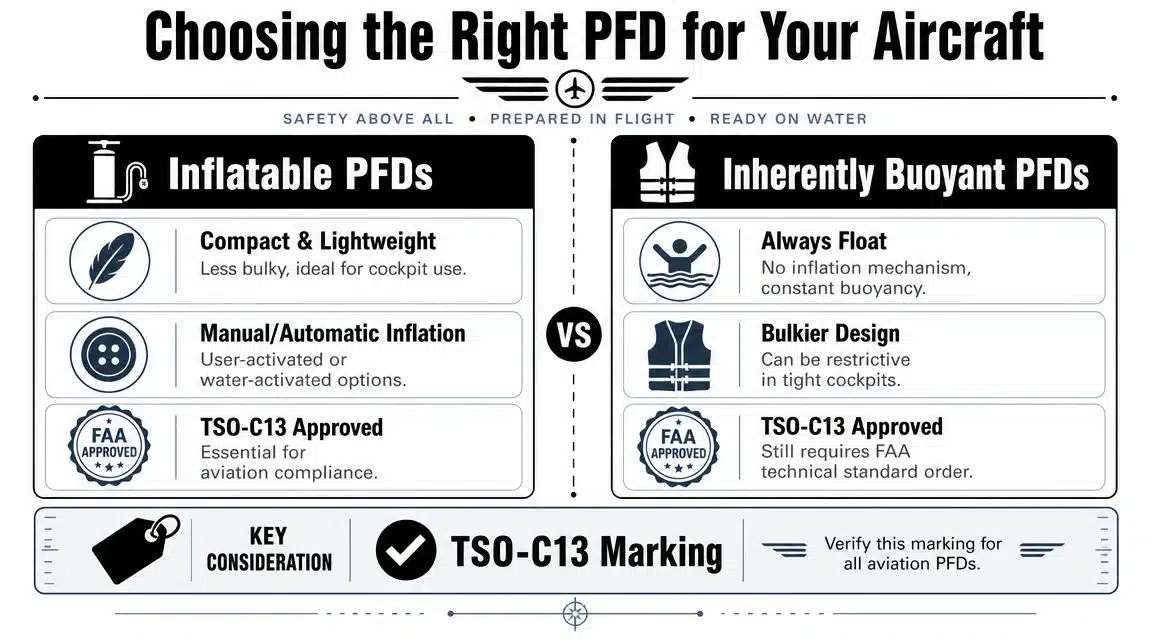
Not every flotation device belongs in an aircraft. Some are too bulky for the cockpit. Some create poor egress dynamics. Some may be acceptable in a boating context but still be the wrong answer for aviation. When pilots shop for gear, they should think in terms of approval, cockpit compatibility, inflation method, and ease of use under stress.
What buoyancy means in the real world
A lot of buyers assume more flotation always means better gear. That's incomplete. The device has to keep the airway clear, but it also has to be wearable in a confined cockpit and usable during an emergency. The U.S. Coast Guard notes that most adults need only about 7 to 12 lb of extra buoyancy to keep the head above water, and that approved wearable PFDs are labeled by performance level, with Level 70 providing about 15 lb of buoyancy, as explained in the USCG life jacket wear guidance.
That principle matters to pilots because aviation vests also live in a world of performance standards and mission suitability. More bulk can reduce wearability. Less bulk can improve compliance, but only if the device still meets the intended use.
Comparing the main options
Here's the practical trade-off:
- Constant-wear inflatable vests: These are popular for helicopter crews and pilots who want the device already on the body. They support the “wear, don't just carry” mindset. The downside is cost and the need for consistent inspection discipline.
- Pouch-style inflatable vests: Common in general aviation because they're compact and less intrusive in small cabins. They can work well if every occupant knows exactly how to don them and when to inflate.
- Buoyant vests: Simple and always floating, with no inflation mechanism to arm or maintain. Their biggest drawback is bulk. In a tight cockpit or cabin, that bulk can interfere with movement, seat belts, and exits.
What not to buy for airplane use
A standard fishing or boating vest may look like a bargain, but it can be the wrong choice operationally. If it's thick enough to change how the pilot fits behind the controls, reaches the flap lever, rotates the torso, or squeezes through a door after impact, it has introduced a new problem.
For aircraft buyers and operators, the best purchase isn't the cheapest vest on the shelf. It's the one people will wear, inspect, and understand. That usually means selecting a device that fits the aircraft, the route, and the likely occupants, not just the regulation.
Buy the PFD for the exit you may have to make, not for the shelf where it will sit.
Carriage vs Wearing A Critical Safety Distinction
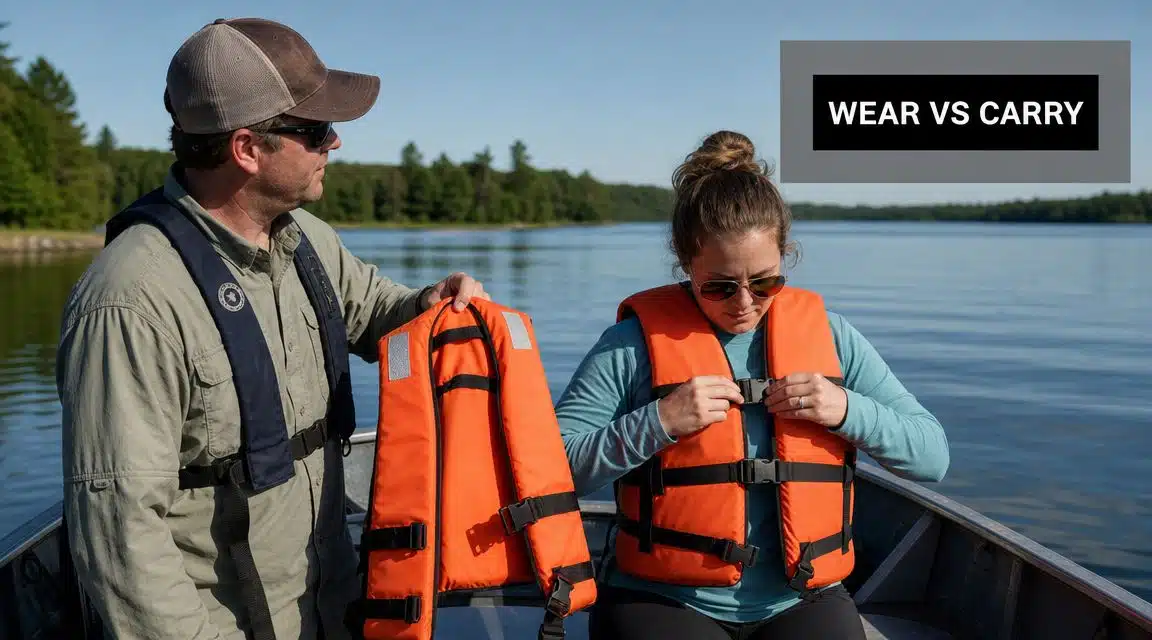
This is the part many pilots don't like hearing. Carrying a life jacket and wearing one are not equivalent safety choices. In a lot of overwater flying, carriage is the legal floor. It isn't the practical standard I'd want for myself or for passengers I'm responsible for.
Why accessible is a harder standard than it sounds
“Readily accessible” sounds easy until you think through a ditching sequence. Noise goes up. Time goes down. The cockpit may be tilted, dark, flooded, or jammed. A passenger who has never opened the pouch before may pull on the wrong tab or trap the vest in a seat belt.
That's why I push pilots to treat wear as the default for meaningful overwater exposure. If a vest is on the body, fitted, and understood, you've eliminated several failure points at once.
What boating data tells us about behavior
Boating data captures a problem aviation also faces. Utah's boating safety guidance says 80% of people who drowned in boating accidents would have survived had they been wearing a life jacket, according to the Utah life jacket safety page. That isn't an aviation statistic, but it is a sharp reminder that “on board” and “protecting the occupant” are not the same thing.
The behavioral gap matters because pilots are adults making adult excuses. We tell ourselves the vest is nearby, conditions are calm, the route is short, or we'll have time. Those are exactly the assumptions accidents punish.
A stronger standard for pilots
On overwater flights, the better practice is simple:
- Pilot wears the vest before engine start: Especially in single-pilot operations, there may be no spare attention left during an emergency.
- Passengers either wear or stage for immediate donning: The closer the route gets to meaningful water exposure, the less sense it makes to leave gear buried.
- No inflation inside the aircraft: This has to be explicit in every briefing.
- Check serviceability during preflight: Treat it like any other emergency item.
A good preflight discipline helps here. If you already run a deliberate Cessna 172 pre-flight check routine, the PFD inspection belongs in the same mindset, not as an afterthought.
What to inspect on an inflatable PFD
Inflatables earn their place by being compact. They also demand more discipline. A useful walk-around check includes:
- Gas cartridge present and full: If the cartridge is missing or spent, the vest may look fine and still fail.
- Status indicator functional: The indicator should show the inflation mechanism is properly armed.
- Oral inflation tube intact: That backup matters.
- Fabric, straps, and closures in good condition: Wear points and damage count.
- Approval and instructions legible: If nobody can verify what it is or how it works, that's a problem.
A vest shoved in a side pocket for months tends to become imaginary equipment. The pilot assumes it's there and serviceable. That assumption isn't safety management.
Mastering the Overwater Passenger Safety Briefing
Passengers don't rise to the level of the emergency. They fall to the level of the briefing they received. If the only instruction they hear is “life jackets are under the seat,” you haven't briefed them. You've pointed at an object.
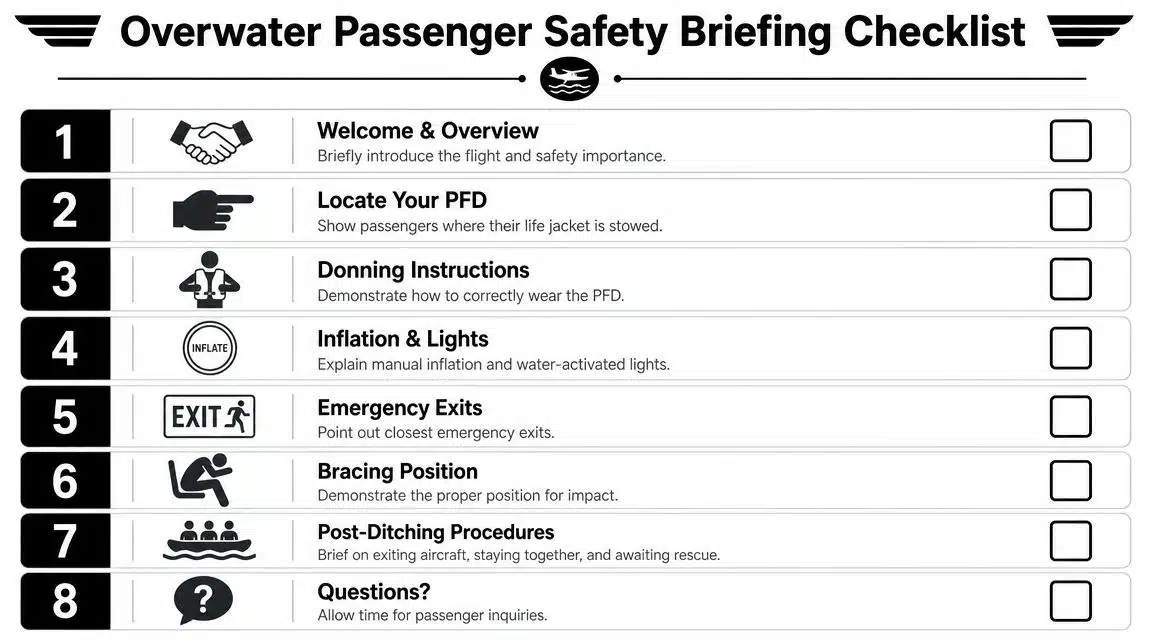
Early in the briefing, a visual checklist helps keep the essentials from getting skipped.
What the briefing must include
A useful overwater briefing covers these points in plain language:
Location of each PFD
Don't gesture vaguely. Physically show the assigned device for each passenger.How to remove it from storage
Some people get stuck before they even put the vest on.How to don it
Demonstrate the head opening, straps, and where the inflation handle is.When not to inflate
Say this clearly: do not inflate inside the aircraft.Exit location and sequence
People need to know which door, handle, or push-out window matters to them.Brace and impact posture
Keep it short and specific.What to do after exit
Stay together if possible. Clear the aircraft. Inflate when outside.Questions and confirmation
Ask the passenger to show or tell you what they'll do.
A briefing script that works
I prefer direct language:
Your life vest is here. Take it out like this, put it over your head like this, and tighten it here. Do not inflate it inside the aircraft. If we have to ditch, get out first, then inflate once you're clear.
That's not elegant. It's effective.
Later in training, crew coordination becomes part of this. The same habits that improve communication in abnormal procedures also improve overwater survival briefings, which is why a lot of pilots benefit from stronger crew resource management habits.
A demonstration video can also reinforce what words alone don't stick.
Why hands-on beats verbal only
A passenger who physically touches the vest, finds the inflation handle, and points to the exit is far more useful than a passenger who says, “Got it.” In flight schools and scenic operations, this is one of the easiest places to improve actual survivability without buying more hardware.
Best Practices for Flight Schools and Operators
For schools, rental fleets, and operators, life jacket regulations shouldn't live in a binder nobody reads. They should appear in dispatch decisions, checklist design, training standards, and maintenance tracking.
Build policy around missions, not assumptions
The cleanest operators define when flotation gear is required based on route and operation type. Don't rely on individual instructors or renters to interpret overwater exposure from scratch every time. Put it in writing.
Useful policy items include:
- Student solo guidance: Define when a solo student may dispatch on a route with overwater exposure and what equipment is mandatory.
- Rental agreement language: Require the renter to acknowledge flotation equipment policy, inspection responsibility, and passenger briefing expectations.
- Aircraft assignment logic: Some aircraft are better suited to overwater operations because the cabin, exits, and survival gear setup are more practical.
- Buyer demonstration flights: If you sell aircraft or helicopters, standardize how overwater demo flights are equipped and briefed.
Treat PFDs like maintained equipment
Inflatable PFDs are only compliant if properly armed and maintained. That includes a full gas cartridge, a functional status indicator, and adherence to manufacturer service schedules, as noted in West Marine's summary of life jacket serviceability requirements. For operators, the lesson is simple. If the item has an inspection need, it belongs on a tracking system.
A workable program usually includes:
- Assigned serial or inventory tracking
- Inspection intervals recorded with aircraft records or safety logs
- Clear replacement criteria for damaged units
- Placard or checklist references in the cockpit or dispatch paperwork
A vest with no inspection record is maintenance deferred by silence.
Train the habit, not just the rule
The strongest safety programs rehearse the sequence. Pilots should practice how to brief, don, verify, and respond after ditching. Simulators and dry drills help because they build order and speed without creating real risk.
This is also where technology can help. Tools that organize procedures, reinforce briefings, and support scenario-based decision making can strengthen operator discipline. For a broader look at that side of training, see how PilotGPT enhances pilot safety.
Frequently Asked Aviation PFD Questions
Are life jackets required over large lakes or rivers
Sometimes yes, sometimes no. The key practical trigger is whether the route puts you beyond power-off gliding distance from shore. The size of the water itself isn't the whole question. Your route geometry, altitude, aircraft performance, and shoreline options matter.
Can I use my own boating life jacket in an airplane
Not as a default answer. Pilots should use aviation-appropriate, approved equipment rather than assuming a recreational boating vest is acceptable. Even when a non-aviation vest floats well, it may be a poor cockpit fit and a weak egress choice.
Do passengers need the same briefing every time
Yes, if they're not trained and current in that equipment. Familiar passengers often become the least attentive. That's a human factor problem, not a knowledge problem.
What about seaplanes
Seaplanes don't get a free pass on risk just because they operate on water. The same disciplined thinking applies. Occupants still need the right flotation equipment, the right briefing, and a plan that works during actual egress.
Why do adults tend to get this wrong
Because adults often choose convenience over wear discipline. In recreational settings, wear rates can split sharply by age. UL reports that children ages 6 to 12 reached a 75% wear rate, while adult wear rates were 29% in the observed Canadian data, as summarized by UL's review of personal flotation device safety statistics. Pilots should recognize that same tendency in themselves and correct for it before the flight.
If you want training that treats risk management as a cockpit skill instead of a checklist slogan, DuBois Aviation offers airplane and helicopter instruction, rentals, and guided proficiency development built around practical decision-making.