
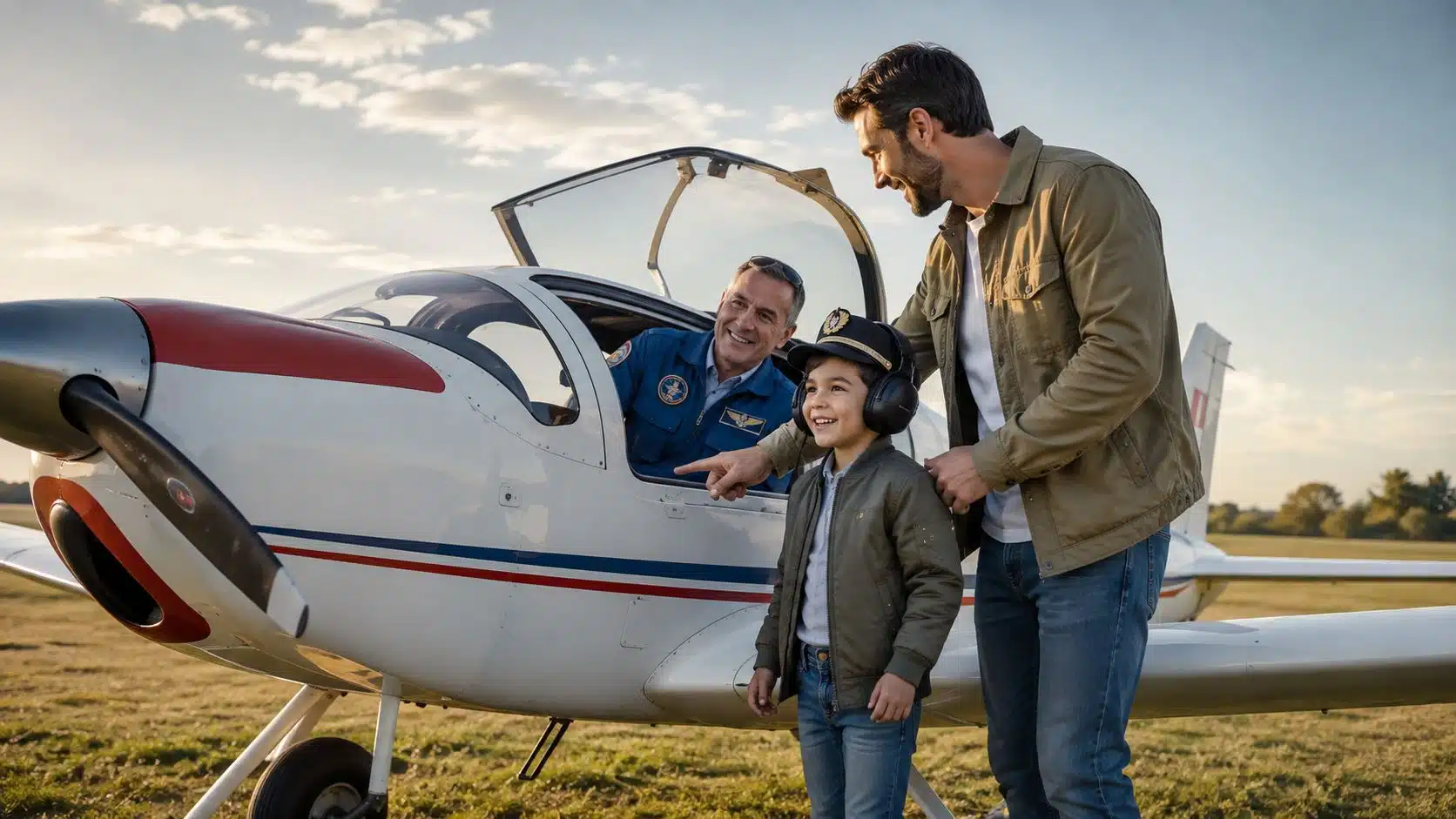
A parent usually starts this search for a very ordinary reason. Your kid sees a small plane turning onto final at Chino, asks how it works, and suddenly you're trying to figure out whether free flights for kids means a local cockpit ride, an airline promo, or something meant for medical travel.
The confusing part is that all three show up in the same search results, but they solve different problems. If you want a memorable first airplane experience, a nonprofit discovery flight is the right lane. If you want a discounted vacation trick, airline promotions are a narrow fit. If you're trying to get a child to treatment, the free-flight market looks completely different. Families who also care about making the day feel special will find useful ideas in making travel memorable with children, but the key is matching the right flight type to the right need.
Table of Contents
- Why Parents Start Looking for Free Flights for Kids
- The Main Free Flight Pathways at a Glance
- How to Apply, Book, and Prepare for a Free Flight
- Safety, Consent, and Insurance Considerations Parents Should Know
- Working with a Local Flight School or Operator Near Chino
- Free Isn't the Only Path, Affordable Next Steps for Kids Who Want More
Why Parents Start Looking for Free Flights for Kids
A lot of parents do not start with a spreadsheet. They start at the fence line at a local airport, with a kid watching a trainer airplane taxi out and asking, “Can I do that too?” That is usually when the search for free flights for kids begins, and it is usually about a first cockpit experience, not a family vacation.
The market is messy because the phrase covers three different realities. One is a short introductory flight at a local airport, often run by volunteers or youth aviation groups. Another is a narrow airline promo that can cut the cost for a child, but only on limited routes and under strict conditions. The third is free air transport tied to medical need or charity travel, which belongs in a different category from leisure travel.
The kid at the fence is usually not asking for a vacation
At Chino, I have seen this play out plenty of times. A parent thinks they need to “book a flight for the kid,” but what the child really wants is a first look inside the cockpit, a headset on, and a few minutes on the controls with an instructor who knows how to make the experience feel real. That is discovery, not travel.
The clearest benchmark in this space is the EAA's Young Eagles program. It has long been the standard for a simple introductory ride, and as noted earlier, it is the one place in this article where that youth-flight model is spelled out in detail. The point is not a transportation subsidy. The point is a first exposure to general aviation that can turn into a serious interest in flying.
Once you identify which lane applies, the booking process for each category follows a very different timeline.
Families should also be honest about the trade-offs before they start calling around. A supervised youth flight at a local airport has a different feel from an unsupervised promo fare, and both are different again from a medical or charity flight with strict eligibility rules. Insurance, consent, age windows, and local operator policy all matter, and they are the things most national guides gloss over. If your goal is making travel memorable with children, you need the right lane, not just the word “free.”
The best way to think about the category is simple. Families are not shopping for one product, they are choosing between a cockpit experience, a fare rule, and a support service. Once you sort that out, the rest gets easier fast.
The Main Free Flight Pathways at a Glance
The quickest way to sort this market is to ask what kind of flight your child is getting. Parents near Chino Airport usually end up choosing between a supervised youth flight, a membership-based cadet flight, a charity trip tied to need, or a narrow airline promotion with a stack of rules.
Free Flight Programs Compared
| Program | Ages | What the child gets | Key limitation |
|---|---|---|---|
| EAA Young Eagles | 8–17 | Free introductory airplane ride with volunteer pilots | It's a discovery flight, not a vacation ticket |
| Civil Air Patrol orientation flights | Youth cadets | A supervised flight experience tied to squadron participation | Requires membership and local squadron access |
| Volunteer pilot medical-flight organizations | Varies by program | Free flights arranged for medical or charity travel | Eligibility is tied to need, not leisure |
| Frontier Kids Fly Free | Under 15 on eligible bookings | One child flies free with a paid adult Discount Den fare | Select flights only, plus membership and reservation rules |
For a parent near KCNO, the practical question is simple. Do you want a child's first look at general aviation, or do you want help getting to a destination under a fare rule? Those are different products, and the difference matters.
Civil Air Patrol orientation flights are the more supervised option. They fit families who want a youth-organization setting and do not mind the membership structure. If your child responds better to routine, rules, and a known squadron, that path usually feels more controlled than a one-off promotional offer.
The charity flight side belongs in its own bucket. These programs exist for medical or hardship travel, so the child gets transportation tied to a real need, not a sightseeing ride. That is why parents should not treat them as a casual free-flight workaround.
Frontier's Kids Fly Free offer is the only airline promo here, and it comes with strict conditions. Frontier says one child under 15 can fly free for each adult Discount Den fare purchased, the child must be on the same reservation, and the offer applies only to select flights (Frontier Kids Fly Free). Read that as a limited fare tool, not a broad family benefit.
For families who want a true cockpit experience near Chino, the local move is to find a nearby Young Eagles rally and ask how the flight is run that day. Volunteer pilots usually keep the ride short and focused on the basics, which is exactly what works for first-timers. If you want the next step after that, a supervised introductory flight lesson at a local school gives a more hands-on feel than a promo seat on an airline ever will.
How to Apply, Book, and Prepare for a Free Flight
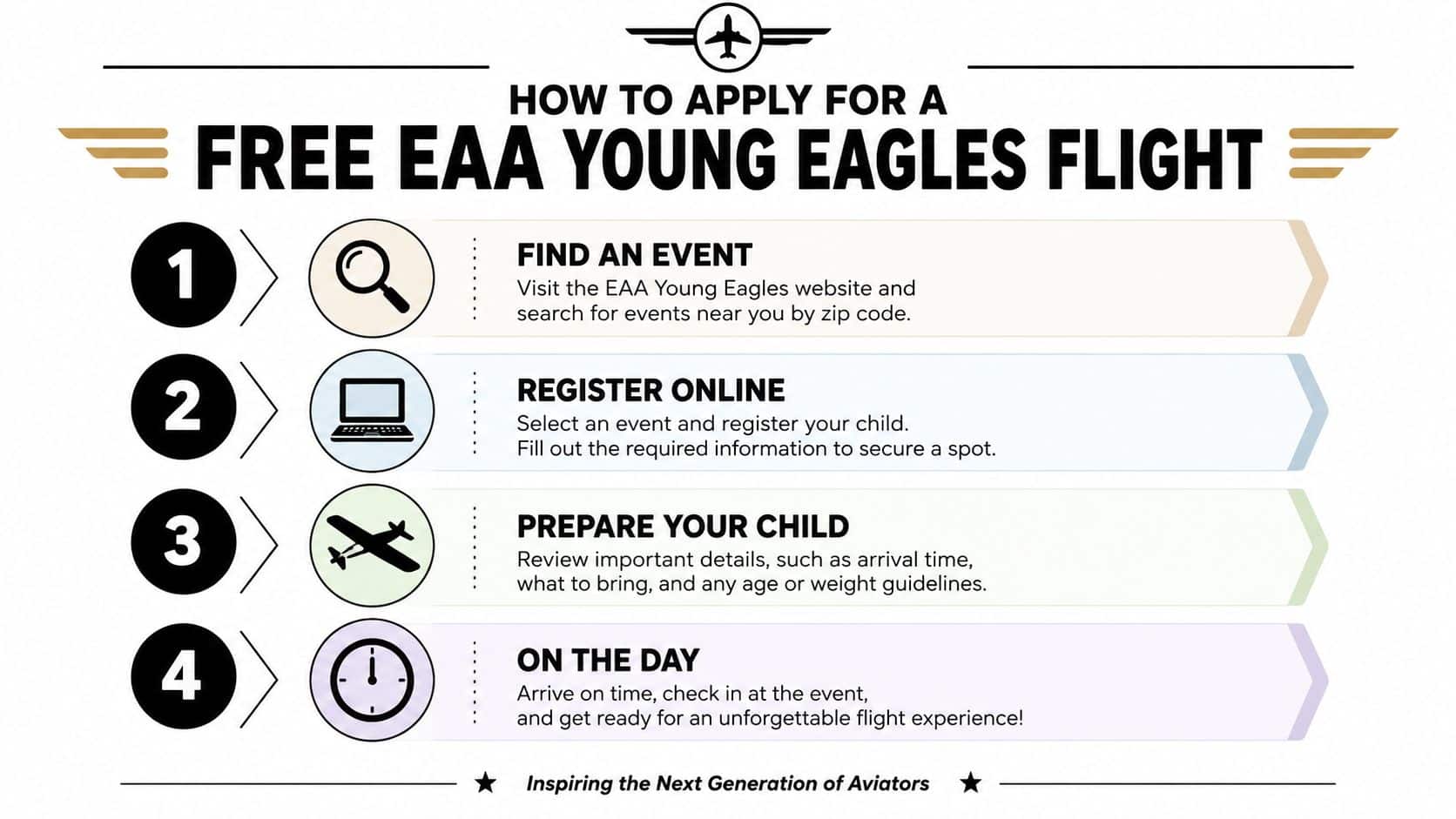
The easiest route for most families is still EAA Young Eagles, because it's built around local events and volunteer pilots rather than a complicated booking engine. Find a nearby rally, register the child, and show up ready for a short preflight briefing. That's the whole shape of it.
The registration part is straightforward, but parents need to treat it seriously. You're signing consent for a minor to fly with a volunteer pilot on a general aviation aircraft, so read every field, confirm the child's age window, and ask where the flight is taking place before you commit. If your child is nervous, tell the organizer in advance so they can explain the experience in plain language instead of overwhelming them on arrival.
What to bring and what to expect
Bring a parent or legal guardian, a calm kid, and clothes that won't get in the way of seatbelts or steps up to the aircraft. Closed-toe shoes are the practical choice at any active airport. A small snack and water help, but don't overpack the child's hands. You want them listening during the ground briefing, not juggling a bag full of distractions.
A basic day-of checklist keeps the whole thing smooth:
- Consent and contact info: make sure the adult signing the form is the adult who'll be there.
- Weather awareness: if the event depends on good flying conditions, be ready for schedule changes.
- Motion-sickness prep: don't hand a kid a giant meal right before the flight.
- Briefing time: show up early enough to listen, ask questions, and settle in.
If you want a local stepping-stone before or after a free ride, a paid introductory lesson can help a child compare “being a passenger” with “being a student.” One practical example is a discovery-flight style lesson through DuBois Aviation's introductory flight lesson, which gives families a direct look at what a first lesson feels like versus a volunteer ride.
Civil Air Patrol is a different booking process. You'll usually work through a local squadron, and that means membership and local participation matter more than quick sign-up speed. The tradeoff is that the experience can feel more embedded in a youth aviation path.
Safety, Consent, and Insurance Considerations Parents Should Know
Parents get nervous here for good reason. A free flight sounds casual, but the adult responsibility doesn't disappear just because the ticket costs nothing. The right question isn't “Is it free?” It's “Who is responsible if something changes, and what protection is in place?”
Ask who the pilot is before you ask about the airplane
Start with the pilot. Find out who's flying, what ratings they hold, and whether the flight is part of an organized youth program or a private arrangement. Then ask what aircraft is being used and whether it's airworthy that day. Finally, ask what happens if the weather changes, the route changes, or the flight gets canceled before takeoff.
That's especially important in volunteer environments, where the organization may carry its own procedures and coverage, but the parent still needs to understand the boundaries. If you're comparing a youth ride with a broader aviation activity, aviation insurance coverage needs is a useful reminder that aircraft use and liability are never one-size-fits-all.
If the organizer can't explain who's operating the flight, what the child is signing, and what happens if the aircraft returns early, keep asking until they can.
The medical-flight side deserves separate treatment. Miracle Flights, for example, serves children who qualify based on financial need and arranges commercial travel for care, which means the screening process is about eligibility, documentation, and actual travel need rather than family entertainment. That distinction matters because many parents casually search for “free flights for kids” when they really need healthcare logistics.
The smartest parent question set is short and blunt:
- Who is legally operating the flight?
- What exactly does my consent cover?
- If this cancels, where does the child stand?
If the answers are clear, you're dealing with a legitimate operation. If they're vague, walk away. Free shouldn't mean fuzzy.
Working with a Local Flight School or Operator Near Chino
A local flight school is where curiosity turns into progress. National programs can give a kid a first ride, but a school at a busy airport like Chino teaches radio work, ramp discipline, and what airplanes do around real traffic. That's the environment where a child stops thinking of aviation as a novelty and starts seeing it as a skill.
What to ask a school before you book anything
Start with the simplest question, “Do you offer introductory flights or youth programs?” Then ask whether the experience is a free ride, a paid discovery flight, or the first lesson in a training sequence. Those are not the same product, and parents need to know which one they're buying.
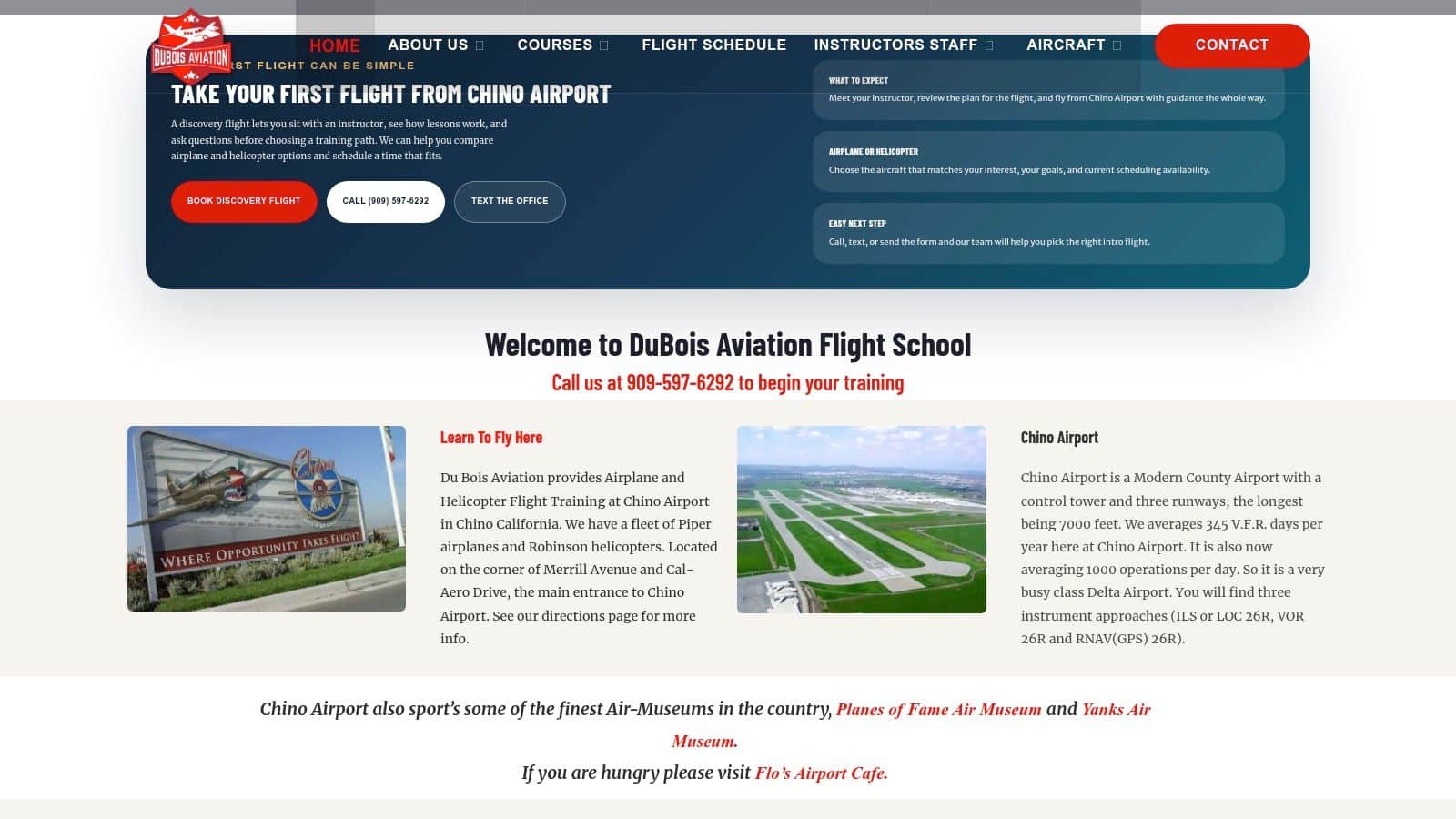
A school like DuBois Aviation at KCNO is a useful example because it sits inside a real towered-airport environment and works across youth and training pathways. The school's Chino Airport flight school page is where I'd send a parent who wants to understand the difference between a one-time introductory experience and a longer training relationship. At a place like that, a child can start with a scenic or introductory experience, then move into camp or structured youth programming if the interest sticks.
The practical difference matters:
- Free introductory ride: usually a short first exposure.
- Paid discovery flight: a longer, more coached experience, often with direct control time.
- First lesson: part of an actual certificate track, with training goals and student progress.
Later in the day, if the kid is still talking about it, you've got real interest. That's when local programs become useful. DuBois Aviation also runs youth Aviation Camp and a Flyers Club, and those are the kinds of programs that let a family keep momentum without jumping straight into a full training bill.
The point of going local is control. You can ask better questions, watch the airport environment, and decide whether your child wants a one-time memory or a long-term aviation path.
Free Isn't the Only Path, Affordable Next Steps for Kids Who Want More
A child who lands one free flight and keeps asking how the airplane turns, what each gauge does, and when they can go back is telling you something real. That is the moment to stop treating aviation as a novelty and start choosing a next step that matches the child's interest, attention span, and age.
The next move should fit the child, not your fantasy of the future
Youth camps are usually the cleanest bridge. They keep the experience hands-on while teaching cockpit vocabulary, airport habits, and the idea that flying is a skill set, not just a ride. Youth camps at schools like DuBois Aviation (youth aviation programs near me) are the easiest bridge when a child wants structure without the pressure of a full training schedule.
Ground school scholarship opportunities make more sense for older teens who already tolerate homework and can sit through systems lessons without drifting. The best ones usually cover ground instruction, books, or testing costs, and they are worth chasing when a student is ready to treat aviation like study, not entertainment.
A paid discovery flight is the cleanest middle step if a child wants more than a free ride but is not ready for a course. It gives you a real read on focus, listening, and comfort in a training environment. Enthusiasm alone does not pay for lessons. Attention does.
Families who are thinking about a private pilot path need to be honest about the early cost curve. The first lessons are where instructor time and aircraft rental shape the bill the most, so do not pretend those hours are cheap. They are the investment stage, and that is where you find out whether the interest is casual or serious.
For older teens with a real career goal, structured pathways start to make sense. Career-oriented programs and aviation coursework belong here, and broader education paths, such as the Certificate III Aviation outcomes, help families treat aviation as practical training, not just a childhood thrill.
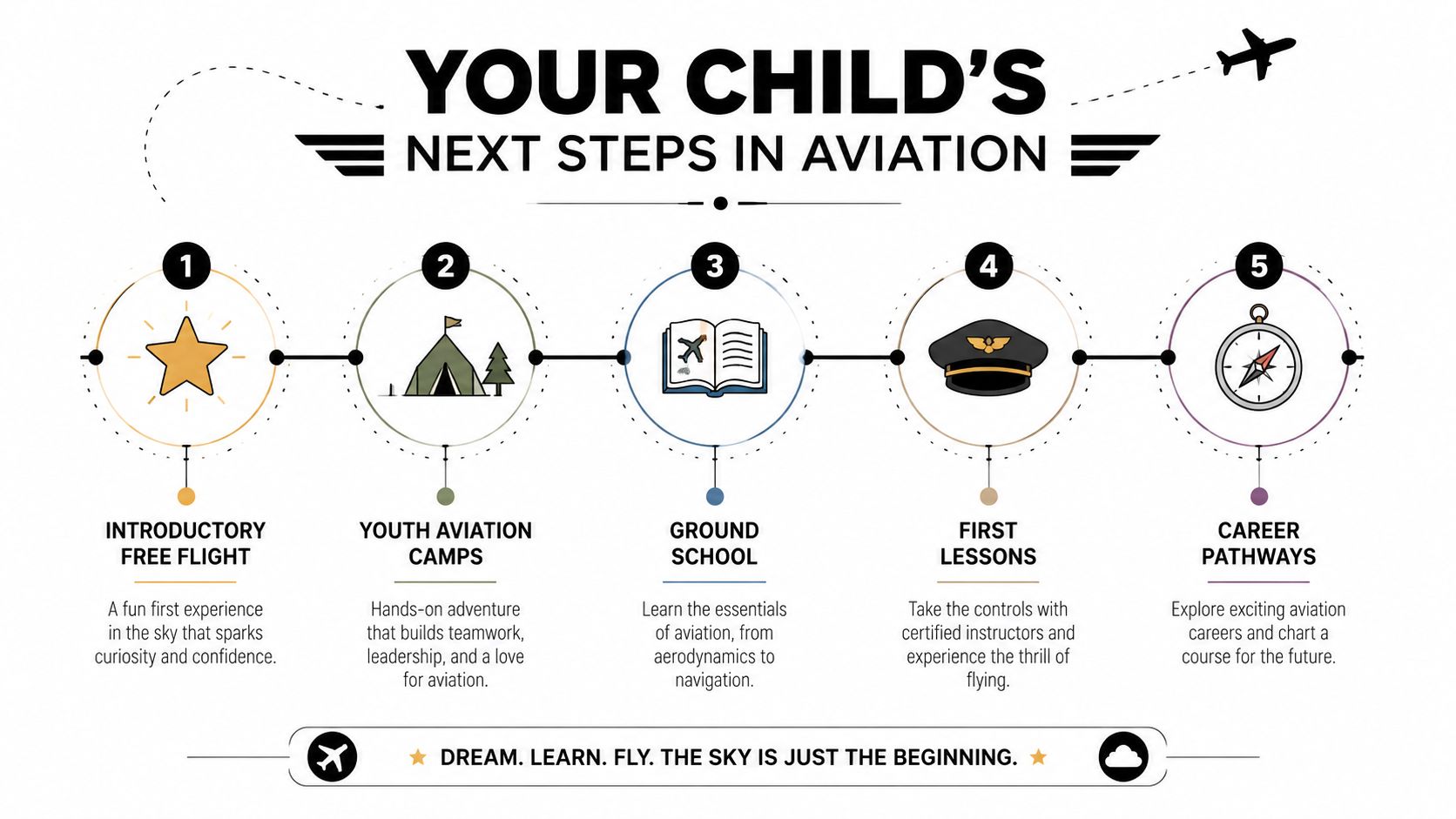
A simple four-week parent plan works better than overthinking it. Week one, find a Young Eagles event. Week two, ask the child what they noticed and what they want to know next. Week three, book a discovery flight or a youth camp. Week four, decide whether the kid is still bringing up aviation after the novelty wears off. If they are, keep going.
DuBois Aviation at Chino Airport gives families a real next step after a child's first flight, whether that first experience came from a volunteer program, a discovery ride, or a school event. If your kid came home asking for more cockpit time, visit DuBois Aviation and look at the youth and introductory options that fit a local aviation path.


