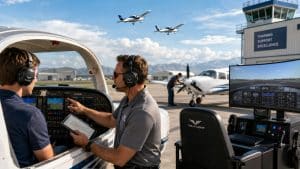
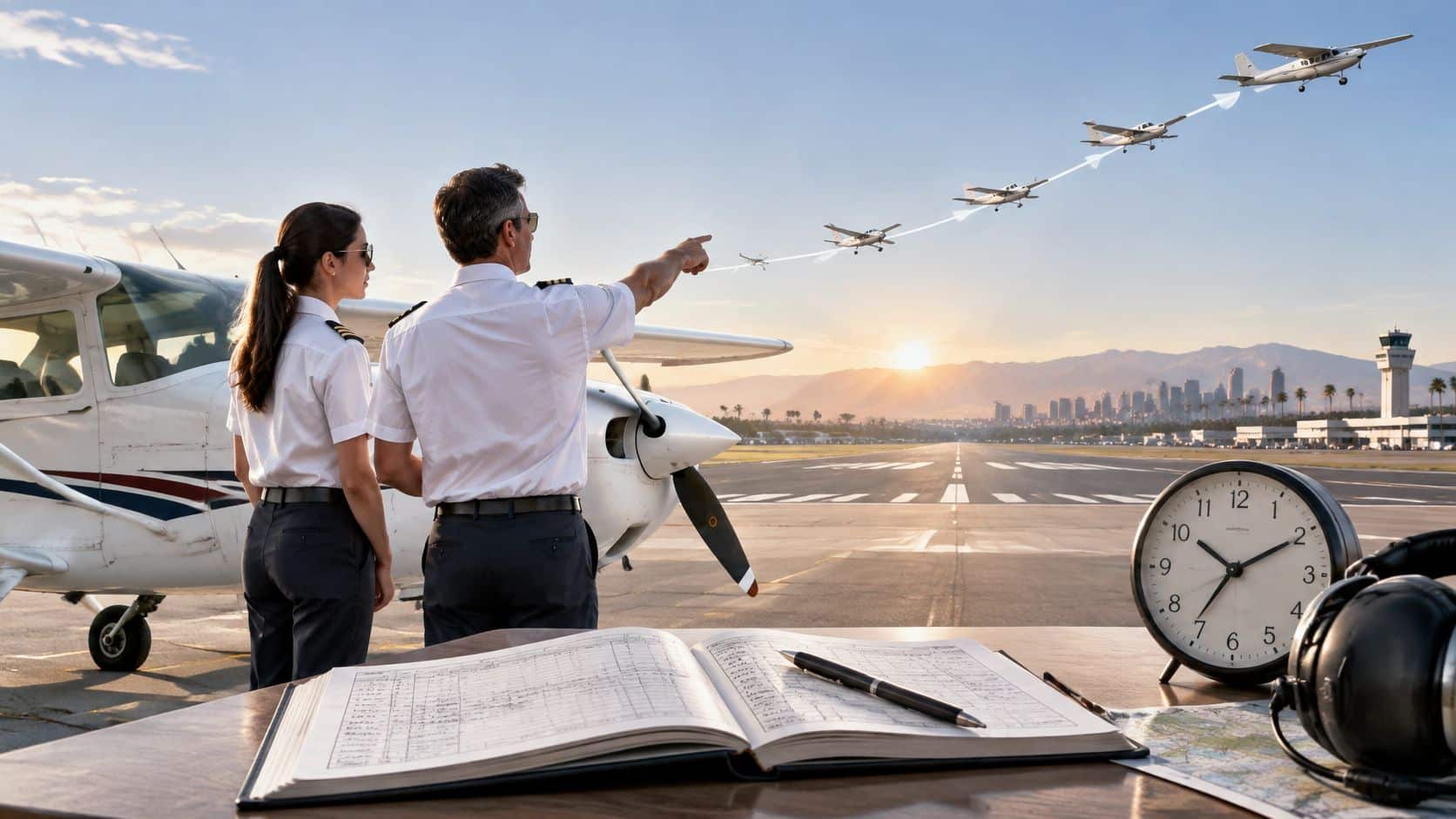
A private pilot certificate requires at least 40 flight hours under Part 61. DuBois Aviation uses two lessons per week as a planning guide for completing training in six months or less, or three lessons per week for about four months. These are estimates, and the completion date depends on preparation, proficiency, weather, aircraft availability, and examiner scheduling.
Training time has three separate measures: hours logged, skills demonstrated, and time spent waiting for a suitable lesson or checkride date. A student may progress steadily in the airplane while weather, aircraft availability, or examiner scheduling extends the calendar timeline.
Table of Contents
- How Long Each Pilot Certificate Takes at a Glance
- Private Pilot Hour Requirements, Category by Category
- Converting Training Hours into Calendar Months
- What Stretches or Shortens Your Training Time
- Instrument, Multi-Engine, CFI and Helicopter Add-On Timelines
- Commercial Pilot Time and the Pilot-in-Command Gap
- Airline Transport Pilot Hour Routes and Career Milestones
- Choose Your Schedule and Book a Discovery Flight
How Long Each Pilot Certificate Takes at a Glance
The FAA's airplane private pilot experience requirements set a legal floor; FAA guidance puts the national completion average at approximately 75 hours. For planning, those figures answer different questions: one describes the minimum experience required, the other how much flight time applicants typically need.
Hours and calendar time by certificate or rating
| Certificate or rating | Regulatory requirements | What determines calendar time |
|---|---|---|
| Private pilot, airplane | Part 61 total-time, instructor, solo, and specific-experience requirements | Lesson frequency, preparation, weather, aircraft availability, and examiner scheduling |
| Instrument rating, airplane | Applicable instrument experience, instruction, and cross-country requirements | Existing experience, lesson frequency, and training availability |
| Commercial pilot, airplane | Total-time and pilot-in-command requirements, plus additional experience categories | Remaining experience and how it is distributed |
| Flight instructor, airplane | Applicable commercial and instrument qualifications, instructor preparation, and practical test | Teaching proficiency and test availability |
| Multi-engine rating | Applicable training and practical-test requirements in a multi-engine airplane | Aircraft access and demonstrated proficiency |
These qualifications have different experience requirements and training objectives, so a single month estimate would be misleading. Calendar time depends on how consistently lessons can be scheduled and whether the student is ready to progress.
Three measures of progress
Legal minimums specify experience required to apply. Meeting them does not by itself show that a student can consistently meet practical-test standards.
Completion hours reflect the flying needed to develop proficiency. A student may need more practice with landings, navigation, or emergency procedures before those skills are reliable.
Calendar time includes the gaps between lessons, as well as time spent studying and preparing. A missed lesson can delay the next opportunity to practice a skill, even when the student has made good progress.
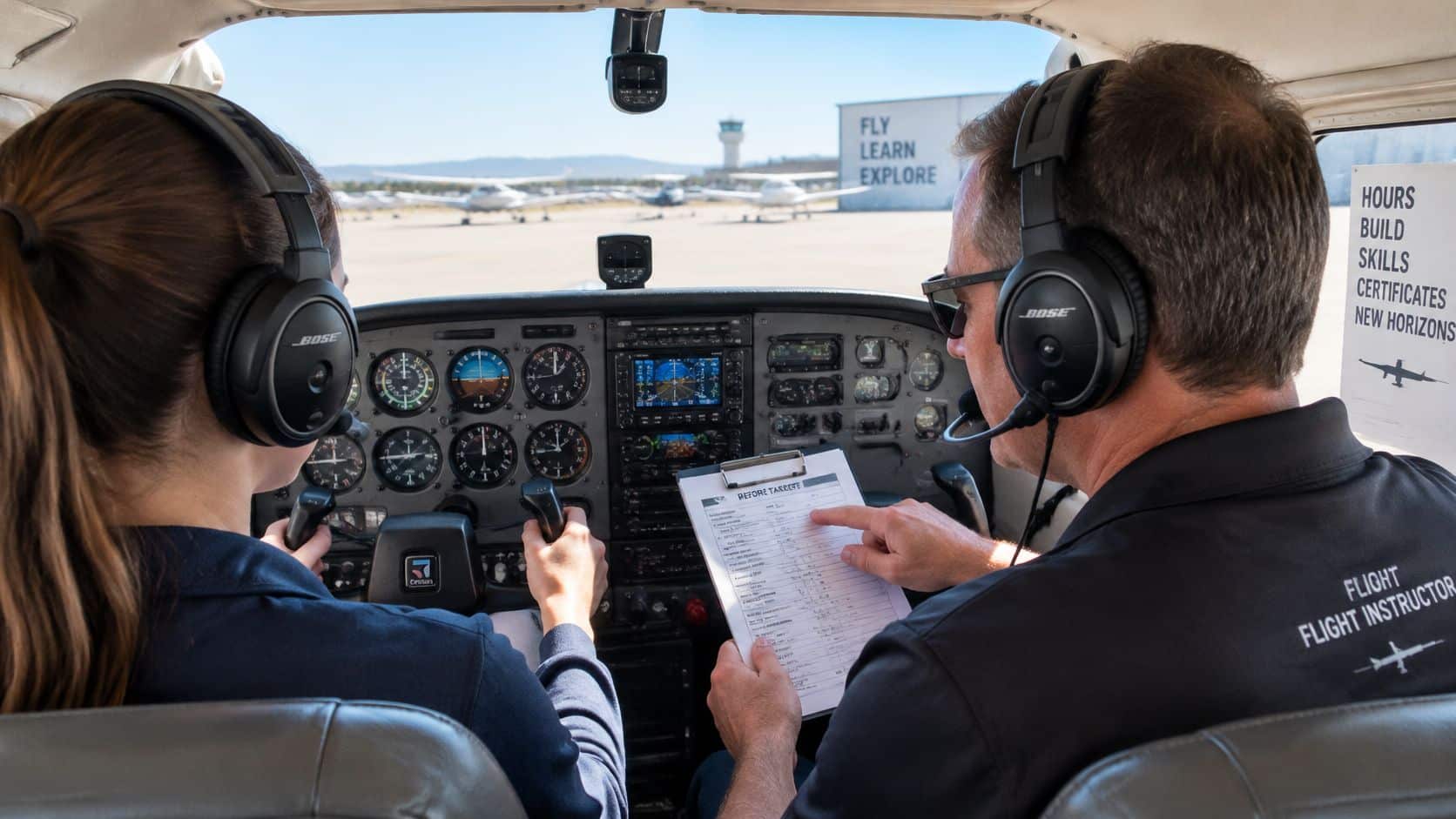
At DuBois Aviation, two lessons per week can take six months or less to complete a private pilot license, while three lessons per week can take about four months. These are planning guides, not guaranteed completion dates; progress also depends on preparation, proficiency, weather, aircraft availability, and examiner scheduling.
Plan around a schedule you can maintain and the skills each lesson needs to build. The next step may be practicing a maneuver, reviewing a procedure, or preparing for a stage check.
Private Pilot Hour Requirements, Category by Category
For an airplane private pilot certificate under Part 61, the FAA regulation sets minimums of 20 hours with an authorized instructor, 10 solo hours, and 3 hours each of cross-country instruction, night training, and instrument training. The FAA's airplane private-pilot experience regulation lists the applicable experience categories.
| Requirement | Minimum hours | What slows it down |
|---|---|---|
| Dual instruction with an authorized instructor | 20 | Lesson frequency, preparation, and suitable weather |
| Solo flight | 10 | Demonstrated readiness and applicable endorsements |
| Cross-country training | 3 | Route preparation, weather, and completing the specified flight |
| Night training | 3 | Evening availability and suitable operating conditions |
| Instrument training | 3 | Aircraft access and coordinating appropriate instruction |
A single flight can count toward multiple categories: for example, a properly conducted and logged cross-country lesson may also count toward instrument training when it meets the requirements for both.
How the categories fit into lessons
Dual instruction builds aircraft control, procedural knowledge, and sound decision-making. A lesson might combine slow flight with practice in aircraft configuration, lookout, and recovery technique.
Solo preparation requires more than repeatable landings. The instructor checks whether the student can recognize an unstable situation, discontinue an approach, follow procedures, and make appropriate decisions without prompting.
At DuBois Aviation, stage-check flights review flying skills, procedures, and decision-making before solo clearance. Passing a stage check does not replace required instructor training or endorsements.
Cross-country lessons cover route selection, fuel planning, navigation, and weather assessment. The cited regulation includes a required cross-country flight exceeding 100 nautical miles total distance. An instructor can identify which flight and logbook entry meet that requirement.
Night training calls for an evening booking that satisfies the applicable night-experience rules. A late-afternoon departure alone may not qualify. Instrument training develops aircraft control using instrument references, distinct from ordinary visual navigation.
A monthly logbook review
A missed category usually points to a specific requirement or skill that remains incomplete. Reviewing the logbook helps identify the next useful lesson.
- Logged experience: Check the entries against each applicable category.
- Required authorizations: Identify endorsements needed before the next milestone.
- Next lesson objective: Define what the student should demonstrate.
- Skills to revisit: Note areas where performance remains inconsistent.
Converting Training Hours into Calendar Months
To convert training hours into calendar time, divide the flight hours remaining by the hours a student completes in an average month. Count completed flight hours only; reserved lessons do not count.
Hours remaining ÷ completed flight hours per month = estimated months of flying
Worked example: converting hours into months
Assume each completed lesson includes 1.5 hours of flight time, and use a four-week planning month. At that pace, a student completes six flight hours in a month. If the planning target is 75 hours, the calculation is:
75 hours ÷ 6 hours per month = 12.5 months
This is an illustration of the arithmetic, not a prediction of when a student will finish. It assumes every planned lesson is completed and each contributes the full 1.5 hours. Any time lost to cancellations adds to the calendar estimate: three weeks without flying adds three-quarters of a four-week planning month.
To make the estimate fit an actual training schedule, use completed flight time from the logbook and check the flight schedule for availability and upcoming bookings. Also account for the chosen aircraft and the student's progress toward the instructor-reviewed training target. Flight-hour totals alone cannot show whether the required skills are consistent or whether the student is ready for a practical test.
What Stretches or Shortens Your Training Time
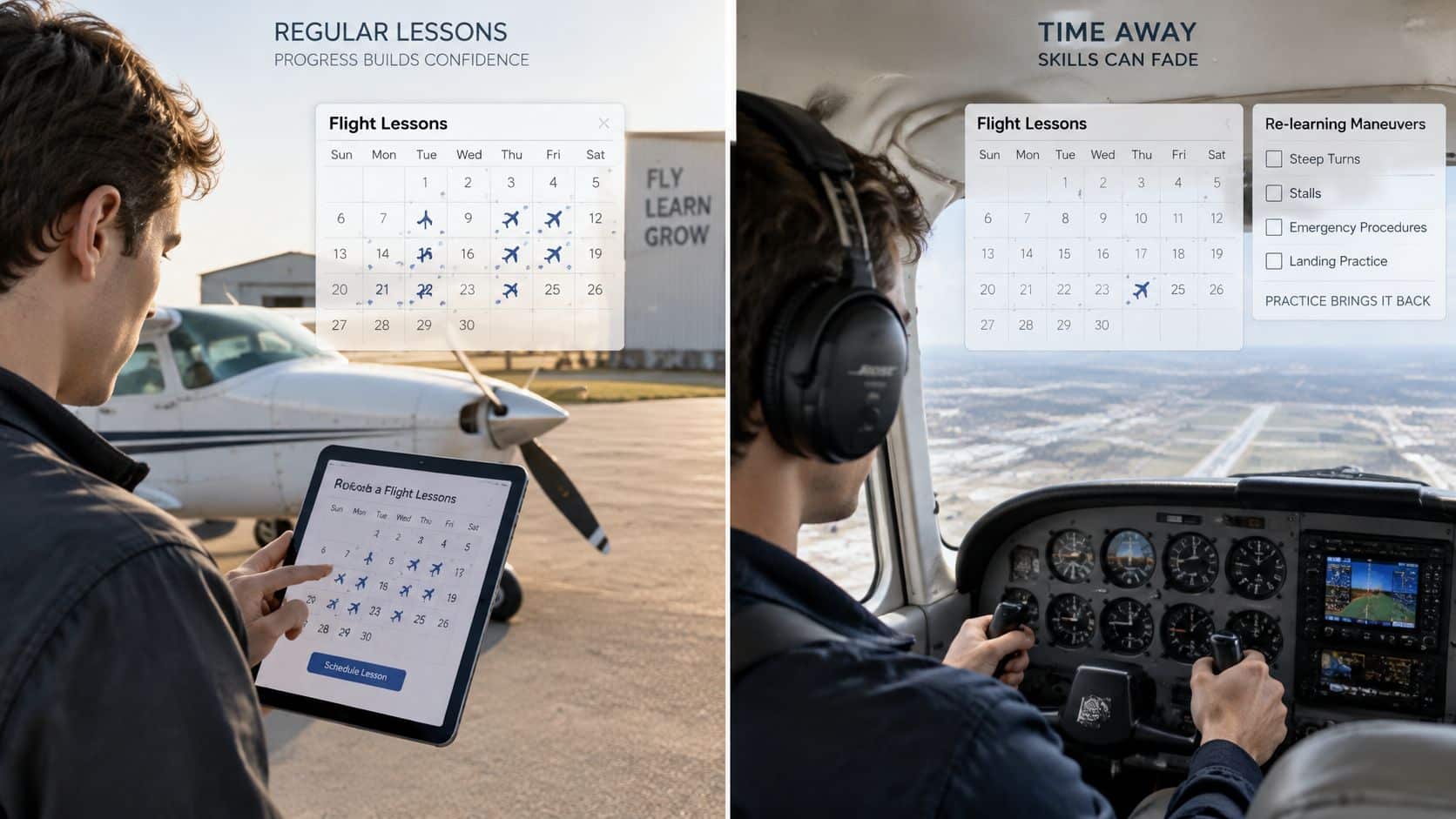
A compressed schedule can still produce a long training timeline if it leaves no room to study between flights. Flying several times close together helps maintain familiarity, but students also need time to review instructor feedback and prepare for the next lesson.
Factors the student can influence
Before a lesson, review the previous debrief and study the next maneuver. Complete navigation work when appropriate. Preparation helps keep lesson time focused on flying and applying skills.
Frequent lessons can help preserve familiarity, while an overloaded schedule can leave a student too tired to absorb the material. Aim for a pace that allows both flight practice and ground review. The Part 61 and Part 141 training comparison can help you consider which training structure fits your availability and goals.
Factors that require contingency planning
Being checkride-ready and receiving a certificate are separate milestones. An instructor determines when a student is prepared, and the practical test still needs an available examiner, an appropriate aircraft, and suitable conditions.
Weather and aircraft availability can interrupt training. Examiner scheduling can add time after a student is ready. Keep the readiness estimate separate from the expected test window.
The following video accompanies the discussion of training continuity.
At Chino Airport, tower communications and traffic integration are part of the training experience. Students should review current airport and airspace information with their instructor before route planning.
Three practical controls help protect continuity:
- Protect recurring appointments: Keep dependable lesson slots instead of rebuilding the schedule each week.
- Plan for gaps: Use ground review and appropriate practice to keep procedures familiar.
- Assess the return: Ask an instructor to assess what refresher flying is appropriate after a substantial interruption.
At DuBois Aviation, private-pilot progress depends on preparation, proficiency, weather, aircraft availability, and examiner scheduling. DuBois Aviation does not guarantee private-pilot completion dates.
Instrument, Multi-Engine, CFI and Helicopter Add-On Timelines
A pilot's next qualification should match the flying they plan to do. Instrument, multi-engine, instructor, and helicopter training each add different skills and experience requirements, so estimate each stage separately.
A staged training path
Private pilot preparation builds aircraft control, navigation, procedures, and independent decision-making. A reliable foundation makes it easier to manage the higher workload of advanced training.
Instrument preparation develops disciplined scanning, procedure management, and clearance communication. Before estimating the remaining work, ask an instructor to review your logged instrument experience and training. The instrument-rating hours and experience guide explains how those requirements fit together. For another perspective on instrument training, read the flyCowboys guide to instrument training.
Commercial preparation develops greater precision in aircraft control and planning while the pilot completes applicable experience requirements.
Instructor preparation shifts the focus from performing a task to explaining, demonstrating, evaluating, and correcting it. The airplane instructor pathway includes commercial and applicable instrument qualifications. Candidates also need practice teaching and assessing others.
Multi-engine training suits pilots whose goals call for experience in more than one engine. Lessons focus on aircraft-specific systems, performance planning, and responses to abnormal situations.
Helicopter training needs its own experience review
An airplane pilot considering helicopter training should begin with an instructor's review of the certificate sought and existing experience. The FAA's commercial-pilot guidance describes an approved Part 141 helicopter sequence with 35 hours for private training, 35 for instrument-helicopter training, and 115 for commercial training, totaling 185 prescribed training hours. These curriculum figures describe that sequence; an instructor can assess how they apply to an individual pilot's experience. Confirm eligibility with the FAA text before scheduling.
Career distinction: Flying a maneuver well and teaching another pilot to fly it require different skills.
At DuBois Aviation, students progress through flying and study, solo, cross-country flying in Southern California, and a checkride once they meet the practical test standards.
For recreational flying, consider whether an instrument qualification supports the trips you want to make. Ask an instructor to review your experience and training goals.
For a career path, map the commercial qualification and the experience you will need to build. Discuss the sequence with an instructor before choosing the next course.
For instructor training, practise explaining decisions and identifying errors. Choose the CFI, CFII, or MEI path that matches the qualifications you intend to teach.
Commercial Pilot Time and the Pilot-in-Command Gap
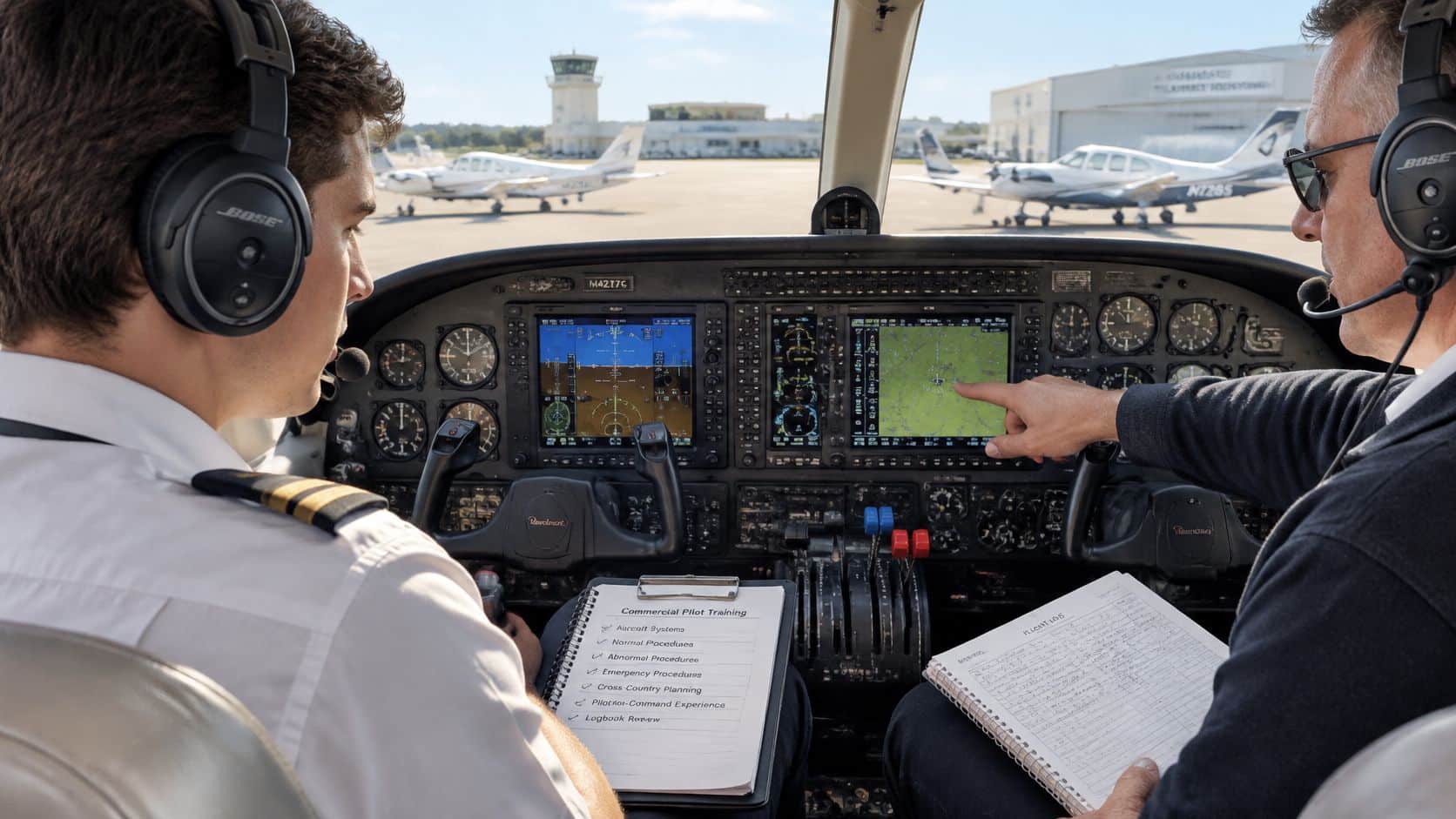
A commercial applicant can meet the total-hour threshold and still need more experience in a specific category. For example, an applicant with 250 total hours but only 40 pilot-in-command hours has a 60-hour shortfall against the 100-hour requirement in the commercial aeronautical-experience regulation.
The same regulation sets the standard Part 61 airplane threshold at 250 total hours, including 100 hours in powered aircraft and 50 hours in airplanes, along with applicable training and operating-experience requirements. The exact requirements depend on the airplane class and the regulation's applicable paragraph.
Audit the logbook before building more time
Log pilot-in-command time only when you were the sole manipulator of the controls and responsible for the flight. An instructor's supervision or a student's time at the controls alone does not establish that a flight qualifies.
Have an instructor review how each proposed flight may be logged. Check the applicable cross-country, night, instrument, and aircraft-category requirements before paying for more flying. A carefully planned navigation flight can build experience in fuel management, radio work, diversion decisions, and aircraft control. Instrument practice may fit into the flight when properly arranged, but it does not erase separate regulatory requirements.
Efficiency without empty hour building
The FAA's commercial-pilot guidance describes a 190-hour alternative for qualifying Part 141 or Part 142 training. This route depends on the approved program and its completion conditions; it is not a general reduction for every commercial applicant.
The pilot time-building guidance can help students focus on useful experience rather than accumulating hours without a clear purpose.
- Total hours: Reconcile the logbook with the applicable threshold.
- Pilot-in-command hours: Confirm that the time qualifies and meets the required distribution.
- Standards demonstrated: Assess aircraft control, checklist discipline, energy management, and decision-making.
These checks measure different things. The logbook records experience, while consistent performance shows readiness for the practical test. Commercial preparation should include situations that require judgment: explaining a fuel-reserve decision, recognizing deteriorating conditions, and revising a plan. A polished maneuver matters, but so does knowing when conditions call for a different choice.
Airline Transport Pilot Hour Routes and Career Milestones
The FAA identifies 1,500 total hours as the standard benchmark for an Airline Transport Pilot certificate. Certain qualifying graduates may be eligible for restricted-privileges pathways at 1,000 or 1,250 hours, subject to additional requirements. The FAA's ATP guidance describes the standard route and restricted-privileges provisions, including an applicable 200-hour cross-country requirement.
| Route | Total pilot hours | Conditions that must also be met |
|---|---|---|
| Standard Airline Transport Pilot | 1,500 | Applicable experience distribution, including standard cross-country requirements, and other eligibility conditions |
| Qualifying bachelor's graduate with an aviation major | 1,000 | Authorized academic pathway, required coursework, associated Part 141 training, and restricted privileges |
| Certain qualifying bachelor's or associate's graduates | 1,250 | Qualifying degree pathway, documentation, and remaining restricted-privileges requirements |
The FAA's institutional-authority document describes the targeted 1,000- and 1,250-hour routes. They apply only to graduates who meet the listed conditions. For the lower bachelor's-degree pathway, those conditions include an aviation major, required coursework, and a commercial certificate and instrument rating obtained through the associated approved training arrangement. Restricted privileges and all remaining eligibility requirements still apply.
Verify the pathway before choosing the program
Before enrolling, confirm that the institution's authorization covers the intended degree pathway and that it can provide the required documentation. Check the applicable Part 141 relationship and whether the aviation coursework satisfies the route. Keep graduation, training, and institutional certification records.
The standard route also includes a substantial cross-country component. Total hours alone do not establish eligibility; the required experience distribution matters too.
Experience-building pace sets the career calendar
The airline path commonly includes instrument and commercial qualifications, followed in some cases by instructor preparation and sustained flying. Flight instructing can provide an experience-building route, though certification does not guarantee a job or a set monthly flying schedule.
Consider a hypothetical calculation: a pilot starting at 250 hours and aiming for 1,500 needs 1,250 more hours. At an assumed 100 hours per year, accumulating that time would take 12.5 years. This arithmetic illustrates how the pace of regular flying can shape a career timeline; it is not a forecast.
Choose Your Schedule and Book a Discovery Flight
A useful training decision combines the desired qualification with a schedule the student can maintain.
- Identify the goal. Select the certificate or rating and review existing experience.
- Count reliable lesson days. Include work, travel, and study commitments.
- Calculate the flying interval. Use realistic completed flight hours.
- Add contingency time. Allow for aircraft downtime, weather, and examiner availability.
- Confirm current openings. Discuss the proposed schedule, proficiency plan, and checkride arrangements.
A discovery flight lets a prospective student sit with an instructor, see how lessons work, and ask questions before choosing a path. Students can request information about private and instrument training, commercial and instructor preparation, multi-engine or helicopter add-ons, aircraft rental, enrollment, or instructor opportunities without assuming every pathway has the same calendar.
Can training continue around a full-time job?
Yes, when the student can protect recurring appointments and study between flights. Reliable attendance matters more than labeling the program part-time or full-time.
Does a canceled lesson mean no progress?
Not necessarily. An appropriate ground session can address planning, aircraft systems, procedures, or knowledge-test preparation without pretending to replace required flight experience.
Should a renter expect the same timeline as a new student?
No. A certificated renter's checkout or proficiency review addresses existing qualifications, aircraft familiarity, and current performance rather than an initial-certificate syllabus.
What should happen during a checkride delay?
The student and instructor should agree on focused review and suitable refresher flying. Readiness needs to remain demonstrable until the actual test.
Is an accelerated schedule always preferable?
No. It works only when availability, preparation, aircraft access, and learning pace support it. A schedule that leaves no room for study or recovery can be counterproductive.
DuBois Aviation offers one-on-one airplane and helicopter instruction at Chino Airport, from discovery flights through advanced ratings. Visit DuBois Aviation to request training information, ask about current course openings, or arrange a discovery flight and discuss a realistic training schedule.