

94.38 percent passed, but that isn't a personal guarantee: the FAA recorded 27,143 Instrument Rating Airplane examinations in its 2025 national testing report. The FAA instrument rating knowledge test is a required certification gate, not an optional quiz. The airplane examination contains 60 multiple-choice questions, requires 70 percent to pass, and must be passed before the practical test under the FAA's instrument-rating requirements.
Table of Contents
- What Passing This Knowledge Test Actually Means
- FAA Instrument Rating Knowledge Test Rules and Codes
- Build an ACS Study Plan Before You Schedule
- Practice for Unfamiliar Questions Not Memorized Answers
- Get Ready for Chart Questions in October 2026
- Match Ground Study to Real IFR Training
- Questions Worth Asking Before You Book the Test
What Passing This Knowledge Test Actually Means
A passing written result means an applicant has met the knowledge-test requirement. It doesn't mean the applicant has completed instrument training or demonstrated practical IFR judgment.
Two practical options worth comparing
These are specific products pilots commonly compare for this type of flying. Confirm compatibility with your aircraft and instructor before ordering.
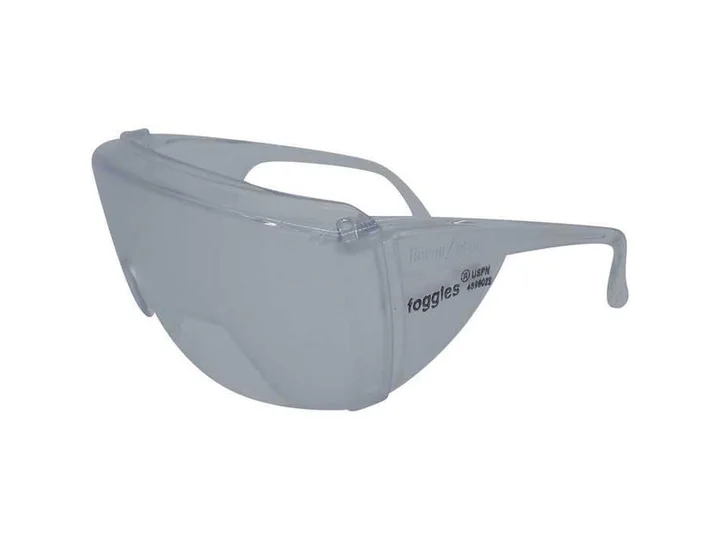 Instrument trainingFoggles Aviation IFR Training GlassesCheck current availability on Amazon (paid link)
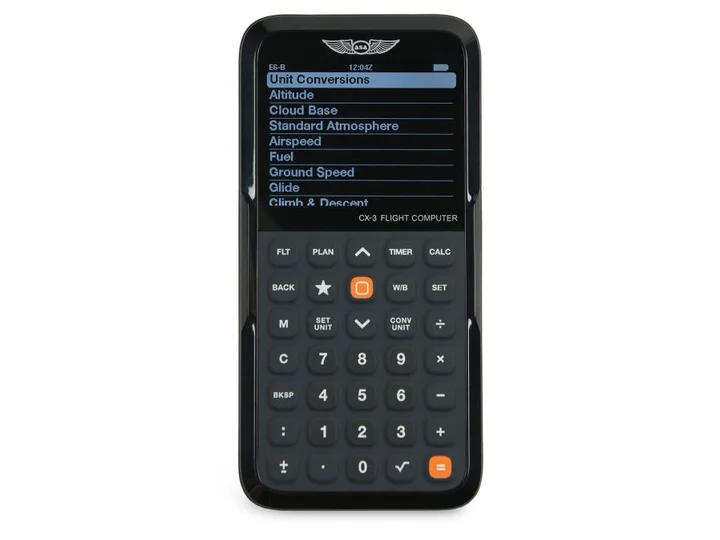 Flight planningASA CX-3 Flight ComputerCheck current availability on Amazon (paid link)
That distinction matters for working students. A question bank offers a convenient finish line, while instrument training demands explanations, decisions, and procedures that still make sense when the question looks unfamiliar.
Read the national results correctly
The same national report recorded an airplane average score of 86.15 percent. Instrument Rating Helicopter testing involved a much smaller group, 597 examinations, with a 94.14-percent pass rate and an 84.47-percent average score, according to the report linked above.
Those averages sit roughly 14 to 16 percentage points above the passing minimum, calculated from those published results. They provide useful perspective, but they don't establish an FAA-required practice-test target.
The aggregate also doesn't separate every applicant's preparation, training background, or testing conditions. A national pass rate can't tell an individual student whether an unfamiliar approach chart will expose a weak area.
Practical rule: A passing score satisfies the examination standard. An explanation that survives a changed scenario is a better preparation standard.
Treat the test as part of certification
The useful question isn't whether an applicant can recognize enough correct answers. It's whether the applicant can connect regulations, weather, navigation, and procedures without relying on a familiar diagram.
A productive preparation plan has distinct jobs:
- Identify the examination. Confirm the aircraft category and correct test code before purchasing preparation materials or reserving a seat.
- Organize around the ACS. Use the Airman Certification Standards to define what needs understanding.
- Apply knowledge to unfamiliar situations. Practice explaining the operational reason behind an answer.
- Prepare for the actual appointment. Resolve timing, documentation, and chart-format questions before test day.
For a renter adding instrument privileges, that approach keeps written preparation connected to future flying. For a career-track student, it also builds a more useful foundation for later training than memorized answer patterns.
Neither student benefits from treating the written as an unrelated academic obstacle. The practical test remains the larger objective.
FAA Instrument Rating Knowledge Test Rules and Codes
The aircraft category matters before the study schedule does. An applicant preparing for an airplane rating shouldn't assume that every examination containing the word “instrument” serves the same purpose.
Under 14 CFR Part 61, Subpart B, instrument-rating applicants must hold, or concurrently seek, the appropriate private pilot certificate and demonstrate English-language proficiency. They must also complete and log the required ground training through an authorized instructor or an approved home-study course.
Separate eligibility from the syllabus
The knowledge examination must correspond to the aircraft category used for the practical test, whether airplane, helicopter, or powered-lift. Choosing a convenient appointment doesn't resolve a category mismatch.
The required knowledge spans several connected subjects:
- IFR rules and procedures. Understand which rules apply and how a procedure develops.
- Clearances and communications. Interpret what ATC authorized rather than what the pilot expected.
- Navigation systems and approaches. Understand the information available and how to apply it.
- Weather and aircraft performance. Connect conditions and aircraft capabilities to planning.
- Human factors. Recognize limitations that affect decisions and workload.
These aren't isolated trivia categories. A planning question can require weather interpretation, performance knowledge, and a regulatory decision at the same time.
Instrument knowledge tests compared
The examination counts and passing standards below come from the FAA test information identified in the testing matrix.
| Test | Questions | Passing score | What to verify |
|---|---|---|---|
| Instrument Rating Airplane, IRA | 60 | 70 percent | Airplane instrument-rating code and current appointment duration |
| Instrument Rating Helicopter | 60 | 70 percent | Helicopter category and applicable scheduling information |
| Flight Instructor Instrument Airplane | 50 | 70 percent | Instructor examination rather than the instrument-rating examination |
The IRA time allowance needs special attention. The instrument ACS listing identifies 2.5 hours, while other FAA materials identify 2.0 hours, including the chart-transition notice discussed later. Applicants should confirm the current duration with the testing center rather than assume every FAA publication or preparation resource displays the same allowance.
That discrepancy isn't a reason to postpone learning. It is a reason to distinguish the governing knowledge requirements from administrative details that can change.
A sensible booking record includes the exact examination name, code, category, and confirmed duration. A screenshot or written confirmation of the appointment details can help prevent an avoidable scheduling misunderstanding.
Build an ACS Study Plan Before You Schedule
A study plan built around the Airman Certification Standards (ACS) prepares you for the FAA knowledge test and gives your later practical-test training a clear structure. The ACS organizes the knowledge, risk management, and flight skills an examiner may evaluate, so use it to check whether you can explain a topic, not just recognize an answer.
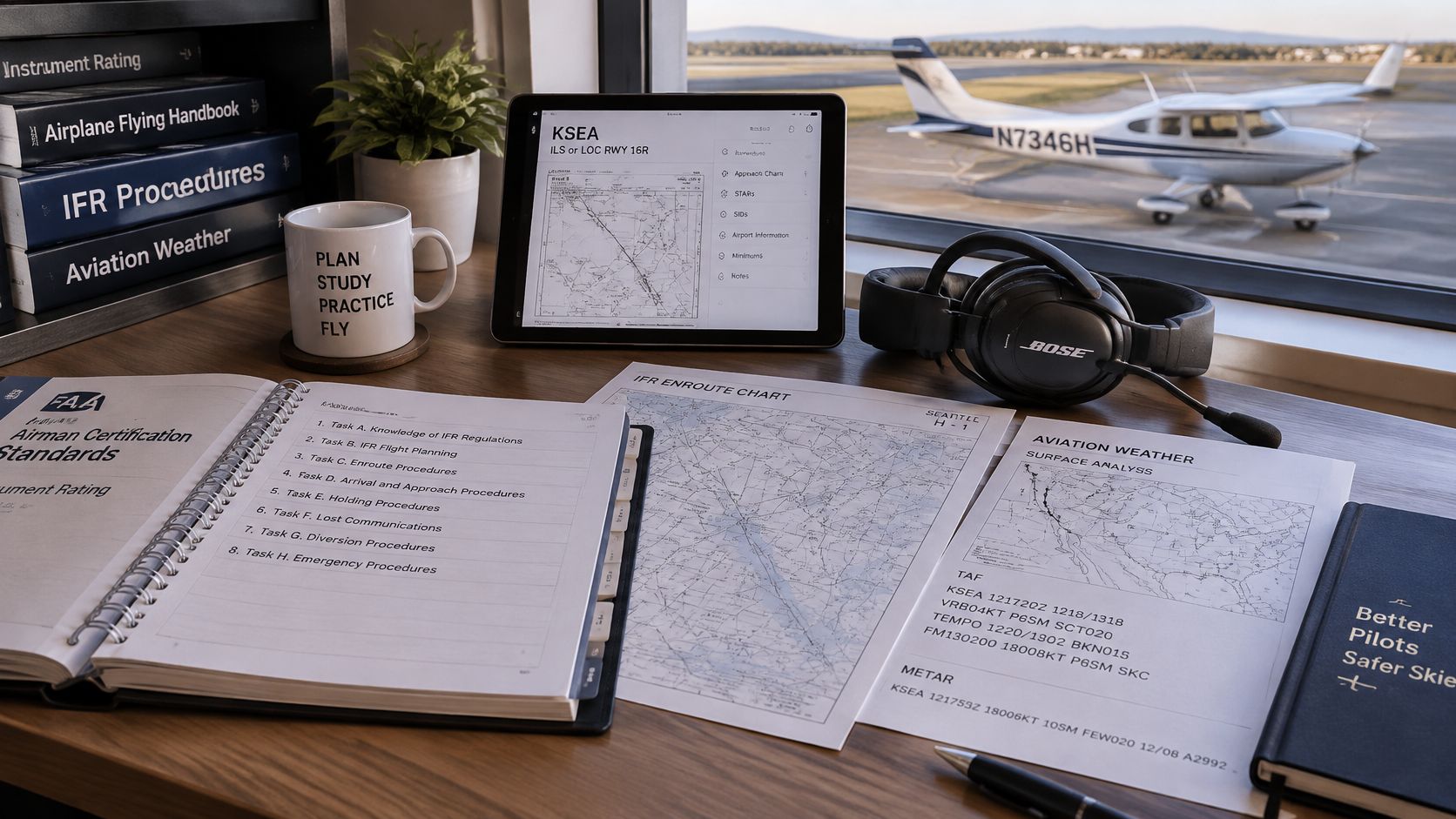
Use the FAA instrument-rating ACS as the syllabus. Keep regulations and procedures, weather, cross-country planning, navigation systems, and risk management in view as you study. The ACS's role in flight training can also help connect written-test topics to practical-test expectations.
Start with the reasoning behind each rule or procedure. For example, when studying alternate requirements, explain which conditions trigger the requirement and how they affect the flight plan. That explanation is more useful than memorizing a choice without understanding what makes it correct.
A structured ground-study course can support this approach. Tie each topic back to the ACS, then explain why the relevant rule or procedure applies. The goal is to build a map of the subject, not a second pile of disconnected reading.
Once you understand the governing logic, add calculations and chart interpretation. Work through airspeed, wind correction, fuel, time and distance, minimum altitudes, holding, and approach depictions. In mixed practice, write a reason for each answer, particularly when the question depends on approach minimums, holding entries, airway courses, altitudes, or GPS integrity.
Fit study to a working schedule. Short sessions can cover one topic and end with a recall exercise. Use longer blocks for calculations and chart work, and bring unresolved questions to an instructor. A weekly routine is a planning choice, not an FAA requirement. Choose dependable study cues, such as breakfast or arriving home, rather than relying on an idealized evening schedule.
Attention habits can protect those sessions. These attention training strategies for students may support concentration, while aviation questions still require authoritative study materials and instructor review.
Schedule the test when you can explain the ACS topics and apply them to unfamiliar questions. A study-app completion bar cannot show that understanding.
Practice for Unfamiliar Questions Not Memorized Answers
A familiar chart can still support an unfamiliar decision. On the knowledge test, start with the question being asked, then find the information that answers it. Treat each item as a short instrument procedure: identify the conditions, select the relevant rule or chart detail, and explain your reasoning.
For example, a plate may look like one you have studied, while the question asks for the clearance limit rather than the approach minimum. Recalling a memorized value will not solve it. Ask what decision the question requires before reading the chart.

Use missed questions to diagnose how your reasoning broke down. Record the topic, your reasoning, the correct explanation, and the type of error:
| Error label | What happened | Corrective work |
|---|---|---|
| Knowledge | The rule or concept was unclear | Review it, then explain how it applies |
| Calculation | The setup, units, or arithmetic were wrong | Rework the problem without answer choices |
| Interpretation | A chart note, symbol, or course was misread | Find the relevant information and explain it |
| Test-taking | A condition was missed or you answered too soon | Restate the question before solving it |
The label should point to a remedy. More calculation practice will not fix a misunderstanding of the question.
Common traps include mixing up a clearance limit and approach minimums, using an outdated alternate rule, or misreading a localizer or VOR course. Pause on temperature and obstacle notes, too. They can change how you interpret the problem.
The Airman Knowledge Test Report (AKTR) records the result and relevant ACS codes, as described in the FAA ACS linked earlier. Use those codes with your instructor to target ground review before the practical test. After a failed attempt, address the missed areas rather than repeating the same questions. A passing score also merits a debrief.
Before you schedule the practical test, check that you can explain why an answer fits, reject unsuitable alternatives, and solve a changed version of the problem. Say when you are uncertain. The written test is an ACS gate, not a measure of every judgment you will need in the airplane or simulator.
Get Ready for Chart Questions in October 2026
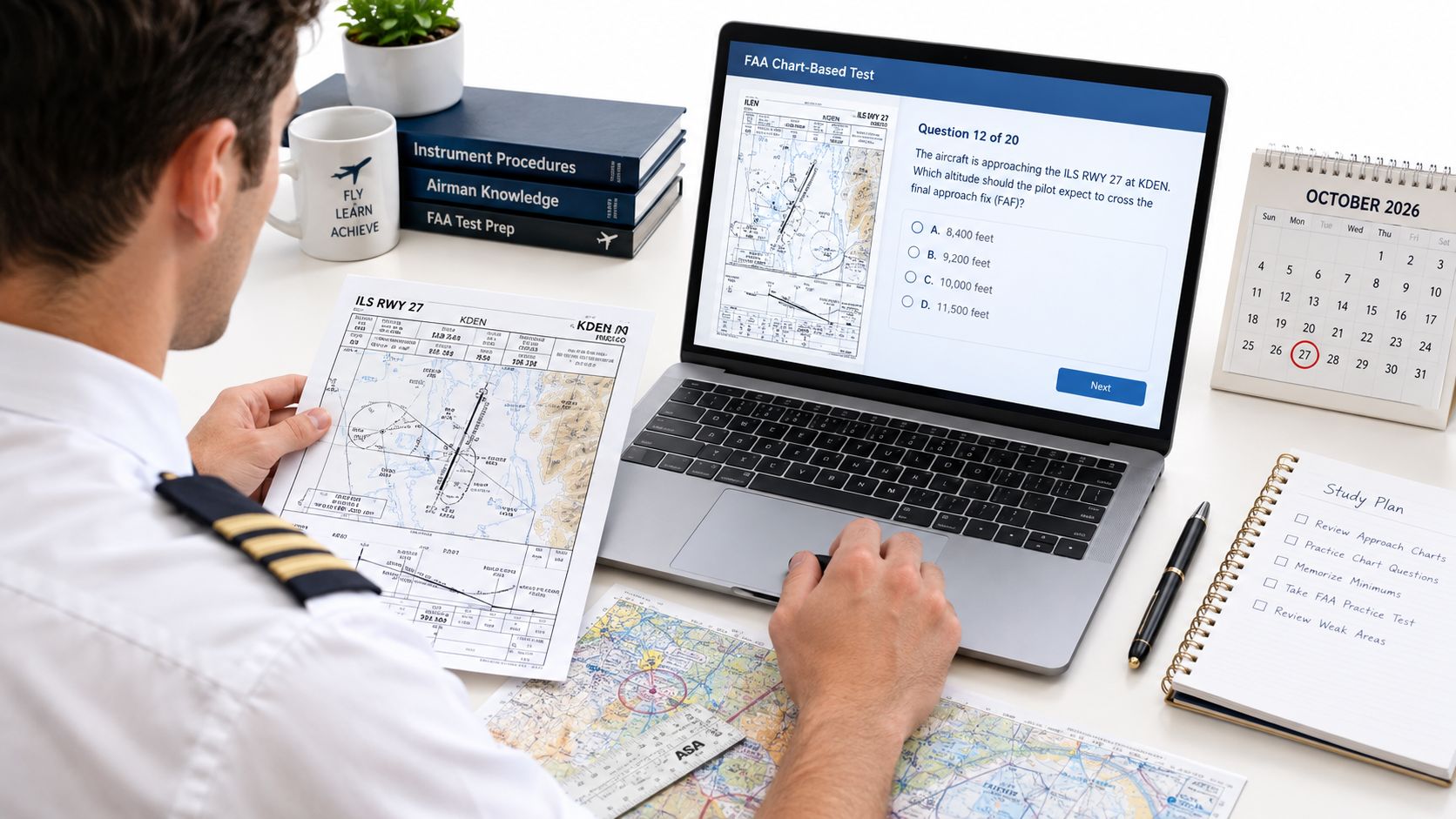
The FAA's announced change beginning October 26, 2026, calls for Instrument Rating Airplane questions using images from current sectional, instrument approach, and low-altitude en route charts, according to its September 2026 special testing notice. The planned format includes images that may not appear in the testing supplement.
That is a chart-reading issue, not a reason to download an updated question bank. Applicants need to locate and apply information on an excerpt they haven't already rehearsed.
Separate the format change from the standard
The announcement retains 60 questions, lists two hours, and retains the 70-percent passing standard, according to the same FAA notice. Its duration listing reinforces the need to confirm the appointment allowance rather than rely on an older preparation page.
The important preparation change is transferable visual interpretation. Students who learned only static supplement diagrams should expect to spend more effort finding information before using it.
Useful drills include:
- Locate a minimum. Find the relevant information and explain why that line applies to the question.
- Identify a course. Distinguish the requested segment from nearby courses and other charted information.
- Apply a note. Explain how a chart note changes the answer instead of merely reading it aloud.
- Change the excerpt. Repeat the task with a different chart so familiarity can't supply the response.
The school's chart interpretation guidance can support that shift from recognizing a figure to reading an unfamiliar one. An IFR simulator can also provide a setting for timed chart drills alongside procedure practice.
Decide when to test based on readiness
An applicant who is ready before the announced transition can choose an available appointment without treating the change as a crisis. An applicant who isn't ready shouldn't compress essential learning merely to avoid a different image format.
Waiting creates its own trade-off. Postponing the examination while continuing to memorize static diagrams doesn't address the skill the planned update emphasizes.
The test date should follow readiness. Fear of a new chart image isn't a substitute for preparation.
Before paying for an appointment near the transition, the applicant should check current FAA and testing-center information. A published transition date deserves attention, but the durable preparation goal remains the same: read the chart presented, identify the operational question, and explain the decision.
Match Ground Study to Real IFR Training
Passing the knowledge test shows that you can meet the written standard. It does not show, by itself, that you can apply that knowledge while planning and flying an instrument procedure. Ground study should prepare you to explain decisions in the airplane or simulator, not just recognize familiar answers.

A useful test for any study arrangement is whether it exposes gaps before they carry into flight training. Home study offers flexibility, but students need a way to check their reasoning with an instructor. Instructor-led ground gives immediate feedback, while still requiring independent review between lessons. Simulator and airplane sessions connect that knowledge to decisions made in sequence.
For example, a student may know how to identify an approach segment on a chart. During a simulator session, the instructor can ask what the student would brief, what conditions would change the plan, and how the next step follows from the chart. That conversation reveals whether the knowledge is usable.
At Chino Airport, KCNO, DuBois Aviation provides one-on-one airplane and helicopter instruction, structured ground-study materials, and an in-house simulator. The towered Class D airport and available instrument approaches can give local students settings for connecting preparation with communications and procedure practice. The training value still depends on clear objectives and a useful debrief.
Students considering instrument rating ground school can ask how ground lessons connect to simulator and airplane work. A realistic weekly schedule helps make that conversation concrete. So does knowing which parts of instrument training currently require the most explanation or practice.
Questions Worth Asking Before You Book the Test
What is the minimum age for the IRA examination?
The FAA testing matrix linked earlier lists 15 as the minimum age for the IRA knowledge test. That is an examination eligibility detail, not confirmation that the applicant is ready for the rating or practical test.
Is the instructor instrument examination interchangeable?
No. The Flight Instructor Instrument Airplane examination is a separate test with 50 questions and a 70-percent passing requirement, as shown in the earlier FAA testing-matrix comparison. The booking should identify the intended certificate or rating, not merely an examination with a similar name.
Does a home-study completion record replace the instructor endorsement?
Applicants using the home-study path still need the authorized instructor's required logbook or training-record endorsement certifying preparation for the knowledge test. Under the Part 61 certification requirements cited earlier, the knowledge-test results report doesn't substitute for that endorsement.
A student should resolve the endorsement process before reserving an appointment. Completing lessons and being documented as prepared are related, but distinct, tasks.
Can an airplane knowledge-test result support a helicopter practical test?
The required knowledge examination must match the aircraft category used for the practical test. An airplane result shouldn't be treated as interchangeable with a helicopter result, as established by the instrument-rating rules discussed earlier.
What should be checked before test day?
The logistical check should stay short enough to use:
- Identification. Confirm the testing center's current identification requirements.
- Appointment details. Check the examination code, category, location, and confirmed time allowance.
- Preparation documentation. Resolve the required endorsement before arrival.
- Chart-reading approach. Plan to identify each question's operational context before selecting an answer.
Self-study applicants should revisit the current FAA testing matrix before paying for a seat. Career-track and instrument students should also confirm how the examination date fits the surrounding ground and flight-training schedule.
DuBois Aviation offers one-on-one instrument instruction, ground study, and simulator-supported procedure practice at Chino Airport. Prospective instrument students and career-track pilots can visit DuBois Aviation to request training information, ask about instrument-course availability, or arrange a school tour with their study schedule in hand.