
You're parked near Chino Airport, watching a Piper Cherokee trace a clean traffic pattern against the San Gabriel Mountains. You can almost feel the yoke in your hands and hear the tower in your headset. That dream of becoming a pilot is closer than it looks, but the first real decision isn't the airplane. It's the school.
If you've been searching for a list of flight schools near me, the hard part isn't finding names. It's figuring out which school fits the way you learn, how often you can fly, and whether your goal is a private certificate, an airline track, helicopter training, or eventually owning your own aircraft.
Chino gives you an unusually strong starting point because you can train at a busy, towered airport and compare several schools without driving all over Southern California. That matters. Students often choose a school based on commute convenience, but training environment matters too, especially if you want strong radio habits early.
This guide gets straight to the useful part. Below is a practical list of flight schools near Chino, with the trade-offs that affect training. I've also included advice for people who already think one step ahead and know they may want to buy an airplane or helicopter later, after training and experience make that decision safer.
1. DuBois Aviation
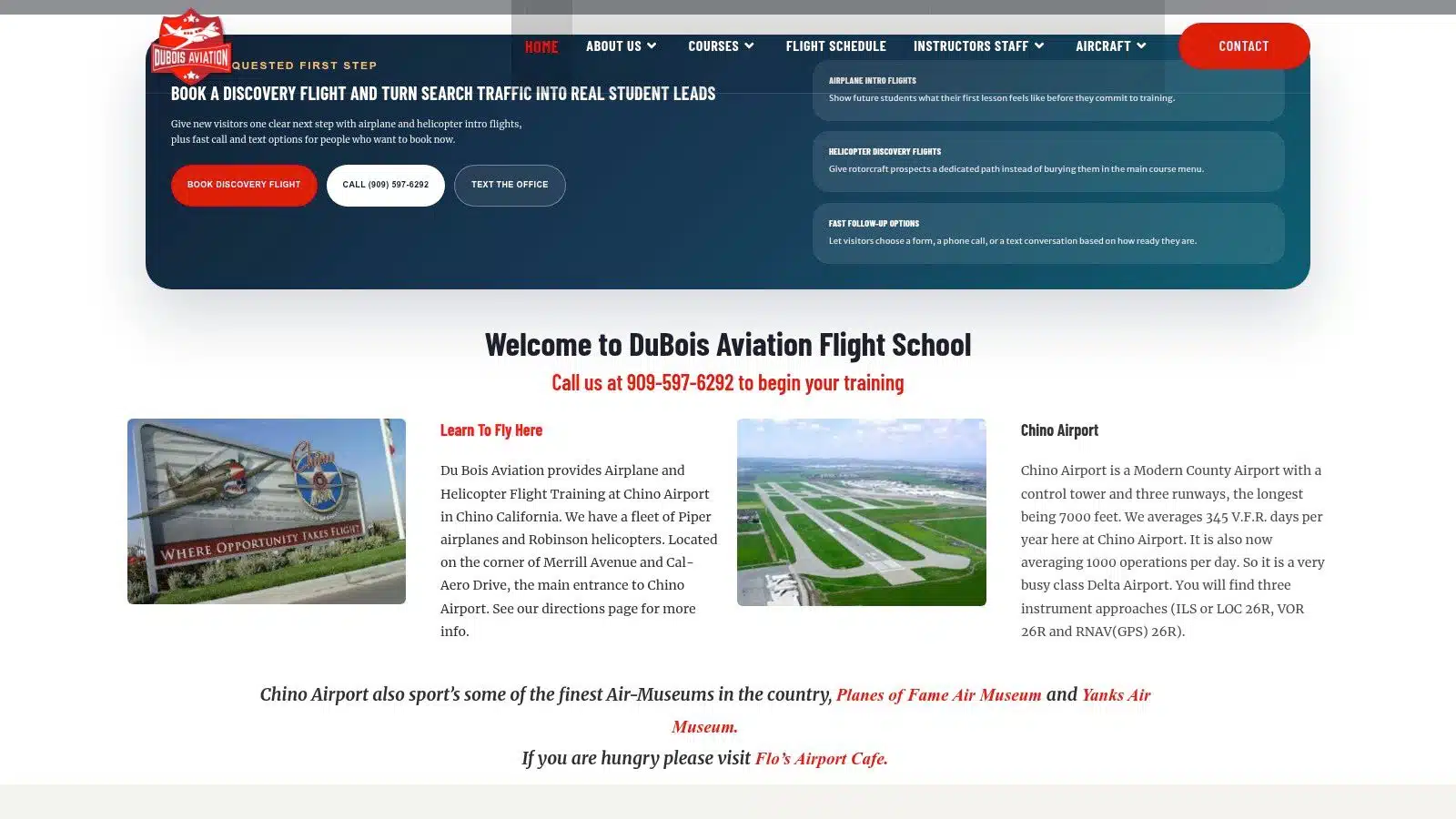
DuBois Aviation is one of the strongest fits at Chino for students who want options beyond a basic private pilot path. It offers both airplane and helicopter training at KCNO, which matters if you are still deciding between fixed-wing and rotorcraft, or if you want to stay with one school as your goals get more specific.
Training at Chino has real value. You are working in a towered environment from the start, dealing with radio calls, sequencing, and traffic flow that force you to stay ahead of the airplane. That tends to build better habits early than a quieter field where students can go a long time without much ATC interaction.
Why it stands out
DuBois uses one-on-one instruction and Jeppesen materials, with instructors holding CFI, CFII, and MEI ratings. The fleet matters too. Students can train in Piper Cherokees, a Cessna 150, a Mooney M20B, a Piper Apache, a Robinson R-22, and an Enstrom F-28A. There is also an in-house simulator and online scheduling seven days a week.
That mix gives students room to grow without immediately outgrowing the school. If you start in a Cherokee and later want instrument, commercial, multi-engine, or helicopter training, you do not have to rebuild momentum somewhere else. That continuity can save time, especially around the private-to-instrument transition where changing instructors or procedures often slows people down.
For students trying to map the full path from discovery flight to certificate, DuBois also has a useful guide on what it takes to become a pilot.
Practical rule: If you think you may want advanced ratings, a multi-engine add-on, or eventually buy your own aircraft after training, start at a school that can expose you to more than one type of operation. It gives you a better frame of reference before you spend real money on ownership.
Trade-offs to know before you call
The main drawback is pricing visibility. The website does not lay out a full rate sheet, so you will need to call or email to compare it properly against other Chino-area schools. Some students do not mind that. Others want every hourly rate on a spreadsheet before they ever talk to dispatch.
The training environment is also practical and piston-focused. That is usually a positive for primary training, because you want repetition, availability, and manageable operating costs. But if your only goal is a tightly standardized airline-track program, you should compare DuBois against schools built specifically around that model.
For a student in the KCNO area who wants solid foundational training now and may be thinking ahead to aircraft ownership later, DuBois makes a lot of sense. You can train in the environment where you may eventually rent, partner, or base an airplane, and that local familiarity pays off long after the checkride.
2. K-Pal Aviation
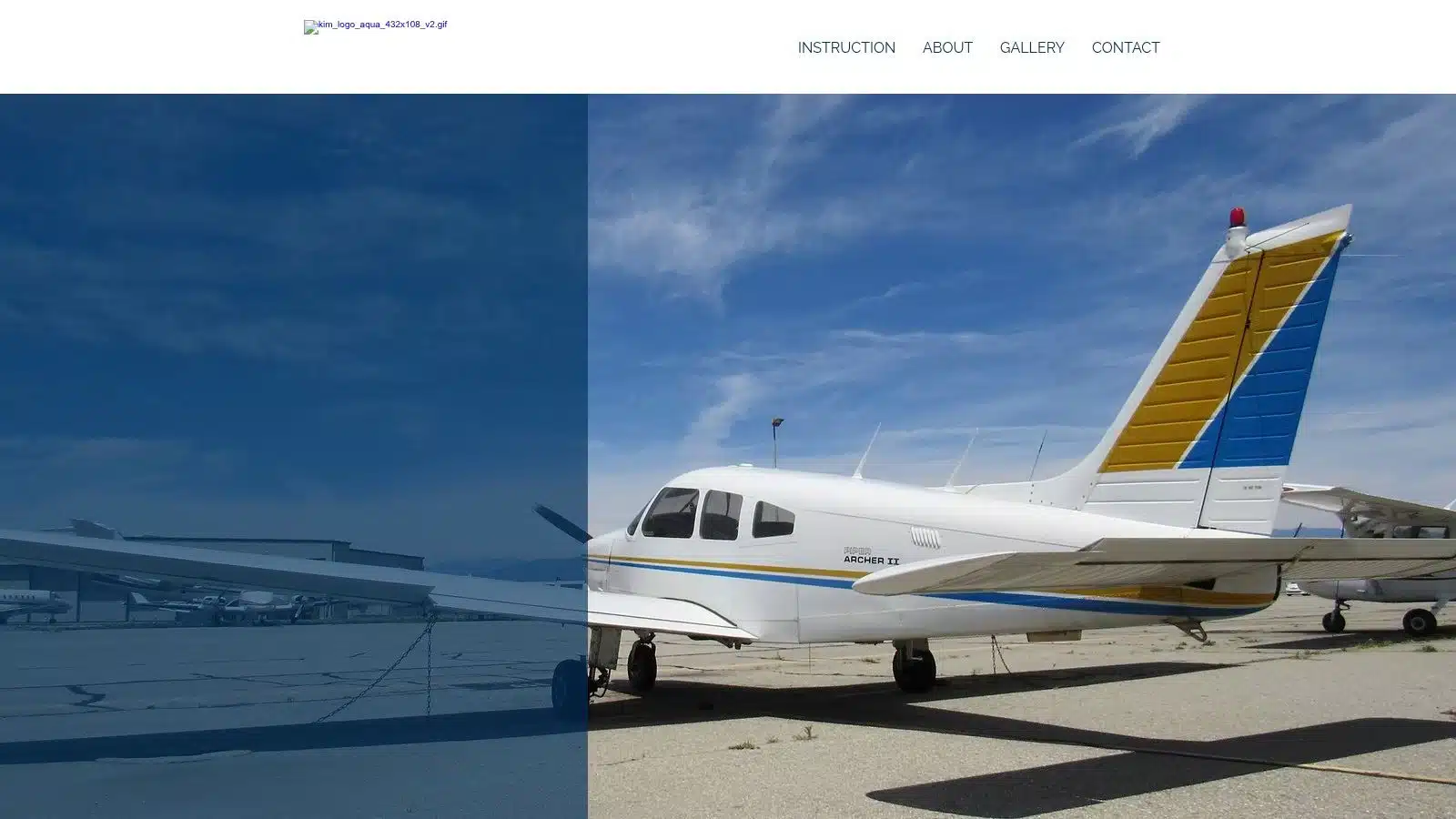
Some students don't want a large operation. They want one instructor, one clear relationship, and less handoff between people. K-Pal Aviation fits that profile well.
It's an instructor-led operation at Chino, run by an ATP-rated CFI/CFII/MEI, with training from private through CFI and CFII. If continuity matters to you, that's a meaningful advantage. You're less likely to feel like you're being passed through a system.
Best fit
K-Pal makes sense for students who learn better with a highly personalized pace and direct access to the chief instructor. Since it's based at KCNO, you still get the benefit of towered-airport work instead of waiting until later to get comfortable with radio calls and sequencing.
If you're still trying to understand the bigger path from first lesson to certificate, DuBois has a straightforward overview of what it takes to become a pilot. Read that, then ask K-Pal how they'd sequence your training and how often they want you flying each week.
Smaller schools can be excellent, but ask one simple question early. “If my instructor gets booked solid, what happens to my schedule?”
Where the trade-offs show up
Small operations are personal, but they can also be less forgiving when an aircraft goes down for maintenance or a schedule gets tight. That doesn't make them worse. It just means your progress may depend more on one airplane and one instructor.
K-Pal also doesn't publish a public rate sheet, so you'll need to contact them for current pricing. If you value instructor continuity more than fleet variety, it belongs on your shortlist.
3. SoCal Aviation Inc.
SoCal Aviation Inc. is another Chino-based option that stands out for students who want structured program pages and support for international training pathways. The school has an on-field presence at KCNO and presents itself as a local option for students across Orange, Riverside, and San Bernardino counties.
One thing to know immediately is that the site includes domestic and international training information, financing details, and references to foreign authority pathways. That won't matter to every student, but for the right applicant it can save a lot of administrative confusion.
Who should look closely
If you need more than just a local CFI and an airplane, SoCal Aviation is worth a look. Students who are comparing financing options or trying to understand how to pay for training can also benefit from reading DuBois' page on financial aid for pilot training, then asking SoCal what funding routes or payment structures they support directly.
The site also mentions simulator capability for instrument training during adverse weather. In practical terms, that matters because weather delays can stretch training, and simulator access helps keep students engaged when flying isn't ideal.
What doesn't come through clearly online
The website doesn't give much public detail on fleet depth or current pricing. That makes it harder to compare against schools that show more operational specifics. Some of the branding and content relationship with partner sites can also feel a little blurry when you're trying to pin down exactly what is flown where.
That said, some students don't need a polished comparison experience. They need a local school at Chino, straightforward program access, and support that extends beyond a simple private pilot syllabus. If that's you, SoCal Aviation deserves a direct call.
4. Aerotech Flight Academy
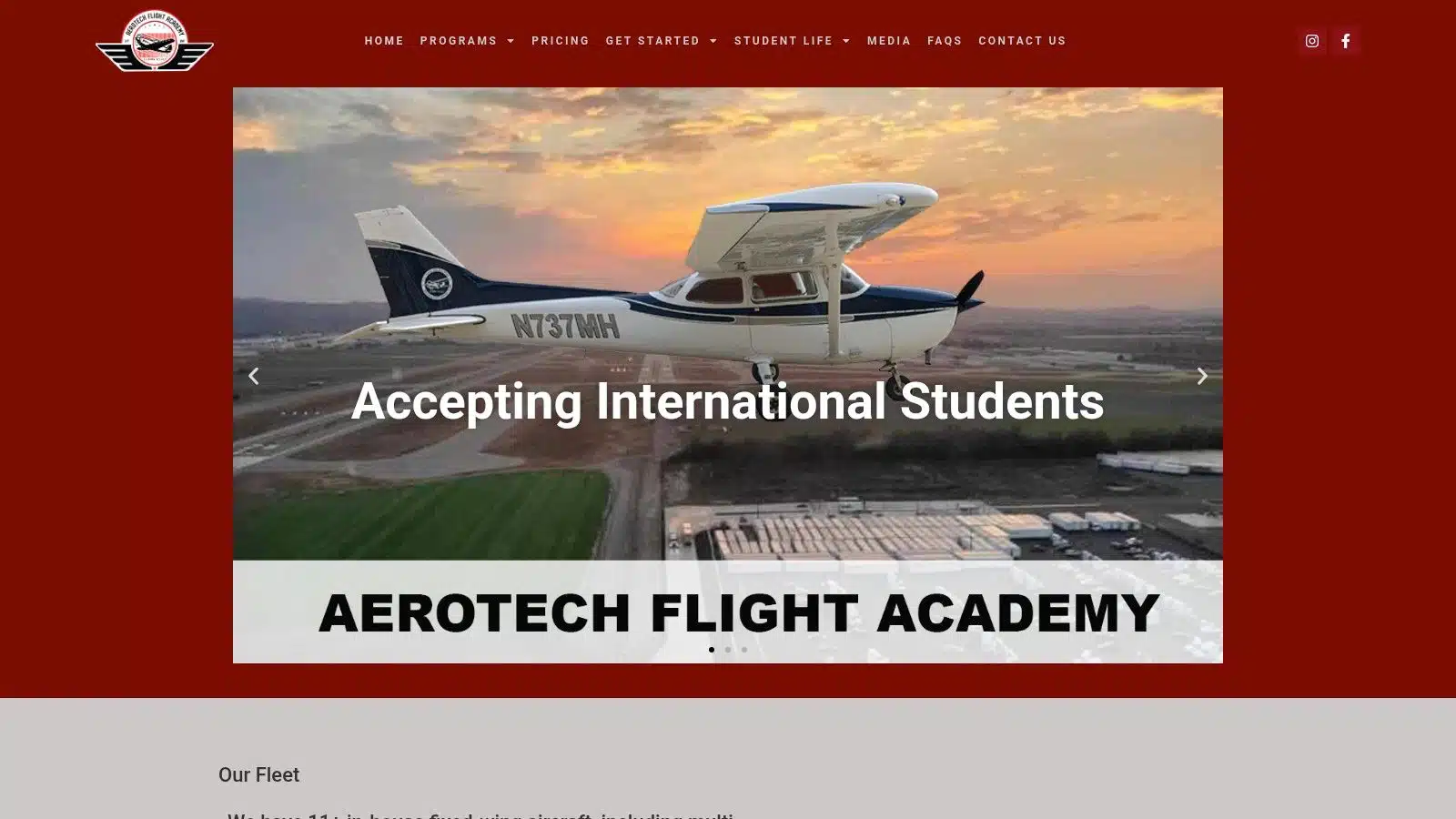
Aerotech Flight Academy is the one to consider if avionics and fleet variety are high on your list. It's family-owned, based in Redlands, and emphasizes customized training with Gold Seal instructor leadership, financing options, and international student pathways.
The biggest attraction is breadth. Aerotech presents a fleet of more than 11 fixed-wing aircraft, plus multi-engine and helicopter options. It also highlights G1000-equipped C172s, which will appeal to students who want to train in a more avionics-forward environment instead of staying strictly with older six-pack panels.
What it does well
For a student who wants exposure to modern cockpit layouts early, Aerotech has real appeal. That doesn't replace stick-and-rudder skill, but it can make your transition to technically advanced aircraft smoother if that's part of your longer plan.
It's also useful for students who already know they may want more than a private certificate. A school with multi-engine and helicopter pathways gives you more room to evolve without restarting the search.
If you think you may eventually buy an airplane, train in more than one aircraft type before shopping. A pilot who has only flown one trainer often buys based on emotion instead of mission.
What to verify before enrolling
The practical issue is geography. Aerotech's main base is Redlands, not Chino, so you need to verify where your training would happen and how much driving is involved. Commute fatigue is one of the quietest training killers in Southern California.
The site also doesn't publish itemized hourly training costs in the way some shoppers prefer. If your process is rate-driven, ask for a full breakdown before you commit. If your process is capability-driven, Aerotech is a strong contender.
5. Flying Academy Los Angeles – Corona Campus
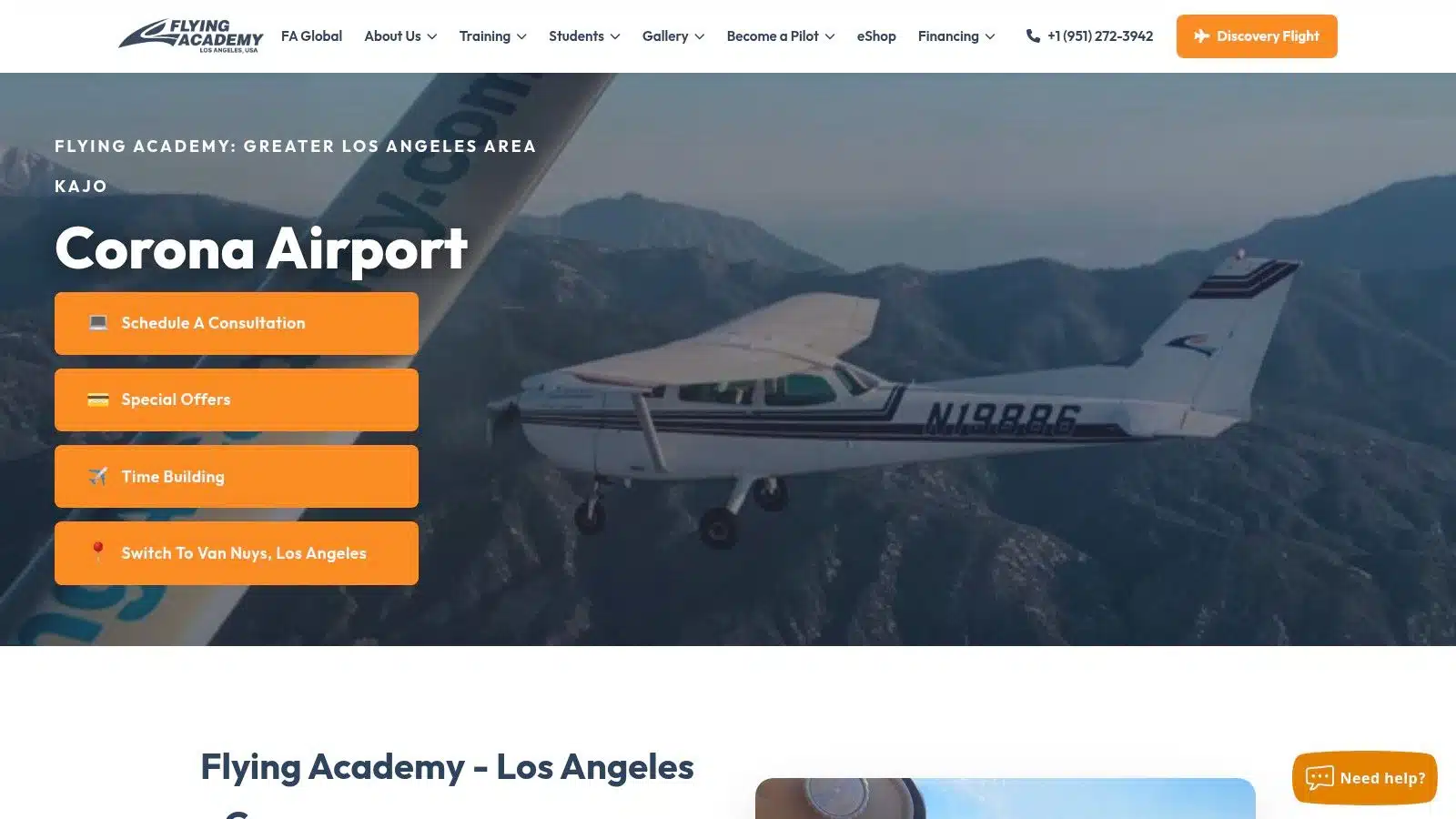
Flying Academy Los Angeles at Corona works well for students who want a structured Part 141 environment and international student eligibility, but don't necessarily need to train at a towered airport every lesson. The school operates from Corona Municipal, an untowered field, and offers private through commercial pathways, discovery flights, and time building.
That airport environment changes the daily rhythm of training. At an untowered field, you can often spend less lesson time waiting on sequence and more time doing the actual maneuver or pattern work you came to do.
Why some students prefer Corona
An untowered airport can be a smart place to start if you're nervous, budget-sensitive, or trying to maximize active training time in each lesson. There's less radio pressure at the beginning, and some students build confidence faster when the airport environment is simpler.
The trade-off is obvious. If your long-term goal is professional flying, you still need towered-airport fluency. That means asking exactly how and when the school transitions students into busier airspace.
The limitation to think through
Many “flight schools near me” searches often miss the point. The closest school isn't always the right training environment for your goal. If your mission is local recreational flying, Corona may fit nicely. If your mission is airline-track confidence, you need to ask how often you'll operate into airports like KCNO or KRAL as part of your progression.
A good school can make either environment work. What doesn't work is staying in your comfort zone too long and then being surprised by ATC workload later.
6. ATP Flight School – Riverside
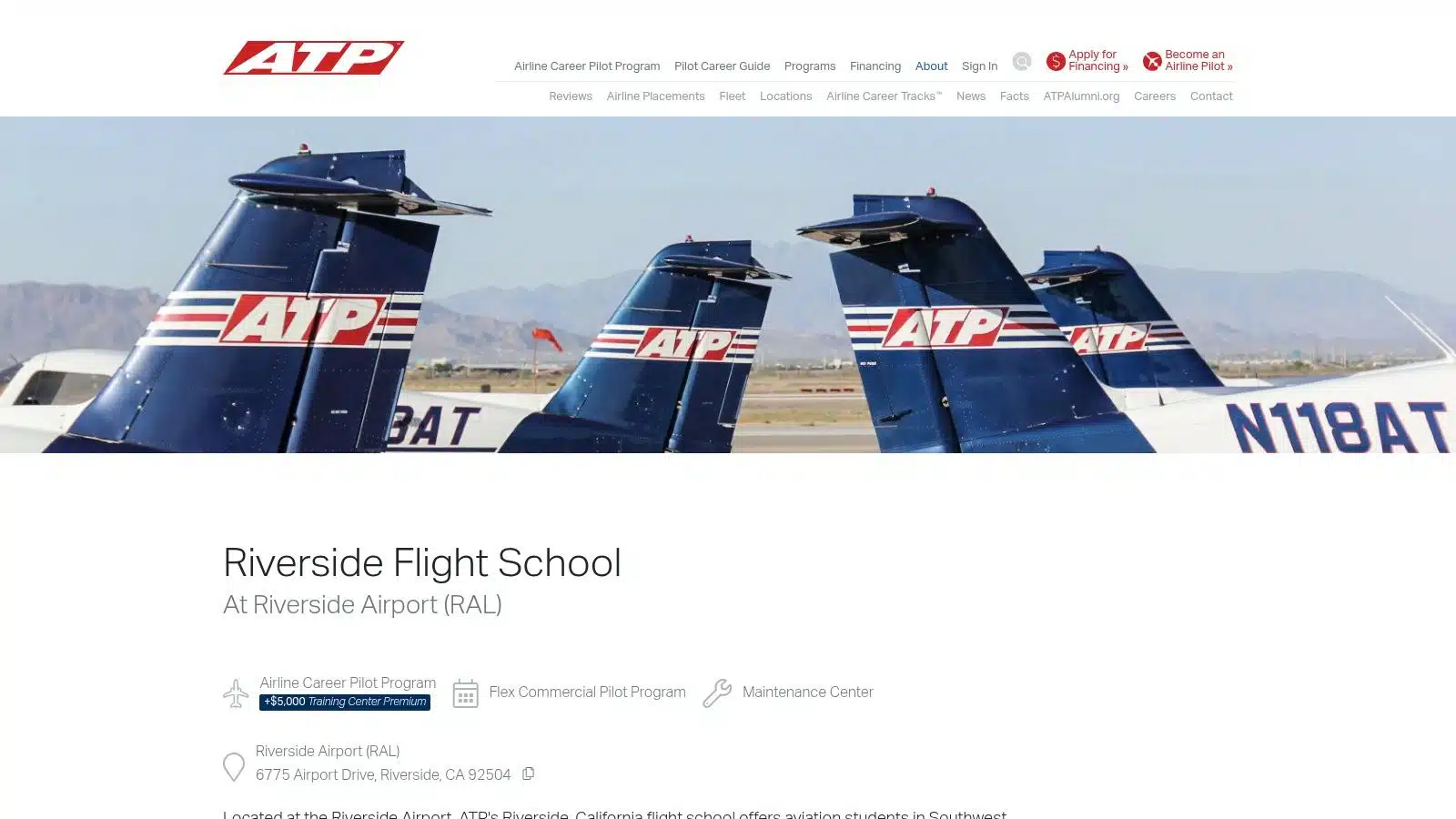
A Chino-area student can drive to Riverside, train in a highly standardized program, and know from day one that the school is built for a professional track, not casual weekend flying. That difference matters.
ATP Flight School in Riverside appeals to students who want a fast, airline-focused pipeline with a set syllabus, defined training flow, and less guesswork about what comes next. If your target is CFI, multi-engine time, and an airline-style progression, ATP is one of the clearest fits on this list.
Where ATP fits well
ATP works best for students who do well in a structured environment and can protect a demanding training schedule. The value is consistency. Training, scheduling, and course flow are designed around momentum, which can help students finish ratings without the long gaps that slow skill development and raise total cost.
That pace can also sharpen decision-making early. In my experience, students who train frequently retain more from lesson to lesson, especially in instrument and commercial phases where repetition matters.
For a Chino-area reader, there is another practical angle. If your long-term plan includes buying an airplane after certification, ATP can still make sense as the training phase of that plan. Use the school for efficient rating progression, then transition later into the kind of local flying and ownership decisions that are easier to evaluate once you hold the certificates.
Where the trade-offs show up
This is not the school I would point every private pilot candidate toward automatically.
If you need part-time pacing, have an unpredictable work calendar, or know you learn best with extra repetition in weaker areas, ATP's system may feel tight. Some students benefit from that pressure. Others start chasing the schedule instead of absorbing the training.
The other issue is personal fit. Large programs can mean less flexibility in how training is delivered and less continuity with one instructor over a long stretch. Before enrolling, ask direct questions about instructor changes, weather interruptions, training backlogs, and what happens if you need more time than the published path assumes.
A fast program works well when your finances, work schedule, and study habits are already in order. If those pieces are unstable, a smaller school near KCNO may give you a better shot at finishing strong.
7. Aces High Aviation
Aces High Aviation is farther from Chino than the other options, but it earns a spot because it does something many schools avoid. It publishes pricing. For buyers and planners, that matters.
Based at Long Beach, Aces High offers private through CFII, accelerated multi-engine training in the DA-42, simulator training with a Redbird MCX, aircraft rental, and a published rate sheet. If you're comparing schools like an adult making a serious financial decision, that transparency is a strong point.
Why transparent pricing matters
Many students underestimate how useful a public rate sheet is until they start calling around. Published pricing lets you compare aircraft choices, simulator use, and advanced training paths without playing phone tag.
Aces High also appeals to students who know they want multi-engine training in a more defined, premium platform. If that's part of your commercial plan, Long Beach may be worth the drive.
The downside is simple
The drive from Chino can be rough depending on traffic, and that matters more than people admit. A great school loses value fast if the commute makes you cancel lessons or arrive tired.
For students who are already thinking about airplane ownership, Aces High's transparent pricing offers a useful lesson. Don't buy an airplane the same way beginners choose a school. Convenience and excitement matter, but numbers and maintenance reality matter more. Before buying any airplane or helicopter, get an independent pre-purchase inspection, review logbooks carefully, verify damage history, and match the aircraft to your mission instead of your fantasy mission. A trainer that flies often and predictably is usually safer for a new owner than a “dream aircraft” that stretches budget, skill, or maintenance support.
Comparison of 7 Nearby Flight Schools
| School | 🔄 Implementation complexity | ⚡ Resource requirements | ⭐ Expected outcomes | 💡 Ideal use cases | 📊 Key advantages |
|---|---|---|---|---|---|
| DuBois Aviation | Moderate, multi-rating programs (airplane + helicopter) with simulator | Varied fleet (Pipers, Cessna, Mooney, Apache, Robinson, Enstrom), experienced CFIs, 7‑day ops | Strong proficiency across PPL→CFI and helicopter; realistic towered‑airport experience | Students wanting combined fixed‑wing + rotor training and career pathways | Dual airplane+helicopter offerings, Jeppesen curriculum, realistic KCNO tower ops |
| K-Pal Aviation | Low–moderate, small, instructor‑led one‑on‑one syllabus | Single‑instructor model (owner/CFI), KCNO on‑field availability | Consistent instructor continuity through Private→CFII | Learners who prefer a single instructor and personalized continuity | Highly personalized coaching, direct owner contact, KCNO operations |
| SoCal Aviation Inc. | Moderate, structured programs with international support | On‑field hangar presence, financing info, foreign‑authority pathways | Pathways suitable for U.S. and international certifications | International students or locals needing foreign‑authority assistance | International student support and financing guidance |
| Aerotech Flight Academy | Moderate–high, customized programs with broader fleet options | 11+ fixed‑wing, multi‑engine and helicopters, G1000 C172s, Gold Seal instructors | Modern avionics exposure and varied aircraft experience | Students seeking G1000 training or varied aircraft types; international candidates | Large fleet variety, G1000 avionics, Gold Seal instructor leadership |
| Flying Academy LA – Corona | Moderate, Part 141 structure with untowered efficient ops | Part 141 and SEVIS approval, multiple light aircraft, on‑site maintenance | Efficient PPL→CPL pipeline; SEVIS for internationals | Students preferring structured Part 141 training or international pathways | Part 141/SEVIS approval, lower congestion at untowered field, structured ground options |
| ATP Flight School – Riverside | High, accelerated, intensive airline‑oriented program | Large standardized fleet, fixed syllabus, financing, airline partnerships | Rapid zero→CFI timeline with direct airline hiring channels | Aspiring airline pilots seeking fastest, predictable career path | Accelerated airline career program, national brand and hiring partnerships |
| Aces High Aviation | Moderate, full‑service with published rates and sim training | Published rate sheet, DA‑42 multi, Redbird MCX simulator, UL94 fuel | Transparent pricing and strong multi‑engine/simulator readiness | Pilots needing multi‑engine DA‑42 experience or clear cost estimates | Published rates, DA‑42 multi‑engine training, full‑motion simulator |
Your Checklist is Complete. Time for Takeoff.
Saturday morning at Chino often answers the question faster than another hour of online research. You walk a ramp, hear runups in the background, sit down with an instructor, and within a few minutes you can tell whether a school feels organized, rushed, flexible, or airline-style strict. That in-person read matters.
A discovery flight is still the right first move. The FAA minimum for a private pilot certificate is 40 flight hours, but very few students finish at the minimum, especially if they train around work, weather, and family obligations. At KCNO and the nearby airports, progress usually comes down to consistency, aircraft availability, and whether the instructor's teaching style matches how you learn.
Training also gets easier once you treat it like a real project. Set a schedule you can keep, ask how often maintenance delays affect bookings, and get clear on total cost before you start. Hourly rates matter, but so do cancellation policies, instructor continuity, fuel surcharges, and how quickly the school can get you to checkride readiness.
How to choose your first call
Start with one or two schools that fit your mission and your schedule.
- Choose DuBois Aviation if you want Chino-based training, towered-airport experience, and the option to continue into more advanced airplane or helicopter training.
- Choose K-Pal Aviation if you prefer a smaller operation where instructor continuity and a more personal pace matter.
- Choose SoCal Aviation if financing support or help for international students is part of the decision.
- Choose Aerotech if fleet variety and modern avionics exposure are high on your list.
- Choose Flying Academy Corona if you want a structured Part 141 path and like the pace of an untowered field.
- Choose ATP Riverside if your goal is an accelerated airline track with a fixed training system.
- Choose Aces High if published pricing, simulator access, and multi-engine options matter more than being closest to Chino.
One more point that gets missed. If you already picture yourself owning an aircraft someday, keep that idea in the background until after your certificate. New students often shop for airplanes before they know their real mission. After training, the picture is clearer. You know whether you prefer a simple two-seat trainer, a four-seat cross-country airplane, a glass cockpit, lower operating cost, or easier maintenance support near Chino.
That long-term ownership goal can still shape your school choice now. A school with a varied fleet, active local maintenance relationships, and instructors who have personally bought, sold, and operated aircraft can give you better advice later. Rent first, finish the rating, fly a few different types, then buy with a mission in mind instead of buying on excitement alone.
The next step is simple. Book the discovery flight, show up with questions, and pay attention to how the school runs on a normal day. The right fit usually becomes obvious once the wheels leave the runway.


