The journey to earning your wings isn't just about learning to fly; it's about following a structured path laid out by the Federal Aviation Administration (FAA). Think of it as a ladder, where each rung represents a new certificate or rating that grants you more privileges. It all starts with a Student Pilot Certificate, moves to the foundational Private Pilot License (PPL), and can go all the way up to the Commercial Pilot License (CPL) and Airline Transport Pilot (ATP) certificate for those aiming for a career in the cockpit.
Each step has its own set of milestones: passing written knowledge tests, logging specific types of flight time, and ultimately, proving your skills in a practical exam with an FAA examiner.
Your Flight Path to Becoming a Pilot
Standing on the tarmac looking at a plane, the idea of actually flying it can feel like a huge, intimidating goal. But the path to becoming a pilot is more like a roadmap with very clear directions. We're going to break down that entire journey, starting from square one.
We'll begin with the first official step, the Student Pilot Certificate, and then dive into what it takes to earn your Private Pilot License (PPL)—the real bedrock of your flying career. From there, we’ll explore what comes next: adding an Instrument Rating (IR), stepping up to a Commercial Pilot License (CPL), and reaching the pinnacle with an Airline Transport Pilot (ATP) certificate. This gives you a bird's-eye view of the whole process, from written exams and checkrides to the all-important flight hour requirements. Our goal is to make the FAA’s pathway feel manageable and clear, even if you’ve never touched the controls of an airplane before.
The Pilot Certification Ladder
Becoming a pilot isn't a single destination; it's a series of accomplishments. Each license you earn is like climbing another rung on a ladder, giving you more freedom and greater responsibility in the air. You start by mastering the fundamentals in good weather and can progressively build your skills to fly bigger, more complex aircraft in challenging conditions.
This chart lays out the standard progression for a pilot on a career track.
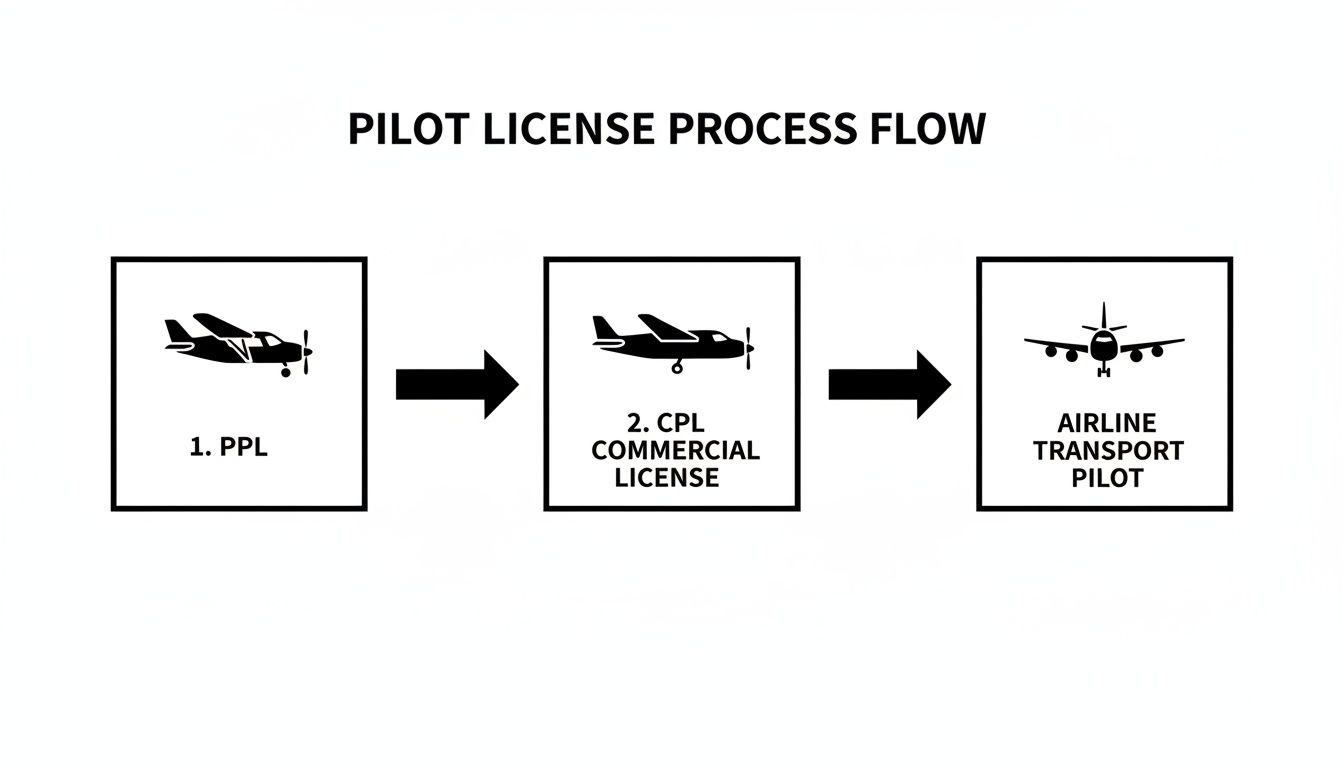
As you can see, each certificate is a prerequisite for the next, taking you from weekend trips in a four-seater to eventually commanding an airliner filled with passengers.
The FAA has set specific age and experience benchmarks you'll need to hit along the way. For a Private Pilot License (PPL), you need to be at least 17 years old, and for a Commercial Pilot License (CPL), the minimum age is 18. For those aiming for the airlines, the journey typically takes 2 to 2.5 years of dedicated training to build the 1,500 flight hours required before most airlines will consider you for a first officer position.
To give you a clearer picture, here’s a quick summary of how the main certificates stack up.
FAA Pilot License Pathway at a Glance
| Certificate / Rating | Minimum Age | Primary Purpose | Key Requirement |
|---|---|---|---|
| Student Pilot | 16 | To fly solo under instructor supervision | Must be able to read, speak, and write English |
| Private Pilot (PPL) | 17 | To fly for personal reasons and carry passengers | Minimum 40 hours of flight time (Part 61) |
| Instrument Rating (IR) | 17 | To fly in clouds and low-visibility conditions | 50 hours of cross-country PIC time |
| Commercial Pilot (CPL) | 18 | To be hired and paid to fly | Minimum 250 hours of flight time (Part 61) |
| Airline Transport (ATP) | 21 (R-ATP) | To act as a pilot for a scheduled airline | Minimum 1,500 hours of total flight time |
This table provides a high-level overview, but each of these steps involves detailed training and specific requirements that we'll explore throughout this guide.
Key Milestones on Your Journey
No matter what you fly—airplane or helicopter—the core process for getting certified is the same. You'll encounter these three major checkpoints for every license or rating you pursue. Knowing what they are from the start helps you map out your training.
- Aeronautical Knowledge Test: This is the "written exam." It’s a multiple-choice test taken on a computer that covers everything from FAA regulations and aerodynamics to weather theory and navigation.
- Flight Training: This is where the real fun happens. You'll be in the aircraft with a Certified Flight Instructor (CFI), logging flight hours while practicing maneuvers, takeoffs, landings, and emergency procedures.
- Practical Test (Checkride): This is the final exam. It has two parts: an oral quiz where an FAA-designated examiner asks you questions, followed by a flight where you demonstrate your skills in the airplane.
The path from student to professional pilot is a marathon, not a sprint. Consistency in training is the single most important factor in progressing efficiently and safely through each certification level.
As you get further into your training, you'll start thinking beyond just renting. Many pilots eventually consider owning their own aircraft to build hours more affordably or to have more freedom to fly. Navigating that process is a skill in itself. To get a deeper understanding of how these licenses and ratings fit together, you can learn more about the different pilot certification levels in our detailed guide.
Clearing Your First Two Hurdles
Before you can even think about taking the controls yourself, every aspiring pilot has to clear two essential checkpoints. Think of them as your official entry tickets into the world of flight training: the FAA Medical Certificate and the Student Pilot Certificate. Getting this initial paperwork sorted out is a mandatory first step on your journey.
These aren't just bureaucratic formalities. They're foundational requirements that confirm you're medically fit to fly and legally cleared to learn under a certified instructor's watch. Knocking these out early prevents frustrating delays later on, letting you focus completely on what you're really here for—flying.
Your Ticket to Fly: The FAA Medical Certificate
One of the very first things you'll need to do is schedule an appointment with an Aviation Medical Examiner, or AME. This isn't your regular doctor's visit. An AME is a physician specifically designated by the FAA to conduct flight physicals and issue medical certificates, which come in three main flavors.
The class you need depends entirely on your flying goals:
- Third-Class Medical: This is the standard for student pilots and recreational flyers. If you're pursuing a Private Pilot License for personal enjoyment, this is the one for you. It has the least restrictive requirements.
- Second-Class Medical: This is the ticket for commercial pilots who fly for hire in roles like aerial photography, pipeline patrol, or agricultural operations.
- First-Class Medical: This is the highest standard, reserved for Airline Transport Pilots (ATP). If your dream is to one day fly for a major airline, it’s a smart move to get a First-Class medical from the very beginning. It ensures you meet the strict health standards required for that career path before you invest heavily in training.
During the exam, the AME will check your vision, hearing, cardiovascular health, and general physical wellness. It’s absolutely crucial to be upfront and honest about your medical history. Many common conditions are perfectly fine or can be managed through a Special Issuance process, but transparency is everything.
Your License to Learn: The Student Pilot Certificate
With your medical certificate in hand, the next step is getting your Student Pilot Certificate. This certificate doesn't mean you can just hop in a plane and go wherever you want. Instead, it's a specific license that legally permits you to fly an aircraft solo, but only with an endorsement from and under the supervision of your flight instructor.
It’s a lot like a learner's permit for driving a car. You can't just hit the freeway alone, but you can practice with a qualified instructor sitting beside you, guiding you every step of the way. This is the official document that bridges the gap between being a passenger and becoming a pilot-in-command.
A Student Pilot Certificate is your official green light from the FAA to begin the most exciting phase of training—flying the aircraft by yourself. It’s a milestone that signifies you’re ready to transition from theory to hands-on practice in the sky.
To get your student pilot certificate, you must be at least 16 years old to fly an airplane or helicopter. You also need to be able to read, speak, write, and understand English. The application process itself is pretty straightforward and is usually handled with your flight instructor through the FAA's Integrated Airman Certification and Rating Application (IACRA) system.
Here at DuBois Aviation, we walk every new student at Chino Airport through this process to make it painless. We'll help you prepare for your AME appointment and handle the IACRA application to ensure all your paperwork is correct from day one. By clearing these hurdles efficiently, you can get into the cockpit and start your flight lessons without any unnecessary holdups.
How to Earn Your Private Pilot License
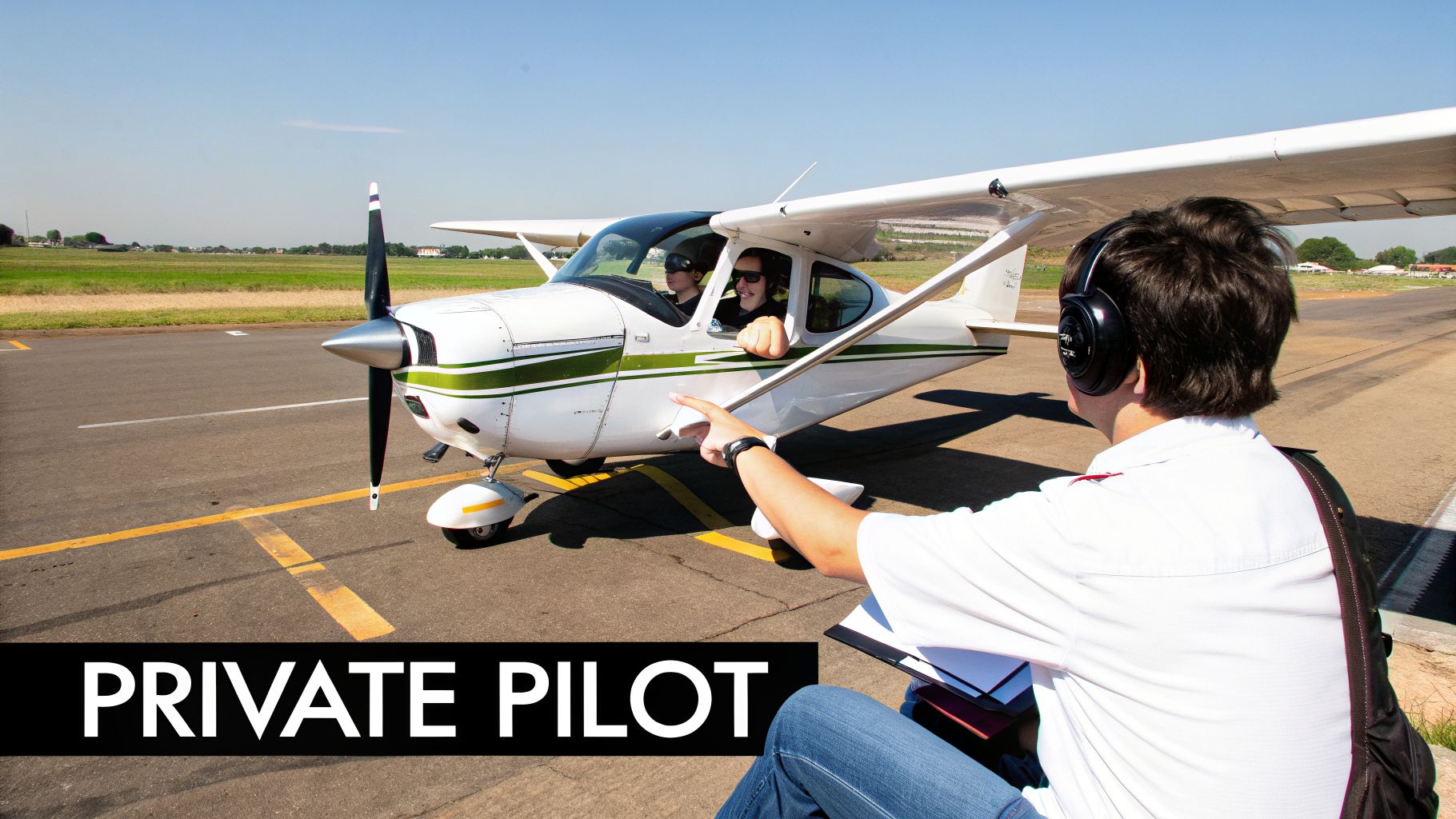
The Private Pilot License (PPL) is your first real taste of freedom in the sky. It's the certificate that finally lets you fly with passengers, share your passion for aviation, and set off on adventures far beyond your local airport. This is where your journey as a pilot truly begins.
Think of the Student Pilot Certificate as your learner's permit; the PPL is your driver's license for the air. To get there, you'll need to blend book smarts with hands-on stick-and-rudder skills, all leading up to two final exams that prove you've got what it takes. Let's break down the official FAA rules into a clear, practical roadmap.
Flight Hour Requirements: The Core of Your Training
The real work of earning your PPL happens in the cockpit. The FAA sets minimum flight hours, but it's crucial to see these as a starting point, not a finish line. The true goal is proficiency—being a safe and confident pilot—not just logging time.
Here at DuBois Aviation, we train under the flexible Part 61 rules. These require you to log at least 40 total hours of flight time, but that time is specifically structured to build a well-rounded skillset. It’s not just 40 hours of aimless flying.
Here’s how that time breaks down:
- 20 hours of dual instruction: This is you and your Certified Flight Instructor (CFI) in the plane together. You’ll learn everything from basic maneuvers and takeoffs to handling emergency procedures.
- 10 hours of solo flight time: This is it—you as the sole occupant of the aircraft. It’s a massive confidence builder and the most critical step in developing your decision-making skills as a true pilot-in-command.
- 5 hours of solo cross-country: You'll be planning and executing flights to other airports, sharpening your navigation and flight planning abilities.
- 3 hours of night flying: You’ll discover the unique challenges and absolute magic of flying after sunset, practicing everything from takeoffs to navigation in the dark.
While 40 hours is the FAA minimum, the national average for students to feel truly ready for their exam is between 60 to 80 hours. The biggest factor influencing your total time is consistency. Flying often keeps the lessons fresh and builds momentum. For a deeper dive, you can learn more about how long it takes to get a private pilot license and see why a steady schedule is your best friend.
The Two Major Tests You Must Pass
Earning your PPL all comes down to passing two final exams: a written test and a practical test (better known as the checkride). These are the gateways that ensure every new private pilot meets the FAA's high standards for knowledge and safety.
The Aeronautical Knowledge Test
Most pilots just call this the "written exam." It's a 60-question, multiple-choice test you’ll take on a computer at an official testing center. It's designed to make sure you have the foundational knowledge to fly safely.
The questions cover a lot of ground, including:
- FAA Regulations
- Aerodynamics (how planes actually fly)
- Weather and Weather Services
- Aircraft Systems and Performance
- Navigation and Flight Planning
You need to score 70% or higher to pass. Before you can even sign up, your instructor will need to review your knowledge and provide an official endorsement.
The Practical Test (Checkride)
This is it—the final exam and the biggest milestone in your training. The checkride is conducted by a Designated Pilot Examiner (DPE), an experienced aviator trusted by the FAA to administer these tests. It’s broken into two parts.
The checkride is more than just a test; it's a demonstration of your ability to act as a safe, competent Pilot-in-Command. The DPE is evaluating your decision-making, risk management, and overall command of the aircraft.
First comes the oral exam. You'll prepare a flight plan for a hypothetical trip, and the DPE will ask you a series of questions about it to gauge your practical knowledge. Once you pass the oral portion, you'll head out to the airplane for the flight test. Here, you’ll perform various maneuvers and procedures, proving you can fly the plane to the standards outlined in the FAA's Airman Certification Standards (ACS).
Building Your Professional Aviation Career
Earning your Private Pilot License is a monumental achievement, no question. But for many pilots, it's just the first major waypoint on a much longer flight plan. The next legs of the journey—the Instrument Rating (IR) and the Commercial Pilot License (CPL)—are what really transform you from a recreational flyer into a capable, proficient aviator ready for a career in the cockpit.
These qualifications aren't just about logging more hours. They're about building a completely different level of skill, knowledge, and confidence. This is where you graduate from only flying on sunny days and learn to operate an aircraft with the precision and professionalism required to get paid for your skills.
Mastering the Clouds with an Instrument Rating
The Instrument Rating is arguably one of the most critical qualifications any pilot can earn. It’s not just a box to check for most professional flying jobs; it’s a foundational safety skill that fundamentally changes how and when you can fly. Think of it as learning an entirely new language—the language of your aircraft's instruments.
As a Private Pilot, you fly visually, which means you are legally required to stay out of clouds and in good weather. The Instrument Rating shatters that limitation. It teaches you to fly solely by reference to your instruments, allowing you to navigate safely through clouds, fog, and murky conditions where you can't see the ground or the horizon.
This training involves:
- Intensive simulator and in-flight instruction laser-focused on interpreting what your flight instruments are telling you.
- Learning instrument approach procedures that allow you to land safely at airports even when the weather is terrible.
- Mastering air traffic control communication within the complex Instrument Flight Rules (IFR) system.
An Instrument Rating gives you the freedom of all-weather capability. But more importantly, it forges you into a more precise, disciplined, and confident pilot, sharpening your skills even when flying in perfect visual conditions.
Finishing this training proves you can handle some of the most demanding conditions aviation can throw at you, making you a far more versatile and safer pilot.
Earning the Right to Get Paid: The Commercial Pilot License
Once you've nailed your Instrument Rating, the next major milestone is the Commercial Pilot License. This is the certificate that officially allows you to be compensated for flying. It’s the bright line separating a hobby from a profession, and as you’d expect, the standards are significantly higher.
To earn your CPL under Part 61 rules, you'll need to accumulate a minimum of 250 total flight hours. This experience isn't just a number; it ensures you have a deep well of practical knowledge to draw from when things get complicated. You’ll also be tested on more advanced flight maneuvers and must demonstrate a much higher degree of precision and aircraft control during your practical test.
The demand for qualified pilots has fueled remarkable growth in the training market, which was valued globally at USD 10.74 billion in 2025. The CPL segment is expected to be the largest part of this, capturing 48.17% of the market share in 2026, since this is the key license for pilots aiming for the airlines or charter operations. You can explore more data on the pilot training market on Fortune Business Insights.
Your First Flying Jobs: Building Experience
A freshly-minted CPL holder with 250 hours isn't quite ready to step into an airline cockpit. The next phase of your career is all about building valuable flight time and real-world experience. Fortunately, many new commercial pilots get their start in a variety of fascinating entry-level roles.
These jobs are crucial for logging the 1,500 hours often required for the airlines and include things like:
- Aerial Survey and Photography: Flying specialized missions to capture images for mapping, real estate, or environmental surveys.
- Pipeline and Powerline Patrol: Patrolling critical infrastructure from the air to spot damage or irregularities.
- Banner Towing: A classic time-building job that demands exceptional aircraft handling skills.
- Certified Flight Instructor (CFI): This is one of the most common and rewarding paths. Teaching others to fly is an incredible way to sharpen your own knowledge and skills while building flight hours.
At DuBois Aviation, our Airline Career Program is built to guide you seamlessly from your PPL through your IR and CPL, giving you the mentorship and high-quality instruction you need to succeed at each professional milestone.
The Final Steps to the Airline Cockpit
For any pilot with their eyes on an airline career, the Airline Transport Pilot (ATP) certificate is the ultimate goal. This is the big one—the credential required to fly for a major airline and take command of a passenger jet. Getting here isn't just about adding another rating to your license; it’s the culmination of years of dedicated training, hard-earned experience, and unwavering focus.
The path to an ATP is tough, and for good reason. The standards are incredibly high to ensure every pilot in that flight deck has the seasoned judgment and skill needed to handle the most demanding flying environments. Earning your ATP is a true mark of professionalism, signaling you're ready for a career at the highest level.
The 1,500-Hour Rule and ATP Requirements
The absolute cornerstone of the ATP certificate is the 1,500-hour total flight time requirement. That number isn't just pulled out of thin air. It’s a benchmark set by the FAA to guarantee pilots have a massive bank of real-world experience before they're responsible for hundreds of passengers. Think of it as the final, most intensive part of your apprenticeship.
But it’s not just about getting to 1,500 hours. The FAA has specific requirements for how you log that time. You'll need to have:
- 500 hours of cross-country flight time
- 100 hours of night flight time
- 75 hours of instrument flight time (in actual or simulated conditions)
- 250 hours as Pilot-in-Command (PIC)
On top of the flight time, you have to be at least 23 years old, pass a challenging written knowledge exam, and then prove your mastery in the cockpit during a final practical test.
A critical step before you can even take that practical test is completing the Airline Transport Pilot Certification Training Program (ATP-CTP). This isn't optional. It's an intensive course packed with classroom and advanced simulator training that focuses on airline operations, crew resource management, and high-altitude flight dynamics.
The whole point of the ATP-CTP is to bridge the gap between flying smaller general aviation aircraft and operating a complex, high-performance jet in a crew environment. It ensures you’re ready for the realities of airline flying from day one.
Building Time from CPL to ATP
The biggest hurdle for most aspiring airline pilots is the long journey from the 250 hours they have when they earn their Commercial Pilot License to the 1,500 hours needed for the ATP. This time-building phase is where you truly sharpen your skills and become a seasoned aviator. By far, the most common and effective way to do this is by becoming a Certified Flight Instructor (CFI).
Teaching others to fly is an incredible way to build hours. It forces you to know aviation inside and out, constantly reinforcing your own knowledge of aerodynamics, regulations, and good decision-making. Other time-building jobs include things like banner towing, pipeline patrol, or aerial survey flying.
Thankfully, there has never been a better time to be on this journey. The industry is facing a massive pilot shortage, with one consulting firm estimating a gap of nearly 24,000 pilots by 2026. This has created a hiring frenzy and driven pilot salaries way up, with some compensation packages seeing an 86% increase. You can read more about the momentum of airline pilot hiring on Aerotime.aero.
The road from 250 to 1,500 hours can feel long, but there are several well-established paths to get there.
Hour Building Strategies for the ATP Certificate
| Method | Pros | Cons | Typical Timeframe |
|---|---|---|---|
| Flight Instructor (CFI) | Deepens knowledge, high demand, builds command experience. | Can be demanding, pay varies by school and location. | 18-24 months |
| Banner Towing | Builds hours quickly, often in desirable coastal locations. | Seasonal work, can be repetitive, requires specific skills. | 1-2 seasons |
| Pipeline/Aerial Patrol | Consistent flying, builds valuable cross-country time. | Can be monotonous, often involves long solo flights. | 18-30 months |
| Charter/Part 135 Pilot | Flies more complex aircraft, builds real-world professional experience. | Higher entry-hour requirements, very competitive. | 24-36 months |
Each path has its own unique benefits and challenges, but becoming a CFI remains the most popular and reliable route for pilots aiming for the airlines.
Adding the Multi-Engine Rating
If you're heading to the airlines, a Multi-Engine Rating (MER) is non-negotiable. This rating is an "add-on" to your pilot certificate that qualifies you to fly aircraft with more than one engine. The training is laser-focused on the unique aerodynamics and systems of multi-engine planes, with a heavy emphasis on handling the aircraft safely if an engine fails.
Mastering these skills is absolutely critical before you can even think about stepping into the cockpit of a multi-engine airliner. To see exactly what it takes, check out our guide on the specific multi-engine rating requirements.
A Pilot's Guide to Buying and Selling Aircraft
 Watch Video
The journey to earning your wings isn't just about learning to fly; it's about following a structured path laid out by the Federal Aviation Administration (FAA). Think of it as a ladder,...
Open the dedicated video pageAnd this isn't just a fantasy for high-time pilots. If you're serious about an airline career, owning can be an incredibly smart move. It puts you in complete control of your flight training, dramatically speeds up your hour-building, and can often be cheaper in the long run than renting. The market for good used aircraft is always humming, but you absolutely need a solid game plan before you jump in.
How to Buy an Airplane the Safe Way
Let’s be clear: buying an airplane is nothing like buying a car. It demands a meticulous, step-by-step approach to make sure you end up with a safe, reliable machine that actually fits your needs—not a money pit with wings.
First, you have to define your "mission." What are you going to do with the plane? Are you grinding out cross-country time on your way to an ATP certificate? Or are you a helicopter pilot practicing autorotations? Your mission profile will immediately narrow down the type of aircraft that makes sense for you.
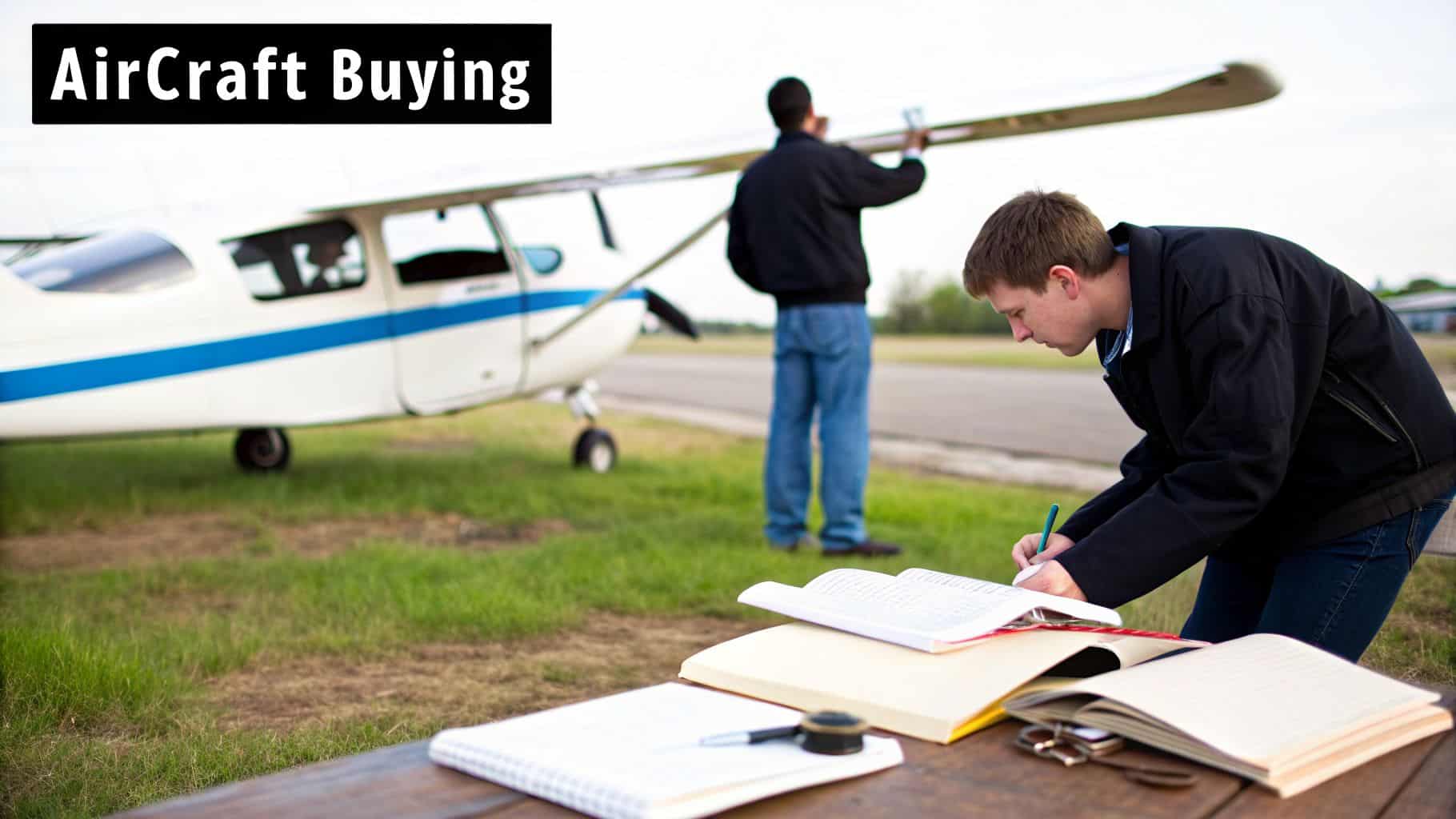
Once you’ve found a promising candidate, you’ve reached the single most important part of the entire process: the pre-buy inspection.
A pre-buy is a nose-to-tail, deep-dive examination of the aircraft and its maintenance records. It has to be done by a certified A&P mechanic that you hire, not the seller. Cutting corners here or, even worse, letting the seller's mechanic handle it is the biggest—and potentially costliest—mistake a buyer can make.
Getting an independent inspection is your only way to get an unbiased, honest look at the aircraft's true condition. It's your ultimate protection against hidden problems that could cost you a fortune down the road.
Understanding the True Cost of Ownership
The sticker price is just the entry fee. The real cost of aircraft ownership is in the recurring expenses, and you need to have a realistic budget for these before you even think about making an offer.
Insurance: This is a big one, and it varies wildly depending on the aircraft model, your total flight time, and how you plan to use it.
Maintenance: You'll have the predictable cost of an annual inspection, but you also need to build a healthy reserve for the unexpected repairs that will inevitably pop up.
Hangar or Tie-Down: You’ve got to park it somewhere. An enclosed hangar provides the best protection from the elements but costs significantly more than an outdoor tie-down spot.
Fuel and Oil: These are your most common operating costs. They'll go up and down directly with how much you fly.
And when it’s eventually time to sell? Getting top dollar is all about preparation. Get your maintenance logbooks perfectly organized, research what similar aircraft have sold for recently, and present your plane with great photos and a detailed, honest description.
Your Pilot License Questions, Answered
Starting the journey to become a pilot naturally brings up a lot of questions. We see them every day—from timelines and medicals to training paths and even aircraft ownership. Getting good, straight answers is the first step toward getting into the cockpit with confidence. Here’s what you need to know.
How Long Does It Realistically Take to Get a Private Pilot License?
Let’s be direct: while the FAA sets the absolute minimum at 40 hours of flight time, that’s not the reality for most people. Plan on needing somewhere between 60-80 hours to build the genuine skill and confidence required to pass your checkride and be a safe pilot.
The biggest factor in your timeline is consistency. If you can commit to flying two or three times a week, you could easily have your license in 4-6 months. If your schedule only allows for a lesson here and there, the process can stretch out to a year or more as you spend time re-learning what you forgot from the last flight. A steady schedule is your best friend.
Can I Get a Pilot License If I Wear Glasses?
Absolutely. This is one of the most common questions we get, and the answer is a resounding yes. As long as your vision is correctable to the FAA's standards with glasses or contacts, you're good to go. The goal is simply to ensure you can see clearly to fly safely.
What about other medical conditions? The FAA has a pathway for this called a Special Issuance medical certificate. The key is to be proactive. Talk to an Aviation Medical Examiner (AME) before you get too far into your training. They can help you understand the process and what, if any, extra steps you’ll need to take.
What Is the Difference Between Part 61 and Part 141 Flight Schools?
Think of it as structure versus flexibility.
A Part 141 school operates under a highly structured, FAA-approved curriculum. Every lesson is laid out in a specific order, almost like a college course. This rigid structure can sometimes allow for slightly lower flight hour minimums for certain ratings down the road.
A Part 61 school, on the other hand, offers a lot more flexibility. Your instructor can adapt the training to your personal learning style and schedule. You'll still meet all the same FAA standards, but the path to get there can be tailored just for you. Both routes lead to the exact same FAA pilot certificate.
What Should I Know About Buying My First Airplane?
Buying your own plane can be a fantastic way to build flight time, but you have to go into it with your eyes wide open. First, figure out your "mission"—what you'll actually use the plane for—as this will dictate the right type of aircraft.
But the single most important part of the process is the pre-buy inspection.
Never, ever skip a thorough pre-buy inspection from a trusted A&P mechanic that you hire, not one recommended by the seller. This is your number one defense against buying a plane with deep, hidden, and expensive problems. You also need to meticulously review the aircraft's logbooks and ensure the title is clean.
Ready to get clear, personalized answers to your own questions? The experienced instructors at DuBois Aviation have guided hundreds of students through every stage of this journey. Visit us at https://duboisaviation.com to see our programs and find out how we can help you get started at Chino Airport.